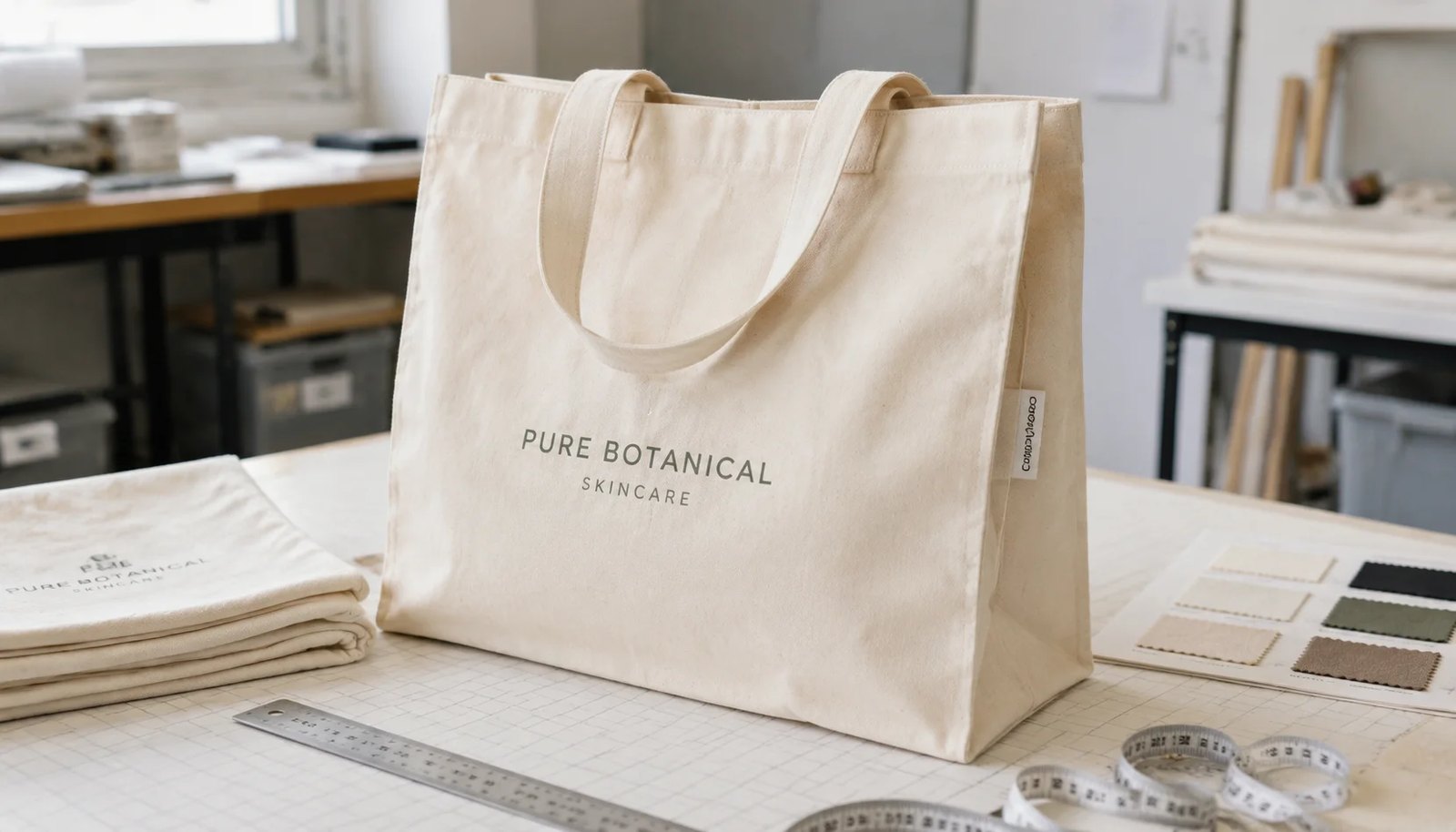
Why skincare brands need a different tote inspection standard
A custom canvas grocery tote for a skincare brand is not just a basic giveaway bag. It often carries boxed serums, pump bottles, jars, glass droppers, and gift-with-purchase bundles that are heavier and less forgiving than dry grocery items. That changes what should be inspected. A bag that looks fine on a factory table can still fail in retail use if the handles twist, the gusset collapses, or the print cracks after folding around rigid products.
Skincare also raises presentation standards. Buyers usually care about logo alignment, clean internal finishing, fabric shade consistency, and a low-dust interior because the bag often sits next to premium primary packaging. The right inspection checklist should therefore combine load-bearing checks with appearance thresholds, packing discipline, and quote clarity. If those points are vague, supplier quotes look similar at first but produce very different delivered results.
- Main buying problem: preventing quality disputes on a product that must carry weight and still represent a premium brand
- Typical failure points: weak handles, inconsistent GSM, print offset in cartons, fabric shade variation, and under-specified packing
- Best use of QC: align expectations before production, not after shipment photos arrive
Start with the right construction spec, not just a reference photo
Most quality problems begin in the RFQ stage because the buyer sends only artwork and an inspiration image. For canvas grocery totes, the factory needs measurable construction data. A skincare launch tote for boxed products often performs better with a bottom gusset or side-and-bottom gusset than a flat body. The gusset lets the bag stand better, protects print shape, and spreads weight over the lower seams instead of pulling the front panel into distortion.
Fabric weight is the second major decision. For most skincare retail and promotional use, 280 to 340 GSM canvas is a practical range. Around 300 GSM is common because it gives enough body for a premium feel without pushing freight cost too far. If the brand is packing heavier glass sets, a slightly heavier canvas may make sense, but very heavy fabric increases crease memory and can create a stiff, less elegant fold in carton packing.
- Useful RFQ spec line: 38 x 35 x 12 cm finished size, 300 GSM natural canvas, bottom gusset, 60 cm total handle length, 3 cm handle width
- Dimension tolerance example: body width and height plus or minus 1 cm; handle length plus or minus 0.5 cm
- For boxed skincare kits, specify target fill weight so the factory knows the stress level at seams and handles
How GSM, weave, and fabric finish affect quality complaints
Buyers often compare prices using vague terms like heavy canvas or premium cotton. That is where quote confusion starts. Canvas can vary in GSM, yarn count, weave tightness, and finishing. Two suppliers can both say 12 oz canvas yet produce different body feel and print performance. A tighter weave usually gives cleaner logo edges and less ink bleed, while a looser weave can feel softer but may show pinholes in larger prints.
For skincare brands, the fabric finish matters because it affects dust, shrink response, and appearance after folding. Unwashed natural canvas usually costs less and prints well, but it may feel slightly firmer. Washed fabric can feel softer and more premium, but dimensions may vary more if the wash process is not controlled. If your brand expects a clean natural tone, define what level of shade variation is acceptable. Cotton is a natural fiber, so some variation is normal, but the lot should still match the approved standard closely enough for retail consistency.
- List GSM and tolerance in the PO, not only ounces
- Request a close-up fabric photo or swatch showing weave density before approving bulk
- If the tote is part of a clean beauty launch, add odor and lint limits to sample approval
- State whether small cotton seed flecks are acceptable in natural canvas
Choose a print method that survives folding, rubbing, and shelf presentation
Screen printing remains the most practical choice for most skincare tote logos because it balances cost, color strength, and production speed. It works especially well for one-color or two-color branding on natural canvas. The main quality concerns are ink penetration, edge sharpness, drying, and rub resistance. A tote can leave the print table looking good but still transfer ink onto adjacent bags if curing is rushed before packing.
Heat transfer and digital-style transfer methods are useful when artwork includes gradients, small text, or full-color cosmetic visuals. The tradeoff is that large transfer areas can feel less breathable and may crack along fold lines if the film and pressing process are not right. Embroidery can look premium for a small logo, but on medium-weight canvas it may cause puckering unless stabilizer use is controlled. The right inspection point is not simply whether the logo looks attractive; it is whether the chosen method fits the tote's folding pattern, intended load, and packed presentation.
- Screen print acceptance: clean edge, no visible pinholes from normal viewing distance, no offset after 24-hour dry period
- For transfer prints, inspect corner adhesion and fold-line behavior after sample folding
- Set logo placement tolerance, for example plus or minus 5 mm from approved position
- Request print strike-off on actual canvas, not on paper alone
Sample approval should mirror bulk production, not just prove the shape
A development sample can confirm size and silhouette, but it is a weak approval tool if made from substitute fabric or a different print process. For a reliable quality result, the key sample is the pre-production sample made with bulk-like canvas, actual handle method, and final print technique. That sample should also follow the planned folding and packing method. Otherwise, buyers approve a beautiful sample that never represented the bulk process in the first place.
For skincare buyers, sample review should include practical handling tests. Load the bag with a realistic product weight, stand it on a shelf, fold it as it will ship, and inspect whether the print cracks, whether the gusset holds shape, and whether the handles sit comfortably when carrying. If individual polybags are planned, leave the sample packed for a short period and then inspect for transfer marks or trapped odor. These are low-cost checks that prevent expensive after-arrival disputes.
- Approve one sealed sample kept by buyer and one matching counter-sample kept by factory
- Measure body, gusset, and handle drop on the sample and record actual values in the approval note
- Photograph print location with a ruler visible
- Test-fill sample with real or equivalent product weight before bulk approval
The quality inspection checklist that matters on the production floor
Final random inspection should not stop at counting obvious defects. For canvas grocery totes used by skincare brands, the most useful checklist combines measurement, workmanship, print condition, cleanliness, and packing accuracy. AQL can be used as the sampling framework, but the defect definitions must be practical. A major defect for this product is not only a hole or broken seam. It can also be a badly shifted logo, significant fabric shade mismatch within one shipment, a handle mismatch obvious at retail, or print offset that reaches adjacent units.
In-line inspection is often more valuable than only final inspection because many tote defects are easier to correct before full packing. Printing issues should be reviewed early while ink curing and placement are still under control. Sewing issues such as handle symmetry, skipped stitches, and thread trimming should be checked before units are folded into cartons. Once bulk is packed, defect sorting becomes slow and expensive, and factories become more resistant to rework.
- Major workmanship defects: open seams, weak handle reinforcement, severe skew, obvious logo misplacement, heavy stains, or wrong size category
- Minor defects: short loose thread ends, slight slub differences, small natural weave flecks if pre-approved
- Useful in-line checkpoints: first print run approval, first 20 sewn bags review, mid-production carton packing review
- Inspect internal cleanliness if skincare kits or premium cartons will be inserted directly into the bag
Packing details can change damage rates and landed cost more than buyers expect
Packing is where a lot of tote programs quietly lose margin. If the quote says standard export packing, that may mean many different things. For a skincare campaign, one buyer may need individual polybags to protect clean light fabric and prevent scuffing in fulfillment, while another may prefer bulk packing to reduce plastic use and freight volume. Neither option is automatically correct. The right answer depends on fulfillment method, print cure stability, and the brand's sustainability position.
Carton planning also affects warehouse handling and freight rates. Overly dense packing can flatten gussets, leave hard fold lines through the print, and push carton gross weight beyond what downstream teams want to handle. Light cartons with too much empty air waste cubic space. A practical target is a balanced carton count that protects the print and shape while keeping carton dimensions efficient for palletization and container loading. Buyers should request estimated pieces per carton, carton dimensions, and gross weight before approving the quote.
- If using polybags, state bag thickness and whether suffocation warning text is allowed or must be omitted
- For bulk pack, ask whether interleaving or inner bundle bands are included to reduce print rubbing
- Set carton gross weight limit if your warehouse or retailer has handling rules, for example under 15 to 18 kg as an internal preference
- Require shipping marks, SKU labels, and assortment labels to match your receiving workflow
MOQ logic and price breaks: how to compare supplier quotes fairly
Canvas tote pricing shifts with a few predictable variables: GSM, size, gusset construction, print colors, handle reinforcement, packing, and order quantity. The common mistake is comparing unit prices without matching these variables. One supplier may quote a lower price based on lighter fabric, shorter handles, smaller print area, and bulk packing, while another includes heavier canvas, individual polybags, and a pre-production sample. Without a normalized quote sheet, buyers end up selecting the cheaper number and paying for corrections later.
MOQ also matters more than many skincare brands expect. Tote factories typically work more efficiently when the same fabric and print setup run across a stable batch. If the order is split into many colorways or size variants, wastage and setup time rise. A smart launch plan is to standardize one body size and one print method, then vary only one or two low-risk features such as body color or side label. That keeps MOQs workable and allows buyers to test demand before committing to a wider SKU spread.
- Typical quote variables to normalize: GSM, body size, gusset, print colors, print area, handle width, packing method, carton count, sample cost
- Ask for quantity breaks at realistic levels such as 1,000, 3,000, and 5,000 pieces
- Separate one-time charges from repeat-order unit pricing
- If multiple SKUs are required, ask whether MOQ applies per colorway, per print, or per total order
Lead time risk is usually hidden in fabric and printing, not only sewing
Buyers often focus on cut-and-sew lead time, but canvas tote schedules are usually delayed earlier in the chain. Fabric sourcing or weaving, shade approval, print strike-off, and sample revision can consume more days than sewing itself. If a skincare launch date is fixed around a campaign or retail floor set, the safest approach is to map the full timeline from artwork release to cargo readiness. That lets procurement see where approvals must happen quickly and where there is no room for back-and-forth changes.
Lead time also changes with seasonality and factory loading. Tote production may look simple, but if your order lands near peak periods or after a packaging revision, even a short sample delay can push the shipment window. Build time into the schedule for one sample correction and one inspection hold. This is more realistic than assuming everything will pass first time. A balanced quote review should ask suppliers not only for total production days, but for a milestone breakdown.
- Useful milestone split: fabric confirmation, print strike-off, pre-production sample, bulk cutting, printing, sewing, final inspection, packing, cargo handover
- If artwork uses Pantone-sensitive cosmetics branding, reserve time for print color adjustment
- Do not book campaign delivery based only on verbal sample-room estimates
- Ask whether labels, polybags, or custom cartons are sourced in-house or externally because bought-in items often delay readiness
Use acceptance criteria and quote questions to reduce post-shipment arguments
The cleanest tote programs are not the ones with no defects. They are the ones where defects were defined early, quote scope was clear, and both parties worked from the same approved standard. Procurement teams should translate quality expectations into measurable acceptance criteria. If a logo can move only 5 mm, write that. If print rubbing on adjacent bags is unacceptable, state the packing and cure expectations. If natural slubs are acceptable but stains are not, document the difference before production starts.
This also improves quote comparison. Suppliers respond more accurately when the RFQ already defines fabric weight, bag size, print method, reinforcement, and packing. Their answers then reveal who understands the product and who is quoting loosely. A supplier that clearly states exclusions, sample route, and carton data is usually easier to manage than one that offers a low number with vague scope. Better documentation up front gives buyers leverage later if quality slips.
- Tie every approval to a physical or photo standard with measurements
- Put tolerance, packing, and artwork placement into the PO, not only in email discussion
- Use the same question set for each supplier so quote differences are easier to explain
- Keep one signed or acknowledged spec sheet as the reference for inspections and claims
Specification comparison for buyers
| Spec decision | Recommended option | When it fits | Buyer risk to check |
|---|---|---|---|
| Fabric weight | 10 oz to 12 oz canvas, about 280 to 340 GSM | Best balance for skincare promo-with-purchase totes carrying bottles, boxed sets, and light retail groceries | Below 8 oz can feel too soft and premium value drops; above 14 oz raises cost, carton weight, and crease marks in sea shipment |
| Cotton type | Conventional cotton canvas with color and strength approval against sealed sample | Fits most branded campaigns where handfeel, print clarity, and cost control matter more than organic claims | If sustainability language appears on pack or website, quote mismatch happens if organic or recycled content is assumed but not specified |
| Bag construction | Bottom gusset or side-and-bottom gusset with boxed corners | Better for skincare kits, pump bottles, and gift bundles that need upright carrying and shelf-ready appearance | Flat totes can distort print area and stress seams when filled with heavier glass bottles |
| Handle attachment | Cross stitch or reinforced box stitch with 2.5 to 3 cm handle width | Suitable for heavier fill weight and repeat retail use | Single line stitch may pass visual inspection but fail in consumer use; request pull-test standard and stitch count |
| Print method | Screen print for solid logos; heat transfer only for photo detail; embroidery only for small premium branding | Screen print is usually the most stable and cost-efficient for skincare branding on canvas | Large heat transfers can crack on fold lines; embroidery on thin canvas can pucker if backing is not controlled |
| Inner cleanliness | Trimmed threads, no loose cotton lint, no oil stains, and no sharp needle fragments | Important when bags are packed with clean beauty, skincare samples, or secondary retail packaging | Factories used to fashion bags may overlook internal dust and lint, which creates a poor unboxing result |
| Packing method | Individual polybag only if brand requires dust protection; otherwise stack pack in export carton with size band | Works for skincare launches where presentation matters but freight cost still needs control | Overpacking increases cubic volume; no poly can cause rub marks or print offset if ink cure is weak |
| MOQ planning | Start with one body size and one print color across 2 to 4 colorways | Helps skincare brands hit workable MOQ while testing regional demand or campaign response | Too many SKUs split the cut-and-sew lot, increase wastage, and make AQL inspection less reliable by reducing repeatability |
| Sample approval route | Approve pre-production sample with exact fabric, print size, handle drop, and carton plan | Best for importers comparing supplier quotes on a like-for-like basis | A photo-approved sample alone leaves room for fabric substitution, handle length drift, and packing surprises |
Buyer checklist before sampling
- State finished bag size in centimeters including gusset depth, handle width, and handle drop, not only a reference photo.
- Specify fabric as canvas with target GSM tolerance, for example 300 GSM plus or minus 5 percent, and whether washed or unwashed handfeel is acceptable.
- Define intended product load, such as 4 glass skincare bottles plus carton inserts, so the factory can match seam and handle reinforcement.
- Lock print method by artwork area: screen print for solid logo, transfer for gradient art, embroidery only if puckering risk is accepted.
- Request a pre-production sample made from bulk-like fabric and actual print process, not a digital mockup or substitute stock fabric.
- Approve logo position with measurable distances from top seam, side seam, and bottom edge.
- Set appearance limits for natural canvas shade variation, slub content, and minor weave flecks before production starts.
- Confirm whether inner seam binding, overlock finish, or turned seams are required based on premium level and lint control expectations.
- State packing rule by unit and carton: pieces per polybag, pieces per carton, target carton size, and maximum carton gross weight.
- Require outer carton shipping marks, barcode label format, and assortment labeling if multiple SKUs ship together.
Factory quote questions to send
- What exact canvas composition and tested GSM are you quoting, and what tolerance do you control in bulk production?
- Is the quoted price based on flat tote construction or gusseted construction with boxed corners?
- What stitch type and reinforcement do you use at the handle root, and can you share your internal pull-test method?
- Which print method is included in the quote, how many colors, and what is the maximum print area before the price changes?
- Does the quote include print strike-off, pre-production sample, and sample courier, or are these billed separately?
- What is your MOQ by colorway and by total order, and how does the unit price change at higher quantity breaks?
- Are natural canvas shade variation and fabric slubs considered standard, and how do you control lot-to-lot consistency?
- What packing format is included: bulk pack, individual polybag, tissue insert, carton liner, desiccant, or barcode labeling?
- What are the estimated net weight and gross weight per carton, and how many pieces fit in a standard export carton?
- How many calendar days are needed for lab dip or fabric confirmation, pre-production sample, bulk production, and booking readiness?
Quality-control points to confirm
- Fabric GSM within approved tolerance and handfeel consistent with sealed sample
- Finished bag dimensions within agreed tolerance for width, height, and gusset depth
- Handle length pair matched and attachment points symmetrical left to right
- Handle reinforcement stitches complete with no skipped stitches or unraveling
- Print position measured from seams and within approved placement tolerance
- Print color reasonably matched to approved artwork standard under neutral light
- Print surface cured adequately with no blocking, offset, or easy rub-off
- No major stains, oil marks, rust spots, mildew odor, or excessive lint inside bag
- Inner and outer seams trimmed clean with no long thread ends or needle damage
- Carton quantity, carton marks, barcode labels, and assortment packing accurate to packing list