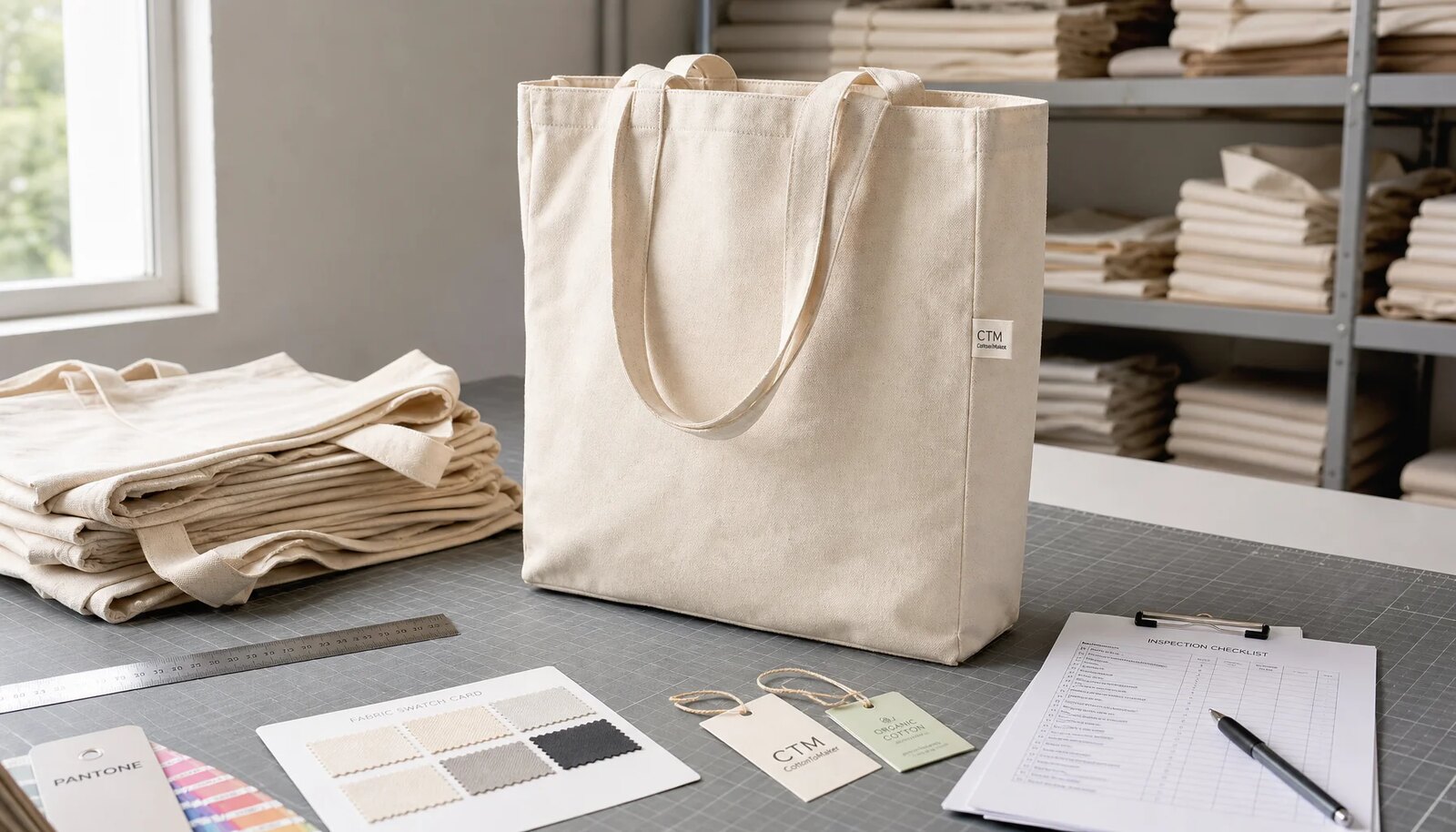
1. Start with the commercial use case and claim risk
Custom canvas grocery totes look simple, but B2B buyers are usually buying three things at once: a carrying product, a branded touchpoint, and a sustainability message. If the tote is sold beside apparel, included with an eco collection, or used as branded merchandise, weak construction or unsupported environmental language can become a brand issue, not just a purchasing issue.
Begin the RFQ with the tote’s job. A lightweight event tote may only carry a T-shirt and a catalog. A grocery tote may be loaded with jars, bottles, produce, and books. A retail resale tote needs a cleaner finish because consumers will compare it with accessories, not disposable bags. Those use cases require different fabric weights, handle reinforcements, inspection limits, and packing methods.
Eco apparel brands also need to separate real specifications from broad language. “Eco-friendly canvas tote” is not inspection-ready. “Natural undyed 100% cotton canvas, bulk packed without individual polybags” is clearer. If you intend to claim organic cotton, recycled cotton, low-impact dyeing, or plastic-free packaging, the supplier must provide documents that support those claims.
- Define channel: wholesale, retail resale, ecommerce, event, subscription box, or internal brand use
- Define expected load: light promotional carry, everyday carry, or full grocery load
- Define claim language before production: natural cotton, organic cotton, recycled cotton, undyed, plastic-free, or reduced plastic
- Require documents for claims that appear on hangtags, product pages, carton labels, or retailer submissions
2. Write fabric specifications that an inspector can verify
Fabric is the main cost driver and the first place quotes become non-comparable. Ask for canvas weight in both ounces and finished GSM. For most reusable grocery totes, 10 oz to 12 oz canvas is a practical starting range. It has more body than lightweight promotional cloth without creating excessive freight weight or uncomfortable handles.
State whether the weight is raw, dyed, washed, or finished. Dyeing, washing, enzyme treatment, and pre-shrinking can change the final measured weight and dimensions. The approved swatch should be tagged with composition, finished GSM, finish, shade reference, shrinkage result, and supplier lot reference.
Natural canvas may include seed flecks and slubs. That is often part of the desired look, but the brand still needs limits. Excessive slubs across the logo area, dark shade bars, oil marks, mildew spots, and fabric skew should not be hidden behind “natural variation.” Approve a shade band and a sample of acceptable slub level before bulk cutting.
- Recommended weight: 10 oz to 12 oz for reusable grocery programs
- Fabric weight tolerance: finished GSM within ±5% unless the purchase order sets a tighter limit
- Dimension tolerance after finishing: width/height/gusset ±1.0 cm for most tote programs
- Rejectable fabric issues: mildew, oil stain, strong odor, severe shade bar, excessive skew, or slub disrupting logo legibility
- Shrinkage: record supplier test method if the tote is marketed as washable or pre-shrunk
3. Check material claims, dyes, and packaging claims before artwork approval
Eco apparel buyers often face stricter review than general promotional buyers. A tote may be inexpensive, but if it carries an environmental statement, the claim should be supported by records. The safest approach is to decide which claims are necessary, then source material and packing around those claims instead of adding sustainability wording after production.
For organic cotton, ask what certification or transaction documentation is available for the specific material. For recycled cotton, ask for recycled content percentage, chain-of-custody documents if available, and whether the material is mechanically recycled, blended, or made from pre-consumer or post-consumer inputs. If a supplier cannot support the claim, use more conservative language such as “cotton canvas” rather than “certified organic” or “recycled.”
Dye and ink compliance also matters. Natural undyed canvas may reduce dye-related questions, but printed logos still introduce ink chemistry. For dyed canvas or colorful prints, request restricted substance compliance records relevant to your market or retailer program, such as azo dye, heavy metal, formaldehyde, and phthalate declarations or test reports when required.
- Organic cotton: request transaction certificate or acceptable chain-of-custody record for the order where applicable
- Recycled cotton: request recycled percentage, supplier declaration, and any certificate or test report the supplier can substantiate
- Dyes and inks: request RSL compliance statement or test report when the retailer or market requires it
- Packing claims: define whether polybags are banned, replaced with paper bands, or allowed only with recycled content
- Avoid unverified wording such as “sustainable,” “green,” or “eco-safe” unless your compliance team has approved the evidence
4. Engineer the stress points: handles, seams, gusset, and top hem
The handle attachment is the most important construction detail on a grocery tote. A clean print cannot compensate for handles that tear away under normal use. Specify handle material, width, length, handle drop, attachment method, reinforcement shape, thread color, and stitch target. Self-fabric handles give a consistent cotton look; cotton webbing can be efficient and strong when sourced in a suitable width and weight.
For standard canvas grocery totes, a practical handle width is 2.5 cm to 3.8 cm. The main seams should usually target 7 to 9 stitches per inch. Reinforcement areas may use 8 to 10 stitches per inch if the fabric and machinery support it without puckering. X-box, box-stitch, or bar-tack reinforcement should fully catch the handle and body layers, with back-tacking at seam ends.
Gusset control affects capacity and presentation. A twisted bottom gusset makes the tote lean and reduces usable space. Inspect flat and standing: lay the bag on a table to check symmetry, then open it and load it lightly to see whether the base sits square. The top hem should be even, secure, and wide enough to support handle stress without exposing raw edges.
- Handle drop tolerance: ±1.5 cm from approved sample or tech pack
- Main seam stitch density: 7 to 9 stitches per inch unless construction requires a different approved target
- No skipped stitch run longer than 2 stitches; no open seam, broken stitch, or missed layer at handle points
- Reinforcement must be centered and complete, not decorative stitching that misses the stress area
- Gusset corners should align within normal dimension tolerance and should not twist when the bag is opened
5. Choose decoration by durability, not only by artwork appearance
Screen printing is usually the best baseline for custom canvas grocery totes with simple logos, bold wordmarks, or one- to three-color artwork. It gives clear quote logic and good repeatability when ink curing is controlled. On natural canvas, expect some texture from the weave, but the approved sample should define the acceptable edge and opacity.
Heat transfer can work for detailed artwork or smaller runs, but textured cotton is less forgiving than a smooth synthetic surface. Check for edge lift, cracking over folds, and pressure marks after packing. Embroidery can create a premium apparel-brand look, but dense stitching may pucker canvas and add bulk when bags are folded in cartons.
Decoration specs should be measured. State artwork size, placement from top edge and side seam or centerline, Pantone reference or approved color sample, number of colors, print side, and acceptable tolerance. A common commercial tolerance is ±0.5 cm for print placement and within 1 mm registration for multi-color logos, unless the artwork intentionally allows a looser hand-made effect.
- Screen print: strong for repeat logos, good opacity, and predictable cost
- Heat transfer: useful for detailed short runs; test edge lift, cracking, and fold resistance
- Embroidery: premium for small marks; inspect puckering, backing, thread trimming, and needle damage
- Woven label or patch: useful for subtle apparel branding; verify spelling, orientation, and sew-down alignment
- Print durability: include dry rub, fold review, scratch check, and tape pull where suitable for the method
6. Make supplier quotes comparable before selecting a price
Canvas tote quotes vary because suppliers make different assumptions. One quote may include 12 oz finished canvas, reinforced handles, one-color screen print, woven side label, barcode carton marks, and export cartons. Another may quote lighter fabric, no label, simpler reinforcement, and bulk packing without barcode work. Procurement should compare the same product, not the same product name.
Build an RFQ baseline with finished dimensions, fabric composition and weight, finish, handle style, gusset, print method, artwork size, labels, packing method, carton marks, inspection plan, target AQL, and order quantity. Then ask for optional upgrade lines: heavier canvas, second-side print, extra color, custom dye, organic or recycled material, hangtag, inner pocket, zipper, snap, individual packing, and desiccants.
Request price breaks at likely reorder quantities. If a launch begins at 500 pieces but may reorder at 1,000, 3,000, or 5,000 pieces, collect those breaks before sample approval. Also ask whether MOQ changes for special materials or trims. Many delays begin when a late sustainability or label request pushes the project into a new material minimum.
- Separate unit cost from sample charge, screen charge, label cost, packing cost, carton cost, and inland handling
- Ask whether quoted fabric is in stock, custom woven, dyed to order, washed to order, or dependent on a mill MOQ
- Collect carton data: pieces per carton, carton size, gross weight, net weight, and estimated CBM
- Confirm who performs printing, sewing, packing, and final inspection if subcontracting is involved
- Require quote validity and a clear timeline from sample to ship handover
7. Treat the golden sample as the contract standard
The approved sample should be more than a visual mockup. It is the physical contract standard for fabric, construction, print, labels, trims, packing, and finishing. If the sample uses substitute fabric, temporary thread, approximate print color, or unfinished packing, record those differences and require a corrected pre-production sample before bulk cutting.
A useful golden sample file includes the tote itself, fabric swatch, print reference, label reference, approved artwork file, measurement sheet, packing photo, and supplier notes. Keep one sealed sample with the factory and one with the buyer or inspection partner when possible. During inspection, compare random production units to this standard before arguing about subjective quality.
Sample review should include handling. Measure the tote, check handle symmetry, open and stand the gusset, fold it as it will be packed, and inspect the print after unfolding. If the tote will be shipped in bulk, stack and compress a few samples to see whether print transfer, heavy creasing, or odor retention becomes an issue.
- Measure sample dimensions against the tolerance table before approval
- Photograph handle reinforcement, inside seams, gusset corners, label placement, and carton setup
- Attach documentation for organic, recycled, dye, ink, or packaging claims before approving artwork with claim language
- Approve the exact folding method if print presentation matters
- Do not start mass cutting until fabric, decoration, and stress-point construction are physically confirmed
8. Use AQL, defect classes, and simple performance tests
A strong quality inspection checklist must be enforceable. For most commercial first orders, use ANSI/ASQ Z1.4 or ISO 2859-1 single sampling at General Inspection Level II unless your retailer requires another plan. A common AQL structure is Critical 0, Major 2.5, Minor 4.0. The exact setting can change by buyer policy, but it must be agreed before inspection.
Define defects in plain language. Critical defects include unsafe contamination, sharp debris, mold, severe chemical odor, or prohibited material substitution. Major defects include handle failure, open seams, wrong dimensions outside tolerance, wrong logo, wrong label, severe stains, incorrect barcode, and print damage. Minor defects include short loose threads, removable lint, slight creasing, or small natural slubs inside the approved standard.
Add basic performance tests. For grocery totes, load test at least 3 pieces per lot or per inspection sample set. A practical baseline is 12 kg static load for 30 minutes, followed by 10 lift-and-lower cycles. Pass means no handle tear, seam opening, reinforcement failure, or major distortion. If the tote is marketed for heavier grocery use, set a higher approved load such as 15 kg.
- Inspection plan: General Inspection Level II, AQL Critical 0 / Major 2.5 / Minor 4.0 unless otherwise required
- Load test baseline: 12 kg for 30 minutes plus 10 lift cycles; no tearing or seam opening allowed
- Dry rub: 20 back-and-forth cycles with clean white cotton cloth; no obvious color transfer or powdering
- Print placement: ±0.5 cm from approved reference points unless the artwork standard says otherwise
- Measurements: bag width, height, and gusset ±1.0 cm; handle drop ±1.5 cm; top hem ±0.3 cm
9. Inspect packing, cartons, and shipment readiness with the same discipline
Packing is both a cost decision and a sustainability decision. Bulk packing reduces plastic and carton volume, but it requires accurate counts and clean handling. Individual polybags may be necessary for ecommerce, retail scanning, or mixed-SKU inventory, but they add labor, volume, and plastic. If the brand wants plastic-free packing, state it in the RFQ and confirm whether paper bands, tissue, or simple bulk packing will meet the receiver’s needs.
Define folding method, pieces per inner pack, pieces per master carton, carton dimensions, carton strength, gross weight, net weight, carton marks, SKU, PO number, barcode format, and barcode location. If multiple colors or artworks are shipped, require carton segregation unless the receiving warehouse approves mixed cartons. Count errors can delay payment and create chargebacks even when product quality is acceptable.
Canvas can trap moisture and odor. Bags should be dry and fully cured before packing. In humid lanes, consider desiccants, dry carton storage, and moisture checks. During final inspection, open cartons from different positions in the stack, smell for trapped odor, confirm physical counts, scan barcodes if used, and compare carton marks against the packing list.
- Bulk packing: best for lower plastic use and efficient freight when warehouse counting is controlled
- Individual packing: use only when retail, ecommerce, or SKU handling requires it
- Plastic-free claim: document actual packing materials and avoid hidden inner polybags
- Carton checks: PO, SKU, artwork, count, carton mark, barcode, gross weight, and carton condition
- Shipment release: hold shipment if carton counts, labels, or product identity do not match the purchase order
Specification comparison for buyers
| Spec decision | Recommended option | When it fits | Buyer risk to check |
|---|---|---|---|
| Fabric weight | 10 oz to 12 oz canvas, also stated as finished GSM; accept ±5% unless brand sets tighter limit | Reusable grocery, apparel merchandise, farmers market, retail resale, and brand activations | A vague “heavy canvas” quote may hide lighter cloth; verify weight from a cut swatch during inspection |
| Material claim | Conventional cotton, organic cotton, recycled cotton, or blend stated by percentage and backed by documents | Eco apparel brands that make public sustainability claims or sell through retailers with compliance checks | Unsupported “eco” wording creates claim risk; request transaction certificates, supplier declarations, and composition records where applicable |
| Fabric finish | Natural unbleached, dyed, washed, enzyme-washed, or pre-shrunk canvas with shade band and shrinkage target | Programs needing specific hand feel, shade, or low-shrink retail presentation | Finishing changes weight, shade, dimensions, and print behavior; approve the final finished fabric, not only raw greige cloth |
| Handle construction | Self-fabric or cotton webbing handles, 2.5 cm to 3.8 cm wide, reinforced with X-box, box stitch, or bar-tack | Totes expected to carry groceries, bottles, books, or repeat daily loads | Handle tear-out is a major failure; inspect stitch density, reinforcement size, and load-test result |
| Stitching | Lockstitch with 7 to 9 stitches per inch on main seams; secure back-tack at seam ends; no open seams | Most canvas grocery tote constructions | Loose tension, skipped stitches, and missed layers reduce strength and are visible to retail buyers |
| Print method | Screen print for bold repeat logos; heat transfer for detailed short runs; embroidery or woven label for premium marks | Choice depends on artwork, order volume, hand feel, durability need, and budget | Check opacity, placement, registration, dry rub, folding, and adhesion before shipment |
| Dimensional tolerance | Bag width/height/gusset ±1.0 cm; handle drop ±1.5 cm; print placement ±0.5 cm unless approved otherwise | Inspection-ready specifications for most commercial tote orders | Unstated tolerance leads to disputes; oversized variation affects carton fit, shelf look, and customer use |
| Packing | Bulk pack for lower plastic use; individual recycled-content polybag or paper band only when channel requires it | Wholesale, ecommerce, retail, distributor, or apparel brand fulfillment programs | Under-specified packing causes creasing, odor, count errors, barcode issues, and unnecessary plastic |
| Inspection plan | ANSI/ASQ Z1.4 or ISO 2859-1 single sampling, General Inspection Level II; typical AQL Critical 0, Major 2.5, Minor 4.0 | First orders, new suppliers, retail delivery, or any branded merchandise program | Without defect classes and AQL, inspection becomes subjective and difficult to enforce |
Buyer checklist before sampling
- Define the tote’s job: grocery carry, apparel merchandise, retail resale, event giveaway, subscription insert, or corporate gifting.
- State fabric composition and claim type: conventional cotton, organic cotton, recycled cotton, recycled blend, or undyed natural canvas.
- Require fabric weight in ounces and finished GSM, with a normal acceptance tolerance of ±5% unless your brand standard is stricter.
- Lock finished dimensions: width, height, gusset depth, handle length, handle drop, top hem width, and measurement tolerances.
- Specify handle width, material, attachment method, reinforcement pattern, stitch density, thread color, and stress-point standard.
- Set main-seam stitch target at 7 to 9 stitches per inch for standard canvas, with no skipped stitch run longer than 2 stitches.
- Define print size, artwork file, Pantone or approved color reference, placement from top and side edges, and placement tolerance.
- Request a sealed golden sample with exact fabric, finish, print, thread, label, hangtag, packing, and carton marking standard.
- For eco claims, collect relevant documentation: supplier declaration, composition test if needed, organic or recycled transaction certificates where applicable, dye and restricted substance compliance records, and packaging material statement.
- Set pre-shipment inspection using a recognized sampling plan, defect classifications, AQL limits, load test method, rub test method, and pass/fail thresholds.
Factory quote questions to send
- What exact canvas are you quoting: composition, yarn type if known, oz, finished GSM, finish, color, and whether weight is before or after washing or dyeing?
- Can you provide fabric swatches tagged with composition, weight, finish, shade reference, shrinkage result, and lot number before bulk cutting?
- If organic or recycled cotton is quoted, what documentation can you provide: supplier declaration, transaction certificate, recycled content certificate, bill of material, or third-party test report?
- What dye, ink, and finishing compliance records can you provide for restricted substances, azo dyes, heavy metals, formaldehyde, or retailer-specific RSL requirements?
- What is your target stitch density at side seams, bottom seam, top hem, and handle reinforcement, and what reinforcement dimensions do you use?
- What load test do you perform on grocery totes, at what weight, for how long, and what counts as failure?
- What print durability tests can you perform for this method: dry rub, wet rub, tape pull, scratch, fold test, or wash test if the tote will be marketed as washable?
- Is the quoted print price based on one side, one color, and a fixed artwork size? What are the surcharges for second-side print, extra colors, oversized print, PMS matching, or special ink?
- What does your MOQ include, and does it change for custom dyeing, organic cotton, recycled cotton, woven labels, hangtags, inner pockets, zippers, snaps, or individual packing?
- Can you quote unit cost, sample charge, screen or setup charge, label cost, packing cost, carton cost, and inland handling separately?
Quality-control points to confirm
- Use ANSI/ASQ Z1.4 or ISO 2859-1 single sampling at General Inspection Level II unless the buyer requires another plan; typical AQL limits: Critical 0, Major 2.5, Minor 4.0.
- Classify critical defects as unsafe contamination, mold, sharp debris, severe chemical odor, prohibited material substitution, or any issue making the tote unfit for normal use.
- Classify major defects as handle failure, broken/open seams, wrong material, wrong artwork, wrong label, dimension outside tolerance, severe stain, print cracking, barcode error, or incorrect carton count.
- Classify minor defects as loose thread shorter than 2 cm, light removable lint, minor crease, small approved natural slub, or slight shade variation within the approved band.
- Verify fabric composition and weight against approved swatch; finished GSM should be within ±5% and shade should match the approved shade band or sealed sample.
- Measure finished bag width, height, and gusset depth at ±1.0 cm tolerance; handle drop at ±1.5 cm; top hem width at ±0.3 cm unless the purchase order states otherwise.
- Check stitch density: target 7 to 9 stitches per inch on main seams and 8 to 10 stitches per inch on reinforcement where construction allows; no skipped stitch run longer than 2 stitches.
- Inspect handles for reinforcement alignment, complete X-box or bar-tack coverage, secure back-tacking, no missed layers, and no broken thread after load testing.
- Perform a static load test on at least 3 pieces per inspected lot: load each tote to 12 kg for 30 minutes, then lift and lower 10 cycles; pass requires no handle tear, seam opening, or reinforcement failure.
- For heavier retail grocery programs, use buyer-approved higher load such as 15 kg if the tote is marketed for heavy reuse; record the test weight on the inspection report.