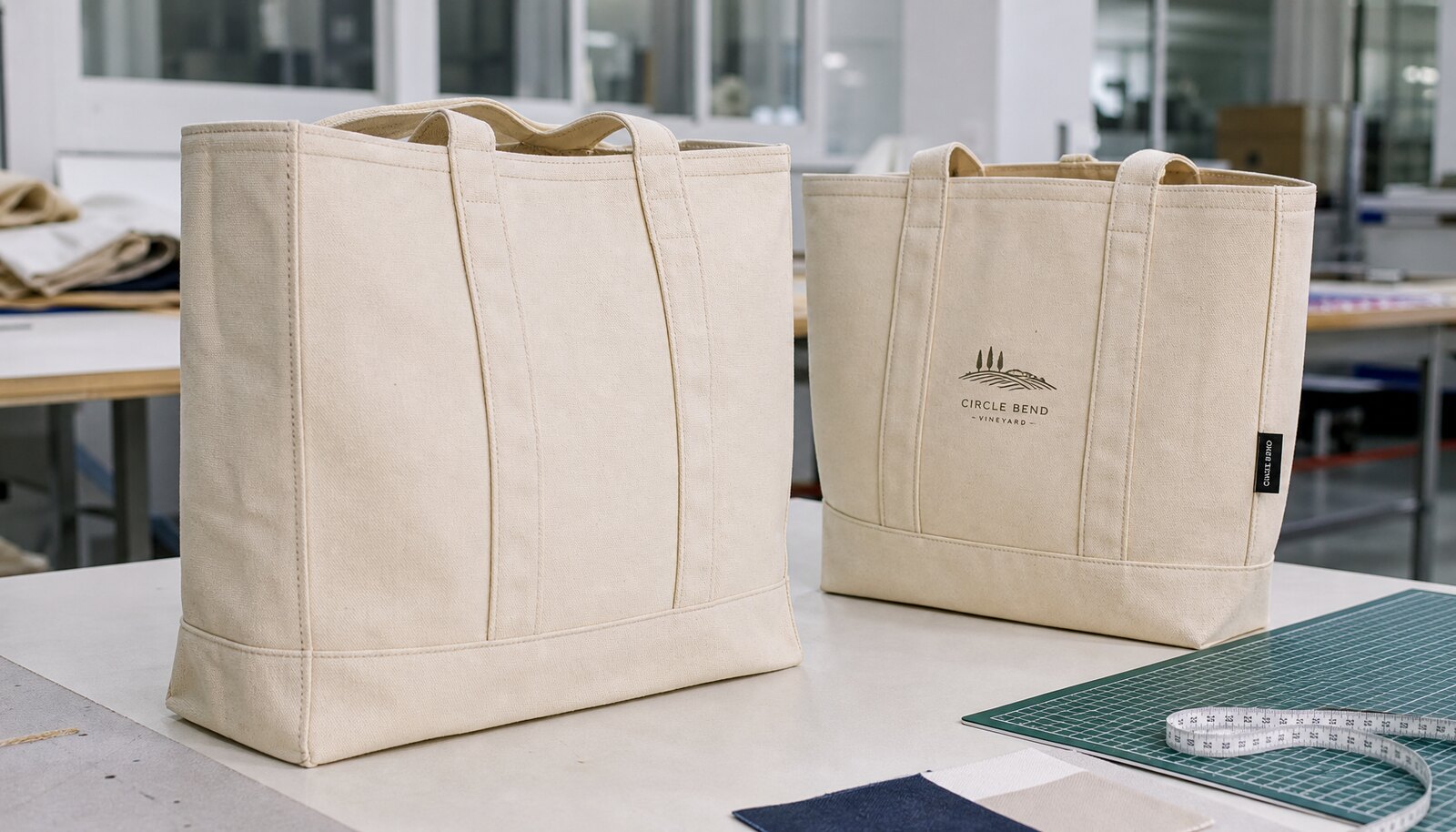
Why boutique wineries need a tighter tote inspection standard
A canvas grocery tote for a boutique winery is not a generic shopping bag. It sits at the intersection of merchandising, hospitality, and light-duty transport. In the tasting room, it needs to look premium enough to support the winery’s brand story. In the retail channel, it has to survive repeated handling, shelf stacking, and customer carry-outs. In gifting, it often has to hold bottles, brochures, corkscrews, or seasonal add-ons without twisting the shape or making the logo look cheap. That combination makes procurement more demanding than it seems at first glance.
The biggest risk is not one dramatic defect. It is gradual inconsistency across a small custom run. A winery may order 500 pieces for a harvest promotion, 1,000 for a holiday gift bundle, or several separate colorways over a year. If the supplier only controls price and not construction, a tote that looked fine in a sample can arrive with uneven handles, soft sides, or print misalignment that changes the customer’s perception of the brand. For a premium winery, that is not a minor issue; it is a merchandising failure.
Buyers should therefore inspect three things together: appearance, functional load performance, and production repeatability. A good tote should present a stable silhouette on shelf, carry its intended load without strain, and match the approved sample across the whole order. That is why procurement teams should define the product as a branded retail item first and a utility bag second. If you specify it that way, supplier conversations become sharper and QC becomes more practical.
- Treat the tote as part of the brand presentation, not only as packaging.
- Inspect for bottle-load durability, seam stability, and print consistency.
- Measure repeatability across the full run, not only the first approved sample.
Build the specification around winery use, not generic grocery use
The right specification depends on how the tote will be used. A tasting-room tote that carries one or two bottles and a brochure does not need the same build as a retail bag that leaves a shop with chilled wine, gourmet food, or a mixed gift pack. Buyers should define the weight profile of the intended contents before asking for fabric weight. If the bag is mainly for visual presentation and light carry, 10 oz canvas may be enough. If the customer is expected to carry two bottles or heavier bundles, 12 oz is usually the safer starting point.
The body dimensions matter as much as fabric weight. A bag that is too shallow can expose bottle tops and create an unstable center of gravity. A bag that is too narrow can force the bottom seam to take more load than intended. A bag that is too wide can collapse and look under-filled on shelf. That is why a proper spec should include finished width, height, depth or gusset if used, and the expected contents. If the winery plans to use the tote as a gift box substitute, the bag should be sized to frame the products cleanly, not merely hold them.
Handle geometry is another frequent miss. A beautiful logo means little if the handles are too short for shoulder carry or too thin for comfortable grip. Buyers should confirm handle width, handle drop, and reinforcement pattern with an actual loaded sample. This matters especially for winery retail where the end user may walk between cellar door, car park, and home, sometimes carrying the tote for a long distance. A practical spec protects the customer experience and reduces the chance of complaints after the first busy weekend.
- Define the intended contents before finalizing fabric weight.
- Choose body dimensions that keep bottles stable and the brand presentation neat.
- Check handle drop with a loaded sample, not just on a flat drawing.
Fabric checks: GSM, weave consistency, shrinkage, and surface condition
Canvas quality is more than a line on a quote. Buyers should ask for the actual measured weight in GSM or oz, the weave structure, and the expected tolerance across the lot. It is common for suppliers to quote a nominal weight such as 10 oz, but if the delivered roll varies too much, the bag may feel inconsistent from piece to piece. A useful procurement approach is to require the supplier to state whether the weight is measured before or after finishing, because washing, dyeing, and coating can change the final hand feel and cut behavior.
A tight, even weave usually gives a cleaner print surface and reduces edge fray during cutting. A loose weave may look rustic, but it can distort under load and make small logos lose definition. Ask for close-up photos or swatches under daylight and inspect for slubs, thin spots, mixed yarn density, knots, and discoloration. In a winery context, these defects are visible because tote colors are often natural, ecru, or lightly dyed. Any inconsistency stands out immediately in a retail display.
Shrinkage should also be addressed in writing. Even if the bag is not intended for washing every week, it may be folded, compressed, or lightly cleaned. If the fabric is not pre-shrunk or if the supplier has no documented shrinkage expectation, dimensions can drift after the first handling cycle. For buyers, the most practical request is not an abstract textile claim; it is a clear statement of acceptable shrinkage range, surface condition, and how the factory will control fabric lots during production.
- Ask for GSM or oz, plus the measurement basis and allowed tolerance.
- Inspect for weave uniformity, slubs, thin spots, and uneven dyeing.
- Require a shrinkage expectation so finished tote dimensions stay predictable.
Stitching, reinforcement, and the failure points that matter most
Most tote failures start in the same places: handle joins, bottom corners, and side seam intersections. If procurement only checks the overall appearance, these points can be missed until the first customer load test. A good inspection checklist should require visible reinforcement at stress points and a stitch pattern that is dense enough for repeat use. Box-X reinforcement is a common and effective option for self-fabric handles, but it must be executed cleanly, with even tension and no skipped stitches. Bar-tacks can also work, provided the factory uses a consistent standard and the count is enough for the planned load.
The better question is not whether the tote has reinforcement, but whether the reinforcement is sized for the load. A wine tote that carries one bottle for a quick purchase may tolerate a lighter build than a tote used for two-bottle gifting. Buyers should ask the factory for a stitch density specification, thread type, and reinforcement drawing. If the supplier cannot describe this clearly, the construction is probably not controlled tightly enough for branded retail goods. Small changes in stitch length and tension can create visible puckering or a weak join even when the outside appearance looks fine.
Seam finishing also deserves attention. Raw edges should not unravel, and the internal finish should not create bulky lumps that distort the tote shape. In premium retail use, customers notice the inside condition when they place products in the bag. Loose threads, uneven seam allowances, and crooked top hems suggest weak process control. That is important for wineries, where the bag is often touched, viewed, and reused rather than discarded immediately.
- Inspect handle joins, bottom corners, and side seam intersections first.
- Request stitch density, thread type, and reinforcement pattern in writing.
- Reject loose threads, puckering, uneven hems, and unfinished internal edges.
Print quality for winery branding: what to approve before bulk starts
The print is usually the first thing the customer sees, so it needs more than color accuracy. It also has to survive folding, handling, carton compression, and occasional abrasion. For boutique wineries, simple logos, clean typography, and restrained seasonal graphics often work best on canvas because they age better than dense artwork. That does not mean the decoration can be casual. It means the print method should match the artwork complexity and the expected use environment.
Screen printing is usually the most dependable option for one- or two-color logos and text. It gives good coverage, a solid hand, and better repeatability when the factory understands curing and registration. Heat transfer can be useful for smaller runs or artwork with more detail, but the buyer should test whether the film edges crack, lift, or mark during folding. If the design includes delicate linework, ask the supplier to show the minimum line thickness they can hold cleanly on the chosen canvas surface. A tote logo that fills in or loses detail can make a premium brand feel underdeveloped.
Color approval should be handled like a production decision, not a casual sign-off on a screen image. Request a strike-off or pre-production print sample and review it under daylight as well as indoor retail lighting. Ask where the print will sit relative to the tote centerline, side seam, and top hem. Misplacement is one of the most common visual defects because the artwork can look correct on a flat proof and still appear crooked on the finished bag. For procurement, the key is to lock size, placement, color target, curing method, and acceptable variation before the factory enters bulk production.
- Match print method to artwork complexity and expected handling.
- Approve a physical strike-off or printed sample under real lighting.
- Lock artwork placement and line thickness limits before bulk begins.
Supplier route, capacity proof, and traceability: how to avoid the wrong factory
A direct factory usually offers the clearest route when quality control matters. You can ask who cuts, who sews, who prints, and who packs. That matters because a tote order often fails at the handoff between departments, not in one isolated step. A trading company may still be a valid option if they manage several processes well, but the procurement team should insist on knowing the actual production site, the real capacity, and whether any critical step is outsourced. Without that disclosure, it is hard to judge quality risk or hold the supplier accountable.
Capacity proof is important for buyers planning seasonal releases. A winery promotion may not be large in absolute terms, but it can still be time-sensitive. Ask the supplier how many tote units of this style they can produce per day or per week, and what else is competing for line time. If they promise a fast schedule without explaining line allocation, material booking, or print queue position, the schedule is fragile. A quote is more credible when it explains how the factory will sequence fabric sourcing, printing, sewing, curing, and packing.
Traceability is another practical source control point. If the bags use dyed fabric or special labels, ask how lot numbers are recorded from fabric roll to finished carton. In the event of a color issue or seam defect, lot traceability shortens the investigation and can prevent a complete order rejection. Buyers do not need a complicated quality system on paper; they need enough documentation to see where the order came from, what material was used, and which cartons belong to which batch.
- Verify the actual factory, not just the sales office or intermediary.
- Ask for weekly capacity and competing line commitments.
- Use lot traceability to isolate issues without stopping the whole order.
A procurement comparison table that reveals real product differences
A quote comparison only works when the spec is truly the same. In tote sourcing, the easiest mistake is comparing a cheap quote with a vague spec against a higher quote with more complete construction detail. The table below helps buyers separate price from value by focusing on tolerance, testing, and procurement implications. If a supplier cannot answer the recommended detail, the buyer is not comparing like-for-like products.
Use this table as a discussion tool in RFQ reviews. Ask suppliers to fill in missing fields before you move forward. The goal is not to create more paperwork; it is to avoid approving a lower unit price that later turns into higher landed cost, rework, or receiving delays. For wineries, where the tote is often part of a brand moment, that hidden cost can be more expensive than the bag itself.
Inspection checklist: from incoming fabric to carton release
A serious inspection plan should begin before sewing and continue until cartons are sealed. Buyers often focus on final inspection only, but a tote run can drift long before the boxes are packed. A practical flow is: fabric check, in-line sewing check, print review, loaded sample test, final count, and carton release. Each step catches a different class of defect. Fabric issues are easiest to stop early; print issues are easiest to fix before curing is complete; packing errors are easiest to catch at the end, but only if carton labels and counts are checked against the purchase order.
Start with material receipt. Confirm fabric weight, color, width, and surface condition against the approved sample or cut swatch. Then check cut accuracy and symmetry before the panels are sewn. A tote can be ruined by small cutting drift because the handles and side seams will no longer align neatly. During sewing, inspect stitch line straightness, seam allowance consistency, and reinforcement at stress points. After printing, inspect registration, color match, coverage, and curing consistency. The final stage should include a count check, carton strength check, and a quick loaded sample test from random cartons.
For buyers who want a usable acceptance standard, ask the supplier to inspect to an agreed AQL level such as AQL 2.5 for major defects and AQL 4.0 for minor defects, or another standard your quality team already uses. The exact number is less important than the fact that it is written and understood by both sides. Classify defects in advance: critical defects are those that make the bag unusable or unsafe; major defects are those that affect function or brand presentation; minor defects are small cosmetic issues that stay within an agreed limit. That structure helps the factory and the buyer make consistent decisions.
- Inspect in stages: fabric, cutting, sewing, printing, loading, and carton release.
- Use an agreed AQL or equivalent sampling standard in writing.
- Separate critical, major, and minor defects before the order starts.
Defect classification and operational acceptance criteria buyers can use
Buyers get better results when they define what failure looks like. A tote with a broken handle is a critical defect. A tote with a crooked logo or missing reinforcement is usually a major defect because it affects brand perception and may also reduce durability. A small thread tail or slight scuff may be minor if it stays within the agreed standard. The point is not to tolerate poor work; it is to give the factory and inspection team a common language that keeps decisions consistent.
Practical acceptance criteria should be measurable wherever possible. For example, finished body dimensions can be allowed within a defined tolerance, such as a few millimeters or a small percentage depending on size, but the buyer should set that number rather than assume the factory will. Handle lengths should be matched within a tight symmetry range so the tote hangs evenly. Print position can be measured from the top edge and side seam to ensure the logo stays centered. If the tote uses a gusset or boxed bottom, the corners should be checked for squareness and seam opening under load.
For functional testing, use the expected product load rather than a generic paper load. A winery tote should be tested with the actual bottle count or an equivalent weighted load, then observed for handle stretch, seam opening, body tilt, and bottom sag. A short pull test on the handles is useful, but it should not replace a loaded carry test. If the bag distorts excessively under normal use, it is not acceptable even if the stitches look neat on the bench.
- Define critical, major, and minor defects before production.
- Measure body size, handle symmetry, and print position with clear tolerances.
- Test with actual bottle weight or an equivalent realistic load.
Packing, carton protection, and warehouse receiving risk
Canvas totes are often damaged after sewing rather than during sewing. Poor packing can create creases, dirt marks, compressed print, or counting errors that slow receiving. For boutique wineries, the packing choice should reflect how the tote will be sold and distributed. Flat packing is usually the most efficient for warehouse handling and count verification. A simple inner polybag can protect against dust or moisture, but the buyer should not overpack a bag that is intended for retail or gift presentation. Every extra packaging layer adds cost, waste, and possible labor at destination.
Carton strength matters more than many new buyers expect. Canvas is heavy enough that a weak carton can deform under stacking, especially when the shipment is consolidated with other goods. Ask the supplier for carton dimensions, gross weight, and whether a carton compression test or drop test is part of their packaging validation. If the cartons are too large and loosely filled, the bags shift during transit; if they are too tight, the folds can imprint on the fabric or the print. The packing method should keep the tote clean, countable, and visually presentable when the carton is opened.
Carton labeling should be treated as part of quality control. Each carton should show SKU, color, quantity, lot number, and destination label in a format your warehouse can read quickly. If the winery uses barcodes or a third-party fulfillment center, confirm the label content before shipment. Receiving errors often come from mismatched carton marks, not from the tote itself. A procurement team that controls packing details reduces labor, avoids re-sorting, and makes replenishment easier later.
- Choose flat packing unless retail presentation or moisture protection requires more.
- Ask about carton strength, compression risk, and drop protection.
- Make carton labels match the PO, SKU system, and warehouse format exactly.
Specification comparison for buyers
| Spec decision | Recommended option | Typical use case | Procurement nuance to confirm | Buyer risk to check |
|---|---|---|---|---|
| Fabric weight | 10–12 oz canvas (about 340–410 GSM) | Retail totes for tasting rooms, gift bundles, and light grocery carry | Ask for GSM tolerance by roll or lot; confirm whether the quoted weight is before or after finishing | A bag that measures lighter on delivery may feel limp, show more seam distortion, and print less cleanly |
| Weave density | Tight, even weave with visible uniform yarn spacing | Brands that want a cleaner print surface and better shelf appearance | Request fabric photos under daylight and, if possible, a cut swatch; ask whether the weave is greige, bleached, dyed, or pre-washed | Loose weave can fray at cut edges, distort after folding, and create print fill-in on fine artwork |
| Handle build | Folded self-fabric handles with box-X reinforcement or dense bar-tacks | Wine shops, tasting room retail, and bundled bottle sets | Confirm handle width, drop length, stitch count, and whether reinforcement is single- or double-layer | Weak handle joins are the most common failure point when bags are loaded and carried repeatedly |
| Handle length and drop | Long enough for shoulder carry if the bag will hold bottles; shorter hand-carry only if that is intentional | Retail tote use where customer comfort matters | Ask for finished drop length tolerance and verify with a loaded sample on the shoulder or forearm | A handle that is too short creates customer complaints even when the tote passes visual QC |
| Stitching specification | Even stitch density with reinforced stress points at handle joins and bottom corners | Orders that need repeat use and stable shape | Request stitches per inch or cm, thread type, and reinforcement pattern drawings | Loose tension, skipped stitches, or weak corners can lead to seam opening under bottle weight |
| Print method | Screen print for simple 1–2 color artwork; heat transfer only for small runs or special effects | Simple winery logos, text, or seasonal marks | Confirm screen count, curing method, and color reference; for transfers, ask about wash and flex resistance | Fine details may blur, crack, or shift if the print process is not suited to the artwork |
| Color control | Pantone-aligned target with agreed tolerance, not a vague 'close enough' match | Brand-sensitive winery packaging | Ask for a strike-off or pre-production print sample; approve in daylight and under warm indoor light | Color drift between sample and bulk can make a premium brand look inconsistent |
| Supplier route | Direct factory with sewing and printing in-house, or fully disclosed subcontracting chain | When QC visibility and repeatability matter | Verify the actual production site, line capacity, and which steps happen in-house versus outsourced | A trading-only quote can hide the real factory capability and make corrective action slow |
| MOQ logic | 500–1,000 pcs per color/design is common for custom production, but varies by process | Seasonal wine releases and regional retail tests | Ask for MOQ by color, logo version, and packing format; ask whether the MOQ changes if artwork changes | A low MOQ may come with higher unit cost, less fabric choice, or mixed batch quality |
Buyer checklist before sampling
- Confirm the exact canvas specification in GSM or oz, the weave density, and the acceptable batch tolerance for weight and appearance.
- Request the fabric origin or lot traceability if the order uses dyed, bleached, organic, or pre-washed canvas.
- Approve tote dimensions, handle length, handle width, and handle drop with a finished sample, not only a flat technical drawing.
- Define the intended bottle load: one bottle, two bottles, mixed retail goods, or a gift bundle, and test the bag against that use case.
- Specify the acceptable dimensional tolerance for body width, height, gusset depth, and handle symmetry before cutting begins.
- Lock the artwork file, print size, placement, Pantone references, and the approved proof method before bulk production starts.
- Require a pre-production sample made from the same fabric type and same print method planned for bulk order.
- Ask the supplier to state thread type, stitch density, reinforcement pattern, and seam finishing method in writing.
- Set a visual defect standard by severity: critical defects, major defects, and minor defects, so the factory knows what is rejectable.
- Ask whether the factory can work to AQL 2.5/4.0 or another agreed sampling plan for final inspection and carton release.
Factory quote questions to send
- What is the exact canvas specification in GSM or oz, and what tolerance do you allow across bulk fabric rolls or lots?
- Can you confirm the weave type, fabric finish, and whether the canvas is pre-washed, pre-shrunk, bleached, dyed, or natural?
- Do you produce and print the totes in-house, or is any part of cutting, sewing, or printing subcontracted?
- What is the MOQ by color, by logo version, and by packing format, and does the MOQ change if we revise the artwork?
- Can you provide a pre-production sample using the same fabric, thread, handle build, print method, and packing style as the bulk order?
- What is the exact handle construction, including width, folded layers, reinforcement pattern, and stitch density?
- What seam reinforcement do you use at the handle joins, bottom corners, and stress points near the opening?
- What is your acceptable tolerance for body dimensions, handle length, and handle symmetry after finishing?
- Which print method will you use, how many colors are included, and what is the setup fee per color or screen?
- How do you control print placement and color match, and can you provide a Pantone-aligned proof or strike-off?
Quality-control points to confirm
- Check fabric hand feel, color, weave density, and visible stains before cutting.
- Measure finished size and handle drop against the approved sample.
- Inspect logo placement, edge sharpness, ink coverage, embroidery tension, or label alignment.
- Test drawstring, zipper, seam strength, or handle reinforcement according to product type.
- Verify carton count, bundle method, moisture protection, and shipping marks before release.