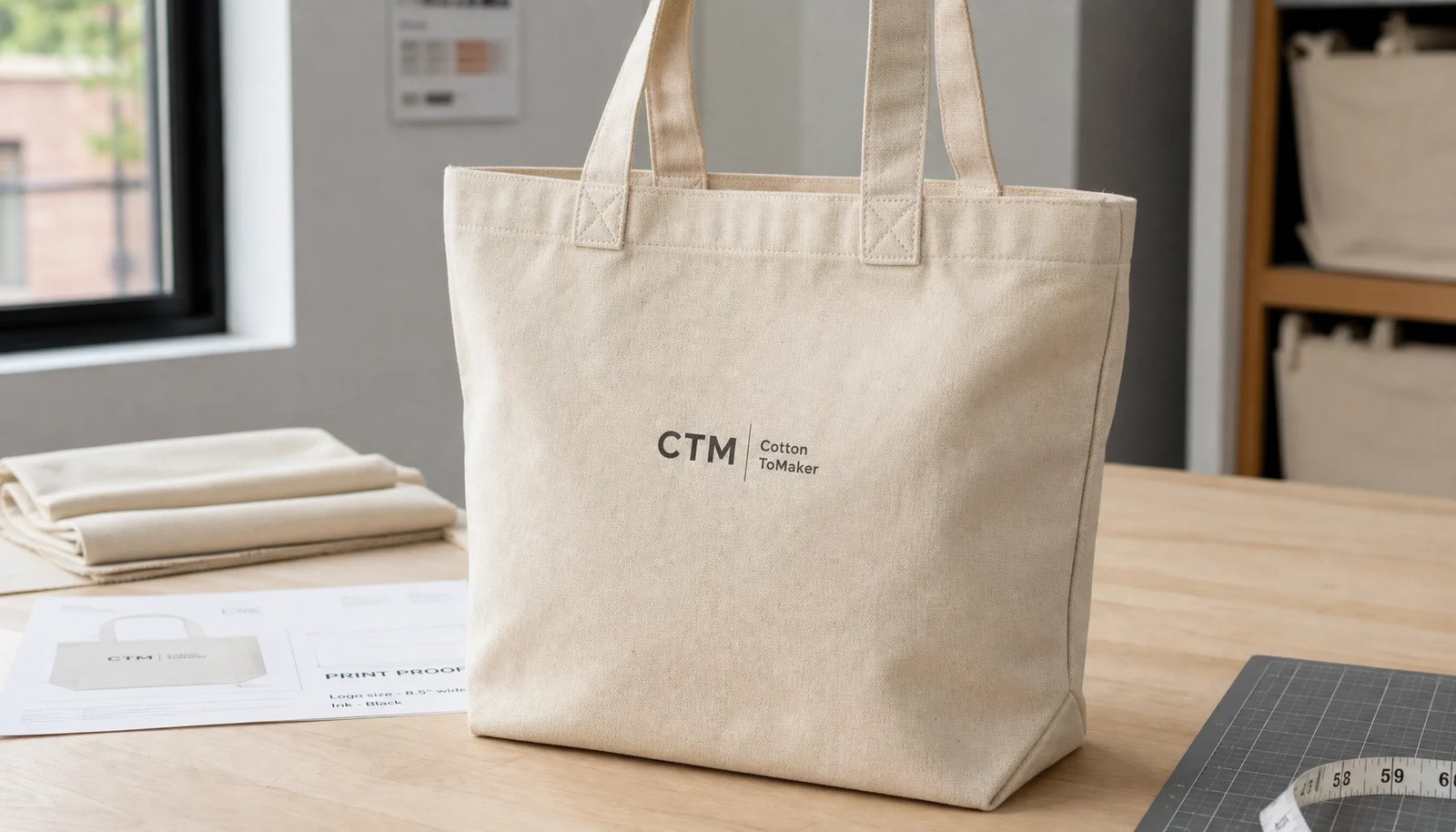
The Proofing Problem Bookstore Buyers Need to Control
Custom canvas grocery totes for university bookstores usually look simple on a quote sheet: natural canvas, school logo, reinforced handles, packed in cartons. The production risk is not simple. University marks are controlled assets, bookstore buyers often split orders by campus, department, season, or event, and the tote must work as both a retail product and a useful shopping bag. A poor print proof can create a bag that is technically sewn correctly but commercially unusable because the logo is off-center, the ink is too thin, or the mascot detail closes up on the canvas texture.
The key buying problem is proof approval before mass production. A PDF proof confirms layout; it does not confirm ink behavior on woven canvas. A full pre-production sample confirms the real relationship between fabric weight, panel size, ink opacity, curing, handle placement, gusset shape, and retail packing. For university bookstore programs, the RFQ should make proofing a production gate, not a loose visual courtesy.
- Treat the approved sample as the quality standard, not the website rendering.
- Separate artwork approval from physical print approval because they control different risks.
- Require proof photos with measurement tape visible for logo size and placement.
- Do not release bulk printing until fabric color, ink color, print size, and handle style are locked.
Choose Canvas Weight Before Discussing Print
For grocery totes, canvas weight affects cost, print surface, standing shape, carton weight, and customer perception. A common working range is 10 oz to 12 oz cotton canvas, roughly 340 to 407 GSM depending on yarn and finishing. An 8 oz canvas can work for lower-cost event bags, but it may collapse more easily and show more print distortion when the bag is loaded. A 14 oz canvas feels premium but raises material cost, sewing resistance, shipping weight, and sometimes lead time if the fabric is not a regular stock item.
Buyers should not compare supplier quotes unless the canvas basis is clear. Some suppliers quote by ounce, some by GSM, and some use a local fabric code. If one quote uses 10 oz natural canvas and another uses 12 oz washed canvas, the cheaper price may not be a better deal; it may be a different product. The RFQ should state fabric weight, color, finish, and acceptable variance so the factory can price honestly and the buyer can compare offers without guessing.
- 10 oz canvas: balanced option for bookstore retail totes and event resale.
- 12 oz canvas: better structure for heavy books, apparel bundles, and premium campus merchandise.
- Natural canvas: lower dye cost but visible seed flecks can affect light-color print appearance.
- Dyed canvas: stronger shelf color story but requires colorfastness and shade-lot control.
Bag Construction Changes Print Accuracy
A grocery tote is not just a larger flat tote. The gusset, boxed bottom, side seams, and handle reinforcement all affect the printable area. If the logo is placed too close to the side seam or bottom fold, the print can curve once the bag is opened. If the handle stitch box falls into the print zone, the operator must either move the print down or risk printing over uneven fabric. Good proofing starts with a bag pattern that gives the logo enough clear panel space.
For university bookstores, the bag often carries textbooks, notebooks, drink bottles, apparel, and gifts. Handle length and reinforcement matter as much as the front logo. A handle that looks fine on a flat photo may feel too short over a winter coat or too long for counter display. The RFQ should state handle drop, handle width, reinforcement pattern, and load expectation so suppliers do not substitute a promotional-tote construction for a grocery-tote use case.
- Define front print zone after gusset and seam allowance are considered.
- Use cross-stitch or box-stitch reinforcement when bags may carry books or heavier merchandise.
- Confirm handle drop for hand carry, shoulder carry, or both.
- Avoid print placement that crosses folds unless the design is intentionally built for it.
Screen Print, Transfer, or Digital Print
Screen printing is usually the most practical method for custom canvas grocery totes when the university artwork uses solid colors, bold marks, and repeat quantity. It gives good opacity on natural canvas, predictable unit cost at volume, and a durable hand feel when the ink is matched to the fabric. For a one-color bookstore logo or two-color mascot mark, screen print is normally easier to control than digital print.
Heat transfer and digital printing have their place. Transfers may help when a logo has gradients, small text, or many colors in a small quantity, but the hand feel can be heavier and edge durability needs review. DTG-style output can show detail, but canvas texture, pretreatment, and color management create variation. A buyer comparing quotes should require each supplier to identify the print method, not just write custom logo printing.
- Use screen print for solid logos, mascots, bookstore names, and repeat programs.
- Use transfer only when artwork complexity justifies the extra feel and durability review.
- Avoid tiny legal text on coarse canvas unless the supplier confirms minimum readable line thickness.
- Confirm whether the quoted price includes each screen, setup, and color change.
Proofing Artwork Without Losing Brand Control
University artwork usually comes with brand rules, licensing approvals, or department-level signoff. The factory should receive vector artwork, Pantone references, final print size, and placement instructions. Raster images pulled from a website should not be used for production proofing. If the bookstore uses multiple marks, each artwork version should have its own proof file and SKU reference to prevent mixed packing or wrong-logo cartons.
A practical proofing sequence is PDF layout first, printed fabric strike-off second, and full pre-production sample third when the order is large or brand-sensitive. The PDF catches spelling, size, and layout. The strike-off catches ink color and edge behavior on actual fabric. The full sample catches construction, print placement, handle length, and packing. Skipping steps may save days at the start but can add weeks if bulk printing has to be stopped or reworked.
- Use AI, EPS, PDF, or SVG vector files for logos and mascots.
- Name each artwork file with campus, department, colorway, and version date.
- Lock the print size in real dimensions, not only as a percentage of the bag panel.
- Keep a signed or emailed approval record for every logo version before bulk production.
Acceptance Criteria for the Print Proof
A useful print proof needs measurable acceptance criteria. Buyers should define print placement tolerance, color reference, ink coverage, registration, edge sharpness, and curing performance. For example, print placement may be allowed within 5 mm from the approved position for normal tote production, while premium retail programs may require tighter control. If the tolerance is not written, the final inspection becomes an argument instead of a decision.
Canvas is a woven surface, so buyers should allow realistic behavior while rejecting preventable defects. Tiny gaps from yarn texture are different from poor ink coverage. Slight shade difference from natural cotton flecks is different from the wrong Pantone mix. The best approach is to approve a physical standard sample and then define what is unacceptable in bulk: smudges, pinholes larger than the agreed limit, visible misregistration, tacky ink, or odor from under-curing.
- Print placement: measure from top edge and side seam using the same reference points each time.
- Color: compare to Pantone or approved sample under consistent light, not warehouse shadow.
- Coverage: reject obvious thin ink, patchy fill, and visible streaking on solid logo areas.
- Curing: reject tacky print, strong solvent odor, or ink transfer during basic rub testing.
MOQ and Cost Drivers Behind the Quote
MOQ for canvas grocery totes is driven by fabric procurement, cutting efficiency, sewing line setup, printing setup, and packing labor. A supplier may offer a low MOQ for a standard natural canvas body but need higher quantity for dyed canvas, custom handle color, custom size, or multiple logo versions. Buyers should understand whether the MOQ is per total order, per artwork, per fabric color, or per SKU.
Print proofing also affects cost. One-color screen print has a setup charge but efficient bulk cost. Multi-color logos require separate screens, registration time, and more waste during setup. Retail packing, hangtags, barcode labels, and individual polybags add labor and carton volume. A clear quote should break out these items so the procurement team can decide where quality matters and where specification changes can reduce landed cost.
- Lowest unit price usually comes from one fabric color, one logo, one print position, and bulk packing.
- Multiple campus logos should be quoted as artwork splits, not hidden inside one average price.
- Custom dyed canvas needs shade approval and may carry higher MOQ than natural canvas.
- Retail-ready packing changes labor time, carton cube, and inspection complexity.
Sample Approval Workflow That Prevents Rework
A good sample workflow starts with a blank reference sample if the buyer is choosing size and construction, then a print strike-off if color or artwork detail is uncertain, then a full pre-production sample for final approval. The blank sample helps the bookstore judge capacity, handle drop, and shelf presentation. The strike-off helps brand teams judge ink. The full sample proves that the real tote and real print work together.
Procurement teams should budget enough time for sample shipping and feedback loops. A rushed sample approval often creates vague comments such as make logo bigger or improve color, which are not production instructions. Better feedback states the requested print width, the exact color reference, the target placement, and whether the current sample is rejected, conditionally approved, or approved for bulk. Factories can act on measurable corrections; they cannot reliably act on subjective comments alone.
- Blank sample approval: size, gusset, handle, fabric weight, sewing, and overall feel.
- Strike-off approval: ink color, opacity, line detail, and rub behavior on actual fabric.
- Pre-production sample approval: final artwork, placement, construction, labels, and packing.
- Approval record: photos, measurements, comments, date, version number, and responsible approver.
Packing Choices for Bookstore and Distribution Use
Packing should match how the totes will be used. For retail sales inside a university bookstore, buyers may need hangtags, belly bands, barcode stickers, price labels, or a clean fold that sits well on shelf fixtures. For orientation kits or event giveaways, bulk packing can reduce cost and make unpacking faster. For distributor programs, carton marks and SKU separation are often more important than individual presentation.
Packing decisions affect landed cost more than many buyers expect. Individual polybags can increase carton cube and create sustainability concerns for campus programs. Belly bands look cleaner but require stable folding and extra labor. Bulk packing lowers material cost but can cause creasing or mixed-logo confusion if the carton plan is weak. The RFQ should request carton dimensions, gross weight, quantity per carton, and packing photos before shipment.
- Retail packing: hangtag, barcode, consistent fold, clean visible logo, and SKU separation.
- Event packing: bulk carton, easy count, minimal packaging waste, and fast distribution.
- Distributor packing: accurate carton marks, PO references, logo version, and destination code.
- Freight planning: carton cube and weight should be available before final shipping quote.
Lead Time Risks in Printed Tote Production
Lead time should be counted from complete approval, not from the first RFQ email. The factory cannot responsibly start bulk production until fabric, artwork, sample, packing, and deposit or payment terms are finalized. For canvas grocery totes, the schedule may include fabric preparation, cutting, sewing, printing, curing, trimming, QC, packing, and export booking. If the order uses dyed canvas or many artwork versions, the timeline needs more control points.
University bookstore calendars create hard deadlines: back-to-school, orientation, alumni weekend, graduation, homecoming, and holiday retail. Missing these windows can turn a good product into dead stock. Buyers should build a reverse schedule from the in-store date, including sample transit, approval time, production, inspection, freight, customs, delivery appointment, and internal receiving. Air freight can rescue time but may destroy margin on bulky canvas totes.
- Do not quote production lead time without stating the approval trigger.
- Add buffer for artwork licensing review if the mark is controlled by a university office.
- Reserve extra time for dyed fabric, multiple logo splits, or retail packing.
- Plan freight using carton cube because totes can be bulky even when unit weight is modest.
Specification comparison for buyers
| Spec decision | Recommended option | When it fits | Buyer risk to check |
|---|---|---|---|
| Fabric weight | 10 oz or 12 oz cotton canvas, about 340-407 GSM | Reusable grocery-style totes sold or issued during campus events where the bag must stand up to books, apparel, and drinkware | Too light a fabric can distort under ink pressure and make the printed school mark look wavy after loading |
| Bag construction | Boxed bottom with side gusset and reinforced handle stitching | Bookstore shoppers need capacity for textbooks, hoodies, gifts, and convenience items | Flat totes may quote cheaper but reduce usable volume and increase seam strain at the bottom corners |
| Print method | Screen print for solid university marks; heat transfer only for complex gradients or small runs | Most bookstore logos, mascots, and department marks use spot colors and need durable shelf-ready output | Digital-looking proofs may not match production screen ink opacity on natural canvas |
| Ink system | Water-based or low-odor pigment ink with tested rub resistance | Retail environments where bags touch apparel, paper goods, and customer clothing | Untested ink can crock on dark apparel or look dull after curing if the canvas has heavy sizing |
| Proof approval stage | Pre-production sample with actual fabric, actual ink, and actual logo size | Orders using official university artwork, licensed marks, or strict brand color standards | Paper proofs alone do not prove registration, ink coverage, shrinkage, or edge sharpness on woven canvas |
| MOQ logic | One base MOQ for the bag body plus colorway or artwork split minimums | Bookstores ordering multiple campus marks, department logos, or orientation variants | A low headline MOQ may become expensive when each artwork version needs separate screens, setup, and packing |
| Packing format | Individual hangtag or belly band if retail; bulk carton if event distribution | Bookstore shelf sales need barcode handling, while welcome kits need fast unpacking | Retail packing added late can change carton count, labor time, and landed cost |
| Inspection threshold | AQL-style final check plus print position tolerance and rub test defined in the PO | Importers and distributors managing licensed university programs across multiple stores | Generic inspection may pass sewing quality but miss logo placement, color drift, or carton label errors |
Buyer checklist before sampling
- Define final bag size as width x height x gusset, not only flat panel dimensions.
- State canvas weight in oz and approximate GSM, with acceptable tolerance if the mill lot changes.
- Send vector artwork with Pantone or brand color references and confirm print size in centimeters or inches.
- Approve one physical pre-production sample made with actual canvas, ink, handle length, and packing style.
- Set print placement tolerance, color tolerance, rub resistance, and registration requirements before deposit.
- Confirm whether each logo version needs its own screen charge, MOQ, inner packing, barcode, and carton mark.
- Require packed carton dimensions, gross weight, units per carton, and pallet suitability before booking freight.
- Keep one signed sample or approved photo set as the reference standard for bulk inspection.
Factory quote questions to send
- What canvas weight, yarn count, and approximate GSM are included in this quote, and is it greige, bleached, dyed, or washed?
- Is the quoted print method screen print, heat transfer, DTG, or another process, and how many colors are included?
- What is the maximum print area on the grocery tote before distortion or seam interference becomes a risk?
- Are screen charges, artwork separation, sampling, hangtags, barcodes, and retail packing included or listed separately?
- What MOQ applies per bag size, fabric color, logo design, print color, and shipping carton configuration?
- What physical sample options are available: blank sample, strike-off print panel, or full pre-production sample?
- What lead time applies after artwork approval, sample approval, deposit, and final packing confirmation?
- What QC evidence will be supplied before shipment: measurement report, print photos, carton photos, rub test, or inspection report?
- What carton size, carton weight, and units per carton are assumed in the quote for sea or air freight comparison?
Quality-control points to confirm
- Fabric weight should be verified by cutting and weighing a known area or by supplier mill report cross-check.
- Finished bag dimensions should stay within agreed tolerance after sewing, pressing, and packing.
- Print position should be measured from top edge and side seam, not judged by eye only.
- Pantone or approved color reference should be checked under consistent lighting before bulk printing continues.
- Rub resistance should be tested dry and lightly damp, especially on dark or saturated print colors.
- Handle reinforcement should pass load testing for the intended bookstore merchandise weight.
- Carton labels should match SKU, logo version, quantity, PO number, and destination routing requirements.
- Random cartons should be opened before shipment to verify packing style, count, odor, moisture, and mixed-logo accuracy.