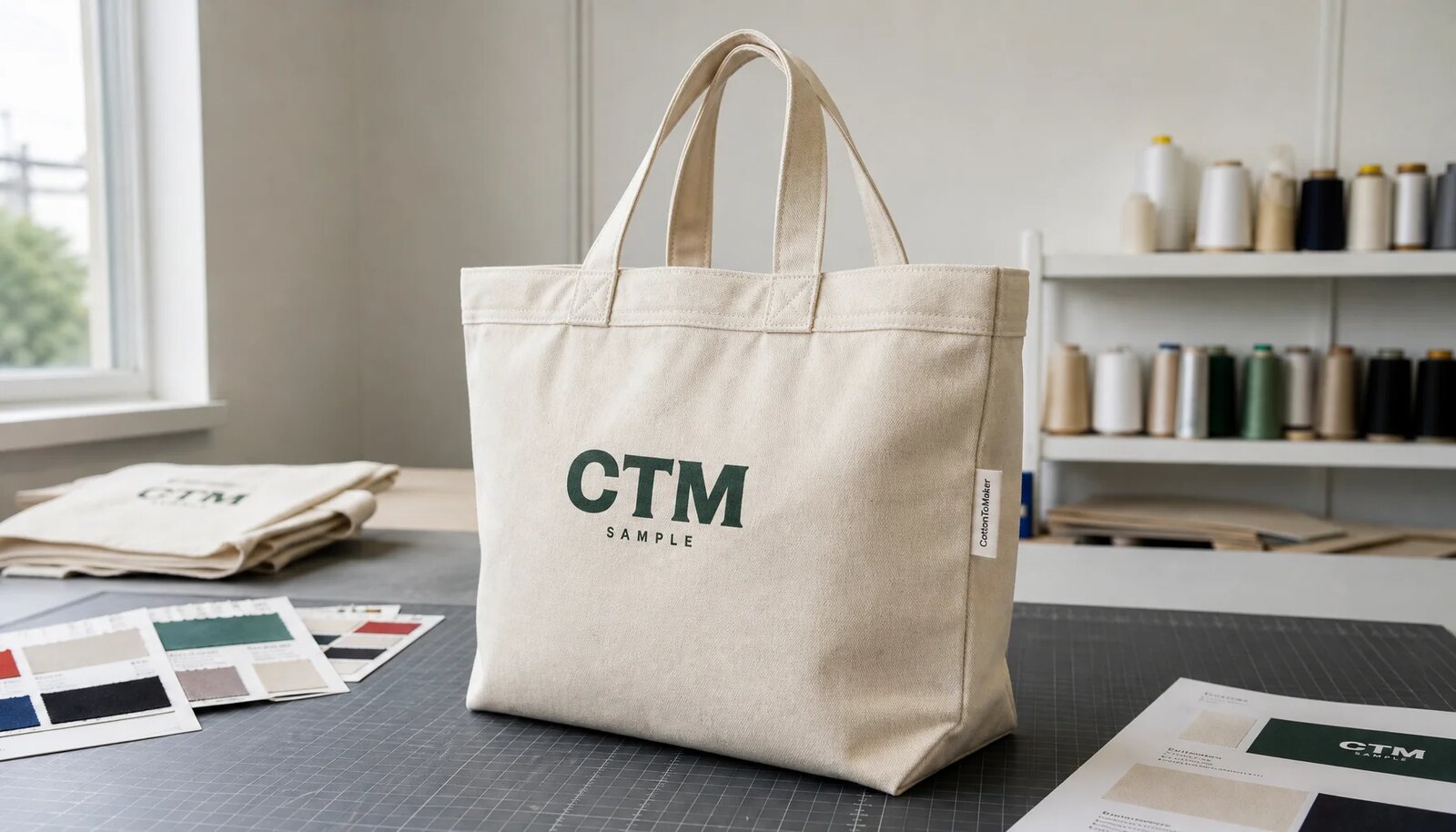
Start With the Hotel Retail Use Case
A custom canvas grocery tote for hotel retail has to do more than hold a logo. It may sit on a boutique shelf beside spa products, carry wine and snacks from a resort market, support a welcome-gift program, or become a paid souvenir guests take home. Those jobs look similar in a mockup, but they call for different decisions in fabric weight, gusset depth, handle length, print size, folding, and packing.
Procurement should define the use case before artwork is approved. A paid retail tote normally needs cleaner shelf presentation and tighter print control than an amenity bag. A grocery-style carrier for bottled drinks, packaged food, towels, or books needs more attention to handle reinforcement and bottom construction than a tote used for brochures. If the order will repeat across several properties, the base specification also has to be easy to reorder without re-solving every detail.
The avoidable mistake is letting the logo lead the project. A mark that looks centered on a flat digital visual may sit too low after a boxed bottom is formed. A destination map can lose detail on heavy natural canvas. A large solid print may feel stiff or crease where the bag is folded. Before screens, transfers, or bulk fabric are ordered, connect the graphic layout to finished measurements, gusset shape, handle position, shelf display, and the way a guest will actually use the bag.
- For grocery-style hotel retail, common finished dimensions are around 38-42 cm wide by 35-40 cm high with a 5-10 cm gusset.
- For shoulder carry, handle length is often about 55-65 cm measured end to end; for hand carry, 35-45 cm may be enough.
- For paid retail display, a boxed bottom and consistent folding can improve shelf presence versus a flat promotional tote.
- For bottled water, pantry items, towels, or books, handle reinforcement is usually more important than adding another print color.
- For multi-property programs, standardize the base tote first and vary only approved artwork when possible.
Write the Tote Specification Like a Buyer, Not a Brief
An RFQ that says custom canvas grocery tote with logo leaves too many decisions open. One supplier may quote light cotton with a flat bottom. Another may quote 12 oz canvas with a gusset, reinforced handles, and retail labeling. The unit prices will not mean much because the products are not the same. A factory-ready specification should state fabric weight, fiber content, color, finished dimensions, gusset, handle construction, stitch type, print method, print size, label requirements, packing, inspection level, and trade terms.
Finished measurements need special care. Cutting size is not finished size. Seam allowance, top hem, gusset formation, pressing, and fabric behavior all affect the final tote. If the buyer needs a 40 cm wide bag, the PO should say whether that means flat top width, visible front panel width, or width when the gusset is opened. For handles, specify either total handle length from stitch point to stitch point or loop drop from the top edge. Do not rely on a photo with arrows unless the measurement method is written.
Tolerances belong in the specification, not in a late inspection email. For many canvas tote programs, practical starting points are body width and height around +/-1 cm, gusset around +/-0.5 cm, handle length around +/-1 cm, and print placement around +/-0.5-1 cm. Tighter targets may be possible, especially for brand-standard hotel groups, but they can increase sorting and cost. Agree them before quoting so the supplier can price the real job.
- State finished size as width x height x gusset, and define the measurement points clearly.
- Specify top hem depth, seam type, stitch density expectation, thread color, and handle reinforcement style.
- List all branding elements: front print, back print, woven label, care label, hangtag, barcode sticker, and carton mark.
- Define tolerances in the PO instead of relying on subjective approval language.
- Keep one signed pre-production sample and one approved strike-off as the physical standard for bulk inspection.
Select Canvas Weight, Fiber, and Finish
Canvas weight should be written in both ounces and GSM because suppliers and buyers may use different shorthand. For paid hotel retail grocery totes, 10 oz to 12 oz cotton canvas, roughly 280-340 GSM, is often a useful range. It feels more substantial than light promotional fabric while staying manageable for sewing, folding, carton weight, and freight. Lighter 6 oz to 8 oz canvas can work for amenity packaging or event distribution, but it may look thin under boutique lighting and carry less perceived retail value.
Heavier is not automatically safer. A 14 oz fabric can feel premium and stand better, but it also raises material cost, carton gross weight, needle stress, and folding stiffness. It can change the print too. A thick or slubby weave softens edges, drinks more ink, and may make large solid artwork feel heavy under the hand. That is why the proof must be printed on the actual fabric weight and color, not on whatever canvas is easiest for the factory to sample.
Finish and claims matter as much as weight. Natural unbleached cotton may show seed specks and shade variation, which can suit an eco-retail look. The same features may be unacceptable for a luxury logo program that expects a cleaner panel. Bleached or dyed canvas can look more controlled, but dye lot variation, rubbing behavior, and print contrast need review. If the order references organic cotton, recycled cotton, or a certification, ask for documentation and chain-of-custody details instead of accepting a broad sustainability claim.
- 6 oz to 8 oz canvas: useful for light use, amenity packaging, or budget programs, but less retail-weight in appearance.
- 10 oz canvas: balanced option for many hotel grocery totes where structure, printability, and cost must stay controlled.
- 12 oz canvas: stronger hand and shelf presence, with higher material cost and carton weight.
- 14 oz and above: premium and sturdy, but may be overbuilt for grocery tote orders and harder to fold flat.
- Dyed canvas: helpful for brand color stories, but confirm dye lot consistency, rubbing risk, and print contrast before approval.
Translate Brand Artwork for Canvas Printing
Hotel brand teams often send polished logo files, but factories need production instructions. A complete art pack should include editable vector artwork, Pantone references, final print dimensions, exact placement, color count, orientation, and clear-space rules. If the design includes small copy, fine strokes, halftones, gradients, metallic effects, or reversed details, flag them before the supplier confirms the print method and price.
Canvas is not paper. It has texture, absorbency, slubs, and shade variation. A thin serif font that looks elegant in a PDF may weaken on 12 oz canvas. Pale ink can disappear on unbleached cotton. A large dark block may create a stiff panel and show fold marks after packing. The artwork review should ask whether the design will reproduce well on the chosen fabric, not simply whether the file is high resolution.
The approval record should be clear enough for a different buyer to manage a reorder months later. Name each ink color. State whether the artwork is centered on the flat panel or on the visible front face when the gusset is opened. Record whether some fabric texture showing through the ink is acceptable. Keep the final art file name, approved strike-off date, and sample reference number in the sourcing file so replenishment orders do not depend on memory.
- Provide AI, EPS, SVG, or editable PDF files when possible; raster artwork should be reviewed for resolution and scaling risk.
- Specify print size in centimeters or inches, not only as a percentage on a visual mockup.
- Confirm whether placement is measured from the top opening, side seam, center line, or bottom gusset seam.
- Ask the supplier to identify strokes, reversed text, gradients, or small details that may not reproduce cleanly.
- Archive approved artwork, Pantone references, strike-off photos, and the physical sample with the purchase order.
Choose the Print Method by Artwork Risk
Screen printing remains the dependable choice for many custom canvas grocery totes. It works well for solid hotel logos, one-color destination graphics, and simple two- or three-color artwork. Still, it has limits. Before proofing, ask the supplier to confirm minimum line thickness, smallest readable text size, registration tolerance for multiple colors, and whether an underbase is needed on dyed canvas.
Heat transfer, digital print, and embroidery can be useful, but they change the product. Heat transfer can reproduce detailed graphics and gradients, yet a large transfer may feel less natural on a canvas grocery tote and may not match the soft retail hand expected in a hotel boutique. Digital direct printing can support many colors, but color strength, pretreatment, rub performance, and repeat consistency should be tested. Embroidery gives a premium signal for small crests or monograms, but it becomes costly and heavy for large front-panel artwork.
The supplier should recommend the method after reviewing the artwork, fabric color, canvas weight, target quantity, and retail expectation. A simple resort mark may be best as screen print. A complex illustrated map may need simplification or transfer testing. A small crest near the top hem may be better embroidered if the budget supports it. The proofing record should state the selected method and the limitations the buyer has accepted.
- Use screen print for bold logos, solid fills, limited color counts, and repeat orders where consistency matters.
- Use heat transfer for detailed graphics only after checking hand feel, edge durability, folding, blocking, and surface appearance.
- Use digital print when many colors are required, but approve a fabric proof for color strength and texture interaction.
- Use embroidery for small premium marks, not large grocery tote panels with dense filled artwork.
- Avoid approving fine strokes or reversed copy until the supplier confirms practical limits on the selected canvas.
Run Proofing in the Right Order
A good proofing process has more than a digital mockup. The digital layout confirms position, scale, and visual balance. The physical strike-off confirms ink behavior on the selected fabric. The pre-production sample confirms the full product: fabric, sewing, handles, labels, folding, and packing. For hotel retail orders, the safer sequence is artwork review, digital layout, physical strike-off, pre-production sample, written approval, then bulk production.
Each proof has a job. The digital layout should approve print size and placement. The strike-off should approve color, coverage, sharpness, registration, and hand feel. The pre-production sample should approve measurements, construction, handles, labels, accessories, barcode, folding, and packing. When these approvals get mixed together, confusion follows. A supplier may think the print is approved while the brand team is still debating placement, or a buyer may approve a construction sample without noticing that the fabric for bulk has not been confirmed.
Approval comments should be measurable. Instead of saying make the logo more premium, write increase logo height from 16 cm to 18 cm, move print 2 cm higher, reduce ink deposit to improve hand feel, or match strike-off option B under D65 light. Date every approval and link it to a physical or digital reference. On repeat orders, this record becomes the standard, which is far more reliable than old phone photos or verbal notes.
- Digital layout should show finished bag size, gusset direction, handle position, print dimensions, and placement measurements.
- Strike-off should use the same fabric color, weight, surface finish, and print method as bulk production.
- Pre-production sample should include actual stitching, handles, labels, hangtag, barcode, folding, and packing where possible.
- Written approvals should state exactly what is approved and list any remaining corrections before bulk.
- Bulk production should not start until both appearance and measurable tolerances are approved.
Define Color, Placement, and Print Tolerances
Pantone references help, but they are not a complete color standard for canvas. Pantone books are printed on paper. Cotton canvas has texture, absorbency, and natural shade variation. A hotel brand green may look darker on unbleached cotton than it does on coated paper. A white logo may need a heavier ink deposit or an underbase on dyed canvas. The approved physical strike-off should become the working color standard for bulk production.
Placement needs the same discipline. A logo centered by eye can drift once cutting variation, sewing tolerance, gusset formation, and handle alignment change the visible front panel. For retail totes, the buyer should specify print location from stable reference points such as the top edge, side seam, center line, or bottom gusset seam. If the tote has a boxed bottom, confirm whether the art is centered on the flat bag or centered on the visible face when filled.
Acceptance criteria should balance brand needs with textile reality. A strict hotel group program may require tighter placement and color control. A casual destination tote may accept more variation from natural fabric. Either way, set the limit before production starts. If the standard is not written, final inspection becomes a debate about taste rather than a check against agreed requirements.
- Common print placement tolerance is about +/-0.5-1 cm, depending on print size, panel shape, and construction.
- Color should be compared with the approved strike-off under agreed lighting such as D65 or TL84, not from phone photos.
- Multi-color registration tolerance should be stated around outlines, small text, and layered artwork.
- Large solid prints should be reviewed for pinholes, uneven ink, tackiness, odor, cracking risk, and hand feel.
- For repeat orders, keep one approved strike-off and one sealed pre-production sample as reference standards.
Compare Quotes Beyond Unit Price
MOQ is not only the total number of totes. A factory calculates efficiency by fabric color, fabric purchasing quantity, cutting plan, bag size, print setup, sewing line changeover, label type, and packing method. A 3,000-piece order split into six property-specific designs may be less efficient than a 3,000-piece order with one base tote and two print designs. That is why two suppliers can quote very different prices for what appears to be the same volume.
For hotel groups, distributors, and resort retail buyers, the easiest way to reduce MOQ pressure is to standardize the base construction. Keep the same canvas weight, body dimensions, handle length, handle material, label position, and packing format. Then vary only the approved front artwork by property or season. If every location asks for a different body color, handle color, woven label, hangtag, and routing format, the order becomes many small runs and the unit price rises.
A useful quote exposes the cost drivers. Ask for price breaks at realistic volumes such as 500, 1,000, 2,500, and 5,000 pieces if those quantities match the buying plan. Ask whether multiple property designs can share one fabric lot and sewing run. Ask whether screen charges are one-time, repeated, or discounted for replenishment. Separate sample, strike-off, courier, testing, inspection, labeling, and special packing charges from the unit price so landed-cost comparison is fair.
- Request MOQ by fabric color, print design, bag size, label type, and packing style, not only one total MOQ.
- Ask whether property designs can be combined to share fabric purchasing, cutting, sewing, and export packing.
- Separate one-time screen, sample, artwork, testing, inspection, and courier charges from the unit price.
- Confirm whether repeat orders can use saved patterns, stored screens, and approved standards to reduce setup time.
- Compare trade terms such as EXW, FOB, CIF, DAP, or DDP on the same basis before awarding the order.
Inspect the Pre-Production Sample as a Contract Sample
The pre-production sample should be treated as a contract sample, not a sales presentation. It should represent the actual fabric, print method, stitching, labels, accessories, folding, and packing that the factory will use for bulk. If the sample is made from available fabric only to save time, mark it clearly as a fit sample, construction sample, or color reference. Do not let it become final approval by accident.
Sample review should separate appearance from function. Appearance includes logo color, print sharpness, fabric shade, label position, folded presentation, and overall retail look. Function includes handle strength, seam security, load behavior, bottom shape, folding, carton fit, and barcode scanning if used. A hotel retail tote can look good on a desk and still fail once a guest fills it with water bottles, snacks, towels, books, or spa products.
Keep a signed sample record. Photograph the tote front, back, inside, handles, gusset, label, print close-up, hangtag, barcode, and packing. Measure the sample and record any approved deviations. If the supplier is allowed to change one element for bulk, such as improving the green ink or replacing a temporary hangtag, write that clearly. The inspection team should know exactly what to compare and which changes were authorized.
- Measure finished width, height, gusset, top hem, handle length, handle width, and print placement against the spec sheet.
- Inspect stress points for skipped stitches, broken thread, loose bartacks, weak reinforcement, or fabric tearing.
- Fold the tote exactly as packed to see whether the print cracks, transfers, blocks, or creases badly.
- Place representative hotel retail products inside to judge capacity, balance, handle comfort, and bottom shape.
- Scan barcodes or retail labels if goods will ship directly to a hotel shop, warehouse, or fulfillment center.
- Photograph, sign, date, and store the approved sample for final inspection and replenishment comparison.
Control Bulk QC, Packing, and Shipment Readiness
Final inspection should be based on the purchase order, approved strike-off, approved pre-production sample, and written tolerances. It should not be a general visual review only. For canvas grocery totes, useful checks include fabric GSM, shade, finished measurements, print placement, print color, registration, ink coverage, seam security, handle reinforcement, loose threads, contamination, carton quantity, carton marks, and packing format.
Functional checks should be agreed before production. A handle pull or load check needs to reflect the intended use of the bag, not an arbitrary number. If the tote is sold for grocery-style hotel retail, the supplier should understand the expected product mix: bottled drinks, packaged food, towels, books, or retail gifts. The check can then focus on handle attachment, seam strength, and bottom construction. If the buyer has a formal test standard, name it in the PO. If not, write an internal check method that is repeatable.
Packing affects both retail presentation and landed cost. Flat bulk packing is usually economical for canvas grocery totes, especially when the hotel or distributor will unpack and display them. Individual polybags protect against dirt and moisture, but they add material cost, labor, volume, and plastic. Paper belly bands, hangtags, or barcode stickers may be a better fit for hotel retail, but they still need proofing for placement, durability, and scan readability. Request carton dimensions, gross weight, net weight, pieces per carton, and carton marks before shipment booking so receiving teams and freight planners are not surprised.
- Verify fabric GSM, finished dimensions, handle length, gusset depth, and print placement against the written tolerance table.
- Check print cure and rub behavior according to the ink system, especially for dark inks and large solid areas.
- Inspect handles with the agreed reinforcement and pull/load method before cartons are sealed.
- Confirm carton count, pieces per carton, carton dimensions, gross weight, net weight, carton marks, and destination labels.
- Check whether fold lines cross the printed logo and whether packing creates unacceptable creasing, odor, blocking, or contamination.
- Confirm barcode readability, hangtag placement, and retail labels before goods ship directly to hotel properties or warehouses.
Specification comparison for buyers
| Spec decision | Recommended option | When it fits | Buyer risk to check |
|---|---|---|---|
| Canvas body weight | 10 oz to 12 oz cotton canvas, approximately 280-340 GSM; write the accepted GSM tolerance, often +/-5% unless both sides agree otherwise | Paid hotel retail totes used for packaged food, bottled water, towels, spa items, books, souvenirs, or resort market purchases | Low GSM can look thin under boutique lighting; high GSM increases carton weight, changes print hand feel, and may require stronger sewing needles |
| Bag construction | Boxed bottom with 5-10 cm gusset, turned top hem, lockstitch seams, and reinforced handle attachment | Hotel shops, resort markets, pantry retail, welcome-gift programs, boutique merchandise, and property-level replenishment | Flat totes cost less but may not stand well, can distort the logo when filled, and may feel promotional instead of retail |
| Handle setup | Self-fabric or cotton webbing handles; 55-65 cm total length for shoulder carry or 35-45 cm for hand carry; 2.5-4 cm width is common | Guests carrying purchases around the property, to the beach, between rooms, or during travel | Handles that are too short reduce reuse; weak box stitch, X stitch, or bartack reinforcement can fail pull checks and create returns |
| Print method | Screen print for 1-3 solid colors; heat transfer or digital print only after testing detailed artwork on the selected canvas | Hotel logos, destination marks, resort maps, seasonal retail graphics, and simple branded artwork | Fine lines can fill in on canvas; large transfers may feel plastic; digital color strength can vary on natural cotton |
| Print proof type | Digital layout plus physical strike-off on actual fabric, followed by a pre-production sample before bulk approval | Orders with brand color requirements, paid retail presentation, multi-property programs, or repeat replenishment | Digital mockups do not show ink absorption, fabric shade, color shift, edge sharpness, curing, folding, or real placement after sewing |
| Color control | Pantone reference plus approved fabric strike-off reviewed under D65, TL84, or another agreed light source | Hotel groups with brand standards, regional property programs, and repeat orders across seasons | Pantone on paper rarely matches untreated canvas without ink adjustment; phone photos and mixed warehouse lighting are not reliable approval tools |
| Dimensional tolerance | Finished body width/height typically +/-1 cm; gusset +/-0.5 cm; handle length +/-1 cm; print placement commonly +/-0.5-1 cm | B2B orders where fit, retail display, and repeatability matter | Without written tolerances, inspection becomes subjective and disputes are harder to resolve |
| MOQ logic | Standardize one base tote and vary print artwork where possible; confirm MOQ by fabric color, print design, size, label, and packing style | Hotel groups, distributors, resort chains, and retail buyers managing several property designs | Too many body colors, handle colors, labels, or hangtags can push each SKU below efficient MOQ and raise unit cost |
| Packing format | Flat bulk pack in export cartons; add polybag, belly band, hangtag, barcode, or inner carton only when retail or logistics requires it | Back-of-house storage, retail replenishment, property-level distribution, and warehouse receiving | Over-packing increases cost and plastic; under-packing can cause creases, stains, odor, barcode damage, or receiving delays |
Buyer checklist before sampling
- Define the exact tote use case: paid hotel grocery bag, pantry shop carrier, boutique retail item, amenity bag, welcome kit, event merchandise, or multi-property replenishment SKU.
- State the retail position and load expectation, such as light gift packaging, daily grocery use, bottled beverages, towels, books, spa items, or resort souvenirs.
- Specify canvas weight in both oz and GSM, fiber composition, natural or dyed shade, surface treatment, pre-shrunk or non-pre-shrunk status, and any organic or recycled documentation requirement.
- Confirm finished dimensions after sewing and pressing: body width, height, gusset depth, top hem depth, handle length, handle width, seam allowance, and written tolerances.
- Choose construction details before artwork approval: boxed bottom or flat, side seams, bottom seam, top hem, reinforcement stitch type, label placement, and whether the bag must stand when filled.
- Provide vector artwork with Pantone references, final print size, print position, color count, minimum line thickness, reversed text size, and brand clear-space rules.
- Require a digital layout for scale and placement, then a physical strike-off on the approved fabric before approving the pre-production sample.
- Separate approval responsibilities: digital layout approves position, strike-off approves color and print quality, and pre-production sample approves construction, accessories, folding, and packing.
- Set acceptance criteria for print placement, color variation, registration, ink coverage, pinholes, cracking, smudging, odor, tackiness, and visible contamination.
- Ask the supplier to review artwork feasibility on canvas texture, especially fine strokes, small reversed copy, halftones, gradients, metallic inks, and large solid ink areas.
Factory quote questions to send
- What exact canvas weight will you use in oz and GSM, and what tolerance do you apply to bulk fabric GSM?
- Is the fabric washed, pre-shrunk, dyed, bleached, unbleached, organic, recycled, blended, or untreated natural cotton, and what documentation can be provided for any claim?
- What are the finished dimensions after sewing and pressing, including width, height, gusset, handle length, handle width, top hem, seam allowance, and normal tolerance for each measurement?
- What minimum order quantity applies by fabric color, print design, bag size, handle type, label type, and packing style, and how does price change at 500, 1,000, 2,500, and 5,000 pieces?
- Which print method do you recommend for this artwork, and what minimum line thickness, smallest reversed text size, registration limit, or detail limitation should we adjust before proofing?
- Can you provide a physical print strike-off on the same canvas before making the pre-production sample, and is the strike-off cost included or charged separately?
- How will Pantone matching be handled on natural or dyed canvas, and under what lighting should the approved strike-off and bulk goods be compared?
- What tolerance do you apply for bag size, handle length, print placement, print registration, print color variation, and fabric shade variation during bulk production?
- How will handles be reinforced: box stitch, X stitch, bartack, or another method, and what pull/load check can be used for grocery-style hotel retail use?
- What packing method is included in the quote, including pieces per carton, carton dimensions, gross weight, inner protection, hangtag, barcode label, carton marks, and pallet requirements if any?
Quality-control points to confirm
- Fabric GSM should be verified against the approved specification using a measured sample area and agreed tolerance, commonly +/-5% unless a tighter standard is written into the PO.
- Fabric composition, shade, surface treatment, and shrinkage status should match the approved sample and purchase order, especially for natural, dyed, organic, recycled, or pre-shrunk cotton claims.
- Finished tote dimensions should be measured after sewing and pressing, not before cutting; common tolerance is around +/-1 cm for body width/height and handle length unless the design requires tighter control.
- Gusset depth and boxed-bottom shape should be checked at multiple points because poor corner alignment affects capacity, shelf presentation, and how the logo sits when the tote is filled.
- Print position should be measured from agreed reference points such as top opening, side seam, center line, or bottom gusset seam, rather than judged by eye only.
- Print color should be compared with the approved strike-off under agreed lighting; bulk approval should not rely only on phone photos or mixed warehouse lighting.
- Multi-color print registration should be checked at outlines, small copy, and logo edges against the agreed tolerance before accepting the lot.
- Ink coverage should be even on textured canvas, with no major pinholes, smearing, ghosting, color contamination, misregistration, cracked ink, or visible screen marks on the approved viewing side.
- Large solid prints should be checked for hand feel, uneven ink deposit, tackiness, odor, blocking during packing, and cracking after folding.
- Print cure should be checked by the supplier's normal method for the ink system, such as rub resistance, tape pull where appropriate, or fold/crack observation after cooling and packing simulation.