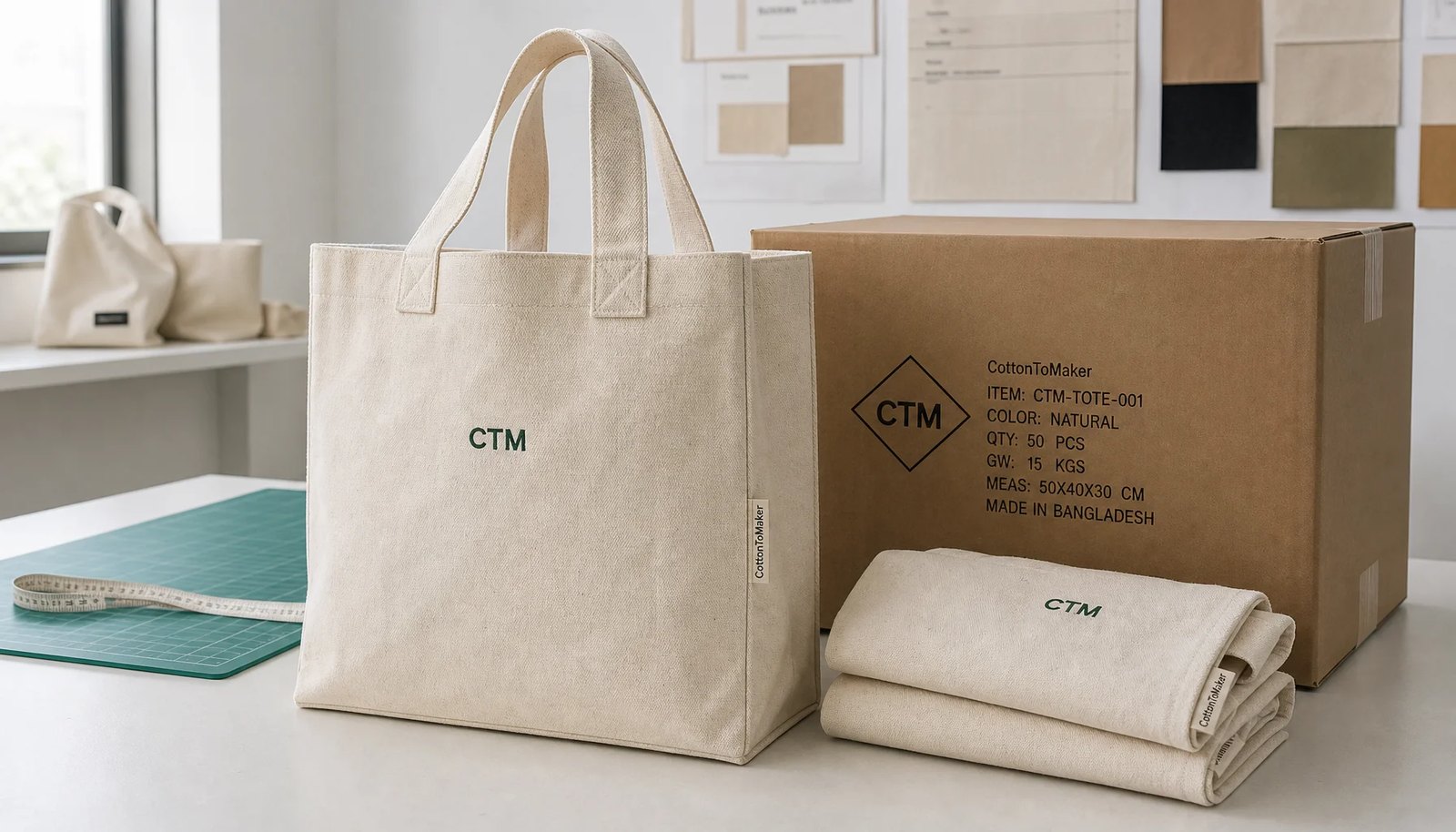
Start With Bookstore Receiving, Not Only the Tote Photo
A custom canvas grocery tote for a university bookstore is both a branded product and an inbound logistics unit. It may be sold at a register, used for grocery checkout, packed into an orientation kit, or distributed by an alumni or campus events team. In each case, the bag must look right, but the cartons must also be easy to receive, count, store, and replenish.
Many RFQs describe the bag clearly and leave packing to the supplier. That can make two quotes look similar when they are not. One factory may assume 100 pcs per carton with tight compression and no inner bundles. Another may quote 50 pcs per carton with bundles of 10 and stronger export cartons. The first unit price may look lower, while the second may reduce damage risk and bookstore labor.
For procurement buyers, the better target is landed cost per usable tote. That includes product price, print setup, carton count, total CBM, freight, handling, receiving time, shortage risk, and the condition of the logo after unpacking.
- Define the use case before quoting: retail sale, checkout use, event distribution, orientation kit, alumni gift, or campus market bag.
- Set a maximum carton gross weight and carton size early, because pieces per carton alone does not control handling risk.
- Use one baseline packing plan when comparing suppliers, then ask for alternate packing options if needed.
- Keep SKUs, artwork versions, and campus destinations separate unless the receiving team approves mixed cartons.
- Treat the fold method, bundle quantity, and carton label as part of the product specification.
Specify the Tote Before You Specify the Carton
The carton plan depends on the tote construction. Fabric weight, gusset depth, boxed bottom, handle material, print area, and hangtag position all change how the bag folds and stacks. A vague request for a canvas grocery tote may produce a flat promotional tote when the bookstore expects a structured shopping bag for books, apparel, snacks, and convenience items.
For many bookstore grocery totes, 10 oz to 12 oz cotton canvas is a practical starting point, roughly 270 to 340 GSM depending on weave and finishing. An 8 oz canvas may suit a low-cost giveaway. A 14 oz canvas can feel more premium, but it increases sewing effort, carton weight, freight volume, and sometimes carton count. These ranges are sourcing references, not universal standards; confirm what each supplier can hold consistently.
A common finished size is about 15 to 16 inches wide and 16 to 17 inches high, with a 4 to 6 inch gusset or boxed bottom. The RFQ should state whether width is measured at the top, across the body panel, or across the expanded bottom. Handle drop should be approved on a physical sample because shoulder comfort is hard to judge from a flat drawing.
- List finished width, height, gusset depth, handle width, handle drop, canvas weight, seam type, and reinforcement method.
- Request both oz and GSM for fabric weight, plus the supplier’s inspection method and tolerance.
- Frame tolerances as agreed commercial specifications, not generic guarantees; many sewn totes use supplier-dependent allowances such as ±5 to ±10 mm.
- Confirm whether the tote must stand, fold flat, hang from a display, or fit into a kit carton.
- Approve the blank tote construction before finalizing carton quantity.
Choose Fabric and Claims Carefully
Fabric choice affects price, lead time, color, print results, and documentation. Natural canvas is often the simplest route and usually has fewer shade approval steps. Bleached canvas provides a cleaner print base but can show dirt during handling. Dyed campus-color canvas may support a stronger retail story, but it requires lab dips, bulk shade approval, and more schedule control.
Recycled cotton, organic cotton, and other sustainability claims should be supported before they appear on hangtags, product pages, or purchase orders. Ask whether documentation applies to raw fiber, yarn, fabric, factory process, or finished goods. If the buyer needs transaction certificates, fiber composition tests, or specific chain-of-custody paperwork, that requirement must be in the RFQ.
University licensing adds another control point. A logo may look acceptable in a digital mockup but fail review because of color, mascot detail, clear space, trademark symbol placement, or tag wording. Assign an artwork code to each campus or department version so samples, strike-offs, inspection reports, carton labels, and invoices are traceable.
- State whether the fabric is natural, bleached, dyed, recycled blend, organic, or conventional cotton.
- Approve dyed fabric with lab dips before bulk fabric purchase where color accuracy matters.
- Ask what documentation supports any recycled, organic, or certified material claim.
- Give each logo, event graphic, department mark, or slogan a unique artwork code.
- Confirm licensing, trademark symbols, hangtag copy, and origin marking before production.
Make Print Approval Physical
Screen printing is usually the cleanest quote basis for one to three spot colors on canvas grocery totes. It works well for university wordmarks, mascots, bookstore slogans, alumni graphics, and event artwork. The RFQ should state print colors, Pantone references, print size, print side, and whether the artwork is centered on the flat panel or the visible panel when the gusset is folded.
Canvas is not a smooth paper surface. Weave texture, slubs, absorbency, and natural shade affect edge sharpness and color appearance. Fine trademark text, thin outlines, and detailed mascot art can break, fill in, or lose definition. A strike-off on actual fabric is therefore an approval step, not a courtesy photo.
Digital transfer, DTG, or heat transfer may be useful for gradients or many colors, but they change handfeel, durability expectations, cost, and sometimes packing behavior. If the print method changes after quotation, require a new sample and revised cost or lead-time confirmation.
- Provide final vector artwork, not only a mockup image.
- Approve print size in inches or centimeters and define placement points from the top edge and side seam.
- Keep fine text and heavy ink areas away from gusset folds and planned carton crease lines when possible.
- Compare bulk print against the approved strike-off on actual fabric.
- Require a new strike-off if fabric shade, ink, print method, artwork scale, or print placement changes.
Plan MOQ by Variant, Not Only by Total Quantity
MOQ is rarely one number for bookstore tote programs. It may be driven by fabric color, handle color, artwork version, label type, hangtag version, barcode format, packing method, and destination. An order for 5,000 natural totes with one print is different from 5,000 totes split across eight campus logos, three tag versions, and separate store labels.
For university systems, a shared blank body is often efficient. Keeping fabric, size, handles, seams, and carton packing the same allows the factory to cut and sew more consistently before separating by print and label. It also simplifies reorders because only the artwork or tag version changes.
Ask where minimums apply before committing to colors and trims. Dyed fabric, custom webbing, woven labels, and printed hangtags may each have separate minimums or setup costs. If a buyer reduces quantity after approving dyed fabric, leftover material liability can become a commercial issue.
- Quote quantity by SKU, artwork, fabric color, handle color, tag version, packing plan, and destination.
- Ask whether MOQ applies per fabric color, logo, label, hangtag, or carton configuration.
- Separate one-time screen or setup charges from reorder unit pricing.
- Use a standard blank tote body when only campus-specific logos change.
- Avoid mixed cartons unless the exact SKU split and label format are approved.
Compare 50 vs 100 Pcs Per Carton Before You Approve Price
A useful carton packing plan for custom canvas grocery totes should include pieces per carton, fold method, inner bundle quantity, bundle material, carton dimensions, gross weight, net weight, total cartons, and total CBM. For canvas grocery totes, 50 to 100 pcs per export carton is common, but the right number depends on construction and receiving limits.
A 50-pc carton is often easier to lift, count, and split across store locations. It may be better for heavier 12 oz to 14 oz totes, bulky handles, boxed bottoms, or retail-ready presentation. The tradeoff is more cartons, more labels, more scans, and possibly more pallet space.
A 100-pc carton can reduce carton count and may work for lighter 8 oz to 10 oz totes or flatter designs. The risks are carton weight, bulging, print creasing, uneven compression, and difficult recounting if bags are loose. Buyers should not approve 100 pcs per carton until actual gross weight, carton size, and post-unpack appearance are acceptable.
- Request 50-pc and 100-pc carton options when both are feasible.
- Compare total CBM, total gross weight, carton count, and receiving labor, not unit price alone.
- Set a practical maximum carton weight based on the receiving site’s handling conditions.
- Check whether a higher count compresses the printed face, handles, hangtags, or boxed bottom.
- Require carton quantities to be verified by physical count and weight reference.
Decide Flat Fold, Half Fold, and Inner Bundles
Fold method affects both freight and presentation. Flat folding usually protects the printed panel and helps staff stack totes for retail sale. It can require a wider carton footprint but may reduce logo creasing. Half folding can reduce carton length, but the fold line must not cut through a thick ink area, center mascot, rigid tag, or boxed bottom seam.
Roll folding is usually less suitable for structured grocery totes because it can distort handles and the bottom shape. If a supplier suggests it for freight savings, ask for unpacking photos and approve it only if the bag returns to a saleable shape.
Inner bundles solve counting and allocation problems. Bundles of 10 are useful for registers, event tables, orientation teams, and department pickups. Bundles of 25 suit larger bookstore receiving where cartons stay mostly intact but still need faster count verification. Paper bands, cotton ties, recycled polybags, or no individual plastic can all work if the buyer accepts the protection level and waste profile.
- Photograph and approve the fold direction before mass packing.
- Avoid fold lines through central logos, thick ink, trademark text, or rigid hangtags.
- Use 10-pc bundles for frequent small allocations and 25-pc bundles for bulk receiving.
- Confirm whether bundle labels are needed for campus, department, or event allocation.
- Specify polybag, paper band, cotton tie, carton liner, or no plastic according to the bookstore’s priorities.
Use Carton Labels as Receiving Instructions
Carton labels are operational instructions. A bookstore shipment may include multiple campuses, artwork versions, price points, and destinations. If labels are generic, receivers must open cartons to identify contents, which slows work and exposes clean totes to dirt, moisture, and misplacement.
A strong master carton label includes PO number, SKU, artwork code, campus or store code, fabric color, bag size, quantity per carton, carton sequence, gross weight, net weight, carton dimensions, and country of origin where required. If the order moves through a 3PL, confirm whether routing codes, pallet IDs, appointment references, SSCC labels, or specific barcode formats are needed.
Retail barcodes and hangtags need the same discipline. If the tote is sold at POS, the barcode must match the SKU in the buyer’s system. If the tote is a giveaway, a retail barcode may not be needed, but bundle labels can still prevent event allocation errors.
- Mark every carton with PO, SKU, artwork code, quantity, carton number, and destination where applicable.
- Use sequential numbering such as 1 of 80, 2 of 80, and 3 of 80 for shortage checks.
- Keep one SKU per carton unless mixed cartons are approved in writing.
- Approve barcode, hangtag, and carton label data against the SKU master before mass packing.
- Include carton label layout in the pre-production or packing-trial approval.
Sample the Bag and the Packout
A polished sample photo is not enough. The pre-production sample should use the final canvas weight, final fabric color, final handle material, final construction, final print method, and proposed fold direction. A shortcut sample made with substitute fabric can help early design review, but it should not release bulk production.
Use staged approvals to catch different risks. A fabric swatch confirms handfeel, weave, shade, and approximate weight. A lab dip confirms dyed color direction. A print strike-off checks ink color, opacity, and edge detail on actual fabric. A blank tote sample confirms body size, gusset, handle comfort, and reinforcement. The pre-production sample brings those details together.
For operational orders, request a packing trial. It should show fold direction, bundle count, bundle material, carton dimensions, estimated gross weight, carton label placement, and the tote’s appearance after unpacking. Keep one sealed approved sample with the factory and one with the buyer or inspector.
- Approve fabric, print, construction, and packout as separate checkpoints when risk or order value justifies it.
- Load-test handles with realistic contents such as books, bottles, apparel, notebooks, and convenience items.
- Check whether tags or barcodes leave pressure marks during carton compression.
- Photograph the approved fold, bundle, carton layout, and label placement.
- Document any change to fabric, ink, handle, tag, fold, carton quantity, or carton dimensions after approval.
Inspect for Bookstore-Ready Condition
Inspection should focus on defects that affect retail use, brand presentation, and receiving accuracy. Shipment-blocking problems can include wrong fabric, wrong logo, unapproved print color, severe misplacement, weak handle stitching, open seams, mold, odor, mixed SKUs, and incorrect carton quantities. Minor loose threads can often be trimmed; a smeared licensed mark cannot.
Set tolerances before production. Canvas cutting and sewing naturally vary, so finished dimensions need a practical allowance agreed with the supplier. Many tote programs use supplier-dependent tolerances around ±5 to ±10 mm for key dimensions, but the exact tolerance and measurement points should be written into the specification. Handle drop and print placement need separate tolerances because they affect usability and brand appearance.
Packaging inspection should happen after final packing, not only during production. Random cartons should be opened to verify quantity, bundle count, SKU separation, fold direction, hangtag accuracy, barcode accuracy, and carton labels. Cotton canvas can also absorb humidity and warehouse odor, so check for dampness, mildew smell, visible mold, stains, softened cartons, and ink transfer before shipment release.
- Use the approved sample and strike-off as inspection references.
- Classify weak handles, open seams, wrong artwork, wrong campus mark, mold, and major color error as major or critical defects.
- Open random final-packed cartons to verify count, bundles, labels, and fold method.
- Record carton gross weight and compare it with the approved packing plan.
- Check carton condition for bulging, compression, moisture, tearing, and incorrect sequence labels.
Specification comparison for buyers
| Packing option | Best use case | Data to request before approval | Tradeoff to check |
|---|---|---|---|
| 50 pcs per carton | Heavier 12 oz to 14 oz grocery totes, bulky handles, boxed bottoms, premium retail totes, or campus receiving teams with lifting limits | Carton L x W x H, gross weight, net weight, total carton count, total CBM, board strength, inner bundle count | Usually easier to lift and count, but may increase carton count, pallet space, carton cost, and receiving scans |
| 100 pcs per carton | Lighter 8 oz to 10 oz totes, simple flat or shallow-gusset designs, low-compression prints, and warehouse receiving with adequate handling space | Final carton weight, compression test or stacking expectation, print crease risk, carton bulge risk, total CBM | Can reduce carton count, but may create heavy cartons, crushed folds, distorted handles, or recount disputes if packed loose |
| Flat folded | Retail-ready presentation, printed front panels, totes that will be sold individually, and orders where logo creasing is a concern | Fold diagram or photo, print position relative to fold, stack height, carton dimensions, bundle method | Protects presentation better, but may require a larger carton footprint than half folding |
| Controlled half-folded | Orders where carton length must be reduced and the artwork can avoid the fold line | Exact fold line, whether the printed face is inside or outside, carton compression, post-unpack appearance | Saves space in some packs, but can crease thick ink, hangtags, boxed bottoms, or central university marks |
| Inner bundles of 10 pcs | Campus stores, event teams, registers, or departments that split inventory frequently | Bundle material, bundle label, count verification method, whether bags are individually tagged | Fast to allocate and count, but more bundle handling and slightly more packing labor |
| Inner bundles of 25 pcs | Higher-volume bookstore receiving where cartons stay mostly intact but still need quick counts | Bundle count per carton, banding material, label data, mixed-SKU rule | Good balance for bulk receiving, but less convenient for small event allocations than 10-pc bundles |
| No individual polybag | Sustainability-sensitive programs, natural canvas messaging, or stores that want less packaging waste | Dust-control method, carton liner if needed, moisture-control plan, warehouse handling expectation | Reduces plastic waste and disposal labor, but offers less protection against dust, humidity, and handling marks |
| Individual polybag or protective sleeve | Premium retail totes, white or bleached canvas, long storage periods, or shipments exposed to multiple handling points | Bag material, suffocation warning if applicable, barcode placement, added labor and waste handling | Improves cleanliness, but adds cost, plastic disposal, and may conflict with sustainability claims |
Buyer checklist before sampling
- Define the tote role: paid merchandise, checkout grocery bag, orientation kit, alumni gift, campus market bag, dorm supply kit, or event giveaway.
- Specify finished size, gusset or boxed bottom, canvas weight in oz and GSM, handle drop, handle width, reinforcement, seam type, print side, and print dimensions.
- State whether the fabric is natural, bleached, dyed, recycled blend, organic cotton, conventional cotton, or another documented material claim.
- Ask the supplier to state fabric weight tolerance and inspection method. Treat tolerances as supplier-dependent unless they are written into the approved specification.
- Provide final vector artwork with Pantone references, trademark symbol requirements, print size, placement points, and licensing approval status.
- Confirm whether hangtags, barcodes, fiber or care labels, country-of-origin marking, and university licensing notes are required before production.
- Set a target maximum carton gross weight and practical carton size for the bookstore or warehouse, not just pieces per carton.
- Request at least two packing options when useful: 50 vs 100 pcs per carton, or flat folded vs half-folded, with total CBM and gross weight for each.
- Approve a pre-production sample that includes actual fabric, handles, print method, fold direction, tag or barcode position, and proposed packing style.
- Require carton labels to show PO, SKU, artwork code, campus or store code, quantity, carton sequence, gross weight, net weight, dimensions, and destination where applicable.
Factory quote questions to send
- What exact canvas is included in the quote, in both oz and GSM, and is it natural, bleached, dyed, recycled blend, organic cotton, or conventional cotton?
- What fabric weight tolerance and shade tolerance are you offering, and how will incoming rolls be checked before cutting?
- What are the finished size tolerances for width, height, gusset or bottom depth, handle width, and handle drop?
- How will dimensions be measured during inspection: flat at the top, across the body panel, across the expanded gusset, or another defined point?
- Which print method is included, how many colors are included, what ink or transfer system is planned, and what artwork size triggers a price change?
- Does the quote include artwork setup, screen charges, Pantone matching, strike-off, woven label, hangtag, barcode sticker, inner bundle label, and master carton label costs?
- What is the MOQ by fabric color, artwork version, handle color, label type, hangtag version, and packing configuration?
- Can you quote 50 pcs per carton and 100 pcs per carton, with carton dimensions, gross weight, net weight, total carton count, and total CBM for each?
- Can you quote flat folded and half-folded packing if both are feasible, and identify the impact on logo creasing, carton size, and labor?
- Will inner bundles be 10 pcs, 25 pcs, loose, paper-banded, cotton-tied, polybagged, or packed another way?
Quality-control points to confirm
- Check fabric weight against the approved tolerance and record roll checks before cutting when the order depends on handfeel, durability, or material claims.
- Compare fabric shade with the approved swatch or lab dip under consistent lighting, especially for dyed campus colors and bleached canvas.
- Verify finished width, height, gusset or bottom depth, handle width, and handle drop using the agreed measurement points.
- Inspect handle attachment for approved box-X, bar-tack, or reinforced stitching, with no skipped stitches, weak backtacks, broken yarns, or needle damage at load points.
- Check seams for open stitching, frayed edges, uneven gusset folding, puckering, distorted boxed bottoms, exposed raw edges where not approved, and inconsistent corners.
- Compare print color against the approved strike-off on actual fabric, not only against a Pantone book or digital mockup.
- Measure print placement from the approved top edge, side seam, or panel reference points, using the tolerance written into the spec.
- Inspect print quality for pinholes, smears, poor opacity, ink cracking, tackiness, transfer marks, registration errors, contamination, and print-through on natural canvas.
- Open packed cartons randomly to verify quantity, inner bundle count, fold method, hangtag or barcode accuracy, SKU separation, and carton label data.
- Check cartons for correct gross weight, net weight, dimensions, carton sequence, destination marking, damage, moisture, odor, compression, and bulging before shipment release.