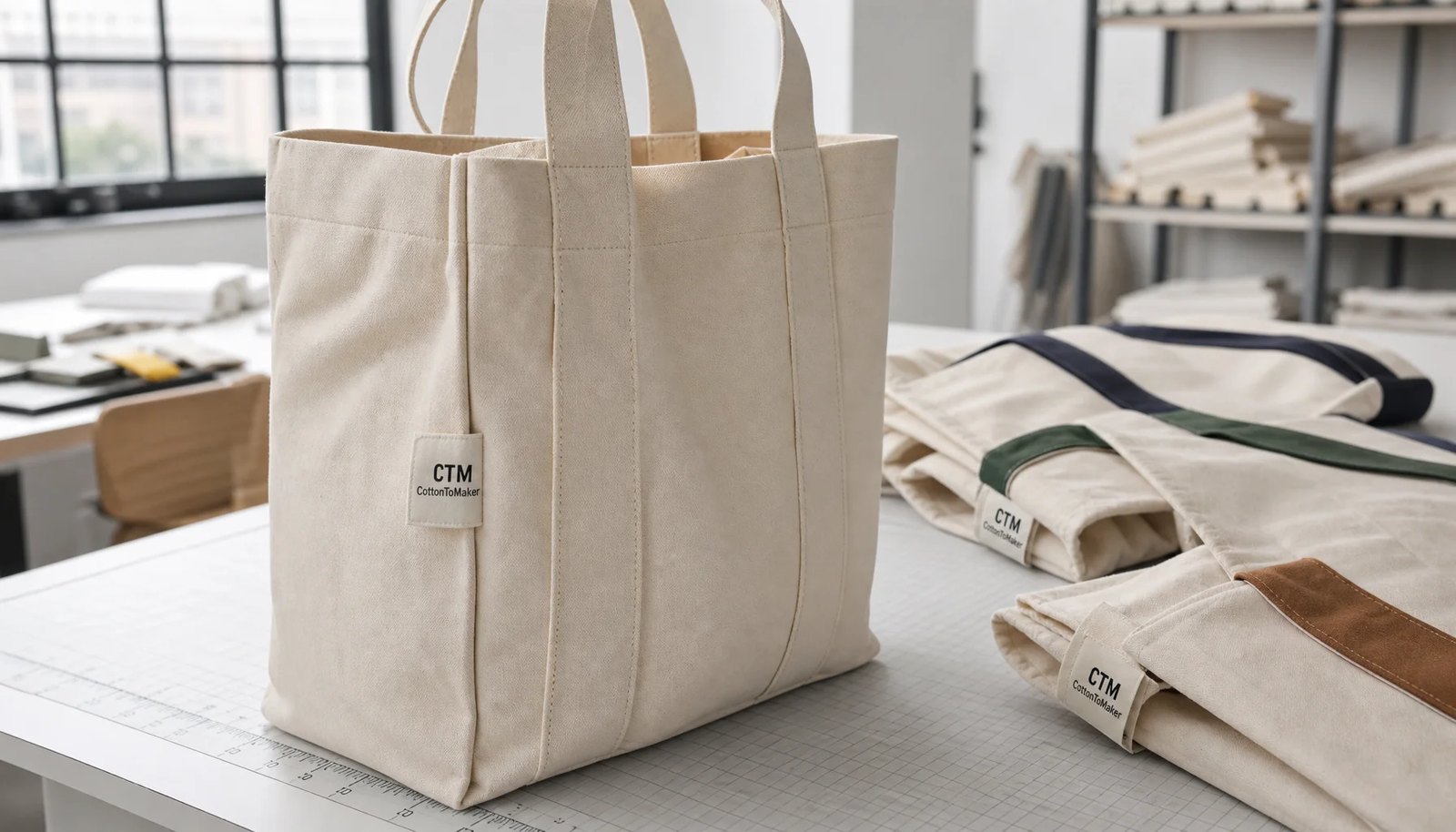
Start With the Booth Job, Not the Bag
A custom canvas grocery tote for a trade show is an operating item before it is a branding item. It may need to carry catalogs across a convention center, hold product samples, support a retail-style booth store, organize distributor kits, or become a reusable grocery bag after the event. Each use changes the MOQ conversation because it changes fabric, handles, decoration, packing, and inspection priorities.
For a light literature handout, procurement can often simplify the spec: natural canvas, standard size, one print location, bulk cartons. For a tote expected to carry drinkware, tools, packaged samples, or a heavy catalog stack, the buyer should protect fabric strength, handle reinforcement, seam quality, and gusset depth before negotiating price. A lower MOQ is not useful if attendees avoid using the bag because it feels weak or uncomfortable.
The best threshold is the failure cost. If a bag is a free booth handout and extras can stay in storage, a simple construction may be fine. If the tote is part of a paid conference kit, sponsor package, or distributor meeting where every unit must look consistent, the approval and QC plan should be stricter. MOQ negotiation should remove unnecessary customization, not the details that support the show experience.
- Define the tote role as brochure carrier, sample bag, grocery giveaway, VIP kit, staff bag, retail item, or distributor pack.
- Use standard natural canvas and one print location when the goal is broad booth distribution at a controlled cost.
- Protect reinforced handles, deeper gussets, and stronger seams when the tote will carry samples or be reused after the show.
- Set an acceptable overrun or underrun percentage before ordering so the supplier does not guess at finished quantity risk.
- Decide whether leftover units are useful for later shows; if yes, a slightly higher run may beat a low MOQ with poor reorder economics.
Build a Quote Spec Suppliers Cannot Misread
MOQ negotiation improves when every supplier prices the same tote. A quote-ready spec should include finished width, height, gusset depth, canvas weight, measured GSM or expected GSM range, handle width, handle drop, seam style, reinforcement method, print method, print size, artwork count, packing format, Incoterm or delivery point, and required delivery date. Without those details, a low quote may simply reflect a lighter cloth, smaller print, narrower handle, or cheaper carton plan.
Canvas weight deserves careful wording because oz and GSM are not universal equivalents. Commercial terms such as 8 oz or 10 oz are common in tote sourcing, but the measured GSM can vary by weave, yarn, finishing, washing, coating, and moisture. Treat any oz-to-GSM conversion as an approximate sourcing reference, not a standardized fact. Ask the supplier to confirm the actual fabric specification for the lot they will use and to state the tolerance they can hold.
Construction details also affect booth usability. Handle drop should be specified, not implied, because attendees may carry the tote over jackets or while holding other materials. Gusset depth should match the items going inside. Print placement should be measured from a fixed reference point such as top edge, side seam, or centerline. These small details reduce disputes and make MOQ discussions less emotional because everyone can see what is being traded.
- State finished size as width x height x gusset, and confirm whether measurements are taken flat or expanded.
- Specify handle width and handle drop separately from total handle length.
- Use supplier-confirmed GSM or a GSM range alongside the commercial canvas weight description.
- Define reinforcement at stress points, such as bartack, box stitch, cross stitch, or another approved method.
- Provide print dimensions, color count, file format, Pantone references if required, and placement measurement rules.
- State whether goods ship flat, folded once, retail folded, individually bagged, kitted with inserts, or bulk packed.
Identify the Real MOQ Driver
MOQ is rarely one number caused by one thing. For custom canvas grocery totes, the minimum can come from fabric rolls, dye lots, cutting efficiency, print setup, accessory suppliers, labor scheduling, packing labor, or carton configuration. This is why one supplier may discuss 500 pieces for stock natural canvas but push the same tote much higher when the body is dyed, the handles contrast, the logo prints in four colors, and each unit needs a hangtag.
Stock material is usually the strongest MOQ lever. Natural, greige, or unbleached canvas in common weights is easier for a factory to allocate because it may already be in inventory or shared across other orders. Dyed canvas, washed finishes, uncommon weights, laminated fabric, or recycled-content requirements can create separate mill or dye-house minimums. The useful question is not only whether MOQ can be reduced, but which upstream minimum is setting the floor.
Decoration is the next lever. One-color screen printing on one side is efficient. Multi-color art adds screens, registration time, drying space, and inspection risk. Printing two sides doubles handling and raises the chance of scuffing or misplacement. Woven labels, patches, snaps, pockets, and special hangtags can have their own supplier minimums. When the event does not need those details, removing them is often a cleaner negotiation move than asking the factory to absorb cost.
- Ask the supplier to name the MOQ driver in writing, not just repeat the minimum quantity.
- Use stock natural canvas when exact body color is not a brand requirement.
- Keep one size, one fabric, one print method, and one packing format when seeking a lower minimum.
- Quote artwork versions separately because each version may carry its own setup and handling cost.
- Treat labels, patches, inserts, and special packaging as separate MOQ questions.
- If a supplier offers a surprisingly low MOQ, ask what changes in unit price, setup fee, lead time, and inspection access.
Use Trade-Show-Specific Negotiation Levers
A buyer asking only for a lower MOQ gives the supplier little to work with. A buyer offering practical tradeoffs creates room. For example, an exhibitor needing 600 grocery totes might accept stock natural canvas, one print side, bulk packing, and a paid setup fee if the factory can hold the same price for a 400-piece reorder within six months. Another buyer may consolidate three booth teams into one shared artwork to reach a better price break, then sort cartons by booth destination.
Quantity breaks are revealing. Ask for the same specification at 300, 500, 750, 1,000, and 2,000 pieces. If the unit price drops sharply after 500, setup and line scheduling may be the pressure point. If it barely moves, material and sewing labor dominate. That information helps procurement decide whether to buy closer to actual need, order for multiple shows, or simplify the spec enough to move into a lower bracket.
Protect quality while trading features. Do not reduce fabric or handle reinforcement below the expected carrying load just to hit a low minimum. Better concessions include removing a second print side, using one universal event logo, standardizing carton quantities, accepting supplier-stock handle webbing, or using carton labels instead of individualized printed inserts. For exhibitors, the negotiation target is dependable delivery and usable bags, not the lowest theoretical unit cost.
- Ask whether a paid setup fee can replace part of the MOQ for a small but time-sensitive order.
- Use one common artwork for all booths and separate teams by carton labels or inserted literature.
- Split delivery releases only when material hold rules, dates, quantities, and price protection are written into the PO.
- Consolidate multiple events or regional teams when leftover units can be used within a realistic calendar.
- Simplify print locations before weakening fabric, handle attachment, or seam construction.
- Ask for a reorder window that keeps the pattern, artwork, label source, and pricing formula available for a defined period.
Make Unit Price, Setup Fees, and Landed Cost Visible
A single unit price hides too much. Procurement should ask suppliers to separate recurring unit cost from one-time or variable charges: sample fee, print screens, plates, artwork cleanup, woven label setup, patch mold, special carton marks, retail folding, barcode labels, inspection support, and delivery to the named handoff point. This matters because the first order and the reorder may have different economics even when the tote is unchanged.
Compare quotes under the same delivery term. EXW, FOB, CIF, DDP, and delivered warehouse pricing can look very different because they include different responsibilities. A low ex-factory price may lose value if cartons are bulky, freight is underestimated, or the supplier cannot provide accurate packing data. For canvas totes, carton dimensions and gross weight affect air freight, ocean freight, courier charges, warehouse handling, and venue drayage planning.
Packing density is a real cost driver. A heavier canvas, deeper gusset, retail fold, belly band, individual polybag, or insert card can change the carton count. For a trade show, poor packing can also create labor cost at the booth. Ask for estimated carton quantity with the quote and final carton details before shipment release. The goal is to prevent a procurement win on unit price from becoming an operations problem during show setup.
- Request unit cost, setup fees, sample charges, packing charges, and local delivery costs as separate quote lines.
- Confirm whether screen charges apply per color, per location, and per artwork version.
- Ask whether first-order setup fees are reduced or removed on exact reorders.
- Request carton dimensions, units per carton, gross weight, net weight, total cartons, and pallet details where relevant.
- Compare quotes under the same Incoterm or delivered location before selecting the apparent low bid.
- Include inspection, reinspection, warehouse receiving, and venue handling costs in the landed-cost view.
Vet Supplier Capacity Before the PO
Supplier vetting should go beyond asking whether a company is a factory. Ask for the legal manufacturer name, production address, export seller name, and the locations for cutting, sewing, printing, labeling, inspection, and packing. If any step is outsourced, document which step, where it happens, and who controls corrections. This is especially important when buying through a trading company or promotional products coordinator.
Capacity proof does not need to be dramatic, but it should be specific. Ask for dated production-area photos, a simple process flow, machine or line count for sewing, print equipment type, estimated daily output for the approved tote, and confirmation that the production window is available. A supplier that can explain its bottlenecks is often easier to manage than one that only promises speed. For a fixed trade show date, unknown capacity is a major risk.
Reorder protection belongs in supplier vetting too. Procurement should ask how long the factory keeps the cutting pattern, artwork placement file, print screen data, label source, carton specification, and approved sample. If the first order goes well, the buyer should not have to rebuild the tote from memory. Documenting the production file is also leverage: it makes the reorder less dependent on one salesperson and reduces the chance of quiet specification drift.
- Confirm legal manufacturer name, production address, export seller name, and all outsourced production steps.
- Ask whether the same facility that made the sample will make bulk production.
- Request practical capacity evidence: sewing lines, print equipment, daily output estimate, and production-window confirmation.
- Require independent inspection access before paying a deposit on higher-risk first orders.
- Ask who controls corrective action if inspection fails: the factory, trading company, decorator, or buyer.
- Document pattern retention, artwork file retention, label source, carton spec, and reorder price rules.
Control Samples and Change Approval
Sampling should prove the production method, not just the visual idea. A digital mockup can show approximate logo placement, but it cannot prove fabric hand feel, print opacity, handle strength, fold marks, carton behavior, or ink cure. A print strike-off can confirm color behavior on canvas, but it does not show the final bag. For a trade show deadline, the strongest approval standard is a pre-production sample made with intended fabric, construction, decoration, labels, fold, and packing.
Every sample approval should say what is being approved. A prototype may approve size only. A strike-off may approve print color only. A packed sample may approve fold direction and carton presentation. If procurement simply says approved, the supplier may treat a partial approval as permission for bulk production. Clear sample-stage language prevents avoidable disputes.
Late changes should trigger a written impact check. Changing artwork after screen setup, changing handle length after cutting markers are made, or adding a label after accessories are ordered can affect MOQ, cost, and lead time. For exhibitors, the show deadline should decide whether a change is worth making. A useful approval rule is simple: no bulk production until the PO spec, golden sample, artwork file, and packing instructions match.
- Use digital mockups for layout discussion, not final quality approval.
- Use print strike-offs to check ink color, opacity, cure, edge sharpness, and behavior on the selected canvas.
- Use a pre-production sample as the final standard for size, construction, print, label, fold, and packing.
- Label duplicate golden samples with approval date, spec version, fabric weight, color reference, and approval owner.
- Mark approvals by scope: size only, print color only, packing only, or approved for bulk.
- Require written cost, MOQ, and lead-time confirmation for every post-approval change.
Inspect for the Failures That Hurt a Show
Canvas tote QC should focus on consistency, function, and packed accuracy. A single photo can look fine while bulk production contains variable handle drops, twisted seams, shifting logos, mixed artwork versions, or carton shortages. Define critical, major, and minor defects before production. Critical defects may include wrong artwork, unsafe contamination, severe odor, or broken handle attachment. Major defects may include wrong size, poor print cure, visible stains, misaligned logos, failed load checks, or carton count errors.
AQL can be useful, but it should be framed correctly. AQL levels such as 2.5 for major defects and 4.0 for minor defects are common starting points in many consumer goods inspections, but they are not automatic standards for every tote order. If using AQL, state the exact level, sample size method, defect categories, and acceptance rules in the PO. If the event is high stakes or there is no time to sort at the venue, tighten the checks for artwork, count, and packing.
Inspect before the shipment is sealed and gone. Incoming fabric checks catch wrong weight or shade before cutting. Inline sewing checks catch handle and seam issues while rework is still possible. Print checks catch cure, opacity, registration, and strike-through before cartons are packed. Final inspection confirms that the packed goods match the golden sample, purchase order, and packing list. First-time suppliers, new decoration methods, and tight deadlines all justify stronger inspection discipline.
- Measure finished size, gusset depth, handle drop, handle width, and print position from random units.
- Run a practical load check matched to expected event contents, not an arbitrary marketing claim.
- Check print cure with rub testing and inspect for unacceptable strike-through inside the tote.
- Open cartons from different parts of the lot to verify count, fold, SKU separation, polybag use, and carton marks.
- Compare shade, hand feel, label placement, seam quality, and print appearance against the golden sample.
- Require corrective action photos and reinspection rules before shipment release if defects are found.
Plan Packing Around Venue Reality
Packing is part of the product for a trade show order. The tote may move from factory to port, warehouse, advance receiving, venue dock, booth storage, and attendee distribution. If cartons are too heavy, inconsistently counted, or poorly labeled, the problem appears when the booth team has the least time to solve it. Packing instructions should be written into the PO, not left to factory habit.
Flat bulk packing is usually efficient for freight and fast distribution. Retail-style folding, belly bands, individual polybags, barcode labels, or inserted cards may be worth the cost for VIP kits, resale, sponsor packages, or distributor sets. The buyer should ask for a packed-unit photo and a master carton photo before shipment release. For multi-booth programs, carton labels should make sorting obvious without opening every box.
Venue logistics need a backward calendar. The factory completion date is not the show delivery date. Account for inland trucking, export clearance, sailing or flight time, customs, destination handling, warehouse receiving, advance warehouse deadlines, marshaling yard rules, and booth delivery windows. A tote order can arrive in the country on time and still miss the booth if carton marks, appointment rules, or warehouse cutoffs are wrong.
- State units per carton and avoid mixed counts unless clearly approved.
- Keep cartons manageable for manual booth handling; ask the supplier to confirm gross weight before shipment.
- Define fold direction, handle placement, polybag use, insert placement, and whether print surfaces need protection.
- Use carton marks with item name, artwork version, quantity, carton number, event name, booth reference, and destination where needed.
- Request packed carton photos, carton dimensions, gross weight, and the final packing list before shipment release.
- Check advance warehouse and venue receiving deadlines before choosing air, sea, truck, courier, or DDP service.
Protect the Reorder Before the First Order Ships
Trade show buyers often treat the first order as a one-time project, then need the same tote again for a regional event, distributor meeting, or next year’s show. Reorder protection should be negotiated while the supplier still wants the first PO. Ask what will be retained, for how long, and under what conditions: cut pattern, print placement file, screens or digital print settings, fabric reference, handle specification, label source, carton plan, and inspection notes.
Price protection should be realistic rather than vague. A factory may not be able to guarantee the same unit price for a year if cotton, labor, freight, or exchange rates move. But it can usually define what stays fixed and what may change. For example, the supplier can agree that an exact reorder will not require a new development fee, will use the same pattern unless the buyer changes size, and will be quoted from the same construction standard. That is more useful than a casual promise to keep everything the same.
Reorder quantity is also negotiable. If the first order uses stock fabric and standard packing, a smaller reorder may be easier to discuss. If it uses custom dyed canvas or unique labels, the same upstream minimums may return. Procurement should capture the reorder MOQ and setup-fee treatment in the supplier file. The first order is not truly complete until the buyer knows how the second order will be handled.
- Ask for exact reorder MOQ, lead time, and setup-fee treatment before placing the first PO.
- Confirm how long the supplier retains the pattern, artwork placement file, print data, fabric reference, and approved sample.
- Document which changes trigger new sampling, new MOQ, or new setup fees.
- Keep one buyer-held golden sample and require the supplier to keep a matching approved sample.
- Request a reorder quote format that separates changed cost drivers from unchanged construction.
- Store carton photos, packing list, inspection report, and final spec with the supplier record.
Specification comparison for buyers
| Supplier route | MOQ pattern to expect | Best fit for exhibitors | Vendor-vetting and pricing leverage checks |
|---|---|---|---|
| Direct cut-and-sew factory with in-house printing | Often more flexible on stock natural canvas and standard sizes; higher minimums when fabric, dyeing, labels, or packing must be purchased specially | Repeat exhibitor programs, distributor campaigns, and buyers who need the same tote reproduced later | Ask for the legal manufacturer name, production address, process flow, dated factory photos, in-house sewing and print capacity, archived cut pattern policy, and quantity breaks at 300, 500, 750, 1,000, and 2,000 pieces |
| Trading company coordinating partner factories | May quote lower MOQs by spreading work across suppliers, but the true factory minimum can be hidden | Multi-category promotional programs where one coordinator manages totes, pouches, apparel, inserts, and shipment paperwork | Require the actual production factory before PO release, confirm inspection access, identify who owns the golden sample, and ask how reorders are protected if the first factory is unavailable |
| Local decorator using blank canvas totes | Often low minimums when blank inventory exists, but construction choices are limited to available blanks | Late show orders, replacement units, small booth teams, local activations, or last-minute artwork changes | Confirm blank brand, actual fabric weight or supplier spec sheet, inventory hold date, print method, cure process, maximum print area, carton count, and whether the same blank will be available for reorders |
| Regional cut-and-sew supplier near the event market | Minimums depend on fabric availability and sewing labor; freight risk may be lower than offshore sourcing | Programs where shorter transit, easier site visits, and customs simplicity are worth a higher unit price | Ask for fabric stock proof, sewing-line capacity for the required week, carton limits, labor bottlenecks, and whether they can scale from a pilot order to a multi-show reorder |
| Offshore factory using stock greige or natural canvas | Usually most negotiable when the bag uses common canvas, standard handles, one print location, and bulk packing | Large trade show runs with enough time for sampling, production, inspection, and international freight | Ask what cloth is physically in stock, how long it can be reserved, whether shade variation is accepted, and whether price breaks are driven by fabric roll use or print setup |
| Offshore sewing with destination-market printing or kitting | Sewing MOQ may be moderate while print versions can stay smaller by region or booth | Campaigns needing multiple languages, regional logos, inserts, late personalization, or local kit assembly | Require a final packed approval sample after local decoration because fold, print hand feel, inserts, carton count, and barcode labels can change the finished presentation |
| Small workshop or manual sample room | Can make prototypes or VIP quantities, but scaling and consistency may be limited | Concept validation, executive gifts, or a short proof run before committing to a production factory | Separate prototype approval from bulk approval; verify seam allowance, handle drop, label position, and whether the same people and machines can repeat the work at quantity |
| Integrated export factory with documented QC and packing control | Minimums may be firmer, but process control and documentation are usually clearer | Retail-quality exhibitor programs, annual show calendars, and buyers needing consistent cartons, inspection reports, and customs documents | Review inspection records, incoming fabric checks, needle control, print cure process, packing list accuracy, document support, and written reorder terms before accepting a higher MOQ |
Buyer checklist before sampling
- Define the event job first: brochure carrier, sample bag, grocery-style giveaway, retail item, VIP kit, staff bag, or distributor pack.
- State target quantity, acceptable overrun or underrun, delivery location, show date, advance warehouse deadline, and latest acceptable delivery date.
- Lock finished width, height, gusset depth, handle width, handle drop, seam type, reinforcement method, and intended carrying load before requesting price.
- Specify canvas weight using supplier-confirmed oz and measured GSM or GSM range, noting that oz-to-GSM conversion varies by weave, finish, and moisture content.
- Choose print method, number of colors, print area, artwork version count, Pantone references if required, and whether the design crosses seams or gussets.
- Ask what sets the MOQ: fabric purchase, dye lot, cutting marker efficiency, print setup, label minimum, packing labor, carton quantity, or production-line scheduling.
- Separate one-time charges from recurring unit cost, including samples, screens, plates, artwork cleanup, label tooling, patch molds, carton marks, and inspection support.
- Request price breaks at practical quantities so procurement can see where setup cost, material yield, or labor scheduling changes the economics.
- Require a pre-production sample or golden sample made with the intended fabric, print method, handle construction, label, fold, and packing format.
- Confirm who owns and stores the approved sample, cutting pattern, artwork files, print screen data, label specification, and packing standard for reorders.
Factory quote questions to send
- What is your MOQ by finished size, canvas weight, body color, handle type, print location, artwork version, label type, and packing format?
- Which part of the order sets the minimum: fabric purchase, dye lot, cutting efficiency, print setup, label or accessory minimum, packing labor, or line scheduling?
- Which stock canvas weights and colors are physically available now, and can you provide measured GSM ranges or fabric test records for the lot you will use?
- If you describe fabric as 6 oz, 8 oz, 10 oz, or 12 oz, what GSM tolerance will you commit to in writing for this order?
- What changes in MOQ, unit price, and lead time if we use stock natural canvas instead of dyed canvas or custom Pantone-matched fabric?
- What are the one-time charges for sampling, screens, plates, woven labels, patches, artwork cleanup, retail packing, carton marks, and sample revisions?
- Can you quote the same spec at 300, 500, 750, 1,000, and 2,000 pieces so we can see the real price breaks?
- Which production steps are in-house and which are outsourced: weaving, dyeing, cutting, sewing, printing, washing, labeling, inspection, and packing?
- What proof can you provide for sewing and printing capacity during our required production window, such as line count, daily output estimate, or current production schedule confirmation?
- Will the same factory that makes the approved sample make bulk production, and will the same cut pattern and print placement file be archived for reorders?
Quality-control points to confirm
- Incoming fabric should be checked before cutting for measured GSM, width, shade, odor, stains, excessive slubs, roll damage, and shrinkage risk against the approved standard.
- Finished width, height, gusset depth, handle drop, handle width, and print position should be measured from random units using written tolerances agreed before production.
- Handle attachment should use the approved reinforcement method, such as bartack or box stitching, and should pass a practical load check matched to the intended show use.
- Print opacity, registration, edge sharpness, ink cure, rub resistance, color match, and strike-through should be checked on the same production fabric lot that will ship.
- Labels, patches, hangtags, care labels, and inserts should match the approved position, orientation, language, stitch quality, and artwork version.
- Loose threads, skipped stitches, needle cuts, broken seams, stains, wet odor, heavy creasing, and dirty fold marks should be corrected before packing.
- Carton count, carton marks, SKU separation, fold direction, polybag use, gross weight, and packing list quantities should match exactly to reduce show-floor sorting errors.
- If independent inspection is used, define AQL level, defect categories, sample size, measurement method, photo requirements, corrective action timing, and reinspection responsibility.