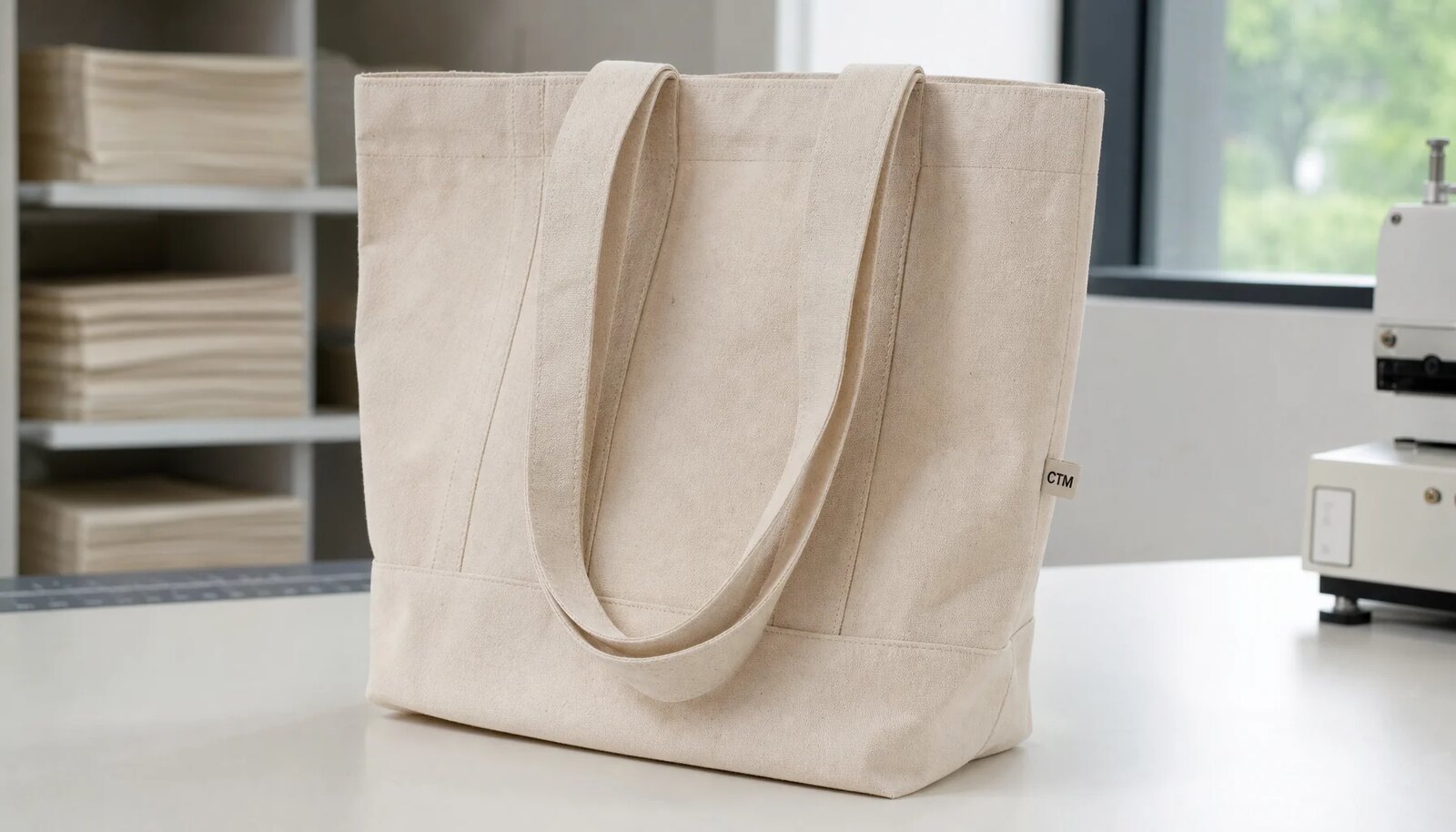
Start With the Event Load
Event totes should be specified around what they must carry, not only how the logo will look. A bag for a badge, agenda, and folded T-shirt is a different product from a grocery-style tote filled with bottled drinks, boxed samples, produce, books, or retail purchases. If the load is not defined, each supplier may quote its own house construction, and the lowest price may simply be a lighter fabric, narrower handle, smaller gusset, or weaker reinforcement.
Write the use case into the RFQ in operational language. For example: "Tote must carry 8 kg of mixed event samples for 10 minutes without handle tearing, seam failure, stitch popping, or major distortion." This gives the factory a performance target and gives procurement a fair way to compare samples.
Distribution method also matters. Bags handed out empty at registration mainly need clean presentation, practical reuse value, and consistent print. Pre-packed totes shipped to a venue must survive folding, carton compression, handling, stacking, and fast handoff by event staff. If the contents include dense goods, glass, liquids, food, or retail products, treat the tote as part of the event logistics plan.
- List realistic contents before choosing fabric weight.
- Define maximum carry load in kg or lb.
- State whether bags are handed out empty, pre-packed, sold, or reused.
- Separate visual requirements from performance requirements.
- Share destination, receiving limits, and kitting method before quoting.
Choose a Finished Fabric Weight
Canvas weight is useful only when buyer and supplier mean the same thing. Promotional sourcing often uses ounces, while mills and international factories often use gsm. As a practical reference, 8 oz canvas is often around 270 gsm, 10 oz around 340 gsm, 12 oz around 400 gsm, and 14 oz around 475 gsm. These figures are approximate because yarn count, weave density, moisture, dyeing, washing, and finishing all affect the final fabric.
For most grocery-style event totes, 10 oz / about 340 gsm finished cotton canvas is the balanced starting point. It gives the bag enough body for reuse without making it too bulky, expensive, or slow to sew. For heavier contents, employee markets, donor gifts, retail-adjacent programs, or bags expected to stay in use after the event, 12 oz / about 400 gsm is often the safer upgrade.
An 8 oz tote can work for light handouts, apparel, and paper inserts, but it should not be presented as a heavy grocery tote unless the load test supports that use. A 14 oz tote has stronger structure and a more premium hand, but it increases material cost, sewing effort, carton volume, and freight weight.
The quote should state whether fabric weight is measured as greige, finished, washed, dyed, coated, or pre-shrunk. A clean RFQ line is: "Quote 10 oz / approx. 340 gsm finished 100% cotton canvas, natural color, with an alternate for 12 oz / approx. 400 gsm."
- 8 oz / about 270 gsm: light event handouts and modest loads.
- 10 oz / about 340 gsm: standard reusable grocery-style event tote range.
- 12 oz / about 400 gsm: heavier contents and stronger reuse positioning.
- 14 oz / about 475 gsm: premium structure with higher cost and bulk.
- Ask whether gsm is measured before or after finishing.
Control Finish and Shrinkage
Two bags with the same nominal weight can behave differently after finishing. Natural canvas is economical and familiar, but it may shrink, skew, or change hand feel after washing. Bleached canvas gives a cleaner print ground but may show dirt and shade variation faster. Dyed canvas can support a brand color, but it adds lab dips, shade approval, colorfastness checks, and lead time.
Pre-shrunk or sanforized canvas is worth pricing when the tote will be sold, mailed, washed, reused heavily, or photographed as a retail-quality item. Size stability also matters when artwork sits close to a seam or when bags must fit a specific carton, insert, or kit layout.
Ask for shrinkage as a measurable value. Request expected length shrinkage and width shrinkage after one wash, and ask which wash method the supplier used. Even low single-digit movement can be visible on a large centered logo or a tightly packed tote. If the supplier cannot quantify shrinkage, keep the artwork away from seams and avoid tight size-dependent packing assumptions.
- Ask for length and width shrinkage separately.
- Use pre-shrunk canvas when finished size must stay stable.
- Approve lab dips for dyed canvas under consistent lighting.
- Keep large art away from edges when shrinkage is uncertain.
- Record the approved finish route in the PO.
Document Fiber and Claims
Material claims need precise evidence. If the tote is described as recycled cotton, organic cotton, OEKO-TEX certified, unbleached, natural, or cotton-poly, the RFQ should state the fiber content and the documents required before marketing copy is approved. Vague phrases such as eco canvas, green material, or sustainable tote do not define the material, certification route, or party responsible for the claim.
Match each claim to the right support. A basic fiber statement may be covered by a supplier composition declaration or test report. A recycled-content claim should be supported by documentation that identifies recycled input and percentage, such as GRS or RCS documentation when applicable. An organic cotton claim should be backed by a valid organic certification route, such as GOTS or an organic transaction certificate where relevant. An OEKO-TEX Standard 100 reference requires a valid certificate for the material or product scope being claimed, not just a general statement in a catalog.
Check certificate holder, product scope, validity date, standard version, and whether the named supplier is actually covered. If the event does not require a claim, simpler language is often better. "Natural 100% cotton canvas" is clearer than unsupported sustainability copy. For sponsor reporting, retail resale, hangtags, inserts, web copy, or event signage, align the wording with documents before artwork is released.
- State exact fiber content in the RFQ.
- Name the document required for each claim.
- Check certificate scope, validity date, and certificate holder.
- Do not print recycled, organic, or OEKO-TEX wording until documents are reviewed.
- Keep claim language consistent across PO, packaging, and event copy.
Specify Size and Gusset
Finished size, gusset depth, and measurement method have direct cost and usability consequences. A front-view mockup can look right while the actual tote feels too shallow, too soft, or too narrow for the event contents. Use millimeters for finished width, finished height, bottom gusset, side gusset if any, handle width, and usable handle drop.
A grocery-style tote usually needs meaningful depth. A bottom gusset, or a full side-and-bottom gusset, helps the bag open, stand, and hold boxed or bulky items. A flat tote works for papers, apparel, and lightweight handouts, but it is awkward for groceries, bottles, food packs, and retail goods.
Ask how the factory measures the bag: flat, pressed, filled, or after final finishing. Then set practical tolerances. For many event totes, +/-10 mm on finished width and height and +/-5 mm on handle drop or print placement are reasonable starting points, subject to supplier confirmation and artwork needs.
- State width, height, and gusset depth in millimeters.
- Confirm the factory measurement method.
- Choose a bottom gusset for boxed or bulky contents.
- Use written tolerances before bulk cutting starts.
- Ask for a revised pattern if the sample does not stand or open properly.
Engineer Handle Performance
Handles are often where a tote fails first. A buyer may approve heavier canvas and still receive a bag that feels uncomfortable because the handles are narrow, poorly aligned, or lightly reinforced. Handle material, width, total length, usable drop, attachment area, and reinforcement method should be quoted as construction details, not left to assumption.
For many event grocery totes, 25-38 mm is a practical handle-width range. Wider handles usually feel better under load because they spread pressure across the hand or shoulder. Hand-carry bags can use a shorter drop. Shoulder-carry bags need more clearance, especially for attendees wearing jackets or carrying other bags.
Self-fabric handles can look substantial and match the body. Cotton webbing handles can be durable, consistent, and efficient to sew. Either can work if the attachment is strong enough. Require box-X stitching, bartacks, double rows, or another approved reinforcement at stress points, then verify it through the load test.
- Specify handle material, width, total length, and usable drop.
- Use wider handles for heavier contents or longer carry time.
- Require box-X, bartack, or approved reinforcement.
- Check left and right handle alignment on the sample.
- Tie handle approval to the named carry load.
Match Print to Canvas
Decoration should be chosen for the actual canvas surface. Natural cotton canvas has texture, absorbency, shade variation, and cotton flecks that can affect print sharpness and color. A clean one-color sponsor mark may print beautifully by screen print. A photo, gradient, or detailed illustration may need transfer or digital decoration.
For volume orders with one to three solid colors, screen printing is usually the practical choice. It offers predictable setup, strong coverage when ink deposit is correct, and good durability when cured properly. Provide vector artwork, print size, print position, Pantone references where relevant, and acceptable color variation on natural fabric.
Transfers and digital print are useful for complex artwork, but they should be tested on production canvas. Transfers can feel stiff or show film edges. Digital print may require pretreatment that changes hand feel or shade. Ask for rub, tape, cure, edge-lift, or wash checks based on the chosen method.
Placement is a quality issue. A common simple-print tolerance is +/-5 mm from an agreed reference point, such as top seam, side seam, or centerline. Oversized prints, seam-adjacent art, gusset panels, and wrap placements need more proofing time and may carry wider tolerances.
- Use screen print for simple one to three color logos at volume.
- Use transfer or digital print when artwork complexity justifies it.
- Approve decoration on actual production canvas.
- Set print size, color reference, and placement tolerance in writing.
- Avoid seam-adjacent art unless the risk is accepted.
Build a Clean RFQ
A strong RFQ does not need to be long, but it must remove guesswork. Include order quantity, delivery date, destination, Incoterm, fabric weight, fabric finish, fiber content, finished size, gusset, handle specification, reinforcement, print method, print colors, print location, packing method, carton requirements, sample requirement, and inspection standard.
Ask suppliers to quote the same base specification. If the team is choosing between 10 oz and 12 oz, request the alternate as a separate line. If a second-side logo is possible, ask for setup and unit cost as a separate option. This keeps price comparison fair and makes later changes easier to evaluate.
Where possible, ask suppliers to separate sample charge, screen charge, fabric, cutting and sewing, printing, packing, carton, inspection, inland freight, and export handling. The final PO may still use an all-in unit price, but the breakdown helps explain why a late artwork change, individual polybag, heavier canvas, or custom color affects cost and timing.
- Send artwork, print size, placement, and color references with the RFQ.
- Quote one shared base specification across suppliers.
- Put alternates in separate lines.
- Confirm Incoterm, destination, duties, pallets, and exclusions.
- Make lead time start from named approvals, not from inquiry date.
Manage MOQ, Variants, and Packing
MOQ is tied to fabric sourcing, cutting efficiency, sewing setup, printing setup, curing, packing, carton marks, and inspection. A natural canvas tote with one logo on one side is easier to quote than a program with several fabric colors, two sizes, multiple sponsor artworks, and mixed packing rules.
For a first run, the cleanest structure is one size, one fabric color, one artwork version, one print location, and one packing method. That does not make the tote generic. It concentrates budget on better canvas, a useful gusset, comfortable handles, clean printing, and reliable packing.
Variants can be worthwhile for sponsor tiers, VIP kits, retail booths, or regional events. Treat each variant as a real SKU with its own MOQ, label, carton mark, packing list line, and inspection count. Ask whether MOQ applies to the total order or to each fabric color, size, artwork, print location, or packing type.
Packing should be decided before bulk approval. Flat bulk pack is usually efficient for venue delivery and kitting. Individual polybags may help with dust protection, barcode handling, or retail presentation, but they add labor, plastic, carton volume, and freight cost. Confirm fold direction, pieces per carton, carton dimensions, gross weight limit, carton label format, shipping marks, pallet limits, and any venue receiving requirements.
- Ask whether MOQ is per order, SKU, fabric color, size, artwork, or print location.
- Keep the first order simple when timing matters.
- Treat custom dyed canvas as a separate lead-time decision.
- Use unique SKU codes and carton marks for each variant.
- Confirm overage, shortage, and replacement policy before production.
Approve Samples and QC
A pre-production sample is the physical standard for fabric, construction, print, and packing. It should confirm canvas weight and hand feel, finished dimensions, gusset, handle drop, handle alignment, reinforcement, print color, print placement, fold direction, and packing method. If substitute fabric or approximate artwork is used, label the sample as a prototype rather than final approval.
Review the sample on a table, not from photos alone. Lay it flat, square it gently, and measure width, height, gusset depth, handle width, and usable handle drop. Inspect handle joins inside and outside. Look for skipped stitches, open seams, puckering, needle damage, loose threads, stains, odor, uneven corners, and print defects.
Run a load test that matches the order requirement, such as 8 kg or 10 kg for 10 minutes. Watch handle joins, side seams, bottom corners, and body distortion. The tote does not need to look untouched after the test, but it should not tear, open, pop stitches, or deform beyond the approved standard.
Final inspection should combine product and shipment checks. Inspect dimensions, gusset consistency, handle reinforcement, stitch quality, fabric shade, print registration, print placement, cleanliness, odor, count, fold direction, carton marks, and gross weight. If your company uses AQL, apply it with a tote-specific defect list that separates critical, major, and minor defects.
- Keep a sealed approved sample with the buyer and factory when possible.
- Record which items are approved: fabric, shade, construction, print, and packing.
- Use a named load test with pass or fail conditions.
- Define critical, major, and minor defects before inspection.
- Request correction evidence after any material or construction change.
Specification comparison for buyers
| Spec decision | Recommended option | When it fits | Buyer risk to check |
|---|---|---|---|
| Base fabric weight | 10 oz / about 340 gsm finished canvas for most grocery-style event totes; 12 oz / about 400 gsm when contents are dense or the tote should feel more premium | Conference welcome kits, sponsor sampling, grocery programs, employee markets, donor events, retail-adjacent giveaways, and venue pack-outs | Confirm whether the quoted weight is greige, finished, washed, dyed, coated, or pre-shrunk. The same ounce label can describe different finished goods. |
| Fabric finish | Natural cotton canvas with stated shrinkage tolerance; pre-shrunk or sanforized canvas when size stability matters | Reusable totes, post-event merchandise, mailed kits, sponsor programs, and any bag likely to be washed | Raw cotton canvas may shrink, skew, or torque after washing. Ask for length and width shrinkage separately. |
| Fiber and claim route | Declared fiber content, such as 100% cotton, cotton-poly blend, recycled cotton blend, or organic cotton, with claim-specific documents | Programs with procurement, ESG, retail, sponsor reporting, or product copy requirements | Avoid unsupported words like eco canvas or sustainable canvas unless the supplier provides the claim basis and supporting documents. |
| Construction standard | Bottom gusset, clean side seams, reinforced handle joins, 7-9 stitches per inch as a typical target range, and trimmed loose threads | Grocery totes that need to stand open, hold boxed goods, and survive event handling | A lower quote may reduce gusset depth, use narrow handles, skip reinforcement, or loosen stitch density. These changes may not show in a front-view mockup. |
| Handle construction | Self-fabric or cotton webbing handles, usually 25-38 mm wide, with box-X stitching or bartack reinforcement | Hand carry or shoulder carry when attendees may add bottles, samples, books, apparel, produce, or purchases | Thin handles can twist, stretch, or feel sharp under load. Confirm handle drop, width, material, reinforcement method, and load test. |
| Print method | 1-3 color screen print for volume logos; transfer or digital decoration only when artwork complexity requires it | Sponsor marks, event branding, store logos, and programs where rub and wash durability matter | Transfers can feel stiff or lift at edges on coarse canvas. Screen prints need correct ink deposit, registration, and curing. |
| Artwork placement | One side, one print position, centered or measured from top seam and side seams, with +/-5 mm placement tolerance when feasible | First production orders, tight deadlines, quote comparison, and budget-sensitive event programs | Oversized flood prints, seam-adjacent art, and wrap placements raise registration risk, ink cost, proofing time, and reject rates. |
| MOQ strategy | Keep one size, one fabric color, one artwork version, one print method, and one packing style per PO when possible | Lowest practical MOQ, cleaner quotation, faster sampling, easier inspection, and simpler receiving | Multiple SKUs can multiply setup cost, carton marks, screen charges, and counting errors even when the unit price looks close. |
| Packaging route | Flat bulk pack with agreed fold direction, pieces per carton, carton dimensions, gross weight limit, PO label, and shipping marks | Event kitting, warehouse distribution, sponsor pack-out, and direct venue delivery | Individual polybags add labor, plastic, carton volume, and freight cost. Use them only when retail presentation, dust protection, or barcode handling requires them. |
Buyer checklist before sampling
- Define the maximum intended carry load in kg or lb, including bottles, catalogs, boxed samples, produce, apparel, food items, books, or retail purchases.
- State the bag use case: empty giveaway, pre-packed attendee kit, grocery-style tote, retail merchandise, employee gift, donor item, or sponsor distribution.
- Specify one target fabric weight in both ounces and gsm, and state whether the weight is raw, greige, finished, washed, pre-shrunk, dyed, or coated.
- Confirm fiber content and claim language, including cotton, cotton-poly, recycled cotton blend, organic cotton, natural, bleached, or dyed canvas.
- State finished width, height, gusset depth, handle width, usable handle drop, seam allowance expectation, and print placement in millimeters.
- Use practical tolerances, such as +/-10 mm for finished bag width and height, +/-5 mm for handle drop, and +/-5 mm for print placement, unless the design requires tighter control.
- Choose one bag size, one canvas color, one artwork version, one print location, and one packing method for the first RFQ unless the program truly requires variants.
- Require a pre-production sample that confirms finished dimensions, gusset, fabric hand feel, handle alignment, reinforcement method, print color, print registration, and packing fold.
- Set a load test with a named weight, such as 8 kg or 10 kg, a hold time, such as 10 minutes, and pass or fail conditions for seam failure, handle tearing, major distortion, and stitch popping.
- Request carton quantity, carton dimensions, net weight, gross weight, fold direction, packing method, carton label format, shipping marks, and pallet guidance before bulk approval.
Factory quote questions to send
- What fabric weight in gsm and ounces will be used, and is that the weight of greige fabric, finished fabric, washed fabric, dyed fabric, coated fabric, or pre-shrunk fabric?
- What is the exact fiber content, and will the canvas be natural, bleached, dyed, pre-shrunk, sanforized, recycled cotton blend, organic cotton, or cotton-poly blend?
- What shrinkage should we expect after one wash in length and width, and what wash method is that based on?
- What yarn count, weave construction, or fabric specification can you provide, and can you send a fabric swatch before the full sample?
- What finished bag width, height, gusset depth, handle width, handle length, and usable handle drop are included in your quote?
- What measurement tolerance will you apply to bag width, height, gusset depth, handle drop, and print placement?
- What handle reinforcement do you recommend for the stated carry load, and will production use box-X stitching, bartacks, double stitching, or another approved method?
- What stitch density range will be used on side seams, bottom seams, and handle joins, and how will loose threads and skipped stitches be controlled?
- How many print colors, print positions, and screens are included, and what are the repeat setup costs for extra colors, extra sides, or reorders?
- What print method do you recommend for this canvas surface, and what curing, rub, tape, or wash check can you provide before bulk approval?
Quality-control points to confirm
- Finished width and height should be measured flat, squared, and without stretching. A common tolerance for event totes is +/-10 mm unless artwork or packing requires tighter control.
- Gusset depth should be consistent across the run, with no twisting or uneven bottom corners that prevent the tote from opening or standing as expected.
- Handle width and handle drop should match the approved sample. A practical tolerance is often +/-5 mm for handle drop and no visible mismatch between left and right handles.
- Handle joins must show the approved reinforcement method, with box-X stitching, bartacks, or double stitching placed at the intended stress points and not too close to a raw edge.
- Stitching should be continuous and secure, with a typical target of 7-9 stitches per inch unless another standard is approved. Reject open seams, skipped stitches, broken threads, needle cuts, and weak corners.
- Seam allowances should be caught fully in the stitch line, with no fraying edges, loose thread nests, or exposed raw edges beyond the approved construction.
- Print registration should stay inside the approved tolerance, such as +/-1 mm for simple multi-color screen print when feasible, with clean edges, correct ink coverage, and no ghosting or smearing.
- Print placement should match the approved artwork file, commonly within +/-5 mm from the top edge, side seam, or centerline reference point.
- Print curing or bonding should be checked by the agreed method, such as rub check, tape check, or wash check, depending on print type and intended reuse.
- Fabric shade should match the approved swatch, lab dip, or sealed sample under consistent lighting, with lot mixing controlled so cartons do not show obvious shade bands.