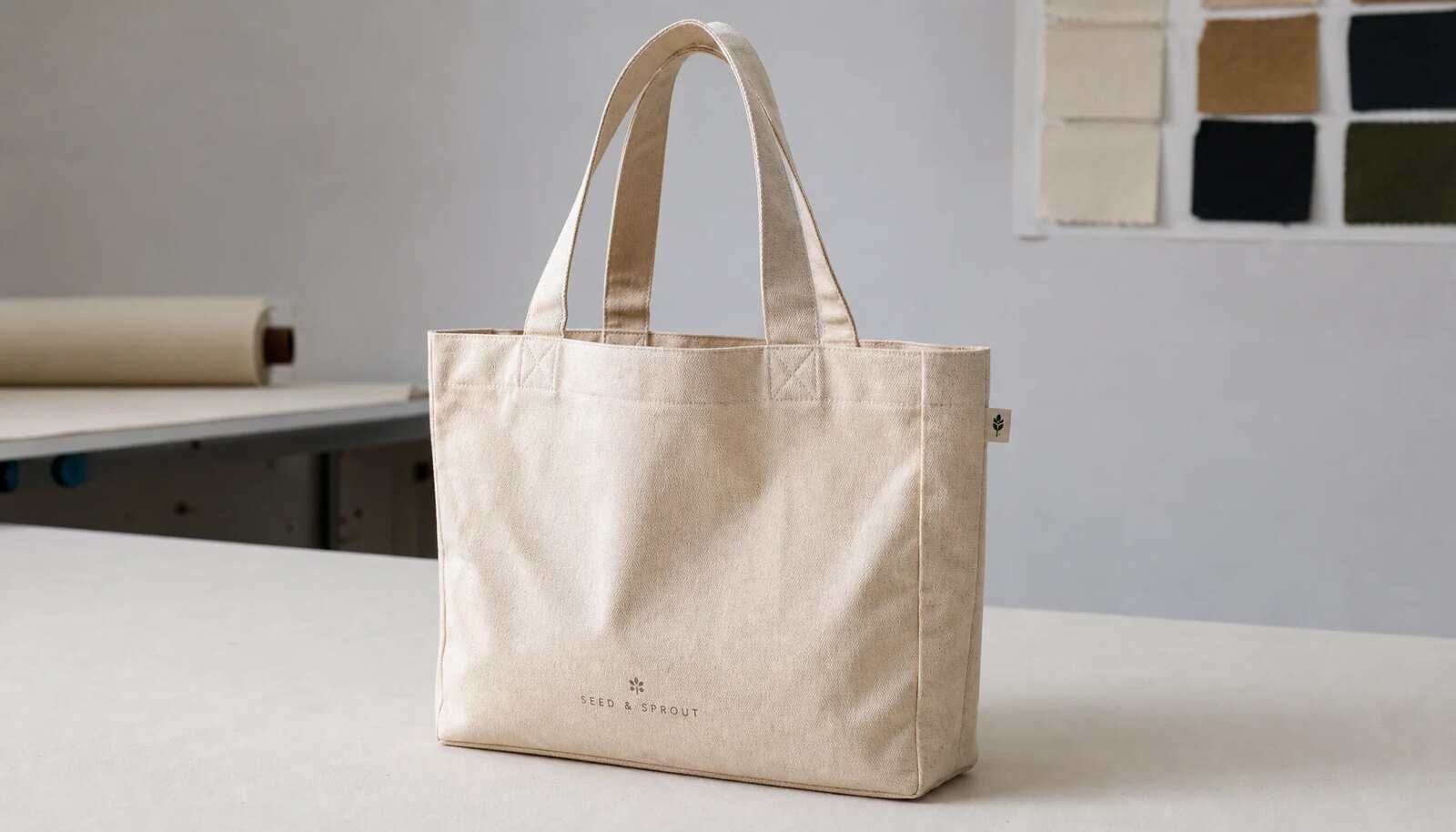
Start with the use case, not the artwork
A custom canvas grocery tote has to do more than carry a logo. It must hold weight, present the brand correctly, survive folding and carton packing, and support any sustainability language that appears on the product page, hangtag, or retail shelf. The material decision comes first because it shapes structure, print behavior, carton efficiency, and the amount of risk you carry into production.
For eco apparel brands, the tote often sits beside garments, packaging, or launch merchandise. That makes the bag part of the brand proof, not just a giveaway. A natural cotton canvas tote with a small one-color print sends a different message from a dyed recycled blend with a woven label and heavier hand-feel. The right answer depends on use case, price point, and the claim you can actually document.
Before you request samples, define the job in plain terms. Is the tote for grocery carry, online order packing, in-store resale, gift-with-purchase, or event distribution? Will it hold bottles, folded apparel, produce, or mixed groceries? Should it feel raw and low-impact or more structured and premium? These answers narrow the material range and keep suppliers from quoting similar-looking but functionally different bags.
- Use the bag's real job to narrow fabric, weight, and construction.
- Treat the tote as a load-bearing retail product, not only a branding surface.
- Tie the material choice to the claim you can support with documents.
Write an RFQ that produces comparable quotes
Weak RFQs create noisy pricing. For canvas grocery totes, your request should include finished body width, body height, gusset depth, handle length, handle drop, handle width, seam allowance, reinforcement method, fabric composition, finished weight, finish, decoration method, packing method, and shipment term. If those details are missing, each supplier will fill the gaps differently and the cheapest quote can simply be the lightest or least reinforced bag.
State whether the controlling fabric weight is finished oz or finished GSM. Some suppliers quote raw cloth weight, while buyers usually care about the actual fabric after bleaching, dyeing, washing, or brushing. Ask the supplier to identify how weight is measured and what tolerance will apply to the production lot. That avoids comparing an unfinished fabric quote with a finished one.
Separate mandatory requirements from optional upgrades. For example, a 10 oz natural canvas tote with screen print and bulk folding is one quote. The same tote with organic cotton documentation, individual polybags, hangtags, dyed fabric, and retail barcode labels is another. If you want clean comparison, ask for line-item pricing instead of a single bundled number.
- Include dimensions, fabric, construction, decoration, and packing in the same RFQ.
- Ask whether the quoted weight is measured before or after finishing.
- Require a line-item quote when documentation or packing may change.
Choose the material based on claim, availability, and acceptable variation
Conventional cotton canvas is still the easiest baseline for many grocery tote programs. It is familiar, widely available, and straightforward to sample. Natural unbleached cotton canvas also fits the visual language many eco apparel brands want: simple, tactile, and low gloss. The tradeoff is that natural cotton can show flecks, yarn irregularities, and shade movement. Those are not always defects, but they should be defined before approval.
Organic cotton canvas belongs in programs where the organic fiber story is real and intended for the finished bag. A supplier saying the cloth is organic is not enough. Ask what part of the supply chain is certified, whether the certificate scope covers the named mill or converter, and whether the final bag can legally carry the intended language in your market. Organic material is a sourcing choice and a documentation choice at the same time.
Recycled cotton canvas is useful when the brand story emphasizes waste reduction or circularity. The practical issue is not whether recycled content sounds good; it is whether the actual lot can support the claim and still meet the visual standard you want. Recycled fiber often introduces more neps, flecks, and shade variation. Blends, including cotton-poly or cotton-recycled options, can improve availability or durability, but they must be labeled correctly and reviewed against the target market's expectations.
- Use conventional cotton for baseline availability and simple comparison.
- Use organic cotton only when the document chain is clear and current.
- Use recycled cotton or blends when the claim, look, and cost all work together.
Treat weight and finish as starting points, not universal defaults
For most custom canvas grocery totes, the practical starting range is often 10-12 oz finished canvas, roughly 340-410 GSM. That range usually gives enough body for grocery use and retail display without making the bag overly bulky or expensive to ship. A lighter 8-9 oz tote can work for low-load event use, but it is more likely to slump, wrinkle, and feel promotional. A 12 oz-plus bag can feel more premium and structured, but it raises sewing difficulty, carton weight, and freight cost.
Finish matters as much as weight. Natural unbleached canvas gives a raw cotton look but may show more specking and shade movement. Bleached canvas improves contrast for artwork and product photography, but it adds process cost and tighter whiteness expectations. Dyed canvas can align with apparel color stories, but it introduces shade control, crocking checks, and more scrutiny on bulk-lot consistency. Washed canvas can soften the hand, though it may shrink or twist if that behavior is not controlled in advance.
Ask for swatches before you approve a full sample run. Review hand-feel, opacity, weave tightness, print surface, and folding behavior. A tightly woven 10 oz fabric can outperform a looser 12 oz fabric in print clarity and seam reliability. Weight alone does not decide the outcome.
- 8-9 oz is a lighter-duty starting point for promo or event use.
- 10-12 oz is the most useful starting range for grocery and retail programs.
- 12 oz-plus can be appropriate, but only if the added structure is worth the cost and freight.
Specify the load path so handles and seams do not become the failure point
Most tote failures happen where load moves through the bag: handle joins, side seams, bottom corners, and gusset transitions. That is why the build specification matters. If the handle is weak, the bag fails no matter how good the logo looks. Your RFQ should define handle material, width, length, drop, attachment position, and reinforcement method. Self-fabric handles create a consistent look. Webbing handles can improve grip and durability. Wider handles usually distribute weight better, but they change the visual balance and sewing method.
Reinforcement must be named, not assumed. Common approaches include box-X stitching, bar-tacks, or a buyer-approved equivalent. The exact method should appear in the pre-production sample and in the inspection checklist. Seam allowance and edge finishing also matter. Narrow allowances may save fabric but reduce strength and increase fraying risk. On heavier canvas, the right seam design usually matters more than adding another ounce of fabric.
Gussets increase capacity and help the tote sit more squarely, which is useful for groceries and folded apparel. Bottom gussets are especially practical for multi-item carry. Side gussets add volume but need symmetry and consistent sewing. Pockets, snaps, zippers, linings, and hardware should be added only when they solve a real use problem, because every extra component adds cost, lead time, and QC complexity.
- Define handle drop and reinforcement in the quote, not after sample approval.
- Require the exact handle stitch pattern to match the approved sample.
- Use pockets, zippers, or linings only when they solve a documented use case.
Match decoration to the canvas surface and the brand claim
Decoration should be selected after fabric is chosen. Screen printing is usually the lowest-risk method for simple logos, text, and limited spot colors on canvas. It gives strong opacity and repeatability when the screen, ink, and curing are controlled. White or pastel inks on natural canvas need special attention because the base fabric absorbs and dulls lighter colors. If the artwork depends on sharp edges or small text, review it at actual size on the actual fabric.
Heat transfer, digital transfer, and similar applied graphics can work for complex artwork or shorter runs, but rough canvas texture changes the outcome. Transfers should be tested on the production fabric and finish, not only on a smooth test panel. Check cracking, lifting, edge peel, and hand-feel after folding. If the tote will be stored tightly folded, do not place the main graphic directly on a hard crease unless testing shows it can tolerate that stress.
Not every brand mark needs to be large. Many eco apparel programs get a better result from a small screen print, woven side label, cotton patch, or understated placement. That keeps the bag usable beyond the first impression. Whatever decoration method you choose, approve position, color standard, and tolerance on the actual tote, not only on a flat strike-off.
- Use screen print for simple, repeatable branding on canvas.
- Test transfers on production fabric for adhesion and fold durability.
- Approve print position, opacity, and rub behavior on the actual tote.
Review the document hierarchy before you commit to production
For procurement, documents should be organized by authority. At the top sits the commercial agreement or purchase order. Next is the technical specification, which should define the bag, the material, the dimensions, the decoration, the packing, and the acceptance criteria. Artwork files and approved visual references sit beside the spec, not above it. Certificates and test reports support claims, but they do not replace the product specification.
The most common sourcing mistake is letting a marketing claim outrank the product file. If you need an organic or recycled claim, ask for the certificate number, scope, validity date, and the transaction or lot record that connects the document to your exact fabric. If the supplier cannot tie the claim to the lot you are buying, the claim is not ready for approval. The same logic applies to country of origin, fiber content, and packaging claims.
Use a simple sign-off chain: approved quote, approved tech pack, approved artwork, approved fabric swatch or lab dip if applicable, approved pre-production sample, and written bulk release. If any step changes, restart the relevant approval. That keeps the order auditable and makes later QC decisions easier to defend.
- Put the purchase order above the spec, and the spec above the artwork proof.
- Verify certificate scope, validity, and lot linkage before accepting a material claim.
- Require written bulk release after the pre-production sample is approved.
Use the right sample sequence and keep the control sample tight
Samples serve different purposes and should not be treated as interchangeable. A reference sample shows shape and general workmanship. A development sample tests a new size, print placement, or construction idea. A pre-production sample should represent the actual order: production fabric, production thread, production decoration method, approved reinforcement, and expected packing presentation where relevant. Only the pre-production sample should become the control sample for bulk approval.
Measure the sample instead of relying on photos. Record body width, height, gusset, handle drop, handle width, print placement, label position, seam appearance, and folded pack-out. Photograph the approved sample from the front, back, inside, bottom, handle join, and print detail. If shade matters, keep a signed swatch or approved fabric cutting with the sample file.
For larger or claim-sensitive orders, ask for a top-of-production sample or early bulk pull after the line starts. That is different from a sales sample made by the sample room. It confirms that production operators, bulk fabric, ink, thread, and machines are all producing the same result. Catching a handle-placement or print-opacity issue early is far cheaper than discovering it after cartons are closed.
- Do not use a sample-room tote as the bulk standard unless it uses production inputs.
- Measure and photograph the approved sample before sign-off.
- Use a top-of-production check when volume, claims, or retail visibility justify it.
Set acceptance criteria for QC, AQL, load testing, and cartons
Quality control works best when it is part of the purchase order. If your company uses AQL, state the inspection plan clearly and avoid treating it as a generic checkbox. A common starting point for consumer soft goods is General Inspection Level II with AQL 2.5 for major defects and 4.0 for minor defects, but that should be adjusted to the program's risk profile. Major defects may include open seams, broken handle stitching, wrong fabric, wrong decoration, severe stains, incorrect size outside tolerance, failed load test, or unreadable required barcode. Minor defects may include small thread tails or slight print variation that remains within the approved range.
Set measurable targets. Many programs use around plus or minus 5 mm for standard tote dimensions, but the right tolerance depends on bag size, retail use, and folding method. Stitch density should be defined in the sample and PO. A common starting range on many canvas seams is around 8-10 stitches per inch, but heavy fabric, thread type, and seam style may justify something different. Inspect skipped stitches, loose tension, seam puckering, frayed allowances, and needle damage.
Load testing should reflect the intended use. If the bag is for grocery carry, define whether you are checking safe carry, repeated lift cycles, or short-duration overload. A common starting practice is to test to 1.5-2 times the expected practical load, but the number should be chosen for the program rather than copied from another product category. Decoration checks should include registration, opacity, curing, rub resistance, and crocking where dyed canvas or dark prints are used. Pack-out checks matter too: carton count, SKU mix, barcode readability, carton marks, fold method, gross weight, and carton condition.
- Define major, minor, and critical defects before production starts.
- Use a load test that matches the bag's real use case, not a generic tote number.
- Inspect the product, the decoration, and the pack-out as one control system.
Plan packing, freight, and claim control together
Packing decisions affect cost, creasing, receiving speed, and the customer experience. Bulk folding is efficient for many import programs. Individual polybags add protection but also add material, handling, and claim implications. Hangtags, belly bands, barcode stickers, and retail labels may be necessary for store distribution, but they should be included in the quote and approved before packing begins. Carton quantities should balance freight efficiency with handling safety; overloaded cartons can split or create warehouse complaints.
Confirm carton dimensions, gross weight, folded method, SKU separation, carton marks, and packing-list format. Mixed cartons should be avoided unless the receiving warehouse wants them and the SKU mix is clearly labeled. If the tote is sold or photographed in an apparel environment, check whether the fold creates deep creases that hurt display quality. In some programs, changing the fold is a better fix than changing the tote itself.
Sustainability claims need discipline. Organic cotton, recycled content, plastic-free packing, paper claims, and country-of-origin language all require support appropriate to the selling market. Ask for certificates, scope documents, transaction or lot records, material declarations, and packaging specifications as applicable. Do not print claims on the tote or hangtag until the documents match the product being purchased.
- Choose packing for warehouse flow and display quality, not only lowest cost.
- Approve labels, barcodes, carton marks, and folding before shipment.
- Treat sustainability claims as controlled specifications, not late-stage copy.
Specification comparison for buyers
| Material or spec option | Typical use in grocery totes | Procurement advantages | Cost, lead-time, print behavior, and failure risk |
|---|---|---|---|
| Conventional cotton canvas | Mainstream branded grocery totes, retail giveaways, event merchandise, and everyday carry bags | Broad availability, straightforward sampling, familiar hand-feel, and easy quote-to-quote comparison | Usually the lowest documentation burden and often the fastest sampling path; print behavior is predictable on standard screen print, but cost can rise if the supplier must source a nonstandard weight or custom shade. Failure risk is mainly tied to weak seams or too-light fabric rather than the fiber itself. |
| Organic cotton canvas | Eco apparel programs where an organic fiber claim is part of the brand story or retail positioning | Supports a cleaner sustainability narrative when the certification chain is clear and current | Typically adds lead time for certified fabric booking and documentation review. Print behavior is usually similar to conventional cotton at the same finish, but buyers should confirm whether the approved lot is bleached, dyed, or natural. Failure risk is mostly claim-related if scope or transaction documents do not match the finished bag. |
| Recycled cotton canvas | Programs emphasizing waste reduction, circularity messaging, or lower-impact material selection | Strong material story when recycled content is documented against the actual lot | Can introduce more shade variation, flecks, and hand-feel inconsistency than standard cotton, which may affect retail presentation. Lead time can increase if the recycled yarn or blended fabric is not a stock program. Failure risk includes claim mismatch and cosmetic variance if acceptance criteria are not defined in advance. |
| Cotton-poly or cotton-recycled blend canvas | Higher durability, shape stability, or cost-managed programs where 100% cotton is not required | Can improve abrasion resistance, reduce shrinkage, and sometimes improve sourcing availability | Often competitive on cost, but print adhesion, heat resistance, and label language need more careful review. Lead time can be shorter if the blend is a stock item. Failure risk rises when the bag is marketed as all-cotton or when the blend is not disclosed clearly to downstream buyers. |
| Natural unbleached canvas | Eco-looking totes, farmers market styles, and apparel-brand packaging with a raw cotton appearance | Low visual processing, tactile feel, and a strong fit for subtle logos or woven labels | Usually cost-efficient and easy to source, with good compatibility for one-color branding. Print behavior is good for dark inks, but light inks can read less sharply. Failure risk is mostly cosmetic: flecks, seed specks, and shade variation must be accepted or rejected by sample. |
| Bleached canvas | Clean white or off-white bags requiring crisp artwork, bright contrast, or retail display consistency | Better base for colorful prints and cleaner photography | Usually adds cost and tighter shade control, plus extra approval steps if whiteness matters. Lead time can increase when bleaching is not in stock. Print behavior improves for light colors and fine detail, but over-bleaching can weaken hand-feel or create a flatter, less natural look. |
| Dyed canvas | Brand-color totes, seasonal capsule drops, or coordinated merchandising | Strong brand identity with less dependence on large print areas | Often slower than natural canvas because shade approval, dye-lot control, and crocking checks are required. Print behavior depends on the fabric finish and background color. Failure risk is higher if the buyer does not set shade tolerance, rubbing limits, and bulk-lot approval before cutting. |
| 8-9 oz canvas, about 270-305 GSM | Lightweight promotional totes, low-load handouts, and simple event bags | Lower material cost and lower freight weight | Fast to source when stock fabric is available, and typically easiest to fold and pack. Print is usually acceptable for simple logos, but the bag may slump under grocery loads and show more seam stress. Failure risk is higher for repeated heavy use, so it should be treated as a lighter-duty starting point. |
| 10-12 oz canvas, about 340-410 GSM | Most custom canvas grocery totes intended for repeated retail or daily use | Best balance of structure, cost, print surface, and carrying comfort for many programs | Often the most useful procurement starting range, but the buyer should still confirm finished weight, weave density, shrinkage, and seam design. Lead time may extend slightly versus lighter stock if the supplier must book specific cloth. Failure risk is lower when the bag is matched to the intended load and reinforced correctly. |
Buyer checklist before sampling
- Define the tote's job before requesting price: grocery carry, apparel packaging, retail resale, gift-with-purchase, or event handout.
- Write the finished size, gusset depth, handle drop, handle width, and intended load in the RFQ instead of leaving them to supplier interpretation.
- State the controlling fabric weight clearly: finished GSM or finished oz, measured on the approved production fabric unless you agree otherwise.
- Choose the material claim first, then ask for documents that support that exact claim: conventional cotton, organic cotton, recycled cotton, or a blend.
- Specify whether the fabric must be natural, bleached, dyed, washed, or brushed, and say how shade variation or surface flecking will be judged.
- Require a construction callout for handle attachment, seam allowance, reinforcement pattern, and any lining, pocket, snap, or hardware.
- Select the decoration method based on the fabric, not the logo alone: screen print, transfer, woven label, patch, or combination.
- Ask for a development sample if the design is new, then a pre-production sample built from production fabric, production thread, and production decoration.
- Request a quote split by blank bag, decoration, packing, setup/tooling, documentation, and freight basis so the total price is comparable across suppliers.
- Set acceptance criteria before the PO: dimension tolerance, stitch target, print placement, load test, carton count, barcode accuracy, and claim documentation.
Factory quote questions to send
- What exact fabric composition, weave, finish, and finished weight are you quoting, and is the quoted weight measured before or after finishing?
- Is the canvas conventional cotton, organic cotton, recycled cotton, or a blend, and which document pack supports that claim for this order?
- What is the fiber or fabric certification status, and can you share the certificate number, scope, validity date, and transaction or lot reference for the quoted fabric?
- Is the quoted color natural, bleached, dyed, or washed, and how will you control bulk shade versus the approved sample?
- What are the finished dimensions, seam allowance, stitch density, handle width, handle drop, and reinforcement method included in the quoted price?
- Which reinforcement pattern will you use at the handle joins, and can you keep the same method in pre-production and bulk?
- What load test do you perform on the bag, what weight do you use, how long is the hold or cycle, and what counts as a failure?
- Will the pre-production sample use production fabric, production thread, production ink or transfer, and the same sewing line method as bulk?
- What is the MOQ by fabric type, color, print count, packing method, and certification requirement?
- What is your normal lead time for fabric booking, dyeing or bleaching, cutting, sewing, printing, inspection, and export packing?
Quality-control points to confirm
- Verify the fabric composition, finish, and finished weight against the approved spec using the same measurement method the supplier used for quotation.
- Check the fabric lot for open picks, weak spots, heavy neps, oil marks, stains, and visible shade movement before cutting starts.
- Treat certification as a document review problem, not a logo problem: confirm certificate scope, validity, and lot or transaction linkage before accepting an organic or recycled claim.
- Use your own AQL standard if you have one; if not, a common starting point for consumer soft goods is General Inspection Level II with AQL 2.5 for major defects and 4.0 for minor defects, then adjust to program risk.
- Classify wrong material, wrong size outside tolerance, open seams, broken handle stitching, severe stains, wrong print, failed load test, and missing required labels as major or critical defects depending on the order.
- Measure body width, height, gusset, handle drop, handle width, and print placement, and do not let the factory substitute a different allowance just because the bag still looks similar.
- Set stitch density as a program-specific target in the sample and PO; a common starting range for many canvas totes is around 8-10 stitches per inch on main seams, but the correct number depends on fabric weight and thread.
- Test handle joins under the agreed load and duration, and define the test in advance so the supplier knows whether you are checking safe carry, repeated lift cycles, or carton-load survival.
- Require the approved reinforcement method to match the sample, such as box-X, bar-tack, or a named equivalent, and reject silent substitutions.
- Inspect print registration, opacity, curing, rub resistance, and edge sharpness on the actual canvas surface, not only on a flat strike-off.