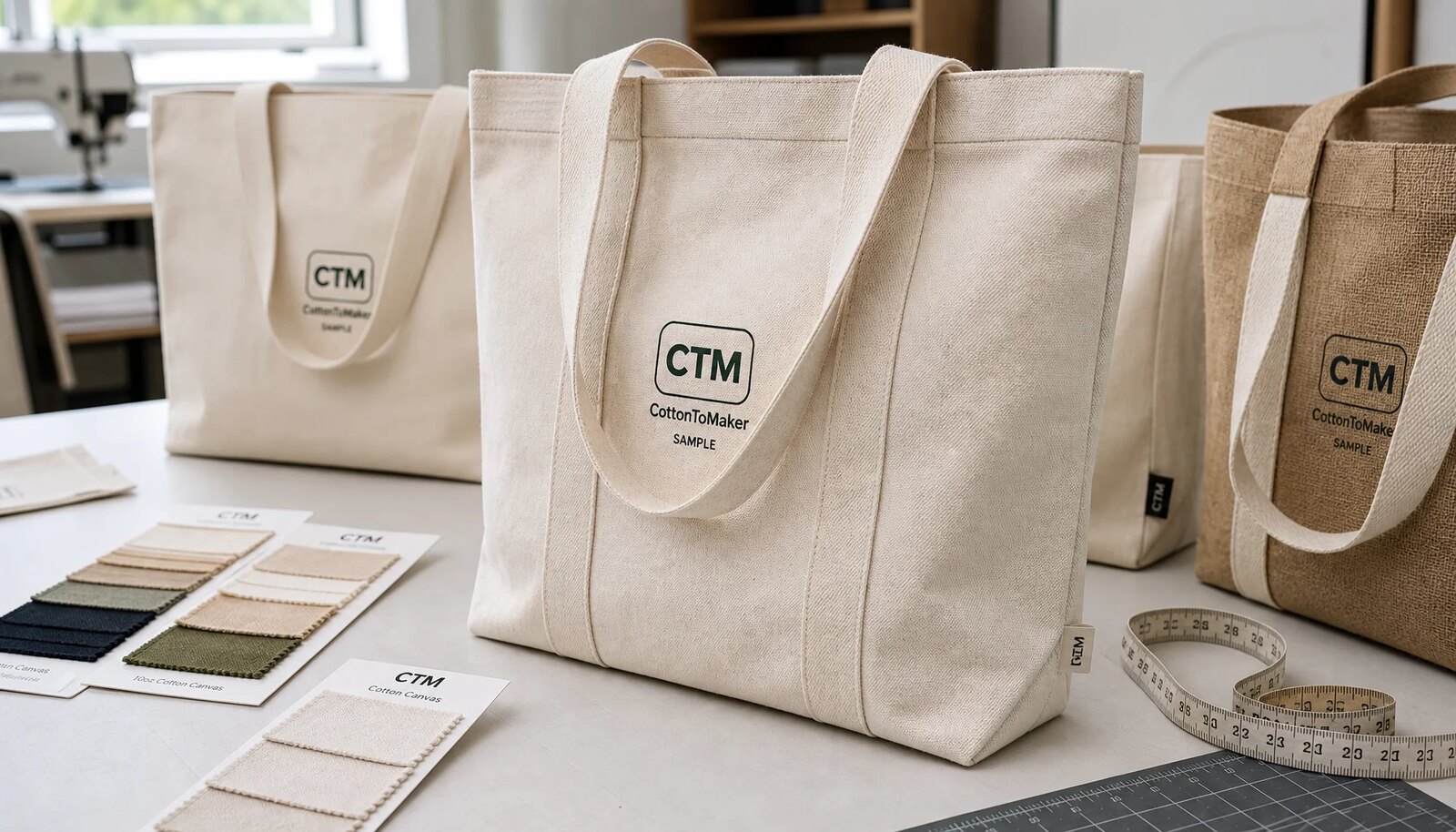
Start With The Commercial Use, Not The Lowest Fabric Price
A custom canvas grocery tote for craft fairs is not a flat promotional bag with a logo dropped on the front. It has to work in a busy retail setting. One customer may put glass jam jars, ceramics, candles, books, soap boxes, folded apparel, art prints, flowers, produce, and purchases from several booths into the same bag. The tote also needs to hang neatly on a booth wall, stack under a table, photograph well for resale, and keep being useful after the event. That is why material selection should begin with the carry use, resale expectation, and channel requirements before anyone asks a factory for the cheapest unit price.
The same tote can need different specifications depending on the buying program. A resale tote should feel more structured, show cleaner stitching, hold print color consistently, and arrive packed in a way that protects inventory. A sponsor giveaway can use lighter fabric if the load expectation is modest, but the handles still need to be safe and repeatable because handle failure reflects directly on the brand. A retailer allocation may need SKU-level carton separation, barcode labels, or hangtags that a single booth order would never request.
Procurement teams get better quotes when the RFQ describes the product mix the bag must carry. Dense goods such as jars, books, and pottery call for stronger handle reinforcement and a more stable bottom. Soft goods such as textiles, maps, and paper inserts can often tolerate a lighter body. If the supplier receives only a logo, quantity, and deadline, they may quote a generic tote that looks acceptable in a digital proof but is underbuilt for grocery-style use. A clear use case protects the buyer and makes supplier comparison fairer.
- Classify the order as resale merchandise, craft fair booth packaging, gift-with-purchase, wholesale grocery tote, farmers market kit, sponsor giveaway, or retailer program.
- Define a realistic load category before quoting: light paper goods, mixed crafts, jars and produce, ceramics and books, or premium heavy-duty reusable use.
- Select 10 oz to 12 oz canvas for most custom canvas grocery totes where durability, structure, and cost control all matter.
- Use 8 oz canvas only for light-duty programs where a softer promotional feel is acceptable and the load expectation is limited.
- Consider 14 oz or 16 oz canvas when the tote is positioned as a premium product and the budget can absorb heavier material, sewing time, and freight.
- Tell the factory whether the bag must stand upright for booth display because that affects fabric stiffness, gusset depth, and pattern design.
Specify Canvas Weight By GSM, Ounces, And Fabric Stage
Canvas weight is often discussed in ounces, but ounce weight alone is a weak basis for procurement decisions. Many suppliers refer to ounces per square yard, while GSM measures grams per square meter. Common commercial references are approximately 270 GSM for 8 oz, 340 GSM for 10 oz, 407 GSM for 12 oz, 475 GSM for 14 oz, and 540 GSM for 16 oz. Treat those numbers as working references, not universal guarantees. Yarn count, weave density, moisture content, washing, softening, dyeing, and finishing can all change the finished handfeel and measured weight.
Fabric stage is where many sourcing mistakes begin. Greige canvas, natural finished canvas, bleached canvas, dyed canvas, washed canvas, softened canvas, and preshrunk canvas can behave differently even when the headline ounce weight looks similar. Washed canvas may fold more easily and feel softer in the hand, but it may lose some crisp structure for booth display. Natural unwashed canvas can feel firmer and more rustic. Dyed canvas needs shade tolerance approval and may print differently from natural canvas. If the sample uses one stock fabric and bulk production uses another batch or process, the finished totes can stand, shrink, and absorb ink differently.
For many craft fair grocery tote programs, 10 oz to 12 oz cotton canvas is the balanced starting range. It gives enough body for mixed purchases while staying manageable for cutting, sewing, screen printing, packing, and freight. Heavier canvas can increase perceived durability, but it also creates thicker seam bulk at the top hem and handle joins. Lighter canvas can meet a tight promotional budget, yet buyers should not market it as a heavy-duty grocery tote unless load testing supports that claim.
- Ask every supplier to state ounces, GSM, weave type, fabric stage, and production tolerance in the written quote.
- Request physical swatches or blank samples for each proposed canvas weight; do not approve stiffness or handfeel from photos.
- Confirm whether the quoted fabric is natural, bleached, dyed, washed, softened, preshrunk, shrink-controlled, or finished after printing.
- Use the same fabric reference for sample and bulk production so print absorption, shrinkage, shade, and structure remain consistent.
- Compare suppliers only when finished bag size, gusset, handles, reinforcement, print method, and packing method are identical.
- Keep an approved swatch in the purchase file and use it as the reference during sample approval and inspection.
Choose A Bag Pattern That Matches Grocery Capacity
The tote pattern determines real capacity as much as the fabric weight does. A flat tote is usually cheaper and quicker to make, but it is not ideal for grocery-style use. Jars, boxed goods, produce, and candles push against the side seams and make the bag awkward to carry. A boxed bottom, side-bottom gusset, or full gusseted construction creates a more stable base, lets products sit upright, and gives the bag a cleaner retail profile at a booth.
A useful grocery tote size range is often about 35-40 cm wide, 35-42 cm high, with a 10-15 cm finished gusset. That range is a starting point, not a rule. A candle brand may need a wider base and moderate height so products do not stack too high. A farm shop may want more height for leafy produce. A pottery seller may need a stronger bottom and careful seam placement. The RFQ should state finished dimensions after sewing. Cutting dimensions and flat-panel dimensions can hide construction differences, which makes a low quote appear equivalent when it is not.
Gusset construction also changes artwork placement. A front logo should sit on the visible panel, not disappear into a fold or land too close to the bottom seam. Large print blocks can distort when the bag is filled. If the artwork must appear centered for retail display, ask the factory to confirm the printable area after the gusset is formed and after the handles are attached. This matters even more when the same tote will be sold by several vendors or displayed on hooks.
- Use a 10 cm gusset for compact merchandise, light groceries, small boxed goods, and easier folding under booth tables.
- Use a 12-15 cm gusset for jars, bottles, produce, candles, ceramics, or multi-vendor craft fair purchases.
- State finished width, finished height, gusset depth, top opening shape, bottom style, and side seam position in the RFQ.
- Ask for flat measurements plus a filled standing photo during sample approval to confirm usable capacity and display shape.
- Keep artwork inside the safe front-panel area and away from side folds, bottom folds, handle joins, and thick seam zones.
- Set separate tolerances for width, height, gusset, handle drop, and print placement because each affects final usability.
Treat Handles As A Load-Bearing Specification
Handles are one of the most common failure points in custom canvas grocery totes. The body fabric may be strong enough, but the bag can still fail if the handle join is poorly stitched, the handle material is too narrow, or the top hem is not built to take stress. At craft fairs, customers may carry the tote for hours while walking between booths. Comfort therefore matters alongside strength. A procurement spec should define handle material, width, drop, reinforcement method, stitch density, thread color, and placement tolerance rather than accepting a vague phrase such as canvas handles.
For shoulder carry, a finished handle drop of about 55-65 cm works well for many reusable grocery totes. Shorter handles can be fine for intentional hand carry, but they are less convenient when customers wear coats or carry multiple purchases. Width changes the perceived quality too. A 3-4 cm handle spreads weight better and looks proportionate on a 10 oz to 12 oz gusseted tote. Very narrow handles can make the bag feel cheaper even when the body canvas is acceptable. Self-fabric handles give a coordinated retail look, while cotton webbing can provide consistent thickness and comfort if the webbing quality is specified.
Reinforcement should be visible, repeatable, and testable. Box-X stitch, cross stitch, bar tack, double bar tack, or a combined method can all work when sewn correctly. The key is consistency: each handle end should be attached through the reinforced top area, the stitch pattern should not wander, the thread should not break, and the body fabric should not tear under the intended load. With heavier canvas, factories also need to manage thick layers at the top hem without skipped stitches, needle damage, or uneven feeding.
- Use 3-4 cm wide handles for better comfort when carrying jars, books, produce, pottery, or bundled craft purchases.
- Specify a 55-65 cm finished handle drop for shoulder carry, or a shorter drop only when hand carry is intentional.
- Define self-fabric canvas handles, cotton webbing handles, or another material with width, thickness, color, and shrinkage expectations.
- Require Box-X stitch, cross stitch, bar tack, double bar tack, or combined reinforcement at every handle end.
- Inspect handle alignment and drop symmetry because uneven handles make a tote look defective even if it passes a basic load check.
- Include handle pull or hanging load testing in QC, especially for 12 oz and heavier canvas or deep-gusset grocery totes.
Select Print Method After Testing Artwork On The Exact Canvas
Print method should follow the artwork, canvas color, fabric texture, ink coverage, and order quantity. For most custom canvas grocery totes for craft fairs, screen printing is the practical default when artwork uses solid logos, simple typography, line art, and one to four spot colors. It is repeatable, cost-efficient at wholesale quantities, and suitable for natural cotton canvas when opacity and curing are controlled. Still, it is not automatically the best choice for every file.
Digital printing, heat transfer, and embroidery each have a place. Digital print can support multicolor artwork and gradients, but the canvas weave can soften edges compared with smoother fabrics. Heat transfer can handle detailed art and smaller mixed-design runs, yet buyers should check handfeel, edge lifting, cracking, and appearance after folding. Embroidery can look premium for a small mark, but it increases cost, may pucker lighter canvas, and is usually not practical for large grocery tote artwork.
Artwork risk should be caught before the supplier locks the production plan. Fine type, distressed texture, thin lines, gradients, heavy ink blocks, and prints near seams create avoidable problems. Dark dyed canvas may need an underbase to make bright colors visible, which adds cost and can change the ink feel. Natural canvas can vary slightly by batch, affecting perceived print color. For bulk orders, approve a printed pre-production sample on the exact canvas weight, color, and finishing planned for production.
- Use screen printing for bold logos, simple slogans, line art, and repeat wholesale craft fair tote programs.
- Provide vector files where possible, Pantone references, print dimensions, print position, minimum line thickness, and acceptable color variance.
- Test digital print or heat transfer for gradients, photos, detailed illustrations, or small mixed-design orders before bulk approval.
- Budget for an underbase, extra pass, or special ink when printing bright colors on dark dyed canvas.
- Avoid placing artwork over gusset folds, handle joins, thick seams, top hem areas, or uneven surface zones unless testing confirms quality.
- Check ink curing, dry rub resistance, folding behavior, opacity, registration, edge sharpness, and cracking on the actual production canvas.
Control MOQ, Unit Cost, And Quote Comparability
Two suppliers can quote very different prices for what appears to be the same canvas tote because their assumptions are not the same. Fabric consumption is a major cost driver, especially when moving from 8 oz to 12 oz canvas or adding a deep gusset. Heavy canvas can slow cutting and sewing, increase needle wear, raise carton weight, and require more careful printing. A low unit price may also exclude screen charges, sample fees, PMS matching, special packing, upgraded cartons, inspection, or inland freight. Procurement should separate these items before choosing a supplier.
MOQ logic needs to be clear before a multi-design craft fair program is approved. Natural canvas often has more flexible availability because factories may keep common weights in stock. Dyed canvas may require a dye lot minimum and shade approval. Custom Pantone-dyed canvas can be inefficient at small quantities. Multiple print designs on the same natural canvas may be easier to combine than multiple fabric colors, but each artwork can still require separate screens, setup, sampling, inspection tracking, and carton separation.
A fair RFQ asks every supplier to price the same construction and list the same assumptions. If one quote uses 8 oz canvas, flat construction, short handles, and mixed bulk packing while another uses 12 oz canvas, a boxed gusset, reinforced shoulder handles, and SKU-separated cartons, the unit prices are not comparable. Ask for line items where possible: body fabric, sewing, handles, print setup, print run cost, packing materials, labels, samples, and estimated freight weight. That detail shows which decisions actually move the landed cost.
- Request price impact for 8 oz, 10 oz, 12 oz, and 14 oz canvas using the same bag size, gusset, handle, print, and packing assumptions.
- Confirm MOQ per fabric color, canvas weight, bag size, print design, screen setup, packed SKU, and shipment destination.
- Keep fabric color, size, gusset, and handle construction consistent across designs when possible to reduce production complexity.
- Ask suppliers to separate screen charges, PMS matching, sample fees, hangtags, individual packing, barcode labels, inspection, and carton upgrades.
- Confirm whether the quote includes export cartons, carton marks, inner bundles, individual bags, or only basic bulk packing.
- Do not award based on unit price until every supplier confirms the same canvas stage, reinforcement, print method, dimensional tolerance, and carton quantity.
Use Samples To Lock The Production Standard
Sampling is the buyer's strongest protection against bulk disputes. A digital mockup can show approximate artwork position, but it cannot show canvas stiffness, seam bulk, handle comfort, print absorption, ink handfeel, or true grocery capacity. For a new custom canvas grocery tote, start with a blank construction sample when the canvas weight, size, gusset, handle type, or pattern is new. This lets the buyer validate body structure and sewing before paying for final print setup.
After the blank sample is approved, request a printed pre-production sample using final fabric, final finished dimensions, final handle construction, final thread color, final artwork, final print size, final print method, and intended packing approach. That sample becomes the control standard for bulk production. The buyer and supplier should keep matching signed samples or detailed approval photos with measurements. If artwork, fabric, handle length, gusset, or packing changes later, revise the approval formally rather than treating it as a casual email note.
Sample review should include practical use tests, not only desk measurements. Load the tote with the type of products it will carry. Hang it by the handles. Fold the printed area. Place it on a table with realistic contents and see whether it stands, leans, or collapses. Check whether the top hem twists, whether the handles feel comfortable, and whether the print sits correctly when the bag is filled. These simple checks catch issues that a flat product photo will miss.
- Request a blank construction sample first when changing canvas weight, gusset depth, handle type, finished size, or bottom pattern.
- Approve a printed pre-production sample before bulk when artwork, fabric color, ink, print method, or print position is new.
- Measure width, height, gusset, handle drop, handle width, print position, top hem width, and carton packing method against the RFQ.
- Load the sample with realistic craft fair or grocery weight and observe seam movement, handle stretch, bottom stability, and comfort.
- Fold and rub the printed area to check cracking, flaking, transfer, curing, and ink feel before bulk production begins.
- Keep one approved sample with the buyer and one with the factory, and use them as the inspection reference.
Write QC Standards Inspectors Can Measure
Quality-control language has to be measurable. Phrases such as strong handles, good stitching, or nice printing are too subjective for a B2B purchase order. A canvas grocery tote inspection plan should cover fabric weight, finished dimensions, stitch density, seam allowance, top hem, handle reinforcement, gusset depth, print placement, print curing, stains, loose threads, packing count, carton marks, and carton condition. The approved sample supports the written specification, but it should not replace it.
Agree defect classification before production starts. Critical defects may include broken handles, wrong artwork, severe contamination, unsafe foreign objects, or a bag that cannot carry the stated load. Major defects may include wrong fabric weight, dimensions outside tolerance, missing reinforcement, open seams, severe stains, print misregistration, wrong color, incorrect packing count, or mixed SKUs. Minor defects may include small thread ends or slight natural canvas variation within the accepted standard. Clear classification helps suppliers, inspectors, and buyers make consistent calls.
Inspection should include visual, dimensional, and functional checks. Measure random pieces. Compare fabric shade and handfeel to the approved swatch. Check stitch density at stress points, not only along easy straight seams. Apply a handle load test on a defined sample quantity. Rub and fold printed areas after curing. Confirm carton marks, SKU separation, carton count, and gross weight. For heavy canvas bags, carton weight matters because overloaded cartons can tear, deform, or create handling problems during freight and warehouse receiving.
- Set finished size tolerance before bulk, commonly +/-1 cm for width and height on standard totes unless tighter tolerance is agreed.
- Set gusset and handle drop tolerance separately, commonly about +/-0.5 cm to +/-1 cm depending on construction and order requirements.
- Define stitch density, often around 7-9 stitches per inch for many canvas tote applications, subject to fabric weight and machine setup.
- Require handle pull or hanging load testing using a weight and duration that reflect the intended craft fair or grocery carry use.
- Check print position tolerance, ink opacity, registration, curing, rub resistance, folding performance, and edge sharpness.
- Inspect stains, oil marks, mildew odor, excessive slubs, loose threads, skipped stitches, open seams, raw edges, and crooked hems.
Plan Packing For Booth Setup, Warehouses, And Freight
Packing is part of the product specification because it affects receiving accuracy, booth setup, freight cost, and customer presentation. Craft fair buyers may need totes sorted by design, artist, retailer, event date, sales kit, or warehouse destination. Bulk packing can reduce waste and carton volume, but it works only when carton marks clearly identify PO number, SKU, fabric color, artwork code, quantity, destination, and carton sequence. Mixed cartons may save a little space, but they often create sorting errors when the booth or warehouse team is working under pressure.
Individual polybags should be used only when the channel requires them. They can protect retail inventory and keep each tote clean, but they add material cost, labor, plastic waste, lead time, and carton volume. For many craft fair programs, bulk pack by SKU with inner bundles is more practical. If the tote is sold directly to consumers, a hangtag, paper belly band, or barcode label may be better than full polybag packing. Include those items in the artwork, sample, quote, and packing instructions.
Carton planning becomes more important as canvas weight increases. A carton of 14 oz or 16 oz gusseted totes can become heavy quickly. Overloaded cartons may deform, split, or exceed comfortable manual handling weight. Before approving production, ask for estimated pieces per carton, carton dimensions, gross weight, carton mark layout, and SKU separation plan. This information supports freight quotation and reduces receiving disputes.
- Separate SKUs by carton whenever possible to speed warehouse receiving, craft fair setup, retailer allocation, and inventory counting.
- Use carton marks with item code, artwork code, fabric color, quantity, PO number, destination, event reference, and carton number.
- Request carton dimensions, pieces per carton, and estimated gross weight before confirming freight or final packing instructions.
- Avoid overly heavy cartons, especially for 12 oz, 14 oz, or 16 oz gusseted canvas grocery totes.
- Use individual polybags only when required by the channel, and price them separately from the base bag cost.
- Confirm whether hangtags, belly bands, tissue, inner bundles, barcode labels, and master carton labels are included in the packing quote.
Protect Lead Time With Approval Milestones
Lead time depends on much more than sewing capacity. Fabric stock, dyeing, sample development, artwork approval, print screens, ink matching, curing time, packing complexity, inspection scheduling, export documentation, freight booking, customs clearance, and inland delivery all affect the real calendar. Natural canvas with a one-color screen print is usually simpler than dyed canvas with several artwork versions, but buyers should still confirm current fabric availability and the factory production queue before promising event delivery.
The biggest schedule risk is often late approval rather than slow sewing. If artwork changes after screens are prepared, print setup may need to restart. If the blank sample is approved and the buyer later changes gusset depth or handle drop, the pattern and fabric consumption may change. If dyed fabric is rejected for shade, new material can delay the order. For seasonal craft fairs and market launches, missed delivery is usually more damaging than paying a slightly higher unit price for a better-controlled supplier.
A practical timeline separates each milestone: RFQ clarification, swatch dispatch, blank sample, artwork proof, printed pre-production sample, deposit, fabric booking, bulk cutting, sewing, printing, finishing, inspection, packing, shipment, and final delivery. The purchase order should state which milestone starts the production clock. Many factories count bulk lead time from deposit plus final sample approval, not from the first quote date. Event-driven programs should include buffer time for inspection findings, repair, repacking, freight delays, and final distribution.
- Freeze artwork before ordering screens, confirming color separations, or approving printed pre-production samples.
- Confirm fabric stock, fabric booking, dye lot timing, and expected shrinkage treatment before placing a time-sensitive order.
- Allow extra time for dyed canvas, custom Pantone fabric, multiple print designs, hangtags, barcode labels, or SKU-separated packing.
- Schedule inspection before the planned ship date, not on the same day goods must leave the factory.
- Build time for sample shipping, approval revisions, export documents, freight booking, customs, and inland delivery.
- Ask the supplier which milestone starts the production clock: deposit, fabric approval, or signed printed pre-production sample.
Specification comparison for buyers
| Spec decision | Recommended B2B specification | When it fits | Buyer risk to verify |
|---|---|---|---|
| Main body canvas | 10 oz to 12 oz cotton canvas, approximately 340-407 GSM by the supplier's stated measurement method; request about +/-5% tolerance when available | Most craft fair grocery totes carrying jars, books, candles, folded apparel, produce, boxed foods, and mixed customer purchases | Ounce references are not always measured at the same fabric stage. Confirm GSM, greige or finished status, weave, shrinkage treatment, and whether bulk fabric matches the approved swatch. |
| Lightweight cost option | 8 oz cotton canvas, approximately 270 GSM, with reinforced handles and controlled seam allowance | Light booth packaging, paper goods, apparel, maps, event giveaways, sponsor programs, and low-price seasonal promotions | Can feel promotional rather than retail, may collapse on display, and may not suit dense grocery loads. Define the carry use before accepting this option. |
| Premium heavy-duty option | 14 oz to 16 oz cotton canvas, approximately 475-540 GSM depending on supplier reference and finishing | Higher-price retail totes, farmers market kits, reusable merchandise, and programs where durability perception supports the sell price | Higher material cost, thicker seam bulk, slower sewing, heavier cartons, higher freight, and possible print cracking on large ink areas if curing and flex testing are not controlled. |
| Gusset and base | Boxed bottom or side-bottom gusset, typically 10-15 cm finished depth | Bottles, jars, produce, boxed foods, ceramics, candles, and multi-vendor craft fair purchases that need a stable base | Flat bag dimensions can hide capacity differences. Require finished width, height, gusset depth, bottom construction, and sample measurements. |
| Handle system | Self-fabric canvas or cotton webbing handles, 3-4 cm wide, 55-65 cm finished shoulder drop, reinforced at each end | Reusable grocery carry and craft fair shopping where customers may carry the tote for several hours | Thin handles, short drops, uneven placement, missing reinforcement, and low stitch density cause comfort and failure issues. Define handle width, drop, reinforcement, and pull test. |
| Handle reinforcement | Box-X stitch, cross stitch, bar tack, double bar tack, or combined reinforcement using suitable thread | Any tote expected to carry grocery or craft merchandise weight | A visible reinforcement pattern is not enough. Inspect stitch density, back-tacking, thread breaks, fabric tearing, and handle alignment. |
| Print method | Screen print for most 1-4 spot color logos; test digital print or heat transfer for gradients, photos, or short multi-design runs | Wholesale craft fair programs with simple branding, artist marks, market logos, sponsor graphics, or seasonal artwork | Fine lines, distressed texture, dark canvas, heavy ink coverage, and printing near folds require pre-production testing on the exact canvas. |
| Inside finishing | Overlocked internal seams plus folded top hem for standard wholesale; bound seams for premium retail | Most canvas grocery totes where durability, cost, and production speed must stay balanced | Loose threads, skipped stitches, raw edges, uneven hems, and weak gusset corners are common low-quote defects. Define seam allowance, SPI, trimming, and rework rules. |
| Packing format | Bulk pack by SKU with inner bundles; individual polybag only when retail channel or warehouse process requires it | Craft fair distribution, wholesale receiving, lower-waste programs, and event kit preparation | Mixed cartons create receiving errors. Require carton marks by PO, SKU, artwork, color, quantity, gross weight, and destination. |
Buyer checklist before sampling
- Define finished bag width, height, gusset depth, handle drop, handle width, top hem width, print area, and dimensional tolerance before requesting price.
- Specify canvas weight in both ounces and GSM, and state whether the quoted weight is greige, dyed, washed, softened, preshrunk, or finished fabric.
- Identify the buying purpose: resale merchandise, booth packaging, gift-with-purchase, wholesale grocery tote, farmers market kit, sponsor giveaway, or retailer allocation.
- Set a target load category such as light paper goods, mixed craft purchases, grocery jars and produce, ceramics, books, or premium heavy-duty reusable use.
- Request fabric swatches or blank samples for every proposed canvas weight because photos do not show stiffness, weave density, shrinkage behavior, handfeel, or folding structure.
- Send final artwork with vector files where possible, Pantone references, print dimensions, print position, ink coverage notes, minimum line thickness, and acceptable color variance.
- Ask the supplier to recommend screen print, digital print, heat transfer, embroidery, or hybrid decoration based on artwork detail, canvas color, order quantity, and durability expectations.
- Require one blank construction sample and one printed pre-production sample before bulk approval when material, bag size, print method, or artwork is new.
- Set acceptance rules for natural canvas shade variation, slubs, seed specks, stains, oil marks, creasing, and dyed fabric shade tolerance.
- Define handle reinforcement, stitch density, thread type, thread color, top hem width, seam allowance, gusset construction, loose-thread trimming, and repair policy.
Factory quote questions to send
- What are the exact ounce weight and GSM of the proposed canvas, and is that measured before or after dyeing, washing, softening, or finishing?
- What fabric weight tolerance do you control in production, and can you provide a swatch from the same fabric type planned for bulk?
- Is the canvas natural, bleached, dyed, washed, enzyme washed, softened, preshrunk, sanforized, or otherwise shrink-controlled?
- Can you quote 8 oz, 10 oz, 12 oz, and 14 oz options using the same finished size, gusset, handle, print area, packing method, and carton quantity?
- What is the MOQ per fabric color, per canvas weight, per bag size, per print design, per screen setup, and per final packed SKU?
- Can multiple print designs be combined on one fabric order if the bag construction and canvas color remain the same?
- Which print method do you recommend for our artwork, and why is it suitable for this canvas weight, weave texture, fabric color, and order quantity?
- What is the maximum reliable printable area on the front panel after allowing for seam bulk, handle joins, gusset folds, and top hem distortion?
- For dark canvas or bright Pantone targets, do you need an underbase, extra print pass, special ink, longer curing time, or adjusted artwork separation?
- What handle reinforcement will be used: Box-X stitch, cross stitch, bar tack, double bar tack, or a combined method?
Quality-control points to confirm
- Finished dimensions should be checked against the purchase specification, commonly within +/-1 cm for width and height, +/-0.5 cm to +/-1 cm for gusset depth, and +/-0.5 cm for handle drop on standard totes unless tighter tolerance is agreed.
- Fabric weight should be verified against the approved swatch and supplier specification, with GSM tolerance documented and weave appearance, stiffness, shade, and handfeel matching the signed sample.
- Natural canvas should be inspected for shade variation, slubs, seed specks, stains, oil marks, mildew odor, excessive creasing, and foreign fibers according to agreed acceptance limits.
- Dyed canvas should be compared against the approved color standard under consistent lighting, with shade banding, crocking risk, and panel-to-panel mismatch checked before packing.
- Handle attachment must pass the agreed pull or hanging load test without tearing fabric, opening stitches, breaking thread, distorting the top hem excessively, or shifting handle position.
- Top hem should be even, flat, and free from twisting, skipped stitches, open seams, loose threads, needle damage, visible raw edges, and inconsistent fold width.
- Gusset depth, bottom alignment, side seam symmetry, and standing shape should match the approved sample so capacity is consistent across bulk pieces.
- Print color, placement, registration, opacity, edge sharpness, coverage, curing, and ink feel should match the approved proof or printed pre-production sample.
- Printed areas should not crack, peel, bleed, or transfer after basic dry rub, fold-flex, and handling checks appropriate for canvas totes.
- Seam allowance and stitch density should be checked on random pieces, especially at stress points such as handles, top hem corners, gussets, bottom seams, and side seams.