Start with the way the tote will be used
A custom canvas grocery tote for a coffee roaster has to do several jobs at once. It may sit beside retail coffee bags at the register, hang from a peg wall, travel to farmers markets, carry wholesale samples, or go home with a subscription customer. In each setting, the logo is judged in motion: folded, filled, stacked, hand-carried, and sometimes worn over a shoulder. A placement that looks balanced on a flat mockup can look too low after the gusset opens or too close to the handle once the top hem is sewn.
That is why procurement should treat logo placement as a production specification, not a late design comment. Placement affects setup time, print yield, inspection rules, packing, and repeat-order consistency. A logo close to a seam may require slower handling. A print across a fold may arrive creased. A heavy block of ink can stiffen the panel and make natural canvas slubs more visible. Those issues cost real money when they appear after bulk production.
Coffee roaster branding often sits among visually busy items: kraft coffee bags, roast labels, cups, menus, shelf talkers, grinders, and brewer boxes. A restrained upper-panel logo usually works well because it remains visible without making the tote feel like disposable advertising. Large event artwork can also work, but it should be approved on a sewn, filled, and folded sample instead of only on a rendered proof.
- Define logo placement in millimeters before the printed sample is made.
- Approve placement on a sewn tote because hems, gussets, handles, and bar-tacks change the usable print area.
- Check visibility while the tote is hanging, filled, folded, hand-carried, and shoulder-carried.
- Document the true front panel and packing orientation so the approved face is protected in cartons.
- Avoid RFQ language such as "center logo on bag" unless it includes measurement points and tolerance.
Choose the bag format before the artwork size
The best tote specification begins with the use case, not the decoration method. A low-cost event giveaway, a paid cafe merchandise item, and a wholesale customer gift do not need identical construction. If buyers expect customers to carry several coffee bags, canned drinks, jars, books, or market groceries, the tote needs enough body, gusset volume, and handle strength. If the tote is mainly a subscription insert, folded size and carton efficiency may matter more than heavy-load performance.
For many coffee roasters, 10 oz to 12 oz cotton canvas is a practical starting point. Ten-ounce canvas is commonly used for branded retail totes because it balances cost, weight, and print stability. Twelve-ounce canvas usually feels more substantial and gives the front panel a flatter printing surface. Eight-ounce canvas can fit cost-sensitive campaigns, but it wrinkles more readily and may feel less retail-grade. Ask for both oz and GSM because fabric weight terminology is not always used consistently across suppliers.
Shape also matters. A flat tote is simple and often cheaper, but a grocery tote with a side or bottom gusset carries more volume and feels more useful. The gusset also creates fold lines, which reduce the safe logo zone. If the artwork sits too low, the bottom expansion can bend or hide it when the bag is filled. Decide whether the tote is mainly brand display, real grocery carrier, or premium merchandise, then size the logo around that job.
- Event giveaway: lighter canvas may be acceptable when load expectations are modest.
- Cafe retail resale: 10 oz to 12 oz canvas, clean sewing, strong handles, and controlled print placement are usually worth specifying.
- Farmers market tote: add gusset depth and reinforced handles, then test the logo on the filled bag.
- Subscription insert: confirm folded dimensions and carton efficiency before approving the finished size.
- Wholesale gift: prioritize consistent finish, protected packing, and repeat-order color control.
Specify canvas weight, finish, and tolerance
Canvas weight is one of the first cost levers in a tote quote, but it is not a simple heavier-is-better decision. Lighter canvas can reduce unit cost and freight weight, yet it may wrinkle during printing and packing. Heavier canvas usually improves hand feel and panel stability, but it increases fabric cost, sewing resistance, carton weight, and sometimes lead time. The right specification is the lightest construction that still supports the intended load, print quality, and retail presentation.
When comparing suppliers, ask for the fabric description in both ounces and GSM. A 10 oz canvas is often discussed around 340 gsm and a 12 oz canvas around 407 gsm, but conversion depends on how the supplier defines fabric ounce. The safer route is to approve a physical swatch or blank sample and state the accepted weight range in the purchase order. If the roaster has sustainability requirements, ask early whether the cotton is conventional, organic, recycled blend, or certified under a specific program, and request documentation.
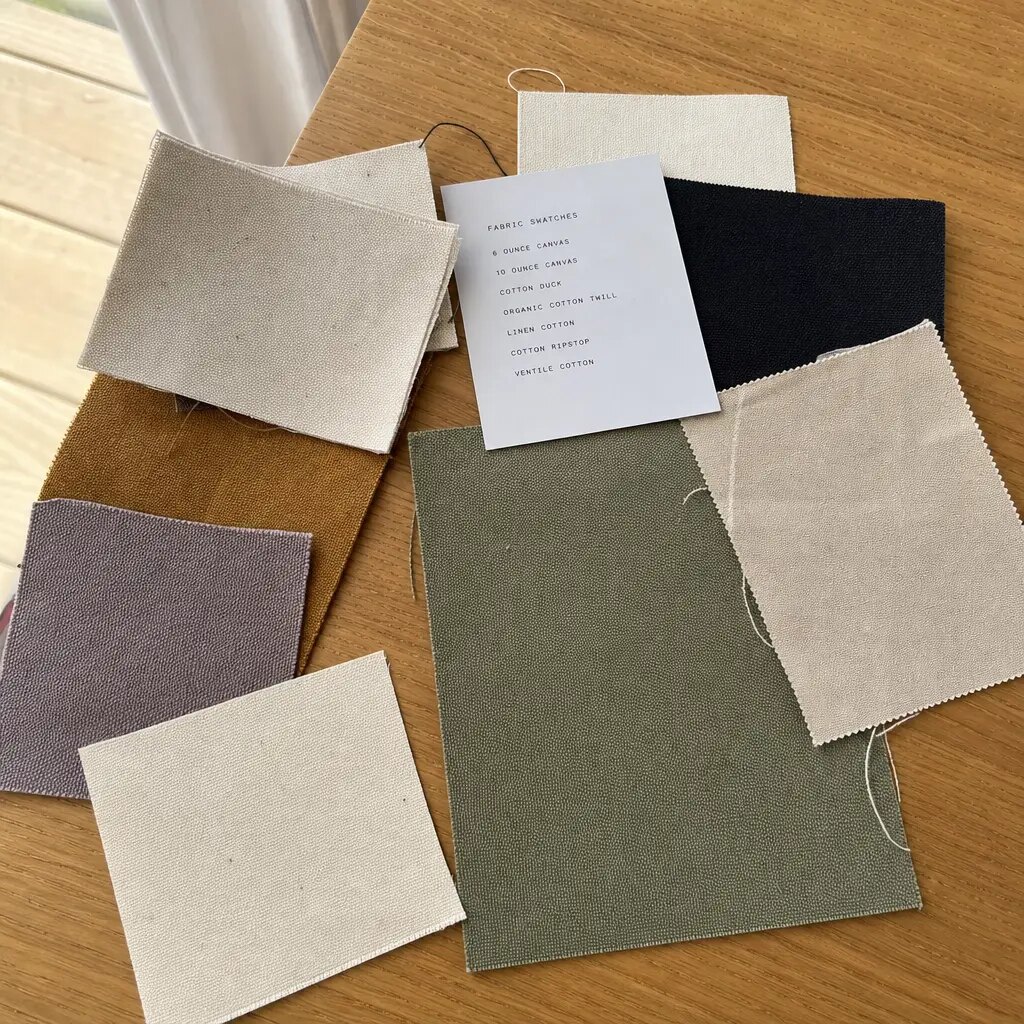
Fabric finish changes both the appearance and the print result. Natural canvas is popular with coffee brands because it pairs easily with kraft packaging, but it is not one universal shade. One supplier's natural canvas may look warm cream while another may look grey or speckled. Bleached canvas gives a cleaner base for color but can feel less earthy. Dyed canvas adds brand flexibility, but it needs shade-lot control and colorfastness checks. Washed canvas may feel softer, yet it can shrink, distort, or make placement less crisp if the process is not controlled.
- State canvas oz and GSM in the RFQ and purchase order.
- Request fabric color and finish: natural, bleached, dyed, washed, greige, or custom dyed.
- For repeat programs, keep an approved fabric swatch or sealed blank sample.
- Ask whether dimensional tolerances are measured before or after washing, pressing, and packing.
- If washability matters, request shrinkage, colorfastness, and print-after-wash expectations before sampling.
- Do not approve ink color without seeing it on the actual canvas shade or an approved equivalent.
Build a logo placement map suppliers can follow
A dependable placement map uses fixed construction points. Common references include the top hem, vertical panel center line, side seam, and bottom fold. Handles can help the eye, but they should not be the only measurement point because handle attachment can shift slightly during sewing. A clear instruction might read: front panel only, logo width 110 mm, top edge of logo 65 mm below top hem, logo centered on panel center line, minimum 35 mm clearance from handle bar-tacks and side seams, placement tolerance +/-7 mm.
The upper front panel is usually the safest location for a coffee roaster grocery tote. It stays visible above the area that bends when the bag is filled, and it works well when the tote hangs from a peg or rests near the register. Lower-panel graphics can look attractive in photography, but they are more likely to crease, disappear into the gusset, or rub against shelves and counters. If the artwork is intentionally large or low, ask for a filled-bag photo and a packed-fold photo before bulk approval.
Two-sided printing needs its own control. The back panel may not behave exactly like the front, especially if the tote includes a pocket, woven label, side tag, or asymmetric handle attachment. If both sides carry artwork, decide whether one diagram applies to both sides or whether each side needs separate measurements. For mixed artwork programs, use item codes and file names that tie each logo version to its approved diagram.
- Keep critical logo elements at least 25-40 mm from seams, bar-tacks, gusset folds, top hems, and bottom folds unless the approved design intentionally crosses them.
- Use the top hem and center line as primary references for most front-panel logos.
- Confirm whether the controlled point is the top of the logo, center of the logo, or bottom of the logo.
- State placement tolerance, such as +/-5 mm or +/-10 mm, before sampling.
- Ask for ruler photos of the sample showing logo width, top distance, and side clearance.
- For offset logos, specify left or right from the viewer perspective to avoid production confusion.
Match print method to artwork and order economics
Screen printing remains a strong option for custom canvas grocery totes when the roaster uses a bold one-color or two-color mark and expects repeat orders. It can create a clean retail finish on canvas when the artwork is vectorized and the fabric surface is stable. The tradeoff is setup: each color can add screen cost, registration work, and inspection risk. Screen printing usually makes the most sense when the buyer can meet a practical MOQ and reorder the same design.
DTF and heat transfer methods can help with lower MOQ, gradients, full-color artwork, multiple cafe locations, or seasonal graphics. They can hold details that may be difficult to screen print, but the buyer should inspect hand feel, edge finish, adhesion, flexibility, and heat marks. A transfer may be acceptable for a pilot order or event tote and less suitable for a retail grocery tote that customers fold, wash, and use repeatedly. Ask whether the transfer has been tested on the same canvas weight and finish.
Embroidery, woven labels, and side tags can add premium detail, but they answer a different brief than a main front logo. Embroidery can pucker canvas when the stitch count is high, and large filled designs can become expensive. Many roasters get a more balanced result from a printed upper-panel wordmark plus a small woven side label. The decoration method should follow the buyer's objective: low-cost campaign, repeat retail item, premium gift, or variable artwork program.
- Screen print: best for stable logos, 1-2 colors, repeat orders, and clean retail presentation.
- DTF or heat transfer: useful for lower MOQ, detailed artwork, gradients, and versioned campaigns.
- Embroidery: better for small marks or premium accents than large grocery-tote graphics.
- Water-based inks may give a softer hand but need opacity checks on natural or dark canvas.
- Fine line art should be checked against minimum stroke width and minimum letter height.
- Request a strike-off or printed sample on actual canvas before authorizing bulk production.
Compare MOQ, versions, and landed cost
A tote MOQ is rarely one simple number. It may reflect fabric purchase, cutting efficiency, sewing capacity, print setup, carton packing, or the supplier's commercial policy. One factory may accept a lower blank-bag MOQ but require a higher quantity for screen printing. Another may accept a small transfer order with a higher unit price. To compare quotes fairly, separate blank tote cost, decoration cost, setup cost, sample cost, packing cost, and freight impact.
Artwork variation is a common cost trap for coffee roasters. A buyer may want one core brand logo plus versions for a flagship cafe, subscription club, seasonal blend, or wholesale event. With screen printing, each version may require its own screen, proof, sample, carton mark, and receiving record. Transfer printing may make versioning easier, but it can raise the per-unit decoration cost or change the feel of the product. The best route depends on whether the buyer is testing demand or building a repeatable merchandise program.
Ask for scenario pricing using the same bag construction. For example: 500 units with transfer print, 1,000 units with one-color screen print, and 2,500 units as a repeat screen-print order. The comparison should include setup, sample freight, bulk freight, inspection, carton CBM, duty assumptions if applicable, and likely reorder cost. A low first unit price is not always the lowest total cost if it increases sample rounds, carton volume, or rejects.
- Ask for MOQ by blank bag, one-color print, two-color print, transfer print, and each artwork version.
- Separate screen, plate, file handling, sample, and repeat-order charges.
- Confirm whether screens or production files are stored and for how long.
- Ask whether mixed artwork can share one cutting and sewing run.
- Confirm whether mixed cartons add labor, labels, or warehouse receiving complexity.
- Compare launch quantity, reorder quantity, and annual expected volume, not only the first order.
Write the RFQ like a production file
A strong RFQ for custom canvas grocery totes should give the supplier enough information to quote the same product every time. Include finished dimensions, gusset depth, fabric weight, fabric finish, handle specification, print method, number of colors, logo size, placement diagram, tolerance, packing method, carton plan, lead time, and incoterm. Without those details, two quotes can look similar in a spreadsheet while differing in fabric body, handle strength, print quality, and freight cost.
Artwork details need the same discipline. Provide vector files when possible, final artwork size, color references, and any minimum brand requirements. If the roaster logo includes tiny text, distressed texture, fine lines, or a registration-sensitive badge, ask the factory to confirm feasibility before sampling. A capable supplier should be able to state minimum line thickness and text height for the chosen print method. If they cannot, treat the first sample as a technical test, not routine approval.
Commercial terms also need alignment. EXW, FOB, CIF, and DDP shift responsibility and cost between buyer and seller. A low EXW price may not include inland transport, export handling, freight, insurance, duties, customs clearance, or final delivery. Packing details are part of the quote because carton dimensions and gross weight drive freight. For multi-cafe rollouts, carton marks and packing lists also affect receiving labor.
- Bag spec: finished width, height, gusset, dimensional tolerance, canvas oz, GSM, color, and finish.
- Handle spec: material, width, drop, attachment point, bar-tack or box-x reinforcement, and expected carry style.
- Decoration spec: method, logo size, color count, Pantone target, setup cost, and repeat-order cost.
- Placement spec: marked diagram with measurement points and tolerance.
- Sample terms: blank sample, printed sample, revision cost, sample lead time, and sample freight.
- Packing terms: fold direction, printed-face protection, polybag choice, units per carton, dimensions, gross weight, and carton marks.
- Commercial terms: MOQ, lead time after approval, payment terms, incoterm, quote validity, inspection responsibility, and change-order rules.
Approve samples with measurable comments
Sampling should reduce uncertainty, not become a beauty contest. If the tote construction is new, begin with a blank sample. This lets the buyer check canvas body, handle drop, stitch quality, gusset shape, folded size, and carrying comfort before print cost enters the discussion. A blank sample is especially useful when moving from a flat tote to a grocery gusset, changing canvas weight, adding a pocket, or changing the handle length.
The printed pre-production sample should be reviewed against the approved placement diagram. Measure logo width and height, top distance from the hem, horizontal centering, and clearance from seams and bar-tacks. Photograph the sample with a ruler and record the file name, fabric shade, print method, ink target, and any agreed correction. If the roaster has several internal approvers, consolidate feedback before sending it to the factory. Conflicting comments can restart sampling and make responsibility unclear.
Approval language should be precise. Instead of "logo looks a bit low," write "move logo up 12 mm; keep width 110 mm; maintain center alignment; tolerance +/-7 mm." Instead of "color is darker," write the approved Pantone target or physical sample reference and state whether the current sample is rejected or accepted as the bulk standard. Keep one sealed approved sample at the factory and one buyer-side reference for incoming inspection.
- Approve blank construction before printing when size, canvas, handle, or gusset is new.
- Approve print on the actual sewn tote, not just a flat pattern or PDF mockup.
- Use ruler photos to record placement and artwork size.
- Fill the sample with typical retail items and check visibility under real carry conditions.
- Fold the sample using the proposed carton method and inspect whether a hard crease crosses the logo.
- State corrections in millimeters, Pantone references, and accepted tolerances.
- Keep signed sample photos and a sealed physical sample for bulk QC comparison.
Inspect bulk for print, sewing, and packing
Bulk QC should cover more than whether the logo is present. A practical inspection plan checks artwork size, placement, color, clarity, adhesion, fabric quality, sewing, dimensions, handle strength, and packing. For placement, inspectors should measure from the same references used in the approved diagram. If the purchase order says the top of the logo is 65 mm below the top hem with a +/-7 mm tolerance, the inspection record should show actual measurements.
Print quality should be checked before cartons are sealed. Screen prints should be inspected for pinholes, smears, ghosting, heavy ink buildup, poor opacity, and registration movement. Transfer prints should be checked for edge lift, adhesive halo, heat marks, gloss mismatch, cracking on fold, and weak bonding around textured weave. If the tote is intended for repeated daily use, request rub, wash, or abrasion testing that matches the expected care instructions.
Sewing quality is part of brand quality. Crooked hems, loose threads, skipped stitches, twisted handles, weak bar-tacks, or uneven gussets can make a tote feel cheap even when the print is correct. Handle pull testing should be performed on finished bags using the agreed load condition, because handle failure is more serious than minor print variation. Packing should preserve the approved result: consistent fold direction, protected printed face, correct carton count, and clear carton marks.
- Measure logo placement and artwork size against the signed diagram.
- Compare bulk color to the approved printed sample under neutral light.
- Inspect small text, thin lines, ink opacity, registration, and edge clarity.
- Check dry rub and adhesion before packing; add wash or abrasion testing for reusable retail programs.
- Inspect seam strength, stitch density, handle bar-tacks, thread trimming, and gusset symmetry.
- Confirm finished dimensions and handle drop are within agreed tolerance.
- Verify carton marks, artwork version, PO number, units per carton, gross weight, and packing list accuracy.
Lock packing and timing before the PO
Packing can protect a good print or quietly damage it. Canvas totes are often flat packed, but fold direction, compression, and carton contact points matter. If the logo is folded against a thick handle stack or rough carton wall, pressure marks can appear. If cartons are overfilled to save space, prints may arrive with hard creases. If cartons are underfilled, bags can slide, deform, and abrade during transit. Approve the packing instruction with the sample, not after production is finished.
Choose packing based on distribution. Bulk cafe replenishment may only need clean flat packing with controlled fold direction. E-commerce resale may require individual polybags, paper wraps, belly bands, or interleaving, and each choice adds cost and material. If the brand avoids plastic, say so in the RFQ. Otherwise, a supplier may default to individual polybags because they are common for export handling.
Schedule risk often starts with missing information. Artwork files, Pantone references, placement diagrams, sample approvals, deposit timing, fabric availability, and holiday calendars all affect lead time. A realistic timeline separates artwork review, blank sample, printed sample, sample transit, approval, bulk fabric preparation, printing, sewing, inspection, packing, and shipping. Bulk lead time should start after written approval and deposit, not after the first inquiry. Once the approved sample is signed, changes to logo size, placement, fabric, ink, or packing should be handled as formal change orders.
- Specify logo-in, logo-out, interleaved, or protected-face packing before bulk production.
- Avoid hard carton folds through the center of the logo where possible.
- Confirm units per carton, carton dimensions, gross weight, and total CBM for freight comparison.
- Use clear carton marks for item code, artwork version, quantity, PO number, and carton sequence.
- Build time for at least one sample correction round on new constructions.
- Confirm which changes restart lead time or require new screens, transfers, or samples.
- Put launch-date requirements, inspection window, and shipping method in the PO.
Specification comparison for buyers
| Spec decision | Recommended option | When it fits | Buyer risk to check |
|---|---|---|---|
| Canvas weight | 10 oz to 12 oz cotton canvas, with GSM stated in the quote; common equivalents are roughly 340 gsm for 10 oz and 407 gsm for 12 oz depending on supplier convention | Cafe retail, grocery use, farmers market purchases, multiple coffee bags, and repeat carry where the tote should feel substantial | Some suppliers quote oz by fabric yardage convention rather than tested GSM. Require a swatch or fabric test report if weight is critical. |
| Finished size | Typical grocery format around 350-420 mm W x 380-450 mm H, with 80-120 mm gusset for higher capacity | Carrying 250 g, 340 g, 12 oz, or 1 lb coffee bags plus mugs, cans, pastries, or market items | Oversized bags raise fabric, carton volume, and freight cost. Undersized gussets make the front logo bend once the tote is filled. |
| Logo position | Upper front panel, usually with top of logo 50-80 mm below top hem and at least 25-40 mm clear from seams, bar-tacks, and gusset folds | Retail visibility when hanging, carried by hand, worn on shoulder, or stacked near the cafe register | Placement based only on a flat digital mockup can drift after sewing. Use a marked placement diagram and measure from fixed points. |
| Artwork size | Primary roaster logo often 80-140 mm wide; larger graphics should be checked against the usable print field and fold direction | Premium brand marks, cafe merch, understated retail bags, and wordmarks with limited ink coverage | Large solid prints may stiffen the panel, highlight weave variation, increase ink use, and create more visible creasing during packing. |
| Print method | Screen print for stable 1-2 color programs; DTF or heat transfer for low MOQ, gradients, or multiple artwork versions | Screen print fits repeat orders and clean brand colors; transfer methods fit pilot runs, events, and seasonal designs | Transfers need adhesion, edge, heat-mark, and hand-feel checks. Screen print needs setup cost, registration tolerance, and color approval. |
| Color control | Pantone Solid Coated or Uncoated target plus approved printed sample on actual canvas; define acceptable shade range under D65 or neutral light | Roasters matching retail packaging, cafe signage, cups, labels, or wholesale displays | Natural, bleached, dyed, and washed canvas shift perceived color. Do not approve color from a screen-only proof. |
| Placement tolerance | Agree numeric tolerance, commonly +/-5 mm to +/-10 mm depending on construction and method; tighter tolerances should be negotiated before sampling | B2B orders where the logo must align cleanly across cartons and repeat replenishment orders | Unstated tolerance causes disputes. Measure from top hem and center line, not from flexible handles alone. |
| Handle build | Self-fabric or cotton webbing handles, 25-35 mm wide, with bar-tack or box-x reinforcement; confirm handle drop such as 220-280 mm for shoulder carry | Grocery loads, cafe resale, staff market events, and customers carrying several coffee items | Weak stitching or short handle drop creates product complaints even when the print is acceptable. Test on the finished sewn bag. |
| MOQ route | Compare blank MOQ, printed MOQ, setup cost, and reorder cost separately; quote screen print and transfer scenarios when demand is uncertain | Launch orders, cafe pilots, seasonal campaigns, and later reorder programs | Low MOQ can hide high setup-per-unit cost. Multiple logos can multiply screens, sample charges, carton marks, and receiving complexity. |
Buyer checklist before sampling
- Confirm finished width, height, gusset depth, handle width, handle drop, handle reinforcement, canvas oz, and GSM before artwork setup begins.
- State the intended use: cafe retail resale, loyalty gift, grocery shopping, farmers market sales, wholesale customer gift, event giveaway, subscription insert, or staff carry bag.
- Ask whether canvas is natural, bleached, dyed, washed, organic, recycled blend, or conventional cotton, and request the fabric shade reference used for the quote.
- Define the true front panel and require the logo position to be measured from top hem, side seam, and vertical center line, not from a flexible handle alone.
- Specify logo width and height in millimeters, color count, Pantone or physical color reference, print method, and placement tolerance in the RFQ.
- Keep critical artwork at least 25-40 mm away from top hems, handle bar-tacks, side seams, gusset folds, bottom folds, pocket edges, labels, and high-stress creases.
- Request a marked placement diagram before sampling and require the same diagram to be used during bulk in-line inspection and final inspection.
- Approve a blank construction sample when the size, gusset, canvas, handle, pocket, label, or stitching construction is new.
- Approve a printed pre-production sample on actual production fabric before mass production; do not rely only on a digital mockup.
- Review sample color under neutral light against the approved Pantone, swatch, lab dip, strike-off, or retained physical standard.
Factory quote questions to send
- What finished tote dimensions, gusset depth, handle width, handle drop, handle attachment method, and canvas weight are included in this quote? Please state both oz and GSM.
- Is the quoted fabric greige, natural, bleached, dyed, washed, organic, recycled blend, or conventional cotton, and can you provide a swatch from the same fabric lot or approved standard?
- What dimensional tolerance do you apply to finished width, height, gusset, and handle drop after sewing and pressing?
- Where will logo placement be measured from: top hem, vertical center line, side seam, bottom fold, gusset fold, or handle position? Can you provide a marked placement diagram before sampling?
- What printable field do you recommend after allowing for seam allowance, hem depth, gusset expansion, handle reinforcement, bottom fold, and packing fold direction?
- Which decoration method are you quoting: screen print, water-based screen print, plastisol screen print, pigment print, DTF, heat transfer, embroidery, woven label, or another method?
- What are the setup charges, screen charges, plate charges, artwork handling charges, sample charges, and repeat-order charges by artwork version?
- What is the MOQ for blank bags, one-color printed bags, two-color printed bags, transfer print, and mixed artwork versions?
- What file format do you require, and what are your minimum stroke width, minimum text height, trapping or registration allowance, and recommended Pantone reference?
- Can you provide a blank construction sample and a printed pre-production sample using the actual canvas, actual print method, and final logo placement?
Quality-control points to confirm
- Logo position: measure from the approved top hem reference, side seam or panel center line, and signed placement diagram. Common commercial tolerance is often +/-5 mm to +/-10 mm, but the PO should state the exact tolerance.
- Print size: verify logo width and height against the approved artwork size, allowing only the agreed tolerance. Check that scaling has not changed between sample and bulk.
- Print clarity: edges should be clean, with no smears, ghosting, excessive ink buildup, pinholes in solid areas, broken strokes, blurred small text, or obvious mesh marks.
- Registration: for multi-color prints, check color-to-color alignment on actual canvas. Small registration movement becomes highly visible in thin roaster wordmarks and circular badge logos.
- Color match: compare bulk print to the approved Pantone, strike-off, lab dip, or sealed sample under neutral light. Record fabric shade because natural canvas undertone changes the perceived ink color.
- Print adhesion and rub: perform dry rub checks before packing. For reusable retail totes, request wash, wet rub, or abrasion checks if the buyer expects repeated laundering or daily carry.
- Heat or transfer defects: for transfer methods, check edge lift, adhesive halo, scorching, gloss mismatch, cracking on fold, excessive plastic hand feel, and poor bonding around weave peaks.
- Seam interference: confirm artwork does not cross seams, gusset folds, bottom creases, top hems, pocket edges, labels, or handle bar-tacks unless this was intentional and approved on the sample.
- Handle strength: inspect bar-tacks or box-x stitching and perform weighted pull testing on finished bags using the agreed load and duration, not just on fabric strips.
- Fabric consistency: verify weight, shade, weave density, slub level, odor, stains, and hand feel against the approved sample. Reject obvious fabric defects in the logo area.