Start From The Event Date, Not The Unit Price
Custom canvas grocery totes for trade show exhibitors are date-sensitive products. A tote that arrives two days after the event has no recovery value, even if the unit price was excellent. Procurement teams should build the buying schedule backward from the booth setup date, then add a warehouse receiving buffer, transit time, customs clearance, production time, sample approval time, and artwork correction time.
For most planned overseas orders, a realistic working window is 10-14 weeks before the event. That does not mean every order requires that full period, but it gives room for proofing, fabric confirmation, print testing, production, inspection, and freight. When the order is placed inside 6 weeks, the buyer is usually paying for compression somewhere: limited fabric choice, less sample control, air freight, reduced QC time, or a simpler print.
- Event date: the day bags must be usable at the booth, not the day they ship.
- Warehouse date: allow time for receiving, counting, repacking, and sending booth kits.
- Production approval date: the point when artwork, sample, fabric, and packing are frozen.
- Risk buffer: add time for public holidays, vessel delays, customs exams, and sample revision.
Define The Tote Like A Carrying Tool
A grocery-style canvas tote is different from a flat convention tote. It is expected to stand better, hold brochures without folding, carry samples, and look reusable after the show. The RFQ should describe the job the bag must do: carry a catalog, retail sample, notebook, water bottle, and promotional insert without handle distortion or bottom sagging.
The most common mistake is sending only a logo and approximate bag size. Factories then quote different structures while using the same product name. One quote may be for a flat 8 oz cotton tote, another for a 12 oz box-bottom canvas grocery bag with reinforced handles. Those are not comparable quotes. The buyer needs to lock the core construction before comparing price.
- Typical size range: about 14-16 inches wide, 14-16 inches high, with 4-6 inches gusset for grocery use.
- Handle drop: about 9-11 inches for shoulder carry; shorter handles may suit hand-carry retail kits.
- Bottom: gusseted or box-bottom if the contents include bottles, samples, or catalogs.
- Reinforcement: box-X or cross-stitch at handle joints for higher load confidence.
Choose Fabric Weight Before Printing
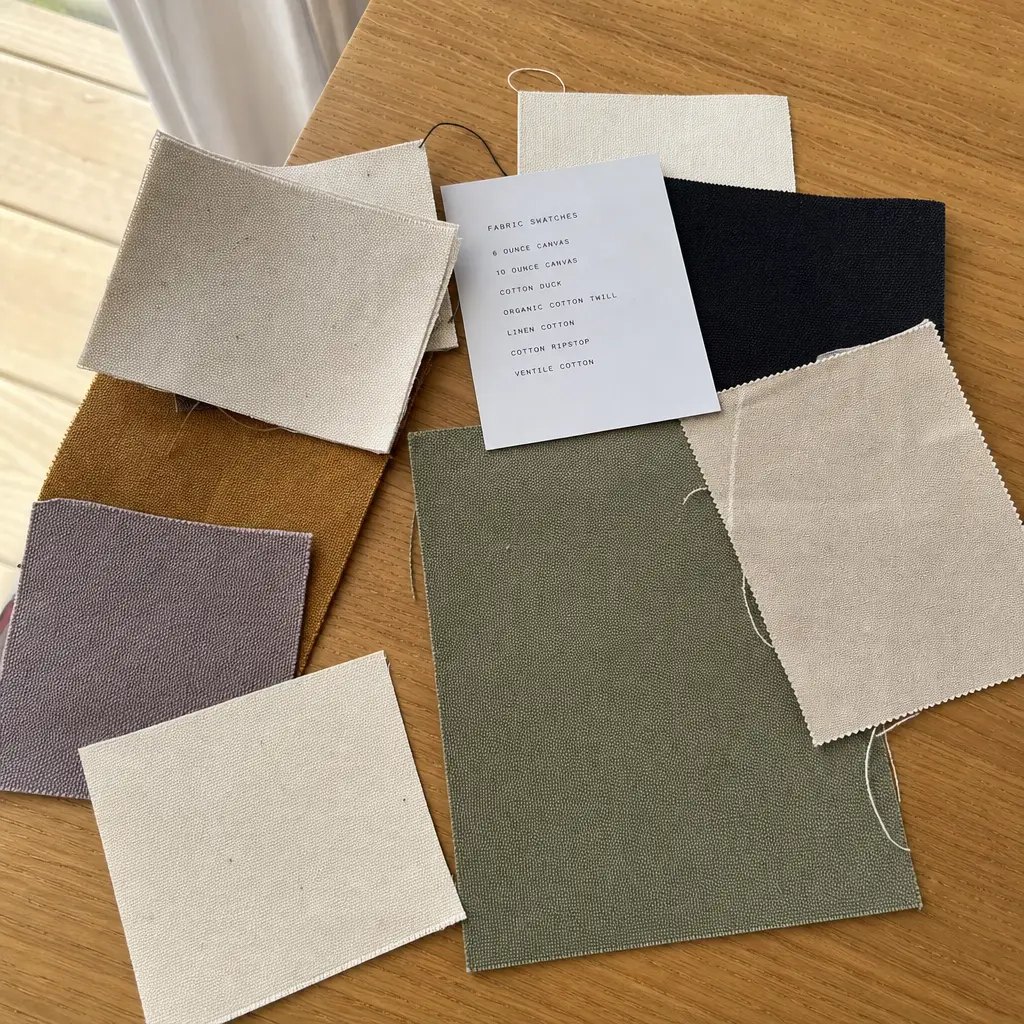
Canvas weight affects cost, appearance, print behavior, packing volume, and lead time. For trade show grocery totes, 10 oz to 12 oz canvas is usually the practical range. It gives the bag enough body to feel like a reusable item without becoming too heavy for freight. In GSM terms, buyers are often looking around 270-340 GSM, depending on the mill and weaving style.
A lighter 8 oz cotton canvas can work for low-cost giveaways, but it may show less structure and allow more show-through from dark contents. A heavier 14 oz canvas feels premium but can increase sewing time, needle wear, carton weight, and freight cost. If the event is a high-value brand launch, heavier fabric may make sense. If the bag is distributed in thousands at a crowded exhibition, the middle range usually performs better commercially.
- Natural canvas: common, cost-efficient, and strong for dark or bold prints.
- Bleached or dyed canvas: cleaner brand color control but may need longer fabric preparation time.
- Recycled cotton blend: useful for sustainability positioning, but shade and fiber flecks should be approved by sample.
- Organic cotton canvas: good for specific brand claims, but certification and fabric availability must be verified early.
Match Print Method To Artwork And Schedule
Screen printing is normally the first choice for custom canvas grocery totes when the artwork uses solid colors, clear logos, and medium to large quantities. It gives strong coverage and predictable cost once setup is spread across the order. For a 1-color or 2-color exhibitor tote, it is often the cleanest route. The buyer should still confirm printable area, line thickness, ink opacity, curing, and whether the fabric surface is coarse.
Heat transfer and digital printing can be useful when the artwork has gradients, photographic detail, many colors, or a short run. The tradeoff is different handfeel, possible edge marks, and different durability behavior on textured canvas. Embroidery can look premium but is usually slower and less economical for large front logos on heavy canvas. A woven side label is a good addition when the main logo must stay clean but the brand wants a more finished retail detail.
- Screen print: best for solid logos, sponsor marks, and repeatable bulk production.
- Heat transfer: useful for complex color artwork or smaller urgent runs.
- Digital print: useful for detailed artwork, but test color strength on natural canvas.
- Embroidery: better for small marks, not oversized event graphics.
- Woven side label: adds brand detail without increasing the main print complexity.
Use MOQ Logic Instead Of Chasing A Random Minimum
MOQ is not only a factory policy. It is linked to fabric purchasing, cutting efficiency, print setup, labor scheduling, and packing. A buyer requesting 200 custom canvas grocery totes with a special size, dyed fabric, and 4-color print is asking the factory to spread several fixed costs over a small quantity. The quote may look high because the order is operationally inefficient, not because the factory is unwilling.
For standard natural canvas with simple screen print, efficient custom MOQ often begins around 500-1,000 pieces, depending on factory workload and material stock. Lower quantities may be possible when using stock fabric, standard size, and simple decoration. If a distributor needs multiple artwork versions, it may be better to keep the same bag body and change only print screens, rather than create separate constructions for each exhibitor.
- Lower MOQ levers: standard bag size, stock canvas color, 1-color print, simple packing.
- Higher MOQ drivers: dyed fabric, custom weave, custom hardware, multiple print positions, complex labeling.
- Cost control method: combine several booth teams under one bag spec and separate by carton labels.
- Quote comparison point: separate bag cost, print setup, sample cost, and packing cost instead of accepting one blended number.
Sample Approval Should Prove Production, Not Decoration Only
A good sample process prevents expensive surprises. The sample should show the selected canvas weight, actual bag construction, handle reinforcement, print method, print placement, and label details. A blank sample only proves shape. A print strike-off only proves color on a fabric piece. For trade show orders with fixed dates, the useful approval sample is a pre-production sample that combines the bag and decoration in the way bulk production will be made.
Buyers should avoid approving only from a low-resolution phone photo. Photos help move quickly, but they do not show fabric stiffness, print handfeel, handle comfort, or true color. If time allows, request one physical sample for approval and keep it as the inspection reference. When the schedule is tight, use a staged approval: digital artwork proof, fabric swatch photo, print strike-off photo, then final sample photo with measured dimensions.
- Dimension tolerance: agree practical limits, such as plus or minus 0.5 inch on finished width and height.
- Print placement: measure from top edge and side seam to avoid subjective approval.
- Color tolerance: use Pantone target or approved physical strike-off where color matters.
- Handle test: load the tote with expected booth contents and hold for a defined time.
- Approval record: keep the signed sample comments with date, version, and buyer name.
Build A Quote Sheet That Makes Suppliers Comparable
A clear quote sheet saves more time than long negotiation emails. Every supplier should quote against the same bag size, canvas weight, print method, quantity, packing, and delivery term. If one factory quotes FOB and another quotes delivered duty paid, or one includes screen setup while another excludes it, the lowest unit price may not be the lowest landed cost.
For canvas grocery totes, freight can change the result. These bags are not extremely heavy compared with metal or glass products, but they are bulky when packed flat in export cartons. Carton dimensions, pieces per carton, gross weight, and packing method are needed before logistics can calculate the true delivered cost. A buyer who compares only unit price is missing a major part of the event budget.
- Required quote data: unit price, MOQ, sample fee, setup charge, lead time, payment term, and trade term.
- Production data: fabric weight, bag size, construction type, handle style, print method, and print area.
- Packing data: pieces per polybag or bundle, pieces per carton, carton size, gross weight, and label method.
- Commercial data: validity period, overrun allowance, shortage policy, and replacement timing.
Plan Packing Around Booth Distribution
Packing is often treated as a warehouse detail, but for trade show exhibitors it affects labor at the destination. If the bags will be inserted into booth kits, cartons should be labeled by destination, SKU, artwork version, or sales team. If the bags go directly to an exhibition venue, carton marks must be simple enough for event staff to identify without opening every carton.
Individual polybags are sometimes requested to protect white or dyed totes, but they add cost, packing time, and waste. For natural canvas grocery totes, flat bulk packing in counted inner bundles is often enough. Retail buyers may need hangtags, barcode stickers, or care labels, while trade show teams may only need clean carton separation and count accuracy. The RFQ should state the packing expectation before final pricing.
- Bulk event packing: efficient for giveaways handed out from cartons behind the booth.
- Inner bundle packing: useful for counting and distributing bags to multiple booth stations.
- Individual polybag: protects light colors but increases cost and unpacking labor.
- Carton label: include PO number, item code, artwork version, quantity, carton number, and destination.
Control Schedule Risk Before It Becomes A Freight Problem
Most late tote projects do not fail in sewing. They lose days during artwork revision, sample waiting, buyer approval, holiday closures, and freight decision delays. A realistic calendar assigns dates to each approval step. If the buyer approval date slips, the schedule should show whether the delivery method must change or whether the spec must be simplified.
The expensive emergency option is usually air freight. Canvas grocery totes can be costly to air ship because cartons take space. A rush order may still be worthwhile for a major show, but procurement should know the tradeoff early. Sometimes the better decision is to reduce quantity for air shipment and move the balance by sea, or use a standard stock tote for late replenishment while keeping the main custom order intact.
- Artwork delay: reduce by sending vector files and Pantone references with the first RFQ.
- Sample delay: reduce by approving fabric and print strike-off in parallel where practical.
- Production delay: reduce by freezing size, fabric, and packing before deposit.
- Freight delay: reduce by obtaining carton data before production ends.
- Receiving delay: reduce by sending carton labels and packing list format before shipment.
Set QC Thresholds That Match Real Use
Quality control for custom canvas grocery totes should focus on the defects that affect event use and brand appearance. Minor natural cotton flecks may be acceptable on unbleached canvas if they were present in the approved sample. Crooked logos, weak handles, dirty panels, unstable seams, and wrong carton counts are more serious. The inspection standard should separate cosmetic variation from functional failure.
For a trade show order, inspection timing matters. A final random inspection before shipment gives the buyer a chance to stop packing or correct defects. If the event date is close, the inspection checklist must be practical enough to execute quickly: measure dimensions, compare print, load-test handles, review stitching, count cartons, and verify labels. Overly vague inspection notes create arguments at the worst possible time.
- Critical defect: wrong logo, wrong artwork version, unsafe handle failure, severe contamination, or missing cartons.
- Major defect: crooked print beyond agreed tolerance, open seams, skipped stitches at stress points, wrong size affecting use.
- Minor defect: small thread ends, slight shade variation within approved range, natural canvas specks if accepted in sample.
- Functional test: load the bag with expected contents plus margin and inspect handle seams after stress.
Specification comparison for buyers
| Spec decision | Recommended option | When it fits | Buyer risk to check |
|---|---|---|---|
| Fabric weight | 10 oz to 12 oz canvas, roughly 270-340 GSM | Good balance for trade show grocery-style totes that need shape, print coverage, and manageable carton weight | Very light canvas may look collapsed on the booth table; very heavy canvas increases freight and sewing time |
| Bag construction | Box-bottom or gusseted grocery tote with reinforced handle stitching | Best for exhibitors handing out catalogs, samples, bottles, or retail kits | Flat totes are cheaper but may not hold bulky literature or products cleanly |
| Print method | Screen print for 1-3 solid colors; heat transfer or digital print for gradients or small runs | Screen print works well for bold logos and sponsor marks on canvas panels | Fine lines may fill in on coarse canvas; confirm artwork minimum line weight before sampling |
| Handle style | Self-fabric canvas handles with cross-stitch or box-X reinforcement | Suitable for heavier booth giveaways and grocery-style reuse | Unreinforced handles can pass visual inspection but fail under loaded carry tests |
| MOQ planning | Use factory MOQ plus print setup logic, often 500-1,000 pcs for efficient custom production | Fits brand teams and distributors that need predictable unit cost and stable shade matching | Forcing a very low MOQ can raise print charges, fabric surcharge, and sample cost |
| Sample approval | Pre-production sample with actual fabric, actual print method, and approved handle stitching | Required when event date is fixed and logo appearance matters under booth lighting | Photo-only approval hides handfeel, tote stiffness, ink opacity, and seam strength |
| Packing method | Flat packed by set quantity per inner bundle, export carton labeled by PO, color, and SKU | Works for warehouse receiving, event kits, and distributor carton allocation | Random bulk packing can slow booth kit assembly and create shortages by location |
| Shipping route | Sea freight for planned orders; air or courier only for approved urgent replenishment | Best when order is placed 10-14 weeks before the show date | Air freight can exceed bag value; volumetric carton size matters more than buyers expect |
Buyer checklist before sampling
- Define the show date, warehouse arrival date, and latest acceptable receiving date before requesting price.
- Specify canvas weight in oz or GSM, not only the word canvas.
- State finished bag size, gusset depth, handle length, and expected loaded use.
- Send vector artwork with Pantone references and note whether color matching is strict or approximate.
- Choose the print method based on artwork complexity, order quantity, and fabric color.
- Request a pre-production sample using bulk fabric and the same print process planned for mass production.
- Set acceptance criteria for print placement, color tolerance, seam strength, and carton labeling.
- Confirm MOQ, setup charges, sample fees, overrun allowance, and whether the quote includes export packing.
- Ask for carton dimensions, gross weight, and pieces per carton before comparing freight.
- Build buffer time for artwork approval, sample revision, holiday closures, customs, and warehouse receiving.
Factory quote questions to send
- What canvas weight and composition are included in this quote, and can you provide the GSM tolerance?
- Is the quoted tote made with flat construction, side gusset, bottom gusset, or box-bottom construction?
- Which print method is quoted, and what is the maximum printable area on the selected tote size?
- Are screen setup, color matching, artwork adjustment, and sample charges included or listed separately?
- What is the MOQ for this exact fabric weight, bag size, and print method?
- How many days are required for sample making after artwork approval, and how many days for bulk production after sample approval?
- Will the production sample use actual bulk fabric and actual ink or transfer material?
- What handle reinforcement is included, and what load test standard can be used for inspection?
- What are the carton dimensions, pieces per carton, gross weight, and recommended container or air shipment volume?
- What is the factory policy for shortages, overruns, print defects, and replacement timing before the event date?
Quality-control points to confirm
- Fabric GSM measured against approved sample with a practical tolerance agreed before production.
- Finished tote dimensions checked at width, height, gusset, and handle drop after sewing.
- Print color compared under consistent light against approved strike-off or Pantone target.
- Print placement measured from top edge and side seams, not judged by eye only.
- Ink adhesion tested by rub test after proper curing time.
- Handle seam strength checked by static load test using the expected event contents plus margin.
- Stitch density and skipped stitches checked at handles, side seams, and bottom stress points.
- Loose threads, oil marks, fabric stains, and needle holes inspected before packing.
- Carton labels matched to PO, SKU, color, quantity, and destination warehouse.
- Random carton count verified against packing list before shipment release.