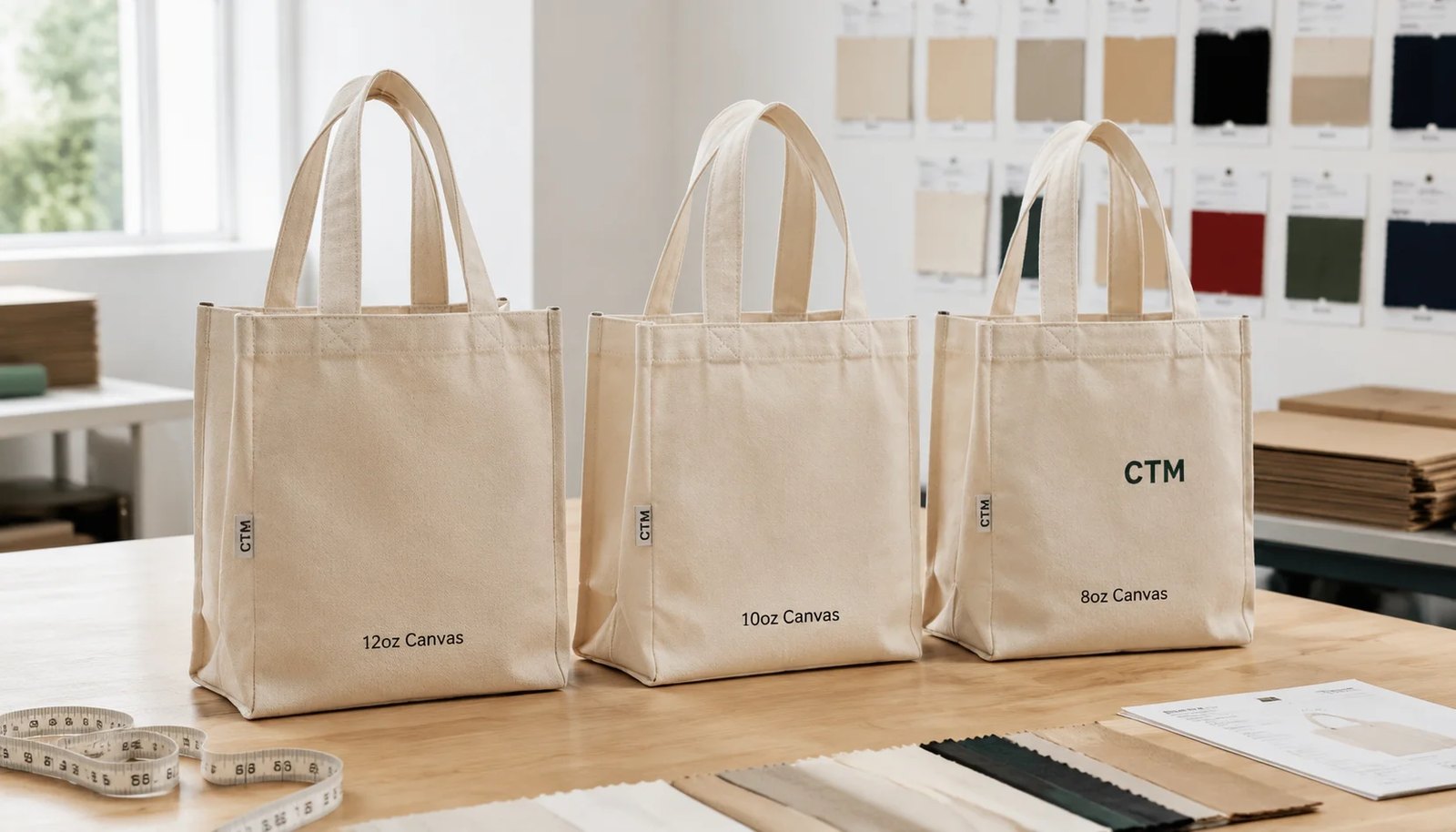
Why fabric weight is the main buying decision for grocery totes
For natural grocers, the wrong canvas weight creates two different problems. If the fabric is too light, stores get customer complaints when the tote sags under jars, produce, and boxed goods. If the fabric is too heavy, the retail price climbs, freight cost rises, and the bag can feel stiff instead of practical. Fabric weight is not a cosmetic detail. It drives durability, print appearance, handle performance, and landed cost.
Many RFQs only say 'canvas tote' without a GSM or ounce target. That leads to quote comparisons that are not really comparable. One supplier may price 8 oz promotional canvas, another may quote 10 oz regular grocery grade, and another may use 12 oz premium fabric. The bags can look similar in photos but behave very differently in stores. Buyers should treat fabric weight as the first controlled variable, not a later sample adjustment.
- Lighter weight reduces unit cost but lowers structure and perceived quality.
- Heavier weight improves reuse life but increases fabric consumption and freight.
- Canvas texture also changes print sharpness, especially on small logos and fine text.
- Handle failure often appears before body failure, so fabric weight must be specified with handle construction.
What GSM range usually fits a natural grocery program
For most custom canvas grocery totes, the commercially safe working range is 220 to 360 GSM. Below that, bags can still work for promotional use, but the chance of sagging and seam stress rises quickly when customers load dense items. Above that, the bag becomes premium and durable, but the weight and stiffness may exceed what the retail buyer needs unless the store intends a high-priced reusable bag program.
A practical rule is to start at 280 to 300 GSM for a standard grocery tote with side and bottom gusset. This range usually balances cost, carrying comfort, and enough body to stand open while packing. If the bag is intended for heavy bottles, bulk grains, or repeated weekly shopping, 330 to 360 GSM may make sense. If the tote is more of a campaign item or checkout add-on, 220 to 240 GSM can work if the buyer accepts the lower service life.
- 220-240 GSM: entry-level promotional grocery tote
- 280-300 GSM: most balanced option for routine retail reuse
- 330-360 GSM: premium heavy-use program or higher retail value
- State whether GSM applies before or after wash if a washed finish is quoted
Convert ounces to GSM carefully when comparing supplier quotes
Canvas tote suppliers often quote fabric in ounces while sourcing teams work in GSM. That is where comparisons become messy. In bag manufacturing, ounce references are not always perfectly standardized because some mills and suppliers use different conventions or round aggressively. A buyer should not rely on '10 oz' alone if the quote value is commercially sensitive. Put the target in GSM and require the supplier to declare the actual finished fabric weight range.
This matters because a supplier can call one fabric 10 oz while another calls a similar one 9 oz or 11 oz. If your internal target is a stable grocery tote, write 'finished fabric 280-300 GSM' rather than only the ounce name. Also note whether the fabric is washed, dyed, laminated, or printed, because processing can alter final feel and effective weight.
- Use GSM as the controlling quote basis when collecting multiple bids.
- Request cut swatch confirmation for any large order where durability is part of the retail promise.
- If the supplier uses oz naming, have them also state finished GSM on the quote sheet.
- Keep one approved physical swatch with your signed sample record.
How bag size and gusset change the right fabric weight
Fabric weight cannot be chosen in isolation. A 300 GSM canvas may be sufficient on a compact tote but can feel too soft on a large supermarket-format bag with a deep gusset. The larger the front panel and the wider the gusset, the more leverage the load puts on the side seams and handle insertion area. This is why some buyers experience good performance in one bag size and disappointing performance when they upscale dimensions without changing GSM.
For natural grocers, gusset depth is especially important because the bag needs to hold cartons, produce containers, and bottles upright. A narrow gusset saves fabric and cost but reduces practical packing volume. A wider gusset improves function but increases material usage significantly. Quote comparisons must therefore include exact bag dimensions and gusset format, or fabric-weight decisions become misleading.
- Deep-gusset grocery totes often need 280 GSM or above to keep shape.
- Large front panels may need heavier GSM even if the target load stays the same.
- Bottom gusset construction influences how stable the bag stands at checkout.
- Fabric usage rises fast when both width and gusset increase; cost impact is not linear.
Print method should be chosen with the canvas texture, not after it
Natural grocers often want a clean, earthy logo on unbleached canvas. That usually points to water-based or plastisol screen printing, depending on artwork coverage and hand-feel preference. On medium-weight canvas, a simple one- or two-color screen print is usually the safest and most economical method. It gives decent opacity and is easier to control in mass production than more complex methods.
Problems start when buyers approve detailed art on a textured heavy canvas without adjusting expectations. Fine lines can break up, small text can fill in, and pantone matching may drift slightly on absorbent natural fabric. If your design uses delicate linework, halftones, or large flood coverage, the print method should be specified during quotation. The right print choice is part of the fabric decision because rougher and heavier canvas prints differently than a smooth lighter cloth.
- Screen print suits bold logos and medium-to-large artwork areas.
- Heat transfer can hold finer detail but changes hand feel and may cost more.
- Digital methods may work for multicolor art, but MOQ and unit pricing differ by factory setup.
- Approve line thickness, artwork size, and print location on an actual fabric sample.
MOQ logic: why fabric weight affects small runs more than buyers expect
MOQ is not only a print issue. Fabric weight can influence MOQ because mills may have different stock positions for 8 oz, 10 oz, or 12 oz canvas, and some factories quote from available greige stock while others buy specifically for the order. A common sourcing mistake is to request multiple GSM options and colors in one small run, then expect all of them to price near the base quote. In reality, every split can trigger lower cutting efficiency, extra material leftovers, or separate dyeing arrangements.
If the buyer is testing a new natural grocery program, it is often more commercial to standardize one body fabric weight across several logo variants or store groups. That lets the factory cut more efficiently and hold more stable quality. If your program may scale later, choose a GSM that is broadly available, then expand into color or style variants after the first production run proves sell-through.
- Stock natural canvas usually supports lower MOQ than dyed or washed custom fabric.
- One shared fabric across multiple SKUs usually prices better than multiple GSM splits.
- MOQ may rise if the order includes inside pockets, contrast handles, or individual retail packaging.
- A low initial MOQ can carry a higher unit price but still be commercially correct for a launch test.
Sample approval should focus on measurable acceptance points
A pre-production sample is only useful if it answers the fabric-weight question clearly. Too many sample approvals are based on general comments like 'looks good' or 'please make slightly thicker.' That creates room for bulk variation and quote disputes. The sample should lock in measurable attributes: finished dimensions, handle drop, fabric weight range, gusset shape, print placement, seam finish, and packing style.
For grocery totes, the best sample workflow is usually fabric swatch approval first, followed by one sewn pre-production sample in the actual quoted material and print method. If the program uses washed canvas, the sample should also use the same washing process because wash changes drape, shrinkage, and print look. Physical approval matters more than digital renderings when the key decision is body structure.
- Retain one signed swatch with the PO file for future claim reference.
- Measure handle drop from top edge after sewing, not from cut panel plan.
- Record accepted print position tolerance, for example within 5 mm from approved location.
- Note whether inside seam is overlock, bound seam, or another finish standard.
Packing plan affects freight, warehouse handling, and retail presentation
Packing rarely gets enough attention in tote bag buying, but it directly affects landed cost and receiving quality. Heavy canvas grocery totes can be over-compressed if the factory tries to reduce carton count. That may save carton volume on paper but can crease printed areas, distort gussets, and make store-level handling slower. Natural grocers with distribution centers often prefer controlled carton weight and predictable counts over the absolute minimum carton number.
A practical packing structure for canvas grocery totes is flat pack in inner polybags by 25 or 50 pieces, then master cartons below the buyer's handling limit. If the bags carry retail barcodes or hangtags, orientation and SKU separation matter as much as protection. Buyers should also consider whether cartons need mixed-size or mixed-art packing, because those decisions can save inbound storage time or create downstream pick errors.
- Keep export carton gross weight aligned with warehouse handling preference, often below 15 kg if manual handling is common.
- Specify whether polybags are allowed, restricted, or must be recycled material.
- Printed bags should face the same direction in pack if store receiving teams count visually.
- Carton marks should include PO, item code, color, quantity, gross weight, and country of origin if required.
Lead time risk usually sits in fabric, printing, and sample loops
Canvas tote lead time is often presented as one simple number, but the actual schedule risk sits in three places: material readiness, artwork and sample approval, and print queue timing. Standard natural canvas may be available quickly, while dyed or washed canvas can add extra days or weeks depending on mill load. If the print requires color matching or multiple placements, approval loops can delay cutting more than the sewing time itself.
For procurement teams, the safest schedule plan is to separate timeline assumptions by stage. Quote stage should identify sample lead time, material booking lead time, bulk production time, and packing readiness. That makes it easier to compare suppliers honestly. A slightly higher unit price from a factory with stable in-house printing and regular canvas supply may be lower risk than a cheaper quote built on subcontracted printing and optimistic fabric timing.
- Natural stock canvas usually shortens material lead time versus custom dyed shades.
- Artwork revisions are a common hidden delay on simple bag programs.
- Holiday shutdowns can affect printing and sewing differently, so ask for stage-by-stage timing.
- Bulk time should begin from final approved sample and deposit, not from inquiry date.
How to compare quotes on landed value, not just unit price
The cheapest tote quote is often based on lighter fabric, smaller gusset, weaker handle reinforcement, or less controlled packing. Those differences may not be obvious in a simple spreadsheet. To compare quotations properly, convert each offer into a landed-value view: actual GSM, usable bag volume, print inclusion, sample cost, carton count, freight weight, and expected service life. This is where medium-weight standard canvas often wins over both extreme low-cost and overbuilt premium options.
For example, a 220-240 GSM bag may save unit cost ex-factory, but if customer complaint rates rise or the bag looks underspecified next to the retail price, the apparent savings disappear. Conversely, a 330-360 GSM bag may perform extremely well but add unnecessary freight and shelf price pressure if the store's target is a routine checkout tote. For most natural grocer buyers, the best commercial answer is not the heaviest bag. It is the lightest bag that still carries the intended grocery load with acceptable retail presentation.
- Normalize all quotes to the same bag dimensions and fabric basis before review.
- Add estimated freight effect when comparing 240 GSM, 300 GSM, and 360 GSM options.
- Include sample charges, print setup, and compliance testing if they are not part of the base price.
- Evaluate expected reuse life against retail selling price and brand positioning.
Specification comparison for buyers
| Spec decision | Recommended option | When it fits | Buyer risk to check |
|---|---|---|---|
| Body fabric weight | 10 oz canvas, about 280-300 GSM | Best all-around choice for grocery reuse programs with moderate loads and acceptable cost | Some suppliers quote lower actual GSM than claimed; require finished fabric tolerance and cut swatch approval |
| Lightweight economy option | 8 oz canvas, about 220-240 GSM | Promotional grocery totes, short campaigns, or low retail price targets | Bag can lose shape under heavy produce, bottles, or canned goods; verify load expectation before approval |
| Heavy-duty premium option | 12 oz canvas, about 330-360 GSM | Higher retail price point, longer reuse cycle, or stores selling glass jars and dense packaged goods | Heavier fabric increases shipping weight, print setup pressure, and unit cost; check landed cost not just ex-factory |
| Handle construction | Same-fabric web handles with cross-stitch reinforcement and 25-30 mm width | Most grocery tote programs where comfort and durability matter | Short handle insertion depth or weak bartack pattern can fail before body fabric; request handle pull test method |
| Gusset size | 15-20 cm bottom and side gusset | Natural grocers needing upright packing for cartons, produce, jars, and boxed goods | Large gussets consume more fabric than many buyers expect; supplier quotes may vary if gusset measurement method differs |
| Print method | Water-based screen print, 1-2 colors | Simple logos on natural canvas with good opacity and lower setup cost | Fine lines and exact Pantone matching can vary on textured canvas; set artwork minimum line width and color tolerance |
| Retail finish | Washed natural canvas with trimmed loose threads and hangtag loop if needed | Retail programs where hand feel and shelf presentation matter | Washing can change bag size and print registration slightly; pre-production sample must match final process |
| Packing method | Flat packed by 25 or 50 pieces in polybag, export carton under 15 kg | Store distribution, easier carton handling, and cleaner receiving process | Over-packed cartons lower carton count but increase deformation, handling issues, and warehouse claims |
| Sampling route | Material swatch plus one sewn pre-production sample before bulk | Programs with custom size, gusset, and logo placement where fabric weight is the main decision point | Digital-only approval hides fabric drape, thickness, and seam bulk; physical sample remains the safer approval basis |
Buyer checklist before sampling
- Define target carrying load in real use terms such as 6 glass jars, 4 beverage bottles, or 8-10 kg mixed groceries before selecting GSM.
- Specify whether quoted fabric weight is finished GSM, washed GSM, or greige equivalent; put tolerance in writing.
- State bag size, gusset depth, handle width, handle drop, and insertion depth so suppliers calculate fabric usage on the same basis.
- Match print method to artwork detail: simple 1-2 color logos suit screen print; fine tonal art may need transfer or digital methods with different cost and hand feel.
- Request a cut fabric swatch and a sewn sample in the actual quoted GSM, not only a visually similar archive sample.
- Set seam and handle reinforcement expectations, including cross stitch, bartack count, and acceptable loose thread standard.
- Clarify if natural canvas shade variation is acceptable or if optical white or dyed fabric is required.
- Approve packing method by pieces per polybag, cartons per SKU, carton weight limit, and whether retail labeling or barcode stickers are needed.
- Review sample dimensions after sewing and after wash if washed finish is used; size can shift materially on canvas.
- Compare landed cost impact of heavier GSM, not only unit price, because fabric weight affects freight and carton count.
Factory quote questions to send
- What is the actual finished fabric weight in GSM, and what tolerance do you control in bulk production?
- Is the quoted canvas cotton canvas, cotton-poly blend canvas, or recycled canvas, and what is the fiber composition by percentage?
- Are dimensions measured seam to seam before packing, and what size tolerance applies to width, height, and gusset?
- What handle material, width, insertion depth, and reinforcement pattern are included in the price?
- How many print colors, what print area, and which print method are included in the quote?
- Does the quote include pantone matching, print strike-off, and pre-production sample, or are these billed separately?
- What is your MOQ by fabric weight, color, and print design, and does MOQ change for dyed canvas or inside pocket options?
- How many pieces fit per export carton, what is carton size and gross weight, and can you cap cartons below our warehouse handling limit?
- What is your standard production lead time after sample approval and deposit, and what steps are on the critical path?
- What in-house tests or third-party tests can you provide for colorfastness, seam strength, and print adhesion if required by retail compliance?
Quality-control points to confirm
- Finished fabric weight should match approved range; use cut swatch weighing method on bulk fabric lots if GSM is commercially critical.
- Bag dimensions must be checked on finished bags with stated tolerance, especially gusset depth and handle drop which often drift in production.
- Handle attachment reinforcement should be consistent on all bags with no skipped stitches, needle damage, or uneven bartacks.
- Print placement must stay within approved tolerance from top edge and side seams; misalignment is more visible on plain canvas than on patterned fabric.
- Natural fabric shade should remain commercially consistent within lot; mixed shade cartons create retail presentation problems.
- Loose threads, seam roping, puckering, and seam twisting should be controlled because they affect both durability and shelf appearance.
- Cartons must match approved packing count and weight limit; compressed packing can distort printed panels and create receiving claims.
- Random load test on finished bags should reflect intended use, especially if the bag is sold for grocery reuse rather than one-time promotion.