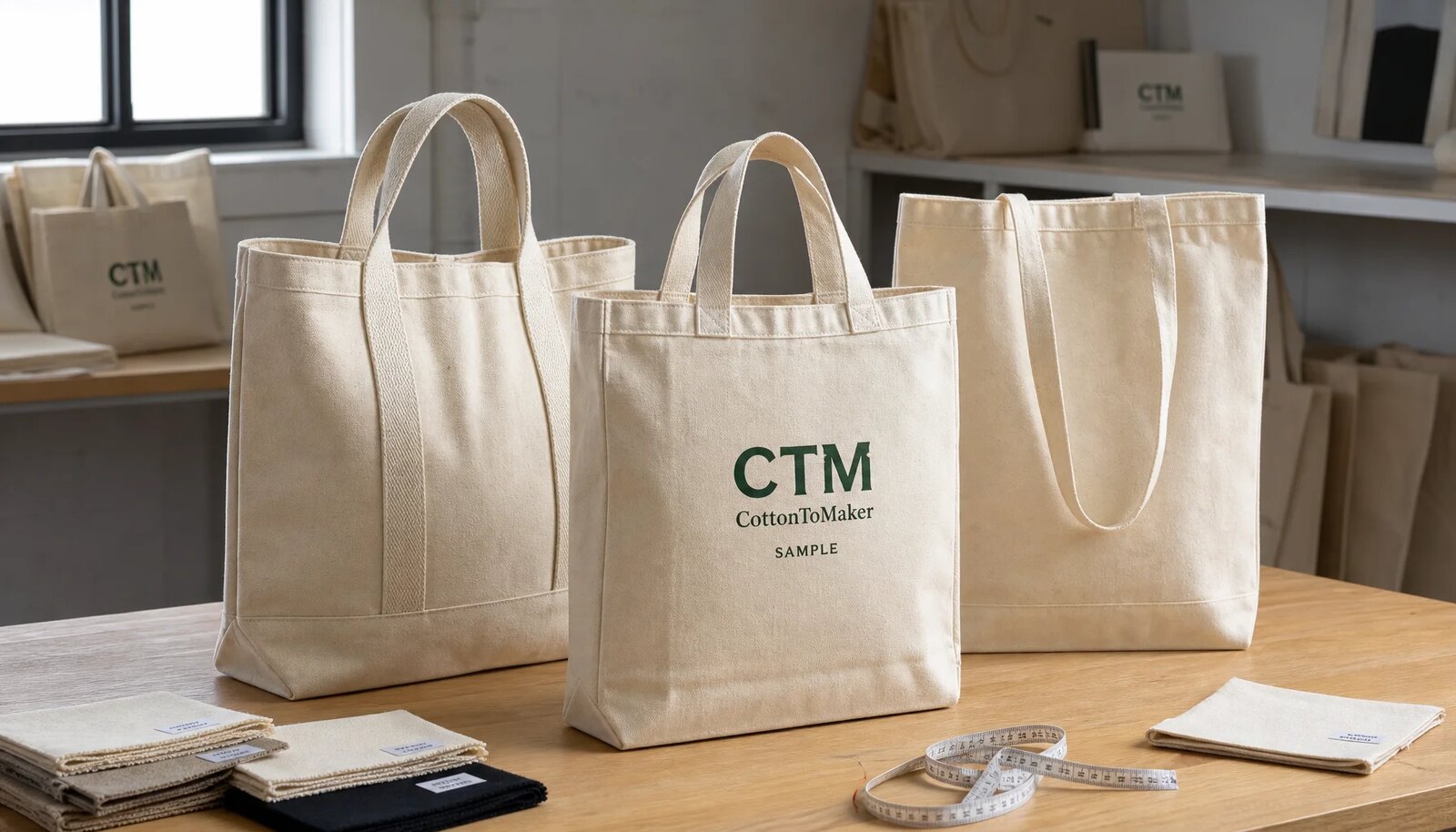
Start With the Tote's Commercial Job
A custom canvas grocery tote for craft fairs has to do more than carry a logo. It may hold candles, jars, soaps, books, ceramics, packaged food, produce, catalogs, and purchases from several booths in one visit. The right specification depends on whether the bag is a free giveaway, paid merchandise, reusable grocery bag, vendor kit, or retail private-label item.
For procurement teams, the first risk is quote incomparability. One supplier may quote 8 oz natural canvas with simple seams. Another may quote 10 oz finished canvas with boxed bottom construction and reinforced handles. A third may quote 12 oz canvas but exclude hangtags, barcode labels, or inner packs. Product photos can look similar while landed cost and performance differ sharply.
A useful RFQ connects fabric weight, bag size, gusset, handle construction, print method, packing, inspection criteria, and delivery date. That prevents a low unit price from hiding a weak construction or missing packing requirement.
- Giveaway: control size and use 8 oz only when load expectations are modest.
- Resale merchandise: start with 10 oz canvas and improve presentation with a label, hangtag, or belly band.
- Premium vendor kit: consider 12 oz when structure and handfeel justify higher material and freight cost.
- Distributor program: define inner packs, carton marks, barcode labels, SKU allocation, and destination splits before comparing prices.
- Reusable grocery use: specify realistic load testing and handle comfort rather than relying on fabric weight alone.
Translate Ounces, GSM, and Finished Weight
Canvas tote fabric is often described in ounces, while mills and factories may inspect it in GSM. As a practical sourcing reference, 8 oz canvas is often about 270 GSM, 10 oz about 340 GSM, and 12 oz about 400 GSM. These are working conversions, not fixed guarantees. Yarn count, weave density, dyeing, washing, coating, and finishing can change the actual finished weight and handfeel.
The RFQ should state both units and use the phrase finished fabric weight. A fabric described before dyeing or washing may not behave like the finished production fabric. Vague terms such as heavy canvas, thick cotton, or export quality are not enough for a B2B buyer comparing suppliers.
Weight affects fabric cost, cutting effort, sewing difficulty, carton weight, shipping volume, foldability, and perceived value. A 12 oz tote may feel premium, but it can increase freight cost and crease risk. An 8 oz tote may pack efficiently, but a large silhouette can make it feel underbuilt.
- 8 oz / about 270 GSM: useful for controlled-size giveaways, light carry, and budget-sensitive programs.
- 10 oz / about 340 GSM: balanced default for reusable grocery totes and craft fair resale.
- 12 oz / about 400 GSM: premium option for stronger structure and higher perceived value.
- 14 oz and above: specialist choice where bulk, stiffness, freight, and sewing cost are acceptable.
- RFQ wording: specify finished fabric weight, tolerance, fiber content, color, finish, shrinkage expectation, and swatch approval.
Match Weight to Size, Gusset, and Load
Fabric weight does not work in isolation. For common craft fair grocery totes, buyers often use a body around 35-40 cm wide, 38-42 cm high, and an 8-12 cm gusset. In that range, 10 oz canvas is often the most balanced starting point because it feels more substantial than 8 oz without the bulk of 12 oz.
A small 8 oz tote can work for flyers, samples, or light purchases. A large 8 oz deep-gusset tote can feel weak because the same fabric supports more volume and invites heavier loading. A small 12 oz tote may look premium but feel unnecessarily stiff for mass distribution.
Load expectation belongs in the purchase order. If the tote may carry jars, books, candles, produce, or small ceramics, define whether the buyer expects a 5 kg, 8 kg, 10 kg, or higher static load test. State the load weight, duration, hanging method, sample size, and pass/fail condition.
- Small light-use tote: 8 oz can work if the body size is controlled.
- Standard grocery tote: 10 oz is a strong baseline for mixed craft fair purchases.
- Premium structured tote: 12 oz helps the bag stand better and feel more substantial.
- Deep gusset tote: reinforce seams and handles because larger capacity encourages heavier loading.
- Load test: define weight, duration, sample size, hanging method, pass/fail criteria, and post-test appearance.
Specify Construction That Prevents Failures
Construction details often determine whether a canvas grocery tote performs like a reusable product. The RFQ should define handle length, handle width, top hem, seam finish, gusset shape, stitch pattern, stitch density, thread color, label position, and reinforcement method. Missing details let suppliers quote different products under the same general description.
For grocery carry, 55-60 cm handles usually support shoulder carry for many users while still working by hand. A finished handle width of 2.5-3 cm is more comfortable under load than a narrow strap. Self-fabric handles give a consistent look; cotton webbing can add contrast or strength, but it must be tested with the actual top hem and stitch pattern.
The top hem is a stress area because it holds the handle ends. A 2.5-3 cm finished top hem is a practical range for many reusable totes, though the approved sample should control the final construction. Handle ends may be trapped inside the hem, stitched onto the body, or reinforced with box/cross stitching or bartacks.
A craft fair grocery tote usually benefits from a boxed bottom or side-bottom gusset. An 8-12 cm gusset helps hold jars, produce boxes, candles, soaps, and packaged foods. Too small a gusset reduces function; too large a gusset adds bulk and can make the folded bag look untidy.
- Handle length: use 55-60 cm for mixed shoulder and hand carry unless short handles are required.
- Handle width: specify 2.5-3 cm finished width for comfort.
- Top hem: define finished hem width and how handle ends are captured or reinforced.
- Seam finish: require overlocked, folded, or bound seams according to durability target and price level.
- Stitch inspection: reject skipped stitches, loose thread nests, broken seams, needle cuts, and weak reinforcement.
Choose Printing for Canvas Texture
Canvas is not a smooth poster surface. Natural cotton canvas has visible weave, seed specks, slubs, and small surface variations. These traits can suit craft fair branding, but they reduce the sharpness of fine artwork. Approve print samples on the actual fabric weight, color, and finish.
Screen printing is usually the practical method for solid logos, simple typography, and one to four spot colors. It is cost-efficient at bulk quantities and can create a clear brand mark on 8 oz, 10 oz, or 12 oz canvas. Artwork should allow for fabric texture: avoid ultra-fine lines, leave clearance from seams and gussets, and confirm color references.
DTF transfer and digital printing can fit full-color artwork, seasonal illustrations, or many small design variations. These methods can reduce screen setup pressure, but they introduce different checks. Evaluate handfeel, edge clarity, rub resistance, fold behavior, curing, and whether the print cracks or lifts after packing.
Embroidery, woven labels, and patches work better for small premium branding than for large grocery tote graphics. A woven label on the side seam, front panel, or top hem can elevate a premium tote without heavy print coverage.
- Screen print: best for bold spot-color logos, clean typography, repeat orders, and cost control.
- DTF transfer: useful for full color, but sample for handfeel, edge lift, fold cracking, and rub resistance.
- Digital print: suitable for detailed artwork when pretreatment, curing, and color consistency are controlled.
- Embroidery: reserve for small logos or patches; avoid large filled embroidery on grocery tote panels.
- Print placement: define size, printable area, seam clearance, gusset clearance, fold clearance, and position tolerance.
Understand MOQ and Price Break Drivers
MOQ is shaped by fabric availability, dye-lot requirements, cutting efficiency, printing setup, sewing changeover, packing labor, carton marking, and the number of SKUs. A factory may offer a low MOQ for stock natural 10 oz canvas with a one-color print because the fabric is common and production is simple. The same factory may require more quantity for custom dyed 12 oz canvas with several artwork versions and retail packing.
Craft fair buyers often want seasonal artwork, artist collaborations, limited-edition colors, or designs for different locations. Those choices may be valuable, but each variation can add a screen, color match, inspection record, hangtag, barcode, or carton mark. If every design has a small quantity, unit price can rise even when the total order looks large.
Ask suppliers to break MOQ into categories: per fabric weight, fabric color, artwork, print color count, label version, packing version, and shipment destination. Also ask what changes when the order is split across designs. This separates true fabric MOQ from print setup and packing labor.
- Lowest MOQ path: stock natural canvas, standard dimensions, one-color screen print, bulk flat packing, one shipment.
- Higher MOQ path: custom dyed canvas, uncommon fabric weight, multiple designs, special labels, retail packing versions.
- Per-design risk: small artwork runs increase setup, color control, inspection time, and carton marking.
- Per-color risk: dyed fabric may require fabric-lot minimums even when bag quantity is smaller.
- Quote clarity: ask for setup charges separately so unit price comparisons are not misleading.
Use Samples to Lock the Specification
A fabric swatch or product photo cannot prove a canvas grocery tote is ready for bulk production. Buyers need to handle the bag, fold it, load it, inspect stitching, check print position, and review packing. Sampling is a purchasing control step, not a formality.
Start with a fabric swatch and blank size sample when the construction is new. The swatch confirms weight, weave, shade, slubs, finish, and print suitability. The blank sample confirms body dimensions, gusset, handle length, handle width, top hem, seam finish, stitch quality, and handfeel before print costs are added. Side-by-side 8 oz, 10 oz, and 12 oz samples are more useful than a verbal comparison.
Use a printed strike-off to approve ink behavior, color, curing, print sharpness, and position. The strike-off should be on the actual canvas color and weight whenever possible. Check whether small text remains readable and whether the print is far enough from seams, handles, and gusset folds.
The pre-production sample should use the actual fabric, print method, sewing details, labels, folding, and packing. Keep one sealed sample for final inspection. If fabric weight, print method, handle construction, label, or packing changes after approval, require written reapproval.
- Fabric swatch: confirms weight, weave, color, shade range, slubs, finish, and print suitability.
- Blank sample: confirms dimensions, gusset, handle construction, seam finish, stitching, and handfeel.
- Print strike-off: confirms artwork size, color, edge sharpness, curing, rub resistance, and handfeel.
- Pre-production sample: confirms the exact bulk specification before full cutting, printing, and sewing.
- Packing sample: confirms fold method, individual packing, belly band, barcode, carton count, and crease risk.
Set QC Thresholds Inspectors Can Measure
Quality control should be measurable. A purchase order that only says good quality or strong stitching leaves final inspection subjective. A stronger PO states fabric weight tolerance, finished dimensions, handle length tolerance, print position tolerance, load test method, defect classification, packing requirement, and approved sample reference.
Fabric checks should include weight, color, weave defects, stains, holes, odor, and shade consistency. Natural canvas commonly has small seed specks and slubs, so define what is acceptable. This matters for retail craft fair programs where totes are displayed together.
Construction checks should focus on handle attachment, top hem, bottom corners, side seams, gusset shape, stitch density, and thread trimming. Inspectors should test the bag according to the agreed load method and then check for seam opening, handle elongation, fabric tearing, or deformation. A bag that carries weight but looks damaged after testing may not be acceptable for resale.
Print inspection should happen after curing. Inspectors should check color, registration, print position, edge clarity, ink coverage, rub resistance, cracking, transfer lift, and contamination. For large front-panel prints, confirm that the approved fold method does not crease a critical logo area.
- Fabric weight: verify finished GSM or oz within agreed tolerance using the defined method.
- Dimensions: measure relaxed flat bags for width, height, gusset, handle length, handle width, and print position.
- Load test: define weight, duration, hanging method, sample size, and pass/fail condition.
- Stitching: reject skipped stitches, broken threads, loose thread nests, needle cuts, seam openings, and weak handle reinforcement.
- Packing: inspect carton marks, inner packs, barcode labels, folding, dust protection, carton dimensions, gross weight, and moisture risk.
Plan Packing, Freight, and Event Timing
Packing is both a landed-cost decision and a presentation decision. Heavier canvas increases carton gross weight and may reduce pieces per carton. A 12 oz tote can look premium, but if packed too tightly it may arrive with hard creases across the printed logo. Review packing before the PO is finalized.
Bulk flat packing is usually the lowest-cost option for giveaways and warehouse handling. It saves labor and reduces packing material, but it is not retail-ready. Loose natural canvas can collect carton dust during transit. For resale, individual packing, recyclable polybags, paper belly bands, hangtags, or barcode labels may be needed. Each choice adds cost and inspection points.
Craft fair distribution often needs practical inner packs. A master carton of 100 loose totes may work for one central booth, but it can be inconvenient for multi-location events or distributor deliveries. Inner packs of 25 or 50 by design, color, or location reduce sorting time.
Plan lead time backward from the required arrival date, not from the factory's best production estimate. Include artwork approval, sampling, fabric booking, cutting, printing, curing, sewing, trimming, inspection, packing, export handling, freight, customs clearance, warehouse receiving, redistribution, and booth delivery. Confirm what starts the production clock: deposit, artwork approval, sample approval, fabric confirmation, or final packing confirmation.
- Bulk flat pack: best for low-cost giveaways and simple receiving.
- Individual packing: protects natural canvas and improves resale appearance, but adds labor and material.
- Paper belly band: useful for barcode and retail presentation, but must not crush the tote.
- Inner packs: improve booth handling, distributor allocation, and inventory counting.
- Carton planning: compare pieces per carton, dimensions, gross weight, palletization, and handling limits.
- Schedule buffer: protect the event date from artwork changes, late packing decisions, inspection rework, and split-destination instructions.
Specification comparison for buyers
| Spec decision | Recommended option | When it fits | Buyer risk to check |
|---|---|---|---|
| Budget craft fair giveaway | 8 oz canvas, often about 270 GSM finished weight, stock natural color, controlled size, reinforced handles | Free booth handouts, light purchases, welcome bags, sponsor bags, short-term event programs | Can feel thin on a large grocery silhouette; confirm finished GSM, top hem, seam type, handle reinforcement, and load test |
| Standard reusable grocery tote | 10 oz canvas, often about 340 GSM finished weight, boxed bottom or side-bottom gusset, box/cross handle reinforcement | Craft fair resale, farmers market carry bags, reusable grocery programs, brand merchandise, mixed purchases | Costs more than 8 oz and ships heavier; require dimension tolerances, production-lot swatch approval, and realistic static load testing |
| Premium craft fair merchandise | 12 oz canvas, often about 400 GSM finished weight, structured gusset, cleaner seam finish, controlled folding method | Paid tote merchandise, artisan retail packaging, vendor kits, premium booth display, bags expected to stand more upright | MOQ may rise for dyed colors; cartons get heavier; printed panels may crease if compressed; sewing quality needs closer inspection |
| Heavy-duty specialist tote | 14 oz+ canvas or cotton duck only when load, stiffness, and retail price justify it | High-end reusable programs, tool kits, heavy product bundles, premium merchandise where bulk is acceptable | Often too bulky for mass event distribution; fewer pieces per carton; confirm needle size, stitch balance, and carton gross weight |
| Finished bag dimensions | 35-40 cm width, 38-42 cm height, 8-12 cm gusset for common grocery use; define flat measurement method | General craft fair totes carrying produce, candles, soaps, books, jars, packaged food, and small craft purchases | Oversized bags make lighter canvas feel weaker; too-small gussets reduce grocery function; PO should state measurement tolerances |
| Handle construction | 55-60 cm handles, 2.5-3 cm finished width, sewn into or onto a 2.5-3 cm top hem with box/cross stitching | Mixed hand and shoulder carry, repeat-use grocery bags, paid tote programs, heavier booth purchases | Narrow straps reduce comfort; weak handle stitching usually fails before fabric tears; confirm stitch pattern, thread, and reinforcement size |
| Print method | Screen print for spot-color logos; DTF or digital for full color after strike-off; woven label or small embroidery for premium branding | Solid brand marks, seasonal artwork, multi-SKU programs, low-to-medium order quantities, private-label totes | Canvas texture affects detail; transfers can feel plastic-like; define seam clearance, color standard, curing, and rub test |
| MOQ and SKU planning | Separate MOQ by fabric weight, fabric color, artwork, print color count, label, packing version, and shipment destination | Seasonal designs, distributor packs, private-label versions, store-specific cartons, multiple fair locations | A low total MOQ can hide high per-design costs; custom dyed fabric, many SKUs, and retail packing add setup and inspection complexity |
| Retail and distributor packing | Flat bulk pack, inner packs of 25 or 50, optional recyclable polybag, paper belly band, hangtag, barcode, and carton marks | Booth resale, warehouse allocation, multi-location programs, branded retail display, clean delivery of natural canvas | Over-compression can create permanent fold marks; unbagged natural canvas can collect carton dust; carton cube affects landed cost |
Buyer checklist before sampling
- Define the tote's commercial role before quoting: giveaway, paid merchandise, reusable grocery bag, vendor kit, distributor program, or retail private-label product.
- Specify fabric as finished weight in both oz and GSM, and ask whether the supplier is quoting greige fabric, finished fabric, dyed fabric, washed canvas, coated canvas, organic cotton, recycled cotton blend, or cotton-poly canvas.
- State the finished bag dimensions and measurement method: body width, body height, gusset depth, top hem width, handle length, handle width, print size, print position, label position, and tolerance.
- Match fabric weight to bag size and load; do not approve a large deep-gusset tote on light canvas without a defined static load test and reinforced handle construction.
- Request the seam construction in writing: overlock, folded seam, bound seam, boxed bottom, bottom seam, side seam, top hem, handle stitch pattern, stitch density, thread color, and thread fiber content if relevant.
- Choose the print method from the artwork and order structure: screen print for spot colors, DTF or digital for full-color small batches, woven label or embroidery for small premium branding.
- Ask for setup and non-unit charges separately, including screens, digital file handling, Pantone matching, custom dyeing, labels, hangtags, barcodes, folding, individual packing, carton marks, and inland freight.
- Approve samples in controlled stages when risk is high: fabric swatch, blank size sample, printed strike-off, full pre-production sample, packing sample, and production top sample.
- Set measurable QC criteria in the PO: fabric weight tolerance, dimension tolerance, stitch defects, load test weight and duration, print rub result, shade tolerance, seam defects, contamination limits, and carton condition.
- Keep one sealed approved production sample and one approved printed swatch for inspection; any change in fabric weight, print method, handle construction, label, or packing should trigger written reapproval.
Factory quote questions to send
- What finished fabric weight are you quoting in GSM and oz, and what tolerance do you control before cutting?
- Is the quoted canvas stock natural, stock dyed, custom dyed, washed, coated, organic cotton, recycled blend, cotton-poly blend, or another construction that changes MOQ, shrinkage, or lead time?
- Is the fabric weight measured before or after dyeing, washing, printing, or finishing, and can you provide a swatch from the intended production quality or bulk lot?
- What are the exact finished dimensions after sewing: body width, body height, gusset depth, top hem width, handle length, handle width, print size, and print position?
- Which dimensional tolerances are included in the quote for body size, gusset, handle length, handle width, and print placement?
- Which seam finishes are included in the price: overlocked side seams, folded seams, bound seams, boxed bottom, inner binding, reinforced bottom corners, or bartacks?
- What stitch type, stitch density, thread specification, needle size, and reinforcement pattern will be used at handle stress points?
- Which print method is quoted, how many colors are included, what ink or transfer type will be used, what curing process is required, and what printable area is recommended away from seams and gussets?
- Can you provide a fabric swatch, blank size sample, printed strike-off, full pre-production sample, packing sample, and production top sample, and what are the costs and timing for each?
- What is the MOQ per fabric weight, fabric color, artwork, print color count, label version, packing version, and shipment destination?
Quality-control points to confirm
- Fabric weight tolerance should be agreed before production. For many canvas grocery tote programs, plus or minus 5% finished fabric weight is a practical starting point, but the exact tolerance should reflect yarn, weave, dyeing, washing, and finishing.
- Fabric lot control matters for natural and dyed canvas. Mixed lots can create visible shade differences when totes are displayed together at a craft fair booth or shipped to the same retail account.
- Finished bag dimensions should be measured on a flat, relaxed bag using a defined method. A common procurement starting point is plus or minus 1 cm for body width and height, plus or minus 0.5 cm for gusset and handle width, and plus or minus 1-2 cm for handle length, unless the buyer requires tighter control.
- Gusset and boxed bottom construction should be checked for symmetry. Uneven gussets affect standing ability, folded appearance, carton packing, and grocery capacity.
- Handle attachment must show the agreed box stitch, cross stitch, bartack, or other reinforcement with no skipped stitches, loose thread nests, broken thread, needle cuts, or weak corners at the stress point.
- Stitch density should be checked against the approved sample or PO. Many buyers specify a measurable range such as stitches per inch or stitches per 3 cm so inspectors are not relying on appearance only.
- Load testing should reflect the real use case. Buyers commonly set 5 kg for light giveaway totes, 8-10 kg for reusable grocery totes, and higher requirements only when the fabric, seam, and handle construction are specified for that purpose.
- After load testing, inspectors should check handle elongation, stitch opening, seam deformation, fabric tearing, bottom corner stress, and whether the tote still looks saleable.
- Print adhesion and rub resistance should be checked after proper curing. Heavy ink coverage, rough natural canvas, dark colors, transfer edges, and fold lines across the print need special attention.
- Print position should be measured from fixed edges, not judged by eye. Define acceptable deviation and keep the print away from seams, gusset folds, and handle stitch areas.