Start With the Bookstore Use Case
A custom canvas grocery tote for a university bookstore is not just a logo carrier. It may leave the counter holding textbooks, bottles, apparel, notebooks, snacks, tech accessories, and gifts. Later it may be reused for groceries, library books, lab supplies, laundry, or game-day purchases. That use pattern is heavier and less predictable than a flat event tote carrying a brochure and T-shirt.
Before requesting prices, separate the business purpose. A giveaway order may prioritize price and speed. A checkout tote needs reliable mixed-load performance. A retail reusable tote carries a stronger promise because students, parents, faculty, and alumni are paying for it. If those uses are mixed in one vague RFQ, suppliers will quote different assumptions and the bids will not line up.
Avoid relying on words such as heavy duty or premium. Use measurable requirements: finished size, fabric GSM, handle width, insertion depth, seam construction, print method, load test, packing method, and inspection scope. For many bookstore projects, buyers discuss target loads around 8-12 kg, but the right number depends on the tote’s size, gusset, handle drop, and claim. Treat any load target as a buyer-supplier requirement to confirm, not a universal standard.
- Classify the tote as retail merchandise, checkout bag, event giveaway, alumni item, or premium gift.
- List expected contents before selecting fabric and handle construction.
- Decide whether the tote must stand upright when filled.
- State whether the load target supports a marketing claim or only an internal QC check.
- Make the durability checklist part of the RFQ, not an afterthought after samples arrive.
Specify Canvas Beyond Ounces
Canvas is often sold by ounce weight, but procurement teams should also request GSM, finish, tolerance, shrinkage expectation, and a physical swatch. Two suppliers can quote 12 oz canvas and deliver different weave density, surface texture, stiffness, shrinkage, and print behavior. As broad commercial references, 10 oz canvas is often around 320-340 GSM, 12 oz around 380-410 GSM, and 14 oz around 450-475 GSM. The supplier’s actual material record and approved swatch matter more than the shorthand.
Finish changes both appearance and performance. Natural canvas may show cotton flecks. Bleached canvas gives a cleaner background but can show dirt more easily. Dyed canvas adds shade-lot and colorfastness questions. Washed or pre-shrunk canvas may improve dimensional stability while changing hand feel and final size. If shelf presentation and reorder consistency matter, the RFQ should say when dimensions are measured: after sewing, washing, steaming, pressing, or final packing.
Use tolerance language that can be inspected. Ask the supplier what GSM range they can control, then put the confirmed range in the PO. Do the same for shrinkage and finished dimensions. Cotton canvas is a sewn textile, so the standard should be practical enough to produce and precise enough for receiving checks.
- Request fabric weight in oz and GSM.
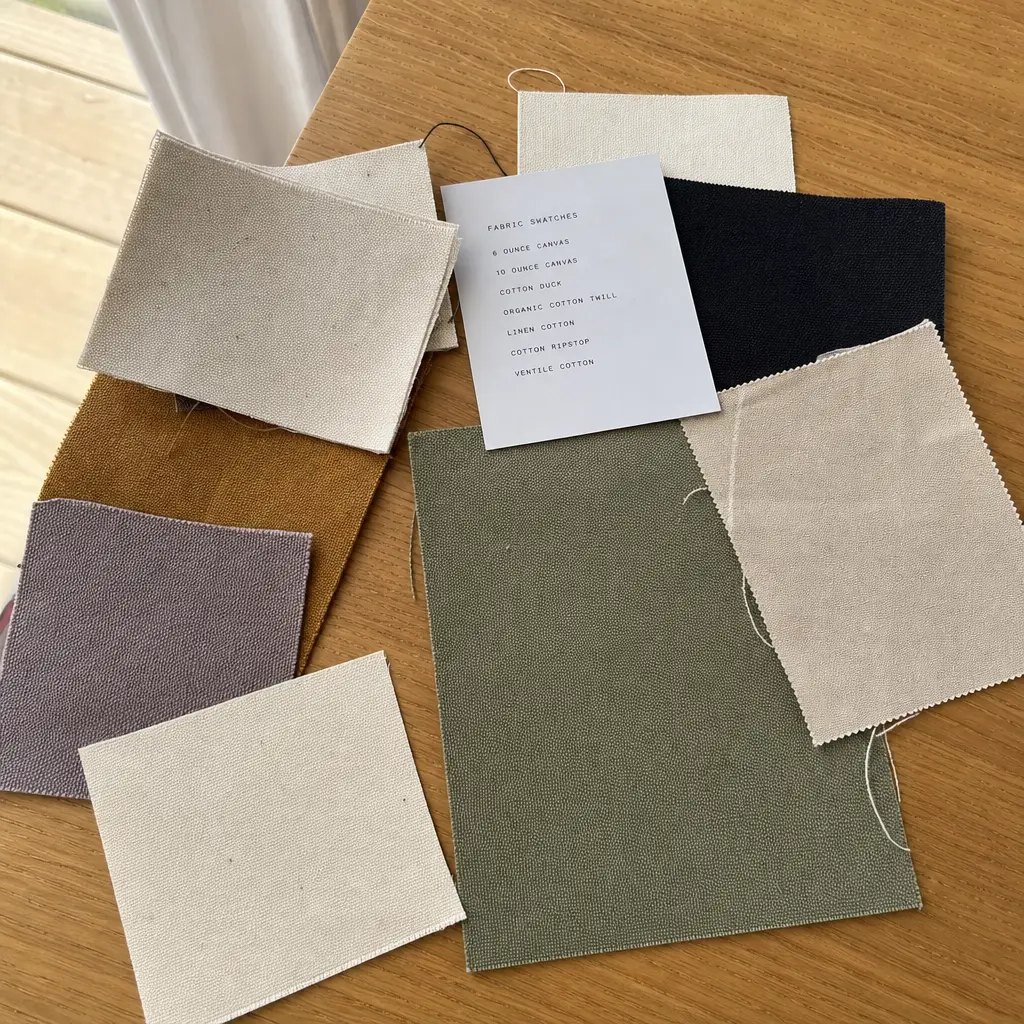
- Approve shade, fleck level, weave, hand feel, and surface texture from a swatch.
- Clarify natural, bleached, dyed, washed, pre-shrunk, resin-finished, or untreated canvas.
- Require approval before changing fabric mill, lot, finish, or dye process.
- Measure finished bags after the agreed factory processes, not only before finishing.
Set Dimensions and Geometry
The bag geometry determines whether the tote works at the bookstore counter and on the customer’s shoulder. Width, height, gusset depth, handle drop, handle width, top hem depth, and print position should be listed separately. A large body with a shallow gusset can look generous in a flat mockup but collapse when filled. A deep gusset may improve standing capacity, yet it increases stress at the lower corners.
Define how measurements are taken. If the tote is listed as 38 x 42 x 12 cm, clarify whether those numbers mean finished flat width, finished height from top edge to bottom, and actual boxed-base depth. Ambiguous measurement points create disputes during inspection and make reorders harder to repeat.
A single loose tolerance is not enough. Body size, gusset, handle drop, handle width, and print placement need separate tolerances because they affect different risks. A tote can meet width and height requirements but still feel wrong if the shoulder drop is too short. A logo can be the correct size but look defective if it rotates or drifts toward a seam.
- Use a measurement diagram for the factory, inspector, and receiving team.
- Check the sample flat, filled, hand-carried, and shoulder-carried if both uses are expected.
- Confirm whether bags must fit shelves, pegs, storage bins, event cartons, or checkout counters.
- Review logo visibility after the gusset opens under load.
- Keep the approved sample and measurement sheet together for reorders.
Engineer Handles and Stress Points
Most tote failures begin at stress points, not in the middle of the fabric panel. Watch the handle attachments, top hem, side seams, bottom seams, lower gusset corners, and folded areas where several layers meet. A heavier fabric with shallow handle insertion can fail sooner than a lighter fabric with better reinforcement.
Handles should be quoted in detail. Ask for material, width, total length, finished drop, insertion depth, stitch pattern, thread type, reinforcement layer, and acceptable distortion after testing. Widths around 2.5-3.8 cm are common for canvas and webbing handles, depending on the bag size and intended comfort. Self-fabric handles give a consistent look; cotton webbing can be efficient and comfortable when the trim is dense and properly sewn.
X-box stitching spreads load better than a single stitch row. Bar tacks can help at the handle exit point when they are placed consistently and sewn with suitable thread. Insertion depth matters because a handle barely caught in the hem can pull out even when the fabric looks strong.
- Specify handle width, drop, total length, and insertion depth into the top hem.
- Require X-box stitching or an equivalent reinforced pattern at each handle end.
- Add bar tacks when repeated textbook or grocery loads are expected.
- Check thread type, stitch density, seam allowance, back-tacking, and loose-thread trimming.
- Inspect bottom gusset corners after load testing, not only before testing.
Test Print Durability, Not Just Artwork
Bookstore artwork may include a university name, athletics mark, mascot, department logo, event message, donor mark, or sponsor logo. The print needs to look correct at delivery and remain presentable after handling, storage, shelf display, and reasonable reuse. Screen printing is often practical for solid campus logos and medium-to-large canvas tote orders, but the process still needs controls.
Ink can fail when curing, drying, stacking, or packing is rushed. Under-cured ink may look acceptable in a photo and then transfer when warm bags are stacked, folded tightly, or stored in humid cartons. Heavy ink deposits can crack if the main fold runs through the artwork. Water-based and plastisol inks can both work when the supplier controls the process and tests the finished result.
Approve the mark on the actual production canvas. A PDF proof confirms layout, not absorption, color shift, opacity, registration, rub resistance, or how the fabric texture affects the logo. Review the print on a filled tote as well as a flat tote because gusset expansion can distort artwork near seams.
- Approve print color and placement on production canvas, not only from a digital proof.
- Ask for ink type, curing process, drying time, and stacking rules.
- Run dry rub and light wet rub checks after full curing.
- Confirm placement tolerance for centering, rotation, top-edge distance, and side-seam distance.
- Avoid folding directly through heavy ink or key campus marks when feasible.
Define Load Tests With Pass Rules
Durability testing only helps when the method is clear. A useful request names the sample type, target load, hold time, cycle count, failure definitions, and reporting format. The supplier can then quote construction intended to pass, and the inspector can verify the result without guessing.
Static load testing checks whether the complete tote can hold a defined weight for a defined time without structural failure. The buyer may set a target such as 8 kg, 10 kg, or 12 kg based on intended use, then require no handle tear-out, no seam opening, no fabric rip, and no severe distortion after the hold. The number should match the tote size and selling claim.
Cyclic lift testing is useful for reusable grocery positioning because customers lift, lower, swing, set down, and lift again. A handle can pass a short hanging test yet loosen after repeated lifts. The report should state how many samples were tested, the weight used, the number of cycles, and any stitch movement, seam creep, handle elongation, or panel distortion observed.
- Test complete production-style bags, not loose handle strips.
- State target load, hold time, cycle count, sample quantity, and failure criteria.
- Inspect handles, top hem, side seams, bottom seams, and gusset corners after testing.
- Include print rub and dimensional checks when the sample uses final fabric and ink.
- Ask for photos of tested samples and close-ups of any distortion or stitch movement.
Put QC Terms in the PO
Quality control should be written into the purchase order before production starts. The QC file should include the specification sheet, measurement diagram, fabric swatch, artwork file, print placement guide, approved sample photos, packing instructions, carton labels, and defect classification. If these details remain scattered across emails, final inspection becomes subjective.
An AQL inspection can support shipment decisions, but visual review alone is thin for a durability-focused tote. The inspection plan should include measurements, handle construction checks, seam checks, print rub review, shade review, odor review, packing review, and functional load checks. Destructive tests do not need to be performed on every unit, but the sampling rule should be agreed.
Defect classes should match bookstore risk. Critical defects may include unsafe contamination, broken needle risk, severe mildew odor, wrong licensed logo, wrong legal mark, or structural failure under the agreed load. Major defects may include open seams, handle misattachment, dimensions outside tolerance, smeared print, wrong SKU label, serious stains, wrong packing, or carton shortage. Minor defects may include small loose threads or natural flecks within the approved range.
- Attach the swatch, measurement diagram, artwork, approved sample photos, and packing instructions to the PO.
- Classify critical, major, and minor defects before production.
- Include load checks, print rub checks, and carton checks in the inspection plan.
- Set remedies for failed inspection: sorting, repair, replacement, remake, discount, or shipment hold.
- Keep one signed sample with the buyer and one at the factory line.
Compare Quotes on Equal Terms
A low quote only matters when the specification is the same. Fabric sourcing, print setup, label requirements, packing material, carton quantity, inspection access, Incoterm, and payment terms can all change the unit price. A one-color natural canvas tote in bulk cartons is not comparable to a dyed tote with woven label, hangtag, barcode sticker, paper band, individual polybag, and final inspection.
Request tiered pricing at realistic quantities such as 500, 1,000, 3,000, and 5,000 pieces while keeping construction unchanged. Ask suppliers to identify any specification change needed to reach a lower price. That shows whether savings come from setup dilution, cutting efficiency, trim MOQ, simplified reinforcement, cheaper fabric, or reduced packing labor.
Break MOQ down by component. The bag may have one MOQ for stock natural canvas, another for dyed fabric, another for labels, another for hangtags, and another for polybags. Very low MOQ can be acceptable for a small event order, but it should not be mistaken for a controlled retail reorder program.
- Compare the same finished size, GSM, handle construction, print method, packing, and inspection scope.
- Separate unit price, sample fee, screen charge, label cost, packing cost, inspection cost, and freight assumptions.
- Ask for carton dimensions, gross weight, pieces per carton, and shipment mode assumptions.
- Confirm Incoterm, lead-time trigger, payment terms, and quote validity.
- Ask what changes if the supplier offers a lower price.
Use Samples as Production Controls
Sample approval should be a control process, not a quick photo signoff. A practical path may include a fabric swatch, blank fit sample, printed sample, and pre-production sample. The swatch confirms fabric weight, shade, texture, and hand feel. The blank sample confirms dimensions, gusset, handle comfort, and sewing. The printed sample confirms artwork, curing, placement, and rub behavior. The pre-production sample brings the details together before bulk cutting.
Document the approved sample. Record supplier name, style number, fabric reference, GSM, finish, finished dimensions, handle details, stitch requirements, artwork file, print size, print location, ink method, packing method, and approval date. Photograph the handle box, bar tack, top hem, inside seam, bottom gusset, front print, back panel, side view, and packing fold.
Test the sample with realistic campus merchandise. Load books, bottles, apparel, notebooks, and gifts similar to actual transactions. Carry it by hand and over the shoulder if the design is meant for both. Check handle comfort, bottom sag, gusset stability, logo distortion, and whether the tote still looks retail-ready after handling.
- Use staged approval when timeline allows: swatch, blank sample, printed sample, pre-production sample.
- Measure and photograph all stress points on the approved sample.
- Repeat affected tests after changes to fabric lot, handle drop, logo size, print method, or packing fold.
- Use retained samples for receiving checks and reorders.
- Do not release bulk production until sample comments are closed in writing.
Plan Packing and Receiving
Packing is part of durability because a tote damaged before reaching the bookstore has failed commercially. Canvas can absorb moisture, collect dust, hold deep creases, and show abrasion. Printed panels can block together if ink is not fully cured or cartons are over-compressed. Handles can deform when folded tightly for long transit.
Choose bulk packing, bundled packing, paper bands, hangtags, barcode stickers, or individual polybags based on policy and handling needs. Bulk packing reduces material use and may support campus sustainability goals, but it requires clean cartons, accurate counts, and sometimes carton liners. Individual polybags improve cleanliness and unit handling but add cost, labor, and plastic. Paper bands can be a useful middle option when quick counting and reduced plastic are both priorities.
Plan receiving before shipment. The bookstore team should verify carton count, SKU, PO, quantity, carton condition, odor, moisture, staining, print transfer, barcode accuracy, and packing fold. If the tote is tied to orientation, homecoming, graduation, or another fixed campus date, build in time for inspection, sorting, or replacement.
- Confirm flat packing, folding, bundling, paper bands, hangtags, barcode stickers, or polybags.
- Set pieces per carton, carton size, gross weight, and carton markings before comparing landed cost.
- Use carton liners or inner bags when humidity, dust, or long transit are concerns.
- Avoid over-compressed cartons that crease prints or deform handles.
- Create a receiving checklist for carton damage, odor, moisture, staining, print transfer, quantity, and labels.
Specification comparison for buyers
| Spec decision | Practical option | Cost / MOQ impact | Durability level | Inspection priority |
|---|---|---|---|---|
| 10 oz canvas tote | Often about 320-340 GSM; confirm actual GSM, finish, and tolerance with supplier | Lower fabric cost; easier for small event runs or stock natural canvas programs | Moderate when size, gusset, and load claim stay modest | Check handle reinforcement, seam allowance, and whether the quoted load target matches lighter fabric |
| 12 oz canvas grocery tote | Often about 380-410 GSM; good starting point for bookstore retail and checkout use | Mid-range cost; usually practical for repeat bookstore orders | Strong when paired with suitable thread, X-box handles, and tested gusset seams | Verify GSM, shrinkage, handle insertion, load test result, and print rub performance |
| 14 oz premium tote | Often about 450-475 GSM; best for premium alumni merchandise or higher retail price points | Higher fabric cost; heavier cartons; may increase MOQ or sewing time | High, if seam bulk and handle attachments are engineered correctly | Inspect needle damage, thick seam areas, print coverage, folded packing, and carton weight |
| Self-fabric canvas handles | Same or compatible canvas sewn into handles | Clean matching look; may use more fabric and sewing labor | Good when wide enough and deeply inserted into the top hem | Measure handle width, drop, insertion depth, X-box size, stitch density, and distortion after testing |
| Cotton webbing handles | Dense webbing, typically quoted by width, thickness, and material | Can reduce sewing complexity; trim MOQ may apply for custom colors | Good to high if webbing is strong and attachment area is reinforced | Check webbing density, comfort, color match, shrinkage, and tear-out at the sewn box |
| Screen printed logo | Production ink printed on approved canvas with curing controls | Cost depends on color count, screens, artwork size, and registration needs | Durable when ink is cured before stacking and tested for rub resistance | Require dry rub, light wet rub, placement tolerance, registration check, and packing fold review |
| Boxed bottom gusset | Common grocery-style base, often around 10-12 cm when standing capacity matters | Uses more fabric and may raise carton volume | Improves capacity but increases stress at lower corners | Inspect bottom seam, gusset alignment, corner reinforcement, and sag after load testing |
| Retail-ready packing | Paper band, hangtag, barcode sticker, or individual polybag as required | Adds labor, material, and component MOQ; improves receiving and shelf handling | Protects presentation if packing is clean and not over-compressed | Check carton count, SKU labels, print transfer, moisture, odor, creasing, and barcode accuracy |
Buyer checklist before sampling
- Classify the order as retail merchandise, checkout support, orientation giveaway, alumni item, sponsor bundle, or premium gift.
- List likely contents: textbooks, bottles, hoodies, notebooks, snacks, stationery, tech accessories, gifts, or grocery-style mixed loads.
- State the finished size, gusset depth, handle drop, handle width, top hem depth, print size, and print placement.
- Request fabric in both oz and GSM, with supplier-confirmed tolerance, finish, shrinkage expectation, and approved swatch.
- Ask the supplier to confirm whether load targets are static, cyclic, or both, and require pass/fail criteria in writing.
- Describe handle construction: material, width, total length, insertion depth, X-box dimensions, bar tack position, thread, and stitch density.
- Set separate tolerances for body size, gusset, handle drop, handle width, print centering, rotation, and distance from seams.
- Approve artwork on actual production canvas using the quoted ink, curing process, print size, placement, and packing fold.
- Include QC checks for GSM, shade, stains, odor, dimensions, seam quality, handle attachment, load test, print rub, packing, and carton labels.
- Compare quotes using the same construction, quantity tier, packing method, inspection scope, Incoterm, lead-time trigger, and payment terms.
Factory quote questions to send
- What exact canvas weight are you quoting in oz and GSM, and what GSM tolerance can you support for this fabric type?
- Is the canvas natural, bleached, dyed, washed, pre-shrunk, resin-finished, or untreated, and when are final dimensions measured?
- Can you provide a swatch from the same fabric type, plus expected shrinkage after factory finishing and consumer washing?
- What load test result can you support for this exact finished size, gusset, handle drop, fabric weight, handle construction, and thread?
- Do you recommend static load testing, cyclic lift testing, or both for the intended bookstore use, and what sample quantity will be tested?
- What are the handle material, width, total length, finished drop, insertion depth, X-box dimensions, bar tack placement, stitch density, and thread type?
- What seam allowance and stitch density are included for the side seams, bottom seam, top hem, gusset corners, and handle attachment?
- Can you send close-up photos of the handle box, bar tack, top hem, inside seam, bottom gusset, side seam, and reverse side of the print?
- Which print method, ink type, color count, curing process, and drying or stacking controls are included in the quote?
- What placement tolerance can you hold for print centering, rotation, distance from top edge, and distance from side seams on finished sewn bags?
Quality-control points to confirm
- Fabric GSM tolerance should be agreed before order release. Plus or minus 5 percent is a useful discussion point for controlled cotton canvas, but the PO should reflect the supplier’s confirmed capability.
- Fabric shade should be checked against an approved swatch under consistent lighting. Natural flecks may be acceptable; oil stains, mildew, dirty marks, and severe lot variation should not be treated as character.
- Finished dimensions should be measured after agreed factory processes such as washing, steaming, pressing, or final folding, with separate tolerances by measurement type.
- Handle pull and load checks should use complete production-style bags because failures often occur at the stitched box, bar tack, top hem, or fabric around the insertion point.
- Static load testing should state target weight, hold time, sample quantity, and failure criteria such as handle tear-out, seam opening, fabric ripping, or severe distortion.
- Cyclic lift testing should repeat lifting and lowering at the agreed load to reveal stitch loosening, seam creep, thread breakage, handle stretch, and panel stress.
- Seam inspection should cover stitch density, skipped stitches, broken thread, seam allowance, back-tacking, top hem security, gusset alignment, and loose-thread trimming.
- Print rub checks should include dry rub and light wet rub on the actual production fabric, ink, color, curing method, and placement.
- Print placement should be reviewed for centering, rotation, distance from the top edge, distance from side seams, and visibility when the tote is filled.
- Packing inspection should check carton strength, carton quantity, gross weight, moisture, odor, folded print transfer, SKU labels, barcode labels, and country-of-origin marking where required.