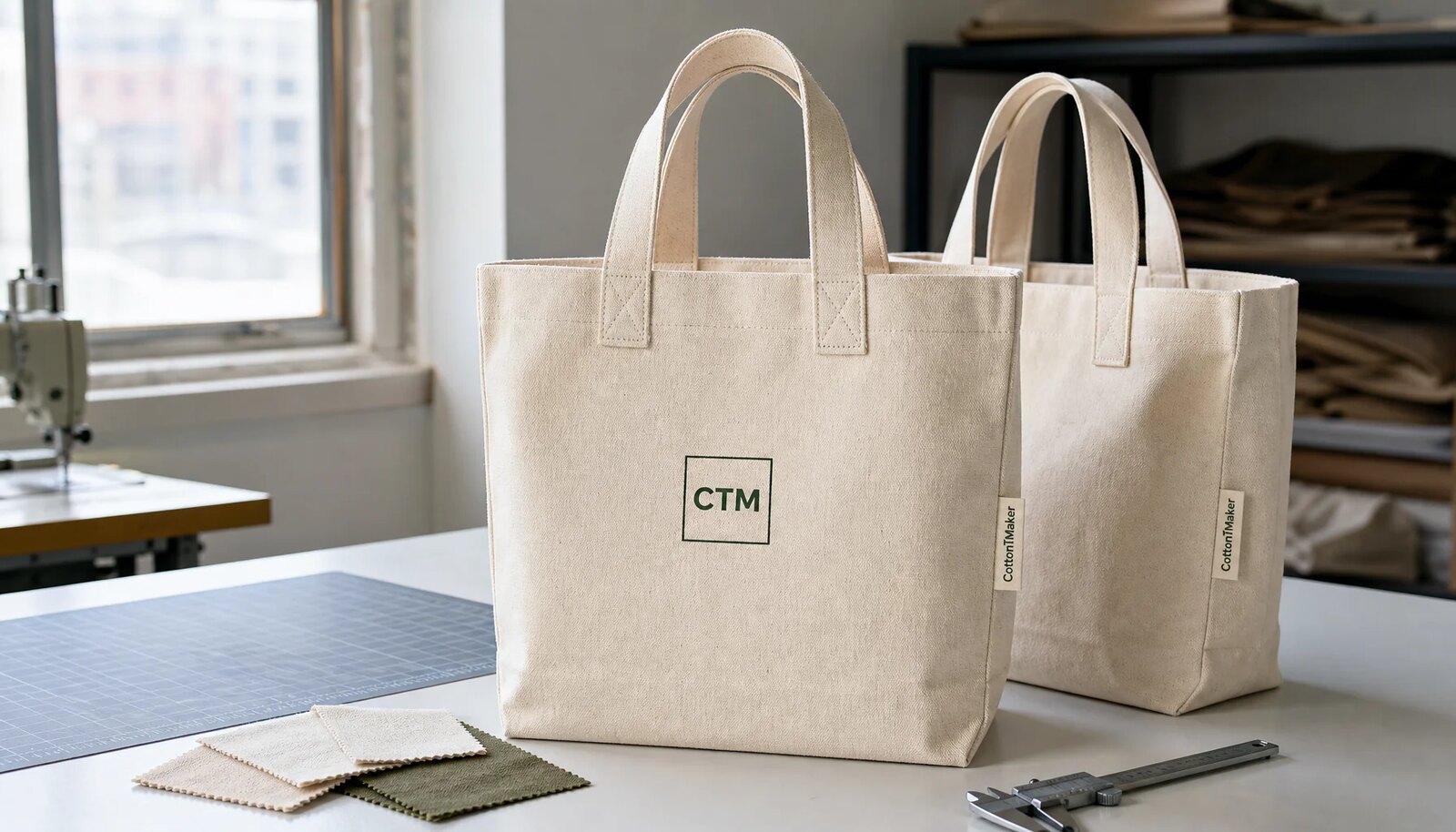
Procurement Goal: Turn Durability Into A Spec
A custom canvas grocery tote for craft fairs is not just a walking advertisement. It is a working package for glass jars, ceramic mugs, candles, soaps, small books, packaged foods, folded textiles, and purchases collected from several booths. The bag needs to carry real weight, protect the brand impression, pack quickly at the booth, and still look good when the customer leaves the venue.
For a B2B buyer, the job is to make that performance quotable. Suppliers cannot price durability accurately from phrases like heavy canvas, strong handles, premium stitching, or eco-friendly tote. Those words sound helpful, but they leave too much room for different fabric weights, different handle tapes, different stitching patterns, and different packing methods. A stronger RFQ states the fabric GSM, finished size, gusset, handle construction, print method, load test, inspection standard, and carton format.
The most common mistake is approving the logo while the structure remains vague. A clean print on light canvas may still fail at the handle. A heavier fabric may still tear if the stitch box is too small or too close to the top edge. A low unit price may become expensive if the shipment arrives with strong odor, logo creases, mixed sizes, weak cartons, or bundle counts that slow receiving before an event.
Treat the tote as a small sewn product with measurable risks. That means separating visual approval from construction approval, and separating sample approval from bulk inspection. The approved pre-production sample should become the reference for fabric, print, sewing, handle feel, folding, carton packing, and reorders.
- Start the RFQ with the expected load and product mix, not only the artwork file.
- Ask each supplier to quote the same GSM, size, gusset, handle, reinforcement, print, and packing.
- Approve construction, print, load testing, and carton packing as separate checkpoints.
- Use the approved pre-production sample as the bulk inspection and reorder reference.
- Define critical and major defects before production starts, not after cartons arrive.
Fabric Weight, GSM, And Canvas Terms
Canvas weight should be quoted in both ounces per square yard and GSM. As a practical conversion, 8 oz is about 271 GSM, 10 oz about 339 GSM, 12 oz about 407 GSM, and 14 oz about 475 GSM. The exact number can shift with weave, yarn count, finishing, and moisture, so the RFQ should include an agreed tolerance. Many buyers use a tolerance such as ±5% unless a stricter buyer manual applies.
For custom canvas grocery totes at craft fairs, 10 oz to 12 oz cotton canvas is often the balanced sourcing range. It gives more structure than lightweight promotional cotton without the sewing difficulty, carton weight, and material cost of very heavy canvas. An 8 oz to 9 oz canvas can work for paper goods, apparel, brochures, greeting cards, or light giveaways. A 14 oz canvas can suit premium reuse programs, but it adds bulk, freight weight, needle wear, and folding resistance.
Do not stop at the headline weight. Ask whether the GSM is measured before or after dyeing, washing, enzyme finishing, coating, softening, or other finishing. A natural greige canvas, dyed canvas, washed canvas, recycled cotton blend, and cotton/poly canvas can feel different even when the nominal GSM is the same. If the tote will be marketed as organic cotton, recycled cotton, unbleached cotton, or another claim, request documentation that supports the exact claim for the destination market.
A swatch from the planned bulk fabric source is more useful than a showroom swatch pulled from a sample rack. Check weave density, light show-through, surface lint, slubs, odor, hand feel, and shade. If the bag will be printed, test the artwork on the same fabric. Ink absorption, edge sharpness, and color appearance change with fabric shade and finish.
- Light-use spec: 8 oz to 9 oz canvas for paper goods, apparel, and low-weight giveaways.
- General grocery spec: 10 oz to 12 oz canvas for reusable craft fair totes carrying mixed goods.
- Premium spec: 14 oz canvas when structure and long reuse matter more than freight savings.
- RFQ wording: state oz, GSM, tolerance, fiber content, weave, finish, color, and measurement stage.
- Swatch approval: compare bulk-source fabric against the quoted fabric before final sampling.
Finished Size, Gusset, And Tolerance Control
The tote shape should match how the bag will be used at the event. A flat tote is economical, folds tightly, and may be enough for brochures, shirts, and light handmade goods. It is less convenient for candles, jars, boxed soaps, pottery, folded textiles, and multiple purchases. A side-gusset or boxed-bottom grocery tote opens faster, stands better during packing, and spreads load more evenly across the bottom and side seams.
A common starting point for a grocery-style craft fair tote is about 38 cm wide by 40 cm high with a 10 cm to 12 cm gusset. That is only a starting point. Buyers should check the largest expected product, event kit requirements, carton plan, and display method before locking the size. If the tote must hang on a peg, fit into a gift kit, sit in a retail bin, or ship inside another box, those limits belong in the RFQ.
Finished tolerances need to be realistic for sewn cotton canvas. Body width and height are often controlled around ±1.0 cm. Handle drop, print placement, and label position may need tighter control, such as ±0.5 cm to ±1.0 cm, depending on branding, display, and packing requirements. Small woven labels may need even tighter placement if they sit close to a seam or near a barcode tag.
The top hem deserves attention because it is part of the strength system. A folded hem gives handle stitches more stable fabric to grip and helps prevent the bag mouth from stretching under load. If the hem is shallow, uneven, or placed too close to the reinforcement, the fabric can tear above the stitch box. Specify top hem width, seam type, and whether handle stitching passes through the folded area.
Write the measurement method into the inspection plan. Bags should be laid flat, squared, and measured without hand stretching. Width, height, gusset depth, handle drop, handle width, top hem width, and print placement should be checked from fixed reference points. This prevents arguments caused by pulling the canvas into shape during inspection.
- Use a gusset or boxed bottom for bulky craft fair purchases and faster booth packing.
- Define body, gusset, handle, top hem, label, and logo tolerances in the PO.
- Measure bags flat and relaxed instead of stretching them to meet size.
- Confirm whether the tote must fit a kit box, display hook, shelf, or shipping insert.
- Treat top hem construction as part of the load-bearing design.
Handle Construction And Load Path
Most tote failures start where the handle joins the bag body. A loaded tote does not only pull downward. It twists when someone walks, swings when the customer changes hands, and jolts when the bag is lifted from the floor. Four small attachment points carry most of that force, so handle width, tape strength, stitch pattern, thread, reinforcement size, and distance from the top edge matter more than they may appear in a product photo.
Self-fabric canvas handles create a matching natural look and are common for custom canvas grocery totes. Cotton webbing handles can offer more consistent thickness and strength when the webbing quality is controlled. For reusable grocery loads, handle width around 2.5 cm to 3.8 cm is a practical range. Narrower handles can cut into the hand and concentrate stress at the stitch line.
Handle drop changes how the tote behaves. Shoulder-carry designs commonly use a finished drop of about 25 cm to 30 cm, while hand-carry totes can be shorter. A longer handle can swing more and create additional twisting force at the top hem. If the buyer changes handle length after a load test, the load path has changed too, so the test result should be reviewed.
A reinforced rectangle with a cross-box or diagonal stitch usually performs better than one straight stitch line. The reinforcement should be large enough to spread load and positioned far enough below the top edge to avoid tearing the bag mouth. Inspectors should check all four attachment points, including the back side and the interior, not only the front pair near the logo.
Ask for close-up sample photos before approving bulk. The photos should show handle width, stitch box size, top-edge distance, thread condition, back-tack quality, and the inside view. During final inspection, handle symmetry also matters: uneven drop length, crooked placement, or different distances from the side seam can make the tote feel cheap even if it does not immediately fail.
- Specify handle material, width, finished drop, stitch box size, and distance below the top edge.
- Use cross-box or reinforced rectangle stitching for grocery-load totes.
- Avoid single-line handle attachment for totes expected to carry dense items.
- Check for fabric tearing above the stitch box, broken thread clusters, and severe puckering.
- Require close-up photos of all four handle ends, including inside views.
Seams, Thread, And Sewing Workmanship
A durable tote is a sewn system. Heavy canvas does not make up for weak thread, skipped stitches, loose back-tacks, or uneven seam allowance. The RFQ should define lockstitch construction, thread type, reinforcement method, and seam allowance where it affects strength or appearance. A visual target such as 7 to 10 stitches per inch can help align expectations, but the approved sample should remain the final reference.
Different seams carry different stress. Side seams and gusset seams control the bag shape. Bottom seams take pressure from hard goods such as books, pottery, boxed candles, or jars. Top hems stabilize the bag mouth and support the handle attachment. If the product mix is dense, ask whether the bottom seam needs reinforcement or whether a boxed-bottom construction is more suitable than a simple side gusset.
Thread choice should match the fabric weight and intended use. Polyester or cotton/poly thread is commonly used where strength and abrasion resistance matter. Pure cotton thread may fit some natural product positioning, but it still needs to be tested for seam strength and wear. Buyers do not need to prescribe every machine setting, but the result must be visible, repeatable, and inspectable.
Finishing quality also affects labor at receiving. Long thread tails, thread nests, needle cuts, dirty seam allowances, and loose fibers can make a tote look low-grade even if it survives the load test. For craft fair programs, poor trimming may force staff to sort or clean bags before distribution, which is exactly the kind of hidden cost procurement teams try to avoid.
Inspection should include exterior and interior views. A front-view photo can hide an open inside seam, a weak back-tack, or a nest of thread at the bottom corner. Ask inspectors to turn the bag, open the gusset, and check stress points under good lighting.
- Check stitch consistency on side seams, bottom seams, top hem, and handle reinforcement.
- Classify open seams, broken reinforcement stitches, and needle cuts as major defects.
- Confirm back-tacks or locked seam ends at load-bearing points.
- Inspect inside seams because many structural defects are hidden from front-view photos.
- Include trimming, loose threads, stains, and dirty seam allowances in final inspection.
Print Durability And Artwork Risk
Print method should follow the artwork, fabric color, ink coverage, hand feel, and event handling requirements. For one to three solid colors on natural or dyed canvas, screen printing with properly cured water-based or pigment ink is often a practical B2B choice. It works well for maker logos, market names, sponsor marks, and simple retail graphics.
Heat transfer can reproduce full-color artwork, gradients, small details, and photographic effects. It should be tested carefully for folding marks, edge lifting, cracking, heat sensitivity, and hand feel. Embroidery can look premium on small marks, but it is usually not efficient for large grocery tote graphics because it adds stiffness, cost, and needle stress to the panel.
Print approval should cover more than color matching. Check logo size, print position, opacity, registration, edge sharpness, ink odor, tackiness, dry rub transfer, cracking after folding, and blocking between stacked bags. If bags are packed before the ink is fully cured or stable, printed panels can mark adjacent bags inside cartons.
Large solid ink areas raise risk. They can stiffen the canvas, show crease lines, trap odor, and create pressure marks when cartons are stacked. If the design has heavy coverage, discuss whether the artwork can be reduced, the fold line can avoid the printed zone, the ink system can be adjusted, or the carton quantity can be lowered to reduce compression.
Fold planning is part of print durability. A strong print can still look poor if every bag is folded through the center of a dense logo. Ask for a packed sample or packing photo after print approval, especially for event programs where totes need to look clean when opened at the booth.
- Screen print: good for bold logos, simple slogans, and limited-color artwork.
- Heat transfer: useful for complex graphics but requires fold, rub, and edge-lift checks.
- Embroidery: best for small premium details, not large flexible grocery graphics.
- Print QC: check opacity, registration, dry rub transfer, cracking, odor, and tackiness.
- Packing QC: avoid hard folds through heavy print zones whenever possible.
Durability Test Protocol For Craft Fair Loads
A useful durability test should reflect real handling. Customers do not carry totes as motionless weights. They lift them quickly, swing them while walking, set them down, pick them up again, and sometimes add purchases from several booths. A practical test combines static load, movement, and inspection after unloading.
Set the target load before sampling. For light products, 5 kg may be enough. For general craft fair grocery use, 8 kg is a reasonable planning level. For dense goods such as books, preserves, pottery, candles, or glass jars, 10 kg may be more appropriate. If the buyer wants a safety margin, state it clearly, such as testing at the target load plus 20% or another agreed margin.
A simple factory protocol can include a static hang test at the agreed load for 30 minutes or 1 hour, followed by lift-and-swing cycles using the same load. The report should identify the sample, test date, weight, test duration, cycle count, load material, and pass/fail result. Photos should show the bag before loading, during loading, and after unloading, with close-ups of all stress points.
Drop testing needs careful wording. Dropping a loaded fabric tote is severe and may damage fragile goods even if the bag survives. If a drop test is required, define the drop height, surface, load shape, number of drops, and acceptance criteria. For many craft fair programs, controlled static and swing tests are more relevant than an undefined dramatic drop video.
The tested sample must match the quoted construction. A tote tested with thicker handles, extra stitching, or higher GSM fabric does not validate a cheaper bulk version. If the buyer changes handle drop, fabric weight, gusset depth, reinforcement size, or thread after testing, the stress path changes and the test should be reviewed or repeated.
- Static test: agreed load for 30 minutes or 1 hour with no tear-out or seam opening.
- Movement test: defined lift-and-swing cycles with the same load and documented cycle count.
- Uneven load check: include hard-corner blocks or equivalent items for jars, books, or pottery.
- Pass criteria: no handle tear-out, broken reinforcement, open seams, or functional distortion.
- Evidence required: sample ID, weight, duration, cycle count, date, and close-up photos.
Sample Approval And Golden Sample Control
A showroom sample is not enough for a durability decision. It may use stock canvas, substitute handles, different thread, a different print process, or a more careful sample-room operator. For production control, approve a pre-production sample made with the intended bulk fabric, final color, final print, final handle, final reinforcement, final label, and proposed packing fold.
Physical sample approval is strongly preferred for custom canvas grocery totes. Photos cannot fully show hand feel, stiffness, odor, fabric density, handle comfort, or print texture. If timing forces remote approval, request a measurement video with ruler checks, handle close-ups, inside seam views, fabric swatch comparison, folding method, and a short load demonstration.
Sample comments should be controlled by version. If sample one has the correct construction but the logo is too low, sample two should correct the logo without quietly changing the fabric or handle. Each approval sheet should list dimensions, tolerances, GSM, handle spec, reinforcement size, thread color, logo file version, print method, label details, packing, and test result.
Keep the final approved sample protected and clearly identified. One sample can stay with the supplier, one with the buyer, and one with a third-party inspector if inspection is planned. For reorders, store digital records: photos, measurements, artwork version, fabric data, packing plan, carton marks, and inspection criteria.
Substitution control is especially important after load testing. A supplier may suggest a different handle tape, thread, stitch density, or canvas lot to save time or cost. Those changes may be reasonable, but they should not enter bulk production without buyer approval and, where necessary, a revised load check.
- Approve final fabric, sewing, print, label, and packing fold before bulk release.
- Record sample measurements with the tote laid flat and squared.
- Label the approved reference so it is not confused with earlier prototypes.
- Do not allow unapproved substitutions after load testing.
- Use the approved sample as the benchmark for inspection and repeat orders.
MOQ, Cost Drivers, And Quote Comparison
MOQ is usually driven by fabric availability, dyeing, print setup, cutting efficiency, label requirements, and packing labor. A stock natural canvas tote with a standard size and one-color print normally has a lower MOQ than a custom-dyed tote with woven labels, hangtags, barcodes, complex artwork, or individual retail packaging.
Compare supplier prices only when the specification is identical. A cheaper quote may use lower GSM, narrower handles, smaller gusset, simpler stitch pattern, no inner bundles, lighter cartons, or different Incoterms. Ask suppliers to show price breaks at 500, 1000, 3000, and 5000 pieces while holding the same construction constant.
If cost reduction is needed, ask for value-engineering options as separate lines instead of accepting an unclear cheaper version. Possible levers include stock natural canvas, fewer print colors, lower ink coverage, bulk bundles instead of individual polybags, simpler labels, or adjusted carton quantities. Keep durability-critical items such as handle reinforcement visible in the cost discussion.
Clarify what the quote includes. Confirm whether the price covers fabric, cutting, sewing, printing, labels, hangtags, barcodes, export cartons, carton marks, inspection support, export documents, inland delivery, or delivery to a forwarder. For event-driven orders, a small unit-price saving can be outweighed by late delivery, rework, sorting labor, or replacement costs.
When two quotes differ, ask each supplier to restate the construction line by line. This is faster than trying to reverse-engineer the price after sampling. The best quote comparison is not the lowest number; it is the lowest dependable number for the same fabric, sewing, print, packing, timeline, and delivery terms.
- Low MOQ route: stock natural canvas, standard size, one-color screen print, bulk bundles.
- Mid-range route: custom size, gusset, reinforced handles, woven label, two-color print.
- Higher MOQ route: custom dye, PMS matching, retail packaging, complex artwork, certification claims.
- Quote comparison: hold GSM, size, gusset, handles, print, packing, and Incoterms constant.
- Cost control: separate optional upgrades from durability-critical construction.
Packing, Cartons, And Event Receiving
Packing affects appearance, receiving speed, and booth operations. Flat packing is usually practical for canvas grocery totes because it protects the printed face and keeps counting simple. Inner bundles of 25 or 50 pieces help warehouses and event teams replenish stock without opening and counting full cartons during a busy setup window.
Carton compression can create visible quality problems. Overfilled cartons may press hard creases across the logo, top hem, or handle area, especially on heavy canvas or heavy ink coverage. Underfilled cartons waste freight and allow bags to shift during transit. Ask the supplier to confirm carton quantity, carton dimensions, fold method, and estimated gross weight after the final sample is approved.
Carton marks should support receiving, not just export handling. Include SKU, color, quantity, purchase order, carton number, gross weight, net weight, destination, and event date when relevant. If shipments go to multiple fairs or regional warehouses, carton labels should allow sorting without opening every carton. Bundle labels inside the carton can speed replenishment even further.
Moisture and odor need attention because cotton canvas absorbs humidity. For long-distance transit or seasonal storage, discuss inner polybags or bundle bags, moisture control, and carton storage conditions. Strong chemical, musty, or mildew odor should be treated as a defect because these totes may carry food-adjacent goods and customer purchases.
Receiving checks should sample cartons from different positions, not only the top of the stack. Inspect a few bags from the top, middle, and bottom of selected cartons. Confirm count, fold quality, print condition, odor, moisture signs, carton damage, and barcode readability before the totes are distributed to event teams.
- Bulk format: flat folded bags in bundles of 25 or 50 inside export cartons.
- Retail-ready format: individual fold, hangtag or belly band, barcode label, and clean carton marks.
- Carton marks: SKU, color, PO, quantity, carton number, destination, and event date if needed.
- Wrinkle control: confirm fold direction and avoid hard folds through printed panels.
- Receiving check: inspect cartons from top, middle, and bottom of the pallet or stack.
Specification comparison for buyers
| Sourcing decision | B2B specification to request | Typical measurable range | QC risk if undefined |
|---|---|---|---|
| Canvas fabric weight | Quote both oz per square yard and GSM. State whether the measurement is for greige, dyed, washed, softened, or finished fabric. | 8 oz ≈ 271 GSM, 10 oz ≈ 339 GSM, 12 oz ≈ 407 GSM, 14 oz ≈ 475 GSM; many buyers use a tolerance such as ±5%. | A supplier may price lighter finished fabric than expected, leading to thin panels, poor shape retention, and lower tear resistance. |
| Fabric composition | State conventional cotton, organic cotton, recycled cotton blend, cotton/poly blend, dyed cotton canvas, or another blend. Require documents for any claim used on labels or marketing. | Common reusable tote options include 100% cotton canvas and cotton-rich blends. Recycled or organic claims need traceability if they appear on product copy or packaging. | Unsupported fiber claims, inconsistent hand feel, shade variation, or compliance issues at receiving. |
| Finished size | Specify width, height, gusset depth, handle drop, handle width, top hem width, print position, and label placement with tolerances. | Larger body dimensions: often ±1.0 cm; handle drop and print placement: commonly ±0.5 cm to ±1.0 cm; small labels: about ±0.3 cm to ±0.5 cm. | Bulk bags may not fit event kits, shelf displays, carton plans, hooks, inserts, or the intended carry style. |
| Gusset and bottom | Choose flat tote, side-gusset tote, or boxed-bottom grocery tote based on product mix and booth packing speed. | A common grocery tote starting point is about 38 cm W x 40 cm H x 10-12 cm gusset. | A flat promo tote can overload side seams and slow booth staff when packing jars, candles, books, ceramics, and bulky goods. |
| Handle construction | Define handle material, width, finished drop, reinforcement size, stitch type, stitch box position, and distance from the top edge. | Handle width 2.5-3.8 cm; shoulder drop often 25-30 cm; cross-box stitching is commonly used for grocery loads. | Narrow handles, shallow reinforcement, or single-line stitching can fail during twisting, swinging, sudden lifting, or repeated reuse. |
| Thread and stitching | Request thread type, stitch density, back-tack or lock method, seam allowance, and reinforcement pattern. | Lockstitch with consistent density; a common visual target is around 7-10 stitches per inch, confirmed by the approved sample. | Skipped stitches, long stitch length, weak back-tacks, needle cuts, and loose thread ends become hidden structural defects. |
| Print method | Match artwork to screen print, pigment print, water-based print, heat transfer, or embroidery. Define curing, fold, rub, and odor checks. | Screen print for 1-3 solid colors; heat transfer for complex artwork; embroidery for small premium marks. | Poor curing, heavy ink coverage, or unsuitable transfer film can crack, remain tacky, lift at edges, or mark adjacent bags in cartons. |
| Load testing | Test the approved construction, not a substitute sample. Document static load, movement cycles, sample identity, and post-test inspection. | Planning loads: 5 kg light use, 8 kg general craft fair use, 10 kg dense goods; add an agreed safety margin if needed. | A photo of weights in a tote does not prove duration, cycle count, sample identity, or pass/fail condition. |
| Packing format | Define fold method, bundle quantity, carton count, carton marks, barcode or hangtag needs, wrinkle control, and moisture protection. | Inner bundles of 25 or 50 pieces; carton gross weight should stay practical for manual handling. | Over-compression creates logo creases; unclear bundle counts slow receiving, stock counts, and event replenishment. |
Buyer checklist before sampling
- Define the real load case before quoting: light paper goods, mixed craft purchases, dense candles or jars, expected maximum weight, and whether customers are expected to reuse the tote after the event.
- Specify fabric in oz and GSM, including tolerance, fiber composition, weave, color, finish, shrinkage expectation, and whether GSM is measured before or after dyeing, washing, or other finishing.
- Set finished dimensions with tolerances: width, height, gusset depth, handle drop, handle width, top hem width, seam allowance if critical, label position, and print location from fixed edges.
- Require handle details in writing: self-fabric or webbing, width, length before sewing, finished drop, reinforcement stitch pattern, stitch box size, thread type, and distance from the top edge.
- Choose the print method from artwork risk, not unit price alone: ink coverage, color count, curing time, fabric color, line thickness, hand feel, fold line exposure, and rub resistance.
- Approve a physical pre-production sample made with production-intended fabric, final sewing method, final handle, final thread, final print, final label, and proposed packing fold.
- Request durability evidence with exact load weight, load material, test duration, swing or lift cycle count, sample ID, test date, and close-up photos of all four handle attachments after testing.
- Define pass/fail thresholds for handle tear-out, seam opening, broken stitches, needle cuts, print cracking, dry rub transfer, tacky ink, odor, stains, fabric holes, and carton count errors.
- Confirm carton specifications: bundle count, carton quantity, carton board strength if required, carton marks, PO and SKU labels, moisture control, barcode handling, and whether bags are retail-ready or bulk-packed.
- Build the timeline around artwork approval, strike-off or print sample, pre-production sample, load test, sample corrections, fabric booking, cutting, printing, curing, sewing, trimming, final inspection, packing, and freight cut-off.
Factory quote questions to send
- What exact canvas weight are you quoting in oz and GSM, at what stage is it measured, and what GSM tolerance applies to bulk production?
- Is the quoted fabric greige, natural, bleached, dyed, washed, enzyme-finished, organic cotton, recycled cotton blend, conventional cotton, or cotton/poly blend?
- Can you provide a bulk fabric swatch or lab-cut swatch showing weave, hand feel, color, odor, shrinkage expectation, and measured GSM before we approve the pre-production sample?
- What finished dimensions are included in the quote, and what tolerances will you apply to body width, height, gusset, handle drop, and print placement?
- Will the tote use a flat bottom, side gusset, boxed bottom, or other grocery construction, and what seam allowance and stitching method are included?
- What handle material, width, finished drop, reinforcement pattern, stitch box size, and distance below the top edge are included in your standard quote?
- What thread type and stitch density will be used for side seams, bottom seams, top hem, and handle reinforcement?
- What load test can you perform on the approved construction, and will the report include weight, duration, movement cycles, sample ID, photos, and pass/fail comments?
- Which print method is quoted for our artwork, and what curing, dry rub, fold, cracking, odor, and carton pressure checks are included before packing?
- What artwork details affect price or durability, including ink coverage, fine lines, halftones, print size, print location, color count, and registration tolerance?
Quality-control points to confirm
- Finished dimensions measured with the bag laid flat, squared, and not stretched; larger body dimensions usually within ±1.0 cm and critical details such as handle drop, logo position, and labels within the agreed tighter tolerance.
- Fabric weight verified from bulk production cuttings or roll samples, with measured GSM recorded and no mixed lots, unexpected thin panels, shade bands, excessive slubs, holes, oil marks, or visible weave changes.
- Handle attachment tested or reviewed against the agreed load protocol, with no handle tear-out, broken reinforcement stitches, seam opening, top hem ripping, or severe distortion at the four attachment points.
- Side seams, bottom seams, gusset seams, top hem, and handle stitching checked for skipped stitches, loose thread ends, long stitch length, weak back-tacks, needle cuts, crooked seams, and uneven seam allowance.
- Handle placement checked for equal drop length, symmetry from left to right, equal distance from side seams, correct handle width, and sufficient reinforcement distance below the top edge.
- Print position measured from fixed bag edges; logo size, color, opacity, registration, and coverage compared with the approved sample under consistent lighting.
- Ink surface checked for dry rub transfer, cracking on fold lines, tackiness, pinholes, smudging, poor coverage, heavy buildup, odor, and blocking or sticking between stacked bags.
- Bag interior checked for trapped thread nests, loose fibers, dirty seam allowances, needle damage, stains, musty odor, sharp trimming, and foreign material that affects retail presentation.
- Labels, hangtags, barcodes, fiber content wording, care labels, country-of-origin marks, and any certification references checked against the purchase order and destination requirements.
- Packing checked for correct fold method, inner bundle count, carton quantity, carton marks, polybag warnings if used, moisture protection, barcode readability, carton condition, and wrinkle control across printed panels.