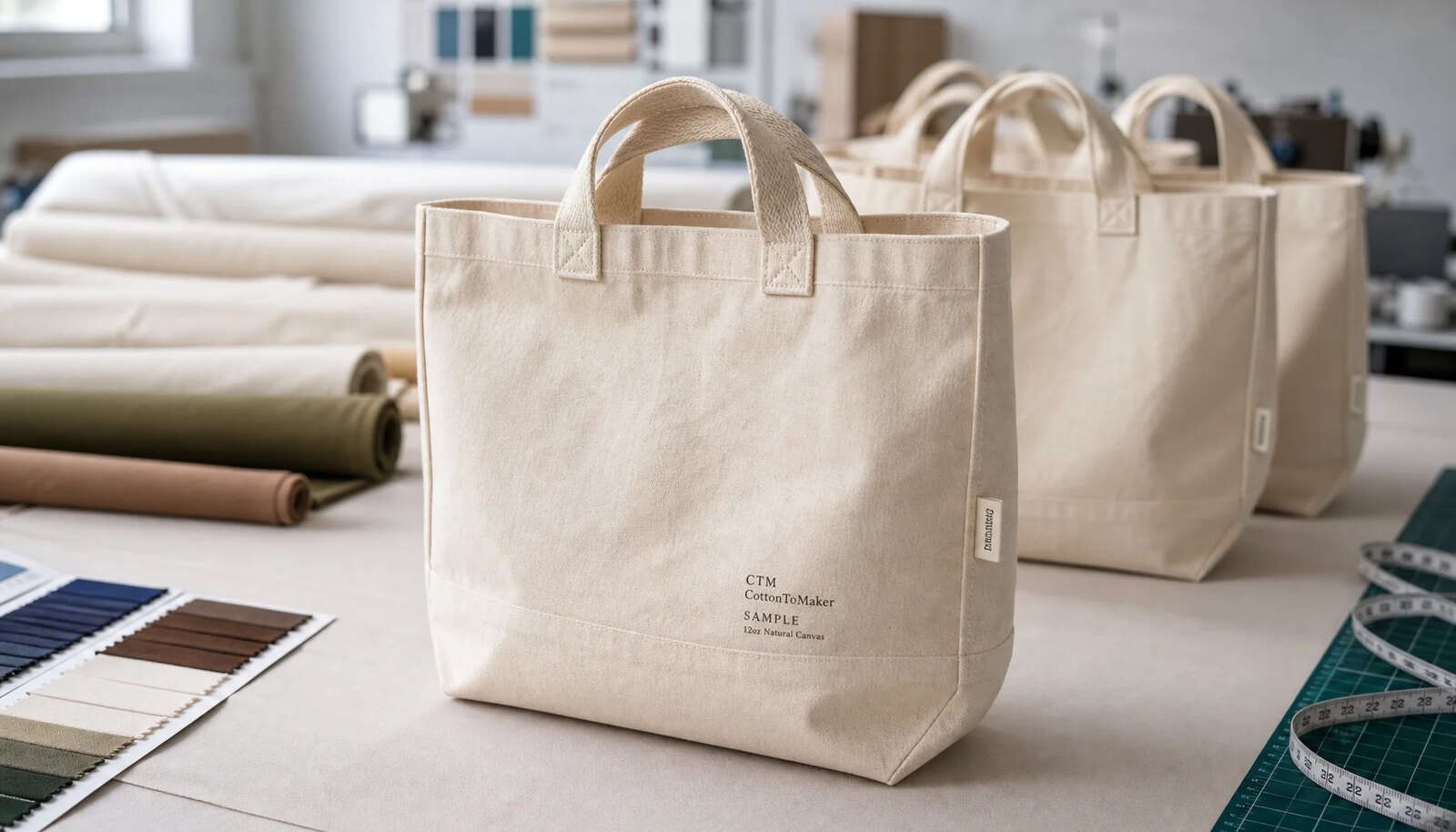
Buying Problem
Craft fair tote programs look simple on the surface: a rectangular canvas grocery bag, a logo, and a delivery date before the event season starts. In production, they become risky when the RFQ leaves too much open. One supplier quotes 8 oz cotton, another quotes 12 oz canvas, one includes screen setup, another hides it, and the cheapest offer may not include the packing, barcode, or handle reinforcement your retail buyer expects.
A useful supplier compliance checklist is not only a document for audits. It is a buying tool that forces every quote to answer the same questions: what material is being used, how the logo will be applied, what the factory can prove, how samples are approved, and what happens if the totes fail inspection before shipment. For craft fairs, the bag must look handmade-friendly but still survive repeated grocery use, stacking, transport, and retail handling.
- Use one controlled specification sheet for every supplier quote.
- Separate visual preferences from measurable acceptance criteria.
- Treat compliance, packing, and schedule as quote items, not afterthoughts.
Canvas Specification
The biggest early mistake is quoting a canvas grocery tote without fixing fabric weight. For this product category, most buyers consider 10 oz to 12 oz cotton canvas a practical range. A 10 oz canvas, often around 340 GSM, is lighter, folds more easily, and can work for promotional craft fair giveaways. A 12 oz canvas, often around 407 GSM, feels more substantial and is better for resale or premium vendor merchandise. Heavier canvas such as 14 oz may look strong, but it increases sewing difficulty, freight weight, and unit cost.
Natural cotton canvas is not the same as a clean white synthetic fabric. Seed flecks, slubs, and shade variation are part of the look unless the buyer specifies bleached or dyed fabric. For craft fairs, that natural look can be a selling point, but it still needs limits. The RFQ should define whether minor specks are acceptable, whether visible oil stains are rejected, and whether fabric panels from different shade lots can be mixed in one order.
- Common economy build: 10 oz natural canvas, simple top hem, standard cotton web handles.
- Common retail build: 12 oz natural canvas, bottom gusset, reinforced handle stitching, cleaner thread trimming.
- Higher-end build: 12 oz to 14 oz dyed or washed canvas, custom label, retail packing, tighter shade control.
Construction Choices
A canvas grocery tote used at craft fairs needs to stand up to uneven loads: candles, jars, ceramics, books, folded textiles, and food items. The construction should match that use. A flat tote is cheaper and easier to print, but a bottom gusset makes the bag more useful for grocery and market shopping. A side and bottom gusset also improves capacity, although it increases cutting and sewing time.
Handle design deserves more attention than many RFQs give it. For a grocery tote, handle drop controls carrying comfort. A short handle may be fine for hand carry, but buyers often want shoulder carry during events. A practical handle drop often sits around 25 cm to 30 cm for shoulder use, depending on bag height. The attachment should be box stitched or cross stitched, with enough stitch area to spread load pressure. Thin handles on heavy canvas look mismatched and can become the first failure point.
- State handle drop, handle width, handle material, and reinforcement stitch type.
- Define gusset depth according to the intended retail use, not only appearance.
- Avoid changing bag size after print artwork is approved because placement and screen size may also change.
Supplier Route
For a custom canvas grocery tote, the supplier route affects both cost and accountability. A direct tote factory is usually stronger when the buyer needs a repeatable canvas program with clear control over fabric, cutting, sewing, and QC. A trading company may be useful when consolidating several product categories, but the buyer must know who controls printing and who absorbs loss if the print, stitching, or packing fails.
Compliance language should be practical. Many craft fair orders do not need the same documentation as a national retail chain, but importers and distributors still need basic evidence. At minimum, the supplier should be able to describe material sourcing, restricted substance controls, needle policy, metal contamination prevention if applicable, and inspection procedure. If the totes will be sold through retail stores, ask early about social compliance audits, product labeling, packaging warnings, and carton marking requirements.
- For direct factory buying, verify production capacity and sample-to-bulk control.
- For trading company buying, identify the actual factory and print subcontractor before deposit.
- For retail programs, align supplier documents with the retailer vendor manual before sampling.
Print Method
Screen printing is usually the cleanest choice for custom canvas grocery totes with simple logos, slogans, or craft fair artwork in one to four solid colors. It gives a durable result when ink is selected and cured correctly. The quote should state the number of print colors, print size, placement, ink type, and whether setup costs are included. A low unit price can become misleading if every design, color, or size requires added screen charges.
Heat transfer, DTF, or digital print can be useful for short runs and full-color images, but the buyer should evaluate hand feel and durability. Full-color event art can look attractive on a sample, then disappoint after folding, stacking, or repeated use if the transfer film is too heavy or edges lift. For craft fair resale, the logo should feel compatible with the natural canvas surface rather than like a plastic sticker sitting on top.
- For screen print, approve a strike-off on actual canvas before bulk printing.
- For full-color artwork, request a fold and rub check after the print has cured.
- For natural canvas, expect Pantone colors to look warmer or duller than on white coated paper.
MOQ Logic
MOQ is not one number for the whole order. A supplier may accept 500 pieces for a stock natural canvas tote but require more for dyed fabric, custom webbing, special labels, or multiple print designs. Buyers should break MOQ into fabric MOQ, bag style MOQ, print design MOQ, and packing MOQ. This prevents a quote that looks workable until the supplier later says each artwork version needs a separate setup or each color must reach its own minimum.
For craft fairs, brand owners often want several designs for different vendors or event locations. That is possible, but the cost structure changes. Shared blank tote production with separate print runs may reduce sewing cost, while multiple bag sizes or fabric colors will increase complexity. The cleanest RFQ groups designs by same bag body, same fabric, same handle, and same packing, then separates the artwork count as a print variable.
- One bag body with multiple screen prints is easier than multiple bag bodies with one print.
- Dyed canvas and custom color handles usually raise MOQ more than natural stock canvas.
- Small repeat orders should keep fabric, size, and packing unchanged to protect reorder pricing.
Sample Approval
A digital mockup is not a production sample. It can confirm artwork direction, but it cannot prove fabric hand feel, sewing quality, color behavior, or print adhesion. The buyer should request a pre-production sample using actual bulk fabric and actual print method before mass cutting. If timing is tight, a two-step sample path works: first confirm blank tote construction, then approve print strike-off or printed sample.
Sample comments need to be written as measurable corrections. Instead of saying the handles feel weak, write the required handle width, stitch pattern, and reinforcement area. Instead of saying the logo is too low, write the approved distance from top hem to print top edge. A good factory can work with numbers faster than impressions, and a good merchandiser will carry those numbers into the production file.
- Keep one signed sample or sealed reference sample for bulk inspection.
- Photograph approved measurements with ruler placement for factory and inspector use.
- Record all sample changes in one approval sheet so old comments do not reappear in production.
Packing Plan
Packing affects both cost and product condition. Bulk flat packing is economical, but it can create wrinkles and print transfer if bags are stacked before ink is fully cured. Individual packing improves retail presentation and SKU control, but it adds labor, material cost, and packing time. Buyers selling at craft fairs may prefer paper bands or hang tags instead of polybags, especially when the brand message emphasizes reusable natural materials.
Carton data belongs in the quote, not only in the shipping documents. Pieces per carton, carton dimensions, gross weight, carton marks, and SKU separation all affect warehouse handling and freight cost. Heavy canvas totes can make cartons uncomfortable to lift if packed too densely. A good specification sets a practical carton weight limit and avoids mixing artwork versions unless the receiving team has agreed to that sorting method.
- For wholesale distribution, use bulk carton packing with clear SKU labels and inner liner.
- For retail resale, add barcode label, hang tag, or paper band requirements before quotation.
- For event kits, define carton assortment by booth, location, or vendor group to reduce repacking.
Lead Time Risk
Lead time should start after deposit, artwork approval, and sample approval, not from the day the first email is sent. A realistic schedule includes fabric reservation, cutting, sewing, print setup, print curing, finishing, packing, inspection, and export handover. Stock natural canvas with a simple one-color screen print is faster than dyed canvas with multiple artwork versions and individual retail packing.
Craft fair calendars create a hard deadline. Missing a vessel or courier cutoff can mean the bags arrive after the selling season. The buyer should identify the last acceptable warehouse arrival date, then work backward with buffer for inspection failure, sample revision, and customs clearance. If the supplier offers a short lead time, verify whether fabric is already in stock and whether printing capacity is reserved.
- Add time for artwork cleanup if files are not production-ready vector files.
- Add buffer for dyed fabric because lab dip approval and dyeing can shift the schedule.
- Do not release bulk printing until the print position, color, and curing standard are approved.
Quote Comparison
The lowest tote price is not always the lowest landed cost. A quote that excludes screen setup, sample courier, barcode labels, stronger cartons, or inspection rework may look attractive but create later charges. For importers and distributors, landed-cost comparison should include unit price, packing cost, carton volume, gross weight, defect allowance, inland freight, export fees, duty basis, and the cost of missed selling time.
When comparing suppliers, normalize the specification first. Put every quote on the same fabric weight, finished size, handle, print method, number of print colors, packing method, and inspection standard. Then compare the differences that remain: sample quality, communication speed, evidence quality, production capacity, payment terms, and willingness to define acceptance criteria in writing. A supplier that answers clearly before deposit is usually easier to manage during bulk production.
- Compare cost per usable approved tote, not only quoted unit price.
- List all excluded charges beside the quote before choosing a supplier.
- Request carton cube and gross weight early enough to estimate freight before order placement.
Specification comparison for buyers
| Supplier option | What to verify | Commercial advantage | Buyer risk to control |
|---|---|---|---|
| Direct sewing factory | fabric swatch, approved sample, seam close-ups, logo test photos, packing pilot, and final inspection evidence | Better sample-to-bulk control and faster production feedback | May be weaker on export paperwork or branded packing unless checked early |
| Trading company | Factory name, production photos, trim-source proof, and who owns QC decisions | Can coordinate small mixed orders and extra services | Markup can hide real factory capability and slow defect decisions |
| Specialized bag workshop | bag size, gusset, handle drop, seam allowance, stitch density, reinforcement patch, and loading expectation | More practical for detailed construction, trims, and repeat programs | Capacity may be limited during peak seasons |
| Low-price general supplier | 8-12 oz cotton canvas, 120-220 gsm cotton, recycled cotton, or blended fabric selected by use case and target price | Useful for simple promotional runs with loose specs | Material downgrades, weak packing, and vague inspection scope can erase savings |
| Retail-ready supplier | fold method, inner bundle, carton count, carton mark, moisture protection, SKU separation, and warehouse receiving needs | Can handle labels, SKU separation, carton marks, and receiving rules | Higher unit cost must be compared against reduced warehouse work |
| Compliance-focused supplier | Fabric records, labeling review, test plan, and production traceability | Safer for retail programs and repeat brand orders | Documentation claims need evidence, not only sales language |
| Local sample room plus bulk factory | Signed sample, bulk factory handoff, first-piece photos, and deviation owner | Good for complex branding before large production | Sample room quality may not match bulk line unless handoff is controlled |
Buyer checklist before sampling
- Define finished tote size with width, height, gusset, handle drop, and measurement tolerance instead of sending only a reference photo.
- Select fabric by oz and GSM together, such as 10 oz around 340 GSM or 12 oz around 407 GSM, because ounce labels are not always used consistently between mills.
- State whether natural canvas shade variation, cotton flecks, and minor slubs are acceptable for the craft fair positioning.
- Specify handle construction, including webbing width, self-fabric or cotton webbing, box stitch or cross stitch, and minimum handle pull expectation.
- Lock print method, artwork size, Pantone references, print placement tolerance, and whether the ink must pass a rub or wash test.
- Request a pre-production sample using actual fabric, actual print method, actual handle, and actual packing where possible.
- Separate prototype sample approval from bulk production approval so the supplier cannot treat a digital mockup as final authorization.
- Require carton packing details, including pieces per carton, gross weight, carton dimensions, inner liner, carton marks, and SKU separation.
- Ask for the supplier's compliance evidence before deposit, including material declaration, restricted substance process, and social audit status if required by the retailer.
- Build calendar allowance for fabric booking, print strike-off, sample courier time, bulk sewing, inspection, and export handover.
Factory quote questions to send
- What fabric weight and GSM are included in this quote, and is it stock canvas or a custom weave/dye lot?
- Is the tote price based on finished size or fabric consumption after cutting waste, and what size tolerance is used?
- Which print method is quoted, how many colors are included, and are screen setup, film, color matching, and strike-off fees separate?
- What MOQ applies to the bag style, fabric color, print design, and carton packing method?
- Can you produce one pre-production sample with actual bulk materials before mass cutting, and how many days are required after artwork approval?
- What are the standard QC checkpoints for fabric defects, seam strength, handle pull, print registration, odor, stains, and carton count?
- Are cutting, sewing, and printing handled in the same facility or subcontracted, and who is responsible if the print fails inspection?
- What packing is included in the unit price, and what are the added costs for individual bags, barcodes, hang tags, or paper bands?
- What production lead time is quoted after deposit and sample approval, and what parts of the schedule are affected by dyed fabric or full-color printing?
- Can you provide carton dimensions, gross weight, HS code suggestion, and loading quantity estimate for landed-cost comparison?
Quality-control points to confirm
- Fabric weight should be checked by GSM cutting sample or lab scale method, not only by supplier description.
- Finished size tolerance should usually be controlled within plus or minus 0.5 cm to 1 cm depending on tote size and fabric behavior.
- Handle attachment should show consistent reinforcement stitching with no skipped stitches, loose threads, or twisted handle placement.
- Print position should be measured from top edge and side seam, with an agreed tolerance before mass production.
- Ink surface should be fully cured with no tackiness, obvious pinholes, heavy bleeding, or transfer marks after stacking.
- Seams should be inspected at stress points, especially gusset corners, top hem, and handle connection areas.
- Natural canvas should be inspected under consistent light for unacceptable stains, oil marks, mildew smell, or severe shade panels.
- Carton count, SKU separation, and barcode labels should be verified before shipment release.