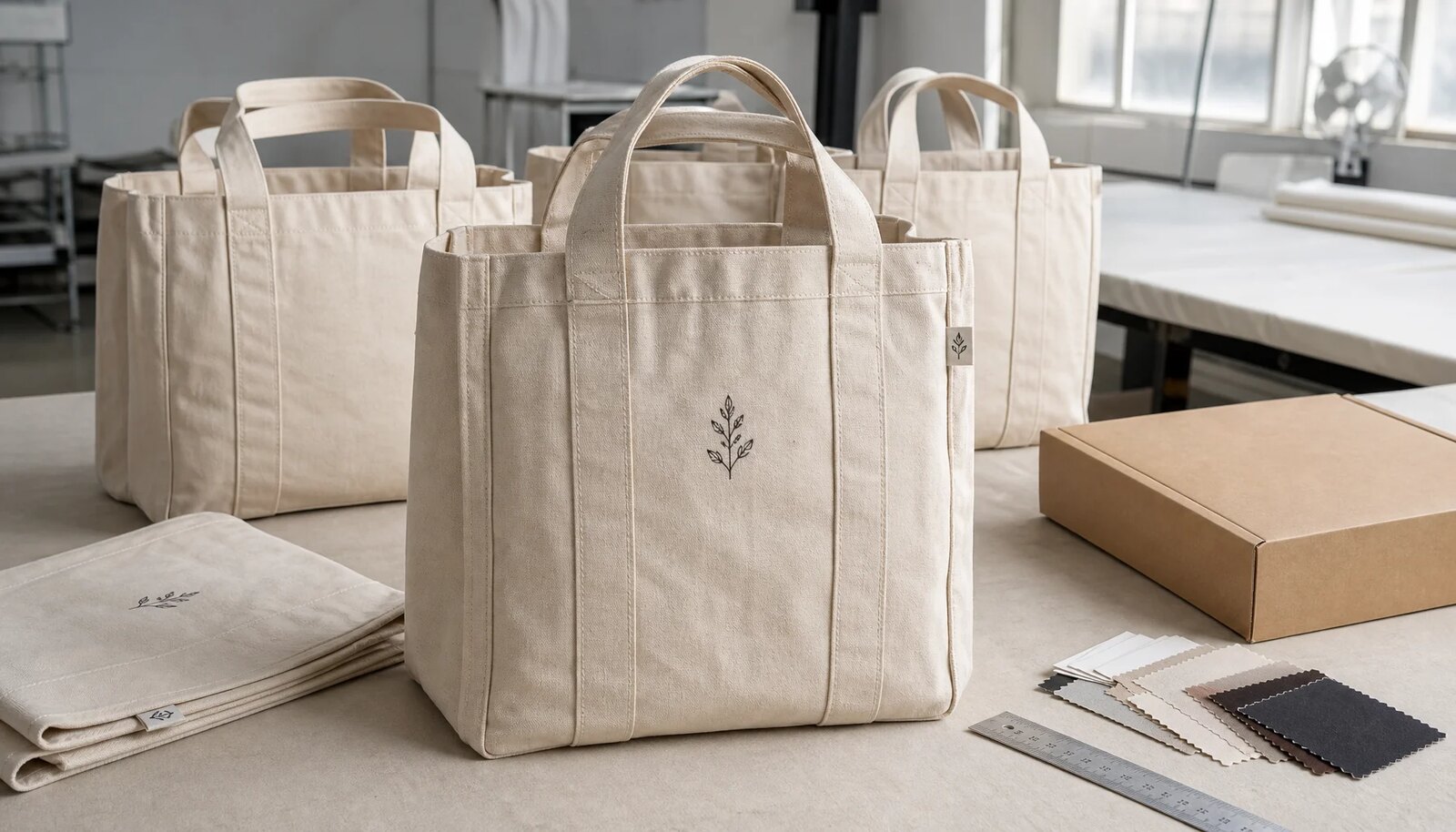
Why carton planning belongs in the tote RFQ
For custom canvas grocery totes used in hotel retail, the shipping carton is not an afterthought. A buyer may approve a good-looking tote sample and still lose margin because the finished bag folds poorly, cartons are too large for the warehouse plan, or each carton becomes too heavy for property receiving teams. The problem usually starts in the RFQ: the bag size is specified, the logo is specified, but the packing method is left for the factory to decide after production.
Hotel retail has several handling points. Cartons may move from factory to forwarder, container, importer warehouse, distributor, hotel loading dock, storeroom, and shop floor. A carton that works for export may not work for a hotel storeroom with narrow shelves or a resort buyer splitting inventory across properties. The best RFQ defines the tote and the carton together, because fabric weight, gusset depth, handle length, print area, and folding method all change the carton cube.
- Treat pieces per carton, carton size, and gross weight as quote items, not warehouse guesses.
- Require the supplier to propose a packing plan before final price comparison.
- Compare landed cost by carton cube when shipping LCL, air, courier, or mixed consolidation.
- Approve a packed sample or carton mock pack before releasing large production.
Start with the hotel retail use case
A canvas grocery tote sold in a hotel gift shop is different from a thin event giveaway bag. It may carry beverages, packaged food, beach items, spa products, local souvenirs, or folded apparel. Buyers should define the likely contents before choosing fabric weight and carton quantity. If the tote is meant to replace a shopping bag at checkout, it needs enough structure and seam strength to carry heavier mixed items without feeling like a disposable promo bag.
The same tote may also be displayed folded on a shelf, hung on a peg, or filled as a retail bundle. That display method affects packing. Flat-folded bags are efficient for carton cube, but heavy gusseted totes may crease at the print area. Rolled or lightly folded totes look better at retail but consume more carton space. Procurement teams should align merchandising and freight expectations early instead of asking the factory to solve both after artwork approval.
- For grab-and-go markets, prioritize flat folding, fast checkout handling, and strong handles.
- For boutique retail display, allow more carton cube if visible crease control matters.
- For resort welcome packs, test the tote loaded with the planned contents before approving size.
- For distributor programs, choose inner bundles that can be split without recounting every piece.
Canvas weight choices and carton cube impact
Most hotel retail grocery totes sit in the 10 oz to 12 oz canvas range, roughly 340-410 GSM depending on fabric construction. An 8 oz canvas can work for lighter retail items and lower price points, but it may feel underbuilt for a grocery-style tote. A 14 oz canvas gives a premium feel, yet it increases sewing bulk, folding thickness, carton cube, and sometimes needle breakage or slower sewing output. The right choice is not the heaviest fabric; it is the weight that matches retail use and freight budget.
When comparing quotes, do not let one supplier quote 10 oz natural canvas and another quote 12 oz washed canvas without noting the difference. Washed canvas can shrink, soften, and change dimensions. Dyed canvas adds color control and crocking considerations. Natural canvas may show slubs and seed specks that are normal unless the buyer defines a cleaner grade. Each fabric decision changes both unit price and packing density.
- 8 oz canvas: lighter cost and smaller carton cube, but less structure for grocery contents.
- 10 oz canvas: common balance for retail totes with moderate load expectations.
- 12 oz canvas: stronger hand feel and better perceived value, with larger carton volume.
- 14 oz canvas: premium and durable, but needs carton testing before freight estimates are trusted.
Bag size, gusset, and handle decisions
For a grocery tote, the gusset often creates more carton impact than the front panel size. A 12 cm gusset gives useful capacity for retail products, but it also creates thicker side folds. If the gusset is too wide, bags may not stack flat and carton count drops. If it is too narrow, the tote looks like a standard flat shopping bag and may not hold boxed goods or bottled items well. Buyers should share intended contents or a load photo with the supplier, not only a finished dimension.
Handle length also matters. A shoulder-length handle around 55-65 cm is common, but long handles must be folded or tucked consistently to avoid a messy carton. Handles that cross the front print can leave pressure marks during transit if the ink is not fully cured. For heavier hotel retail uses, the handle attachment should use bar tacks, box stitch, or cross stitch, and the top hem should have enough layers to hold the reinforcement without puckering.
- Define bag size as finished flat dimensions, including gusset and handle length.
- Set tolerance for body size, gusset depth, handle length, and handle placement.
- Avoid changing gusset after quote approval unless carton cube is recalculated.
- Test loaded samples with real or similar retail items before approving mass production.
Print method and folding risk
Screen printing is usually the practical choice for custom canvas grocery totes when the artwork uses solid hotel logos, simple icons, or one to three brand colors. It gives good coverage and predictable cost at wholesale quantities. Pigment printing can suit a softer lifestyle look, but color may absorb differently on natural canvas. Heat transfer can reproduce fine detail, yet it should be tested carefully on heavy canvas because large transfer areas may feel stiff or crack when folded repeatedly.
Carton planning must include the print location. If the bag is folded across a large front logo before ink is properly cured, the print can block, stick, crack, or pick up pressure lines. A factory can often adjust the folding direction, add interleaving for sensitive prints, reduce pieces per carton, or extend curing time. These choices affect cost and lead time, so they should be written into the RFQ instead of discovered during final inspection.
- Use screen print for most solid-color hotel retail logos and repeat orders.
- Request strike-off approval for Pantone color, ink hand feel, edge sharpness, and print position.
- Define whether the print may be folded directly, folded away from the crease, or protected by tissue.
- Include rub resistance and tape test expectations if the tote will be handled frequently in retail.
MOQ logic behind different quotes
MOQ for canvas grocery totes is not only one number. A supplier may have separate minimums for fabric dyeing, canvas weight, bag size, print setup, label weaving, inner packing, and carton customization. A stock natural canvas body with one-color screen print may have a lower MOQ than a dyed 12 oz canvas tote with custom woven side label and SKU-specific cartons. Procurement teams should separate these MOQ drivers before judging whether a quote is competitive.
For hotel retail, repeat replenishment is often more important than the first order quantity. If a buyer starts with several property designs or seasonal logos, the order may look large overall but small by SKU. That can create higher unit costs, extra screen charges, and inefficient cartons. A better approach is to standardize the bag body and carton plan, then vary the print or label only where the retail program needs it.
- Lowest MOQ usually comes from natural canvas, standard size, standard carton, and simple print.
- Dyed canvas may require fabric-lot MOQ even if the finished bag order is smaller.
- Multiple hotel logos should be quoted by SKU, not only as one combined order.
- Custom labels and barcodes can add MOQ or setup cost even when the tote body is shared.
How to compare unit price with carton cost
A cheaper unit price can become expensive if the carton cube is poor. For example, a quote that packs 80 pieces per carton may look similar at the unit level to a quote that packs 125 pieces per carton, but the freight cost per bag may be very different. This matters especially for air freight, courier replenishment, LCL shipments, or hotel programs that ship partial quantities to different properties. Carton dimensions and gross weight should appear in every serious quote.
Buyers should request a packing estimate with carton length, width, height, net weight, gross weight, and pieces per carton. Then compare total cartons per order and estimated CBM. If two factories quote different packing plans, ask whether the difference is caused by fabric weight, folding method, handle length, print protection, or conservative packing. The answer tells you whether a lower cube is realistic or only a spreadsheet assumption.
- Calculate total CBM from carton dimensions multiplied by carton count.
- Check carton gross weight against warehouse and courier handling limits.
- Review whether cartons can be palletized without overhang if warehouse distribution requires pallets.
- Do not approve a high piece count per carton until a packed sample or carton photo is reviewed.
Sample approval should include packing
Many tote samples are approved as single loose pieces. That is not enough for a grocery tote where carton compression, folding crease, and handle placement can affect the retail appearance. A pre-production sample should show the exact fabric, print method, sewing construction, label, folding direction, and inner packing method. If the factory cannot provide a full carton sample, ask for a packed bundle with photos of the carton mock-up and measured dimensions.
The approval record should include measurable acceptance criteria. Instead of simply writing "sample approved," record the finished dimensions, fabric weight, handle length, print position, stitch density, seam finish, folding method, pieces per inner bundle, and export carton plan. This protects both buyer and factory when bulk production starts. If the hotel retail team later changes the display requirement, the packing and price may need to change too.
- Approve one open sample for construction and one folded sample for packing appearance.
- Photograph the approved fold sequence and handle tuck position.
- Measure the sample after folding to estimate realistic carton thickness.
- Keep signed fabric and print swatches with the purchase order file.
Packing details that prevent warehouse problems
Export carton planning should balance cube, weight, retail condition, and receiving efficiency. For many canvas grocery totes, 100-150 pieces per carton is a practical starting range, but the final number depends on bag size, fabric weight, gusset, handle bulk, and print protection. A carton that exceeds a comfortable gross weight may save freight cube but create complaints at hotel receiving or distributor warehouses. A carton that is too light may increase CBM and handling cost.
Inner packing should match the distribution model. A hotel chain shipping to multiple properties may prefer bundles of 10 or 25 pieces for easier allocation. A retail buyer selling individual totes may request barcode labels, hangtags, or shelf-ready bundles. Single-piece polybags protect presentation but add labor, material, disposal concerns, and carton volume. If sustainability is part of the retail story, paper bands or bulk bundling may fit better than individual plastic bags.
- Define carton marks with PO number, SKU, color, quantity, destination, and carton sequence.
- Require moisture-resistant export cartons if goods ship during humid seasons.
- Use consistent inner bundle counts so warehouse teams can receive without recounting loose bags.
- Confirm whether hangtags, price labels, or barcodes are attached before or after packing.
Lead time risks in hotel retail programs
Lead time is often underestimated because buyers count only sewing days. A realistic schedule includes artwork confirmation, fabric sourcing or dyeing, sample making, sample shipping, buyer approval, printing setup, print curing, sewing, trimming, pressing, packing, final inspection, and export documents. If the tote is for a seasonal hotel retail launch, small delays in sample approval can compress production and increase quality risk.
Carton decisions can also affect schedule. Custom carton size, printed carton marks, barcode labels, or special inner packing may require additional preparation. Large prints may need longer curing time before folding. Heavy canvas may slow sewing output. If the supplier changes carton size after production because the first packing plan fails, shipping documents and warehouse planning may also need revision. The safest schedule locks the carton plan before bulk sewing finishes.
- Build sample approval time into the purchase calendar, not only factory production days.
- Freeze artwork, fabric, and packing together before bulk material cutting.
- Allow extra time for dyed canvas, large print areas, custom labels, or SKU-specific packing.
- Schedule final inspection after packing is complete so carton count and marks can be verified.
Specification comparison for buyers
| Spec decision | Recommended option | When it fits | Buyer risk to check |
|---|---|---|---|
| Canvas weight | 10 oz to 12 oz cotton canvas, usually about 340-410 GSM depending on weave | Hotel gift shops, resort markets, and grocery-style retail where the bag must stand up better than a lightweight promotional tote | Do not compare only by ounce; request GSM, yarn count if available, shrinkage tolerance, and whether the quoted weight is before or after washing |
| Bag size and gusset | Around 38 x 35 x 12 cm or a buyer-defined size tested against shelf, bottle, and folded apparel use | Mixed hotel retail baskets: snacks, towels, spa items, souvenirs, and grab-and-go grocery purchases | Oversized totes increase carton cube quickly; a 2 cm change in gusset can reduce units per carton and raise landed cost |
| Handle construction | Self-fabric handles, cross-stitched or bar-tacked, 55-65 cm length for shoulder carry | Retail customers expect grocery totes to carry heavier contents and feel durable at checkout | Long handles may crease badly in folding; short handles reduce usability for tourists carrying purchases around the hotel |
| Print method | Screen print for solid logos, pigment print for soft vintage look, heat transfer only for small detailed artwork after testing | Hotel logos, retail slogans, boutique resort branding, and one to three spot colors | Large dark ink areas can stiffen panels and stick during packing if curing is rushed; set rub and wash test expectations |
| Inside finishing | Bound or overlocked seams with reinforced stress points | Standard bulk orders where durability matters more than premium lining | Loose threads and weak side seam stitching create returns; define thread trimming and seam allowance standards in the sample approval |
| Carton packing method | Flat folded by panel, handles tucked consistently, packed 100-150 pcs per export carton after cube test | Most hotel retail replenishment programs where cartons move through warehouse, storeroom, and property receiving | Too many pieces per carton creates overweight handling complaints; too few pieces wastes ocean or air freight cube |
| Inner packing | Bundled by 10 or 25 pcs in a polybag or paper band, with carton marks by SKU and color | Multi-property hotel chains, distributors, or retail buyers who split cartons by location | Single-piece polybags add labor and material cost and may conflict with sustainability rules; clarify before quoting |
| Inspection level | AQL inspection with critical, major, and minor defects defined for fabric, print, sewing, packing, and carton condition | Brand owners and importers needing consistent retail presentation across repeat orders | If carton drop, barcode, and moisture checks are missing, the product may pass sewing inspection but fail warehouse receiving |
Buyer checklist before sampling
- Define the real retail use: grocery, resort market, amenity sale, minibar replenishment, spa retail, or souvenir checkout.
- Specify fabric by GSM or ounce plus acceptable tolerance, color, shrinkage expectation, and whether the canvas is natural, dyed, or washed.
- Confirm finished bag dimensions, gusset depth, handle length, handle width, and reinforcement method before artwork placement is finalized.
- Send artwork as vector files with Pantone references and define print position from top edge, side seam, or center line.
- Request a pre-production sample packed in the intended folding method so creases, print cracking, and handle placement can be reviewed.
- Set carton rules: pieces per carton, maximum gross weight, carton dimensions, inner bundle size, carton marks, and pallet compatibility if needed.
- Compare quotes using unit price plus carton cube, not unit price alone, especially when the order may ship by air or LCL.
- Approve a carton mock pack before mass production if the tote has a wide gusset, heavy canvas, long handles, or large front print.
- Include inspection standards for seam strength, print adhesion, color tolerance, moisture level, carton compression, and barcode readability.
- Build lead time around fabric booking, sample approval, print curing, final inspection, and shipping documents rather than only factory production days.
Factory quote questions to send
- What exact canvas weight are you quoting in oz and GSM, and is that greige, finished, dyed, or washed fabric weight?
- What finished size tolerance can you hold for the bag body, gusset, and handles after cutting, sewing, and pressing?
- How many pieces per export carton do you recommend for this size, and what are the estimated carton dimensions and gross weight?
- Can you provide a carton cube comparison for 100 pcs, 125 pcs, and 150 pcs per carton so we can estimate freight impact?
- Which print method do you recommend for our artwork, and what curing, rub test, or wash test standard will you use?
- What MOQ applies to fabric color, print color, bag size, and packing method separately?
- Will the sample be made with production fabric and production print, or only similar material for size approval?
- What is the normal lead time for sample, fabric procurement, printing, sewing, packing, inspection, and export documents?
- Can carton marks, barcode labels, SKU labels, and inner bundle labels be included in the quote?
- What defect classifications do you use for fabric stains, skipped stitches, print offset, carton damage, and wrong packing count?
Quality-control points to confirm
- Fabric weight should match approved tolerance, with visible stains, oil marks, slubs, and color variation classified before cutting.
- Finished dimensions should be measured on flat, unfilled bags after pressing, not on stretched or overstuffed samples.
- Handle attachment should pass agreed pull strength or load testing, especially where shoulder-length handles meet the top hem.
- Print color should match approved Pantone or signed sample within a realistic tolerance for cotton canvas absorption.
- Print adhesion should be checked by rub, tape, or wash method appropriate to the print type and retail claim.
- Seams should be straight, secure, and trimmed, with no open seams, skipped stitches, exposed raw edges where not intended, or loose bar tacks.
- Packing count should match the carton mark, inner bundle count, purchase order, and packing list.
- Cartons should stay within agreed gross weight and show correct dimensions, SKU marks, destination marks, and moisture protection.
- Random cartons should be opened during inspection to confirm folding direction, handle placement, print protection, and barcode readability.
- Moisture, odor, and mildew risk should be reviewed before closing cartons, especially for natural canvas stored during humid seasons.