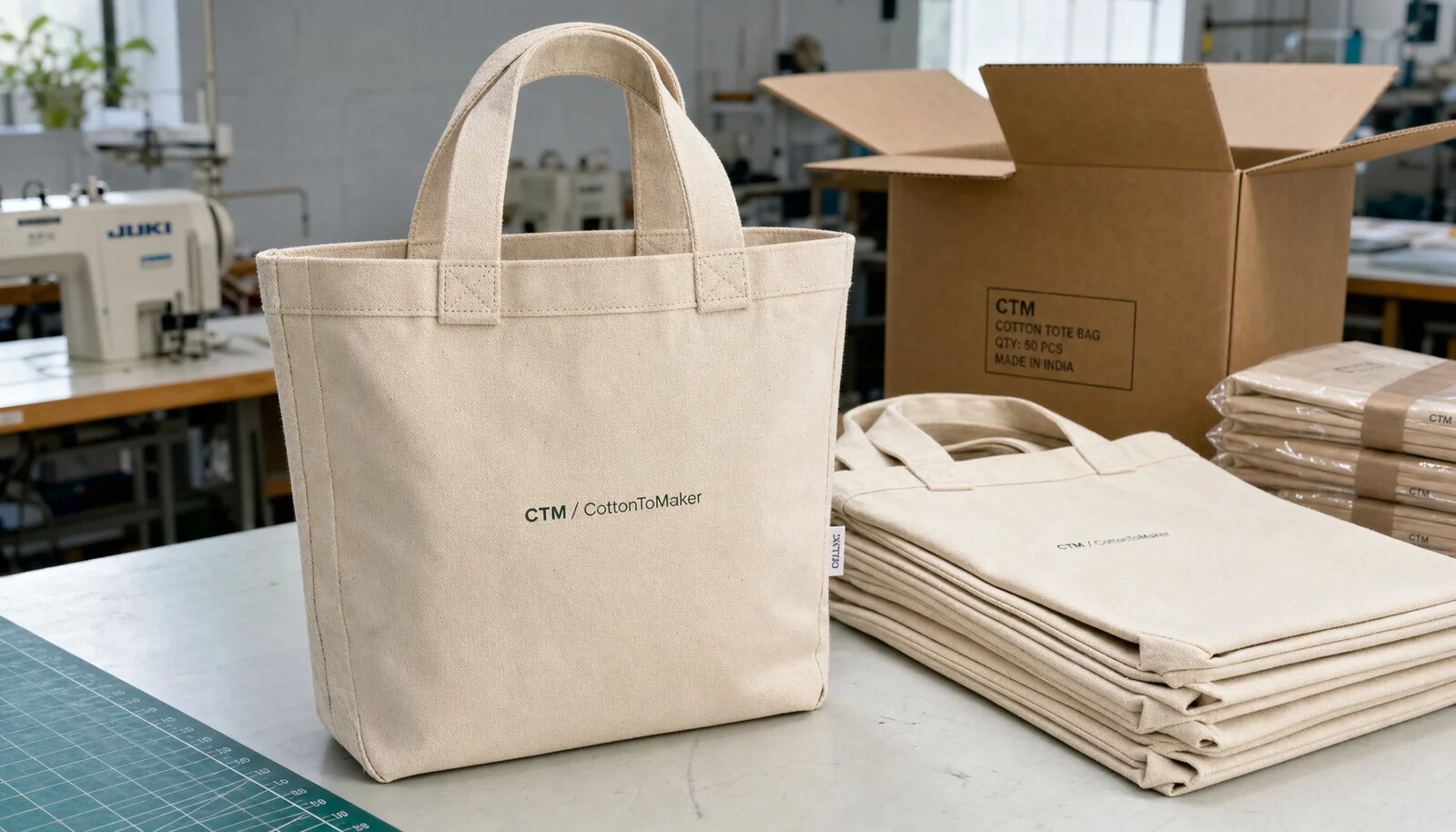
Define the Packing Problem Before the Bag Spec
A custom canvas grocery tote for a craft fair is not only a logo bag. It has to survive shipping, warehouse handling, booth unpacking, and real shopper use. The carton packing plan affects how clean the bags arrive, how many cartons fit on a pallet, how quickly staff can distribute them, and whether the handles or printed panels arrive creased in the wrong place. Treat packing as part of the product specification, not as an afterthought after the unit price is agreed.
The most useful RFQ starts with the distribution model. A brand shipping to one central warehouse can accept larger master cartons and palletized delivery. A distributor sending cartons to multiple fair locations may need lighter cartons, clearer carton marks, and predictable bundle counts. A retail buyer selling the tote as merchandise may need inner presentation such as paper belly bands. These decisions change labor, carton size, CBM, and landed cost.
- State whether cartons will go to one warehouse, multiple fair sites, or retail back rooms.
- Set a maximum carton gross weight before the supplier proposes packing quantity.
- Decide whether bags are bulk packed, bundled, belly banded, or individually packed.
- Require the sample stage to include folded size and a trial carton layout.
Choose Canvas Weight for Load and Carton Efficiency
For grocery-style canvas totes, 10 oz to 12 oz cotton canvas is usually the practical range for craft fair programs. In GSM terms, that is roughly 340 to 407 GSM, depending on fabric construction and finishing. Lighter 8 oz canvas can work for low-cost promotional use, but it often feels too soft when carrying jars, books, candles, ceramics, or packaged food. Heavier 14 oz canvas gives a premium hand feel but quickly increases carton weight and shipping volume.
Buyers should avoid approving canvas only by the oz label. Mills and suppliers may calculate weight differently, and washing or finishing changes the hand feel. A good RFQ states both oz and GSM, plus a tolerance. For example, a buyer can specify 12 oz canvas, target 407 GSM, natural color, with plus or minus 5 percent tolerance. This gives the factory a measurable standard and gives the inspection team a way to reject fabric substitution.
- Use 8 oz only when the tote is mainly a giveaway and not expected to carry heavy purchases.
- Use 10 oz for a balanced reusable tote where freight cost matters.
- Use 12 oz when the bag is sold or positioned as a durable brand item.
- Review carton gross weight if moving above 12 oz, because freight and manual handling change quickly.
Set Size, Gusset, and Handle Details Together
A grocery tote needs volume, but oversized bags waste fabric and make cartons bulky. A common working size is around 38 x 35 x 12 cm with a side or bottom gusset. This holds typical craft fair purchases without turning into a large beach tote. If the bag is intended for vendors selling produce, jars, packaged snacks, or craft kits, the gusset matters more than extra height. A shallow flat tote looks cheaper when filled and puts more stress on the side seams.
Handle length should be decided by use case, not guessed from a photo. Hand-carry handles can have a shorter drop, while shoulder-carry handles need more length and may require wider webbing for comfort. For craft fairs, many buyers choose shoulder-friendly handles because shoppers carry the bag while walking between booths. The handle attachment should use cross stitching or bar tacks, and the RFQ should include target carrying load rather than vague wording such as strong handles.
- For general grocery use, specify finished size, gusset width, and acceptable tolerance.
- For shoulder carry, define handle drop and handle width in centimeters.
- For heavier use, request reinforced handle stitching and a pull test method.
- For carton planning, ask the factory to show the folded size after handles are laid flat.
Select Print Method Based on Artwork and Folding
Screen printing is usually the most cost-controlled option for custom canvas grocery totes when the artwork is one to three solid colors. It gives a clean brand result and works well on natural canvas if the artwork does not require photographic detail. For complex logos, gradients, or many colors, heat transfer or digital methods may be proposed, but those choices can affect hand feel, wash behavior, and the way the print reacts when folded inside a carton.
The packing plan and print method are connected. If the printed panel is folded sharply through a heavy ink area, the bag may arrive with a visible crease or ink stress line. The supplier should propose a fold that avoids putting the main logo on the hardest fold whenever possible. During sample approval, the buyer should fold the printed sample as packed, place it under light compression, and inspect whether ink cracking, transfer, or surface shine becomes a problem.
- Use screen print for solid logos, event marks, simple slogans, and repeat orders.
- Use transfer only when artwork complexity justifies the higher risk and feel difference.
- Provide Pantone references but approve on actual canvas, not only on a digital proof.
- Include print size, placement from top seam, and allowed position tolerance in the RFQ.
Build MOQ Logic Around Fabric, Artwork, and Packing
MOQ for canvas totes is not only a sales rule. It comes from fabric purchasing, cutting efficiency, print setup, sewing line arrangement, and packing labor. A simple natural canvas grocery tote with one-color screen print may be realistic from 500 to 1,000 pieces per design. Custom dyed canvas, special labels, multiple print versions, or retail packing can push the efficient MOQ higher because the factory has more setup points and more materials to control.
Procurement teams should ask for stepped pricing instead of negotiating only one quantity. A quote at 500 pieces may look expensive, while 1,000 or 3,000 pieces may reduce print setup and cutting waste per unit. However, over-ordering for a craft fair program can create storage cost and obsolete event stock. The better comparison is landed cost per usable tote, including excess inventory risk, not only FOB unit price.
- Request price breaks at realistic order levels such as 500, 1,000, 3,000, and 5,000 pieces.
- Clarify whether MOQ applies per logo, per fabric color, or total shipment quantity.
- Separate the cost of woven labels, belly bands, cartons, and special marks from the base tote.
- Avoid changing artwork after sample approval, because print screens and packing labels may need to be remade.
Approve Samples With Production Criteria, Not Photos
A sample photo can hide fabric weight, handle feel, stitching density, and folding marks. For custom canvas grocery totes, the approval sample should use the same fabric weight, same handle material, same print process, and same intended fold as bulk production. If the factory uses substitute fabric for the first sample, that can be acceptable only for shape review, not for final approval. The final pre-production sample should represent the production standard.
The buyer should record measurable approvals before production starts. Finished dimensions, handle drop, print size, print placement, canvas shade, GSM, stitch reinforcement, and packing fold should be written into the approval sheet. If the tote will be sold at a craft fair, also check presentation details such as thread trimming, top hem neatness, and whether the front panel lies flat enough for retail display.
- Measure the sample flat and compare it with the RFQ tolerance.
- Weigh the fabric or request a GSM test record for the approved material.
- Load the sample with realistic goods and inspect handle comfort and seam stress.
- Fold the sample as packed and inspect the logo area after 24 hours under light pressure.
Design the Carton Packing Plan Around Handling
A common starting point is 50 pieces per export carton for 10 oz to 12 oz canvas grocery totes, but this is not a universal rule. The correct quantity depends on bag size, fabric weight, handle bulk, whether the bags are folded once or twice, and whether inner bundles are used. The carton should be full enough to prevent movement, but not so tight that the fabric creases badly or cartons bulge.
For craft fair distribution, carton handling is often less controlled than normal retail warehouse handling. Cartons may be moved by event staff, stacked in temporary storage, or opened repeatedly during booth setup. Keeping gross weight below about 18 kg is a practical target for manual handling, though the buyer can set a lower limit. Carton marks should make event distribution easy: item code, design name, quantity, carton number, gross weight, and destination if cartons are split by location.
- Start with 50 pieces per carton, then validate by carton size, gross weight, and crease condition.
- Use inner bundles of 10 or 25 pieces when event teams need quick counting.
- Avoid individual polybags unless cleanliness, retail sale, or compliance rules require them.
- Request carton dimensions and CBM per 1,000 pieces before comparing freight quotes.
Control Cost Drivers Beyond the Unit Price
Canvas tote quotes can look similar at the unit level while having different real costs. Fabric weight, fabric width yield, handle material, print color count, print area, label type, packing labor, carton quality, and inspection requirements all change the final cost. A lower quote may use lighter canvas, narrower handles, smaller print size, or fewer pieces per carton. Those changes may not be obvious unless the RFQ forces the supplier to itemize the specification.
Landed cost is especially important for grocery totes because canvas is bulky. A few cents saved on unit price can disappear if cartons are oversized or underfilled. Buyers should compare FOB price together with carton CBM, gross weight, pieces per carton, and expected freight mode. For distributor programs, include repacking labor and the cost of damaged cartons in the comparison. The cheapest factory price is not always the cheapest delivered program.
- Compare quotes using the same GSM, same dimensions, same print area, and same packing method.
- Calculate CBM per 1,000 pieces and gross weight per 1,000 pieces for each supplier quote.
- Flag quotes that omit carton size, print setup, sample fee, or label cost.
- Treat carton quality as a cost item when goods are shipped to temporary event locations.
Set QC Thresholds Before Production Starts
Quality control should be written in practical thresholds that a factory inspector or third-party inspector can apply. For canvas grocery totes, the main risks are fabric substitution, inconsistent size, weak handle stitching, crooked logo placement, print defects, dirty fabric, moisture marks, and poor carton condition. These are not abstract quality issues; they directly affect whether the tote can be sold, distributed, or used confidently at a craft fair.
A useful inspection plan includes incoming material checks, inline sewing review, print inspection, and final packed carton inspection. Buyers do not need to overcomplicate the process, but they should define what is critical. For example, broken handle stitching, major stains on the front panel, wrong logo color, and cartons over the agreed weight should be treated differently from tiny natural cotton specks. Natural canvas has character, but preventable production defects should not be accepted as fabric texture.
- Critical defects include wrong artwork, unsafe stitching failure, mold odor, and wet or crushed cartons.
- Major defects include visible stains, crooked print, skipped stitches at handles, and wrong finished size.
- Minor defects can include small natural specks if they are consistent with the approved canvas sample.
- Final inspection should include packed carton count, carton marks, and random unfolded bag checks.
Protect the Schedule From Common Craft Fair Risks
Craft fair orders often have fixed event dates, which makes schedule planning more important than squeezing the last small discount. A realistic timeline includes artwork confirmation, sample making, sample shipping, buyer review, possible sample revision, material booking, cutting, printing, sewing, finishing, packing, inspection, and export handover. If the buyer approves artwork late or changes the print after sampling, the production window shrinks immediately.
The highest schedule risks are custom dyed fabric, late packaging decisions, unclear carton marks, and slow sample approval. Natural canvas with standard handles and screen print is easier to schedule than dyed fabric with multiple logo versions and retail belly bands. Buyers should lock the packing plan before bulk production, because carton size and inner packing affect purchasing of cartons, labels, and sometimes pallet planning.
- Reserve time for a real pre-production sample, not only a digital artwork proof.
- Approve carton marks and packing layout before the factory orders cartons.
- Build extra time when using dyed canvas, custom woven labels, or multiple destinations.
- Do final inspection before shipment, not after cartons arrive at the event warehouse.
Specification comparison for buyers
| Spec decision | Recommended option | When it fits | Buyer risk to check |
|---|---|---|---|
| Canvas weight | 10 oz to 12 oz cotton canvas, roughly 340 to 407 GSM | Reusable grocery tote for craft fair vendors, heavier than giveaway cotton but still foldable for carton packing | Too light may sag with jars or books; too heavy raises freight cost and reduces carton quantity |
| Bag size | Approx. 38 x 35 x 12 cm with boxed bottom or side gusset | Fits produce, packaged crafts, brochures, candles, and small retail purchases without looking oversized | Very deep bags increase fabric yield and make folded cartons bulky; shallow gussets reduce real grocery capacity |
| Handle construction | Self-fabric or cotton webbing handles, 2.5 to 3.5 cm wide, cross-stitched at stress points | Needed when buyers expect 5 to 8 kg practical carrying load during event use | Thin handles save cost but fail first; request pull test and stitch density details before approval |
| Print method | Screen print for solid 1 to 3 color logos; heat transfer only for complex artwork or gradients | Screen print is stable for repeat craft fair orders and keeps unit cost predictable at volume | Thick ink on canvas can crack on folds; printed panels should be tested after folding and rubbing |
| Carton packing | Flat folded, 50 pieces per export carton as a starting point, with carton weight controlled under 18 kg | Works for mixed booth distribution, warehouse handling, and distributor repacking | Overpacked cartons deform handles and increase carton burst risk; underpacked cartons waste CBM |
| MOQ logic | 500 to 1,000 pieces per design for standard canvas and one logo color; higher for dyed fabric or custom labels | Suitable for regional craft fair programs, brand activations, and distributor seasonal stock | Low MOQ quotes may hide fabric substitution, digital print setup charges, or higher per-carton freight |
| Sample approval | Pre-production sample using bulk fabric weight, final handle stitching, final folding, and carton test pack | Best when the tote will be sold, bundled, or distributed through multiple event locations | A nice photo sample is not enough; approve actual weight, seam allowance, print position, and packed dimensions |
| Inner packing | No individual polybag unless required; use bulk folded bundles or paper belly bands for retail presentation | Reduces plastic, saves labor, and keeps craft fair unpacking faster at booth level | Loose packing may create dust marks; confirm fabric cleanliness, bundle quantity, and moisture control |
Buyer checklist before sampling
- Define the tote as a grocery-capable bag, not a thin promotional shopper; state target fabric weight, bag size, gusset, and expected carrying load.
- Give the supplier final artwork with print size, color reference, logo position, and whether minor canvas texture show-through is acceptable.
- Specify carton quantity per carton, maximum gross weight, carton size target, and whether the goods will be palletized or courier handled.
- Request one approved pre-production sample made with bulk fabric, bulk trim, final stitching, final print method, and the proposed folding method.
- Set acceptance criteria for fabric GSM tolerance, handle pull strength, seam security, print rub resistance, and carton drop or compression condition.
- Separate unit price, sample fee, print setup, label cost, carton packing cost, inland freight, and export documentation in the quote.
- Confirm whether the MOQ is per style, per color, per print design, or per shipment, especially if craft fair locations need different logos.
- Review packed carton CBM and gross weight before approving production, because freight cost can change the landed cost more than small unit-price differences.
Factory quote questions to send
- What canvas weight in oz and GSM will be used, and what tolerance do you apply in bulk production?
- Is the quoted fabric greige, natural, bleached, dyed, or washed, and does the price include shrinkage allowance?
- What is the exact bag size, gusset construction, handle length, handle width, and stitch reinforcement method in the quote?
- Which print method is included, how many colors are included, and what is the maximum print area before extra charges apply?
- What is the MOQ per artwork, per fabric color, and per shipment, and what price change applies at 500, 1,000, 3,000, and 5,000 pieces?
- How many pieces are packed per export carton, what are the estimated carton dimensions, gross weight, and CBM per 1,000 pieces?
- Can the pre-production sample include final folding and carton packing so the buyer can approve both product and packing plan?
- What fabric, sewing, printing, and final inspection checks are included before shipment, and can photos or inspection records be shared?
- What is the normal timeline for artwork proof, sample making, sample revision, bulk production, final inspection, and export handover?
Quality-control points to confirm
- Canvas weight should match the approved standard within the agreed tolerance, commonly around plus or minus 5 percent unless otherwise specified.
- Finished bag dimensions should be measured flat with clear tolerance, often plus or minus 1 cm for body size and plus or minus 1.5 cm for handle drop.
- Handle attachment should use reinforced stitching, with no skipped stitches, loose threads, broken bar tacks, or obvious needle damage.
- Print position should follow the approved sample, with color variation controlled against the approved swatch or Pantone reference.
- Print adhesion should pass a basic dry rub and fold check so ink does not crack heavily or transfer during carton compression.
- Seams should be straight enough for retail presentation, especially at the top hem, gusset edges, and handle attachment points.
- Cartons should be clean, dry, export grade, properly taped, and marked with item code, quantity, carton number, gross weight, and destination details if required.
- Packed cartons should not exceed the agreed gross weight or show bulging, crushed corners, moisture marks, or excessive empty space.