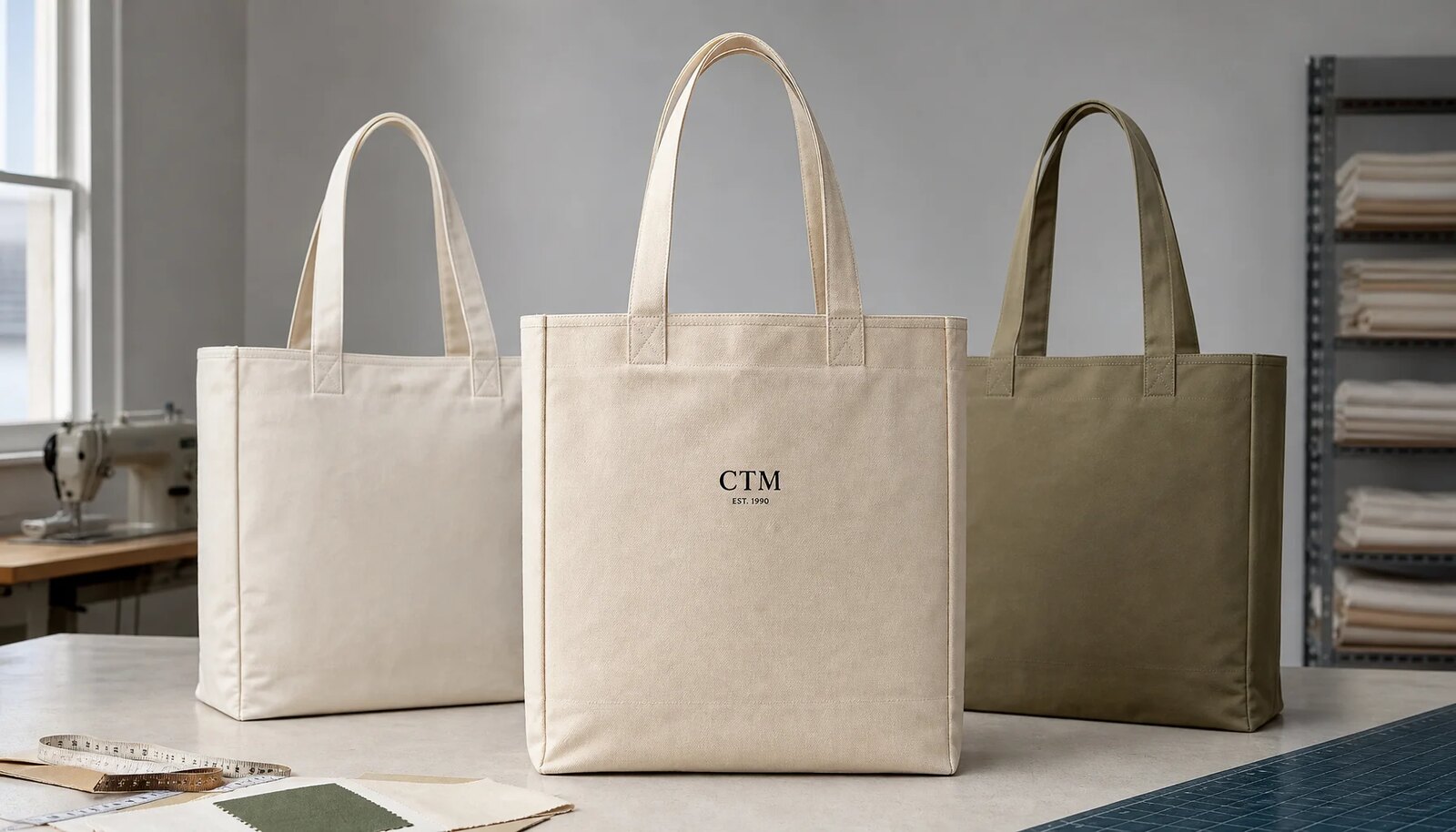
1. Start With the Hotel Retail Pricing Goal
A custom canvas grocery tote for hotel retail is a merchandise purchase, not just a logo order. It may sit near a resort market checkout, hang in a spa boutique, support a local-goods display, or sell as a destination souvenir. The bag must feel worth the retail price, protect the hotel brand, and reorder without unexpected changes in fabric, print, or packing.
Start with three commercial numbers: target retail price, acceptable landed cost, and expected sell-through period. If a hotel wants the tote to sell as a practical market bag, the specification should probably prioritize 10 oz canvas, a usable gusset, reinforced handles, and reliable bulk packing. If the tote is a premium destination item, 12 oz canvas, a cleaner tag package, or a larger print may be justified. If it is a checkout add-on, those same upgrades may damage margin.
Also decide whether the product is a core replenishment SKU or a seasonal one-time buy. Core programs benefit from a stable base construction and repeatable artwork files. Seasonal programs can accept more design variety, but they carry higher version risk and leftover inventory risk.
- Define the use case before quoting: paid retail SKU, checkout add-on, spa boutique item, resort grocery tote, or seasonal destination collection.
- Set a target retail price and margin before choosing canvas weight or label details.
- Estimate opening stock, back stock, and reorder trigger by property.
- Use one base construction across hotels when possible, then vary artwork, tags, or carton marks.
- Do not approve premium features unless merchandising can recover the added landed cost.
2. Use a Real Pricing Model, Not a Single Unit Price
A useful bulk pricing plan separates the base tote from setup charges, artwork versions, packing, and landed-cost assumptions. The figures below are planning examples only; actual factory pricing changes with cotton cost, exchange rate, order timing, print method, origin, destination, and packing. The purpose is to show how hotel procurement can compare suppliers without relying on a vague unit price.
For a standard 10 oz natural cotton canvas grocery tote, 38 cm wide by 40 cm high with a 10 cm boxed gusset, reinforced handles, and one-color front screen print, a planning range might look like this before freight and duty: 500 pcs at $3.80-$5.20, 1,000 pcs at $3.10-$4.30, 3,000 pcs at $2.60-$3.70, and 5,000 pcs at $2.40-$3.40. Adders may include screen setup, strike-off, barcode labor, hang tag attachment, property sorting, and upgraded carton protection.
Use a simple formula: landed cost per tote equals factory unit price plus allocated one-time charges plus packing adders plus freight per unit plus duty and customs plus warehouse receiving plus property distribution. If a $120 screen and $80 strike-off are spread across 500 units, they add $0.40 per tote. Across 5,000 units, they add $0.04. That difference matters when comparing low-volume property logos.
- Request the same four tiers from every supplier: 500, 1,000, 3,000, and 5,000 pieces.
- Keep one-time charges outside the unit price first, then allocate them in your spreadsheet.
- Calculate version cost separately when one order uses multiple hotel logos.
- Ask for carton CBM and gross weight early so freight is not a late surprise.
- Compare margin using landed cost, not factory unit price alone.
3. Normalize Supplier Quotes in a Spreadsheet
Two quotes are comparable only when they assume the same product and the same commercial terms. One supplier may quote EXW with no export handling, no carton liner, and no barcode labor. Another may quote FOB with stronger cartons, screen charges included, and hang tags attached. The lower number may not be the lower cost.
Create columns for finished size, canvas weight, finished bag weight, gusset, handle drop, reinforcement, print method, color count, print size, packing method, pieces per carton, carton dimensions, gross weight, CBM, trade term, setup charges, sample charges, tag labor, barcode labor, inspection allowance, lead time, and payment terms. Then convert each supplier to a common view. If Supplier A excludes hang tag labor at $0.12 per unit and Supplier B includes it, add $0.12 to Supplier A before comparing.
For multi-property hotel groups, add columns for version quantity, screen charge per version, carton mark per property, and SKU separation labor. A total order of 5,000 pieces split across five logos is not the same as one 5,000-piece logo. Version splits affect screens, print setup, sorting, labels, inspection, packing lists, and slow-moving stock.
- Mark every quote as EXW, FOB, CIF, DDP, or other, and compare on one chosen basis.
- Convert all excluded charges into per-unit adders for a fair comparison.
- Record each supplier’s assumed carton pack and CBM, not just unit price.
- Separate base-bag MOQ from artwork-version MOQ.
- Flag any quote that does not state fabric weight, finished size, print method, or carton data.
4. Build a Factory-Ready Tote Specification
A factory-ready RFQ prevents suppliers from filling gaps with their own defaults. “Canvas tote with logo” can mean a thin flat bag, a heavy boxed-gusset tote, long shoulder handles, short hand-carry handles, or very different seam finishing. Each version changes cost and retail value.
State finished width, finished height, gusset depth, top hem depth, handle material, handle drop, handle width, handle placement, reinforcement style, fabric ounce weight or GSM, print method, print size, print position, labels, hang tags, barcode needs, packing format, carton marks, and inspection tolerances. Finished dimensions matter more than cutting dimensions because the guest receives the sewn bag.
For hotel market use, a practical starting point is about 38 cm wide by 40 cm high with a 10 cm to 12 cm gusset. Test the sample with actual store items: bottled drinks, snacks, folded apparel, sunscreen, spa products, small towels, and local gifts. A tote that looks clean on a shelf may still be awkward when loaded.
- Specify finished measurements and tolerances, not only style references.
- Include handle total length and handle drop; avoid vague wording such as “shoulder length.”
- Define seam finishing, top hem, and reinforcement method.
- Measure print placement from the top hem, side seam, centerline, or bottom edge.
- Attach artwork files, Pantone references, barcode specs, and carton-mark templates to the RFQ.
5. Choose Canvas Weight by Retail Position and Landed Cost
Fabric weight is a major price driver and a major retail-perception driver. An 8 oz cotton canvas tote can work for lightweight checkout use, but it may feel underbuilt for a paid grocery-style hotel retail item. For many hotel market totes, 10 oz to 12 oz is the practical comparison range. A 10 oz fabric is often around 340 GSM, while 12 oz is often around 407 GSM, depending on weave and finishing.
A 10 oz tote usually offers a strong balance of cost, sewing efficiency, printability, and freight weight. A 12 oz tote feels more structured and premium, but it raises fabric consumption, sewing effort, carton gross weight, and sometimes freight cost. If the hotel’s retail price is modest, 12 oz may reduce margin. If the tote is sold as a destination merchandise item, the heavier handfeel may support the price.
Natural canvas is often the simplest route because it avoids dye-lot complexity and works with resort, spa, market, and sustainability-led displays. Dyed canvas should be quoted separately because it may require lab dips, higher fabric MOQ, shade approvals, rubbing checks, and longer lead time.
- Use 8 oz for basic checkout or promotional use, not a premium grocery-style retail tote.
- Use 10 oz as the baseline for balanced hotel market programs.
- Use 12 oz when retail price and brand positioning justify the upgrade.
- Ask for finished bag weight to reduce risk of fabric substitution.
- Quote dyed, organic, recycled, washed, or bleached options separately because MOQ and documentation requirements differ.
6. Engineer the Bag for Grocery Use
Hotel guests judge the tote when they load it. A grocery-style tote should open easily, carry comfortably, and hold volume without twisting. The boxed bottom and gusset depth are important because hotel markets often sell bulky but lightweight products such as towels, snack boxes, bottled water, sunscreen, and local food gifts.
Construction choices affect both cost and complaint risk. A boxed bottom uses more material and sewing time than a flat tote, but it improves loading and shelf presence. A double-fold top hem strengthens the handle area. Reinforced stitching at handle stress points is essential because this is where failures are most visible. Inside seam finishing also affects the guest’s impression of a paid retail product.
Handle design must be measured. Self-fabric handles look cohesive but use more fabric. Cotton webbing handles can be consistent and comfortable for heavier loads. If shoulder carry is expected, test the sample on real users rather than assuming the handle length is correct.
- Use a 10 cm to 12 cm gusset for most hotel grocery totes.
- Require bartack, box stitch, cross stitch, or double-row reinforcement at handle stress points.
- Load the sample with actual hotel store items before approval.
- Check that the base opens correctly and does not twist badly when filled.
- Avoid oversized dimensions unless the merchandising plan requires them; larger bags raise fabric use and carton volume.
7. Select Decoration for Artwork, Durability, and Reorders
Screen printing is usually the most predictable decoration method for bulk hotel retail canvas totes. It works well for one to three solid colors, destination graphics, simple logos, and repeat replenishment. Cost depends on color count, print size, print position, ink type, screen setup, and artwork versions.
Canvas texture affects the result. Fine lines, small serif type, pale colors, and large solid ink areas may not match a digital proof. Natural canvas has a warm base tone, so ink colors can appear different than expected. Require a physical strike-off when color, opacity, edge sharpness, or handfeel matters.
Heat transfer, digital print, and embroidery can be valid alternatives, but they change price and QC. Heat transfer may support gradients but can feel less integrated with canvas. Digital print may help with many artwork versions, but durability should be tested. Embroidery can look premium for small marks but adds thread density, backing, and production time.
- Use screen print for simple logos, destination art, and repeat bulk orders.
- Require a strike-off for brand-critical colors, fine type, large ink coverage, or light ink on natural canvas.
- Ask whether screen charges apply per color, per side, per artwork version, and per reorder.
- Keep artwork away from seams, gusset folds, and thick handle areas unless the factory confirms control.
- Record approved file names, Pantone references, print size, print placement, and strike-off date.
8. Plan Allocation, Packing, and Timeline Together
Bulk pricing is stronger when it reflects how the tote will be received and sold. A hotel group may order one base tote construction but split it across several property logos. That approach can protect fabric and sewing economics, but it introduces artwork approvals, SKU separation, carton marks, and property allocation work.
Packing should protect retail presentation. Over-tight cartons can crease handles, distort gussets, and cause printed panels to rub. Loose packing can create dirty fabric, crushed corners, and mixed SKU errors. Flat packing in 25 or 50 piece bundles is common, but the right method depends on print coverage, carton weight, warehouse handling, and whether the tote needs hang tags or barcode stickers.
Lead time should be built from approval milestones, not from the first inquiry. Include artwork cleanup, swatch approval, strike-off, courier time, pre-production sample approval, material booking, cutting, printing, curing, sewing, trimming, packing, inspection, and shipment booking. Reorders move faster only when the first order’s samples, artwork, carton data, and QC records are retained.
- Set opening stock by property, not just total group quantity.
- Define barcode, hang tag, belly band, carton mark, and mixed-carton rules before PO approval.
- Confirm bundle quantity, carton dimensions, gross weight, net weight, and CBM.
- Use SKU codes for property, artwork version, fabric color, retail price tier, and packing format.
- Schedule inspection before the cargo-ready date becomes urgent.
9. Approve Samples and Inspect Bulk Production
Approve the tote like a retail product, not just a logo proof. Open it, load it, carry it, fold it, place it on a shelf, and compare it with the planned retail price. Check whether the canvas feels strong enough, whether the print is clean on textured fabric, whether the handles are comfortable, and whether the gusset performs with typical merchandise.
Sample comments should be measurable. Instead of saying the handle is short, state the required handle drop and tolerance. Instead of saying the print is too low, state the print center position from the top hem and side seam. Instead of saying the fabric feels thin, refer to GSM, finished bag weight, or the approved swatch.
For bulk inspection, combine general sewn-goods checks with tote-specific controls. Inspect dimensions, handle reinforcement, stitch quality, print adhesion, print placement, fabric shade, odor, stains, loose threads, carton marks, barcode placement, SKU separation, and packing condition. Keep one approved sample with the buyer, one with the factory, and one available for inspection.
- Approve a final sample made with production fabric, final print, final handles, and final tag or label package.
- Measure width, height, gusset, handle drop, print size, print placement, and finished bag weight.
- Perform a practical load check using hotel market products.
- Use dry rub and handling checks to confirm the print is cured and not transferring.
- Do not release shipment until carton marks, quantities, SKU separation, and packing condition are verified.
10. Keep Reorder Records and Review Sell-Through
The first production run should create the standard for future orders. Keep the approved sample, fabric swatch, artwork files, Pantone references, strike-off, PO specification, carton template, inspection report, and supplier quote worksheet together. Reorder problems often start when a new buyer or factory contact cannot see what was approved last time.
After the shipment reaches the hotel, review sell-through and complaints before locking the next tier. If the tote sells quickly but guests mention handle comfort, adjust handle width or drop. If the tote has strong margin but weak shelf presence, improve folding, tags, or display-ready packing. If freight cost is high, review carton pack and fabric weight before reordering.
A good pricing plan is not only about getting a lower number at 5,000 pieces. It is about building a repeatable product with known costs, known tolerances, known carton data, and clear property allocation. That is what makes a hotel retail tote easier to manage over multiple seasons.
- Retain approved samples and swatches for every production version.
- Compare reorder pricing against the same specification and carton assumptions.
- Track sell-through by hotel property and artwork version.
- Review damages, guest feedback, barcode issues, and receiving problems after the first delivery.
- Use first-run data to decide whether to increase quantity, reduce versions, upgrade fabric, or simplify packing.
Specification comparison for buyers
| Pricing scenario | Example planning range before freight | What the quote should include | Buyer risk to normalize |
|---|---|---|---|
| Entry checkout tote: 8 oz canvas, flat or shallow gusset, 1-color print | Approx. $1.60-$2.60 at 1,000-5,000 pcs, depending on size and packing | Basic cotton canvas, simple sewing, one screen print, standard bulk carton | May be too light for a paid grocery-style hotel tote; confirm finished bag weight, handle reinforcement, and whether setup or barcode labor is excluded |
| Core hotel market tote: 10 oz canvas, 10-12 cm boxed gusset, reinforced handles, 1-color screen print | Approx. $2.40-$3.90 at 1,000-5,000 pcs before freight and duty | Balanced fabric weight, grocery shape, reinforced handles, retail-ready fold, export carton | Best comparison baseline; require same finished size, same handle drop, same print size, same carton pack, and same trade term across suppliers |
| Premium boutique tote: 12 oz canvas, boxed gusset, heavier handles, larger print or label package | Approx. $3.40-$5.80 at 1,000-5,000 pcs before freight and duty | Heavier canvas, stronger structure, more sewing time, larger carton weight, possible hang tag or label | Higher unit cost may be justified only if retail price supports it; compare landed cost per tote and margin after distribution |
| Multi-property version split: one base tote, 3-6 hotel logos | Base unit may follow total quantity, but screens, sorting, labels, and carton marks add approx. $0.10-$0.45 per unit equivalent depending on split | Shared fabric and sewing with separate artwork approvals, screens, SKU labels, carton marks, and packing lists | Total order quantity can hide version MOQ; compare base-bag total separately from each logo quantity and setup charge |
| Dyed or seasonal color tote | Often adds fabric MOQ, lab dip time, and possible $0.30-$0.90+ per unit versus natural canvas, depending on dye route | Lab dip, fabric dyeing, shade approval, colorfastness checks, possibly longer material lead time | Shade bands and reorder mismatch; require approved lab dip, rubbing checks, and reorder shade tolerance |
| Retail-packed tote with barcode, hang tag, or belly band | Common adders may run $0.05-$0.35+ per unit plus tag printing, depending on complexity | Tag or barcode production, attachment labor, SKU separation, scan check, carton marks | Supplier may quote the bag only; normalize tag printing, labor, incorrect-label liability, and mixed-carton rules |
Buyer checklist before sampling
- Define the retail use first: paid grocery tote, hotel market checkout bag, resort merchandise, spa boutique item, welcome amenity for resale, or seasonal destination collection.
- Set target retail price, desired gross margin, opening stock, and planned sell-through period before selecting 8 oz, 10 oz, or 12 oz canvas.
- Write finished size, gusset depth, fabric weight, finished bag weight target, handle drop, handle width, reinforcement method, print size, print position, label, tag, barcode, packing, carton marks, and tolerances into the RFQ.
- Request tiered pricing at 500, 1,000, 3,000, and 5,000 pieces using the identical specification, then request a separate version-split table for multiple hotel logos.
- Ask suppliers to show unit price, setup charges, screen fees, sample or strike-off fees, label or barcode labor, carton cost, carton quantity, carton dimensions, gross weight, CBM, and trade term.
- Normalize competing quotes in a spreadsheet by converting all assumptions to the same incoterm, carton pack, artwork version count, packing method, and included charge list.
- Compare 10 oz and 12 oz versions with finished bag weight and estimated carton CBM so merchandising can see the cost and freight effect of a premium upgrade.
- Confirm whether quoted pricing includes Pantone matching, strike-off, pre-production sample, woven label, hang tag, barcode sticker, carton liner, export carton, inspection support, and export documents.
- Plan property allocation before ordering: opening quantity, reserve stock, replenishment trigger, seasonal safety stock, SKU code, and carton mark by hotel or retail collection.
- Approve a production sample that includes final fabric, final print, final handles, label or hang tag, barcode if required, and representative folding or bulk packing.
Factory quote questions to send
- Can you quote 500, 1,000, 3,000, and 5,000 pieces using the same finished size, fabric weight, handle, gusset, print, packing, and trade term?
- Please separate recurring unit price from one-time charges: screens, artwork cleanup, strike-off, pre-production sample, tag setup, barcode setup, and special carton marks.
- What is the price difference between 10 oz and 12 oz cotton canvas for the same construction, and what finished bag weight should we expect for each?
- What MOQ applies per fabric color, finished size, print design, handle material, label, hang tag, barcode format, and packing method?
- If one order is split across several hotel logos, what is the minimum quantity per artwork version and what screen, sorting, packing, or carton-marking charges apply?
- Does the unit price include Pantone matching, screen setup, strike-off, export carton, carton liner, barcode application, hang tag attachment, and standard export documentation?
- What carton quantity, carton dimensions, gross weight, net weight, and estimated CBM are assumed for each fabric-weight option?
- Which trade term is quoted—EXW, FOB named port, CIF, DDP, or another term—and which origin, freight, duty, brokerage, or local delivery costs are excluded?
- What lead time applies after artwork approval, strike-off approval, deposit, material booking, pre-production sample approval, and final bulk go-ahead?
- What AQL level and product-specific checks can be used for pre-shipment inspection, including dimensions, handle strength, print adhesion, odor, stains, loose threads, barcode accuracy, and carton marks?
Quality-control points to confirm
- Fabric should match the approved swatch or production sample for handfeel, shade, weave appearance, and weight; use GSM and finished bag weight checks where practical.
- Finished width, height, gusset depth, top hem depth, handle drop, handle width, and print placement should be measured against written tolerances and the approved sample.
- A practical sewn-goods tolerance is often plus or minus 1 cm for width and height, plus or minus 0.5 cm to 1 cm for gusset depth, and plus or minus 1 cm for handle drop unless tighter control is agreed in writing.
- Handle attachment should match the approved reinforcement method, with no skipped stitches, broken threads, loose bartacks, open seams, or weak stress points.
- The tote should open correctly, load as intended, and not twist badly when filled with representative hotel market items such as bottles, snacks, folded apparel, or spa products.
- Print color should be compared to the approved Pantone reference or strike-off under consistent lighting, not only against a digital proof.
- Print adhesion should pass basic dry rub and handling checks after curing, with no ink transfer to adjacent bags, liners, tissue, or packing materials.
- Canvas panels should be checked for stains, oil marks, heavy slubs in the print area, odor, shade variation, holes, weaving defects, and cutting flaws.
- Packing should protect retail presentation: no severe creasing, crushed gussets, mixed SKUs, dirty fabric, damp cartons, incorrect carton marks, or barcode placement errors.
- Inspection should verify carton quantity, SKU separation, property marks, PO number, carton sequence, gross weight, net weight, carton condition, and any hotel receiving-label requirements.