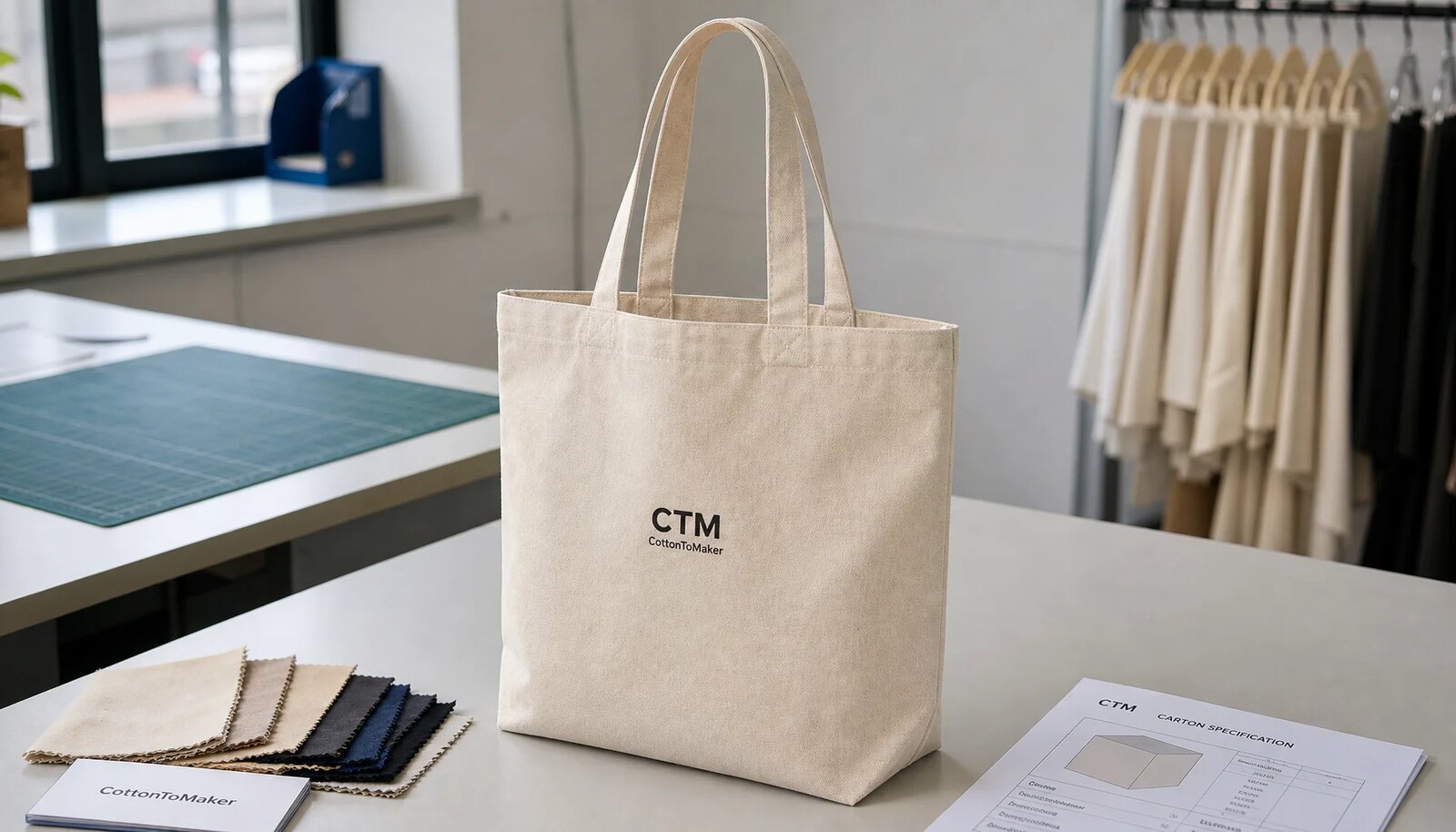
Start With the Event Receiving Flow
A custom canvas grocery totes carton packing plan for event planners should begin with the day the cartons arrive, not with the day the bags are sewn. Picture the receiving point. Will a warehouse team scan cartons and store them by SKU? Will a convention center dock move them through a material handling contractor? Will event staff open boxes behind a registration desk while attendees are already lining up? Each version needs a different packing plan.
The same tote can be packed well for one workflow and poorly for another. A 100-count master carton may be efficient for freight and warehouse receiving, but it can slow down a registration crew that needs four lanes of 25 bags each. A 25-count bundle adds labor at origin, yet it can save time during setup and reduce counting mistakes. For fixed-date events, that tradeoff is often worth pricing instead of guessing.
Map the tote journey before approving the RFQ. Write the path from factory pack-out to export handoff, freight mode, destination receiving, storage, internal movement, and final handout point. A hotel ballroom may have tight elevators and limited back-of-house storage. A convention center may care about dock appointments, pallet labels, booth numbers, and material handling rules. A 3PL may focus on barcode data, carton sequence, and allocation accuracy.
The packing plan then becomes a control document. It tells the supplier how many totes to put in each carton, how to fold them, how to bundle them, what labels to apply, and what the final packing list must show. It also gives procurement a fair way to compare quotes. Without that plan, suppliers can quote different carton counts and packing methods while appearing to price the same bag.
- Define the final handoff point: central warehouse, 3PL, venue dock, booth, registration counter, retail DC, or direct-to-attendee kit line.
- List who touches the cartons after delivery: freight carrier, warehouse receiver, material handling contractor, event staff, sponsor team, decorator, or 3PL pack-out crew.
- Estimate dock access, elevator use, storage room size, pallet restrictions, setup time, and maximum carton weight your staff can handle safely.
- Decide whether the tote must be handout-ready when cartons open or whether destination staff will sort, count, and repack before the event.
Lock Tote Construction Before Carton Math
Carton count depends on the physical build of the tote. A thin flat tote folds tightly. A boxed-bottom grocery tote with side gussets, heavier handles, reinforced stress points, and a large print area takes more room and may need gentler folding. Before asking suppliers for carton pricing, lock the finished dimensions, gusset depth, canvas weight, handle drop, handle width, seam style, and decoration position.
Use both ounces and gsm in the RFQ. An 8 oz canvas is commonly around 270-280 gsm and can work for light event handouts. A 10 oz canvas is commonly around 330-340 gsm and is a practical baseline for grocery-style event totes that carry brochures, snacks, produce samples, or small sponsor items. A 12 oz canvas is commonly around 400-410 gsm and gives a sturdier retail feel, but it reduces carton density and raises freight weight. These gsm values are typical ranges, so the supplier should quote the actual fabric standard and tolerance.
Construction details also affect packing risk. Long handles create more bulk unless folded neatly. Boxed bottoms improve standing shape but add thickness near the base. Heavy stress-point stitching is good for carrying, but it changes how tightly the tote stacks. A large front print may need the tote folded so the logo is not sharply creased. Natural cotton canvas can also vary in shade between lots, so repeat programs should approve shade standards and avoid mixing lots inside destination-specific cartons.
If those details change after the quote, the carton plan changes with them. More fabric can mean fewer bags per box. A thicker handle can push gross weight above a receiver's preferred limit. A larger print can change the fold. For procurement, this is why the bag specification and carton packing plan should be priced together.
- Specify finished width, height, gusset depth, handle drop, handle width, fabric composition, canvas weight, and reinforcement method.
- Ask for finished-dimension tolerance, often around +/-1 cm for sewn tote bags unless the buyer requires tighter control.
- Ask for fabric-weight tolerance, commonly around +/-5%, and require written approval for any substitute canvas lot.
- For grocery-style carrying, use 10 oz canvas as a practical baseline unless the load is clearly light or the buyer wants a heavier retail feel.
- If totes will carry bottles, catalogs, produce, or boxed samples, request reinforced handles and a loaded sample check before bulk approval.
Connect Print Method to Folding
Decoration should be specified together with packing because the print surface is one of the first places transit damage appears. Screen printing is often practical for medium and large event orders with simple logos, spot colors, and repeat artwork. It can be durable and economical at quantity, but buyers should still check ink opacity on natural canvas, Pantone matching, cure time, and registration on multi-color artwork.
Transfer methods, including heat transfer and DTF transfer, can work well for detailed artwork, gradients, short runs, or late sponsor logos. They also need a careful packing review. The buyer should check hand feel, edge adhesion, cracking risk, and rub behavior before approving carton compression. A transfer that looks sharp on a flat sample can still fail if it is folded too soon, stacked too tightly, or pressed face-to-face without protection.
Artwork placement needs a measurable tolerance. For many tote programs, print placement tolerance around +/-3 mm to +/-5 mm is realistic, depending on artwork size, sewing variation, and fixture accuracy. Large centered logos make small skew more visible. Multi-color prints require registration checks and production pull samples. If brand color matters, approve a strike-off on the actual canvas instead of relying only on a digital mockup.
Folding should be part of print approval. A hard crease through a solid logo, metallic ink, puff print, or transfer film can leave a permanent mark. If the tote has a large front graphic, ask the supplier to show the fold line on the sample and inside the first carton. That one photograph can prevent an expensive surprise at the venue.
- Attach vector artwork and specify print size, print location, number of colors, Pantone targets, and whether artwork may cross a fold line.
- Ask for a printed strike-off on the same fabric color and weight used for bulk production.
- Confirm cure time before folding and carton sealing, especially for large solid ink areas, transfers, puff ink, metallic ink, or dark prints.
- Require a simple rub check after curing and before packing so tackiness, transfer, or smearing is caught before cartons leave the factory.
- State whether minor shade variation is acceptable or whether the print must match a signed physical standard.
Choose the Right Supplier Route
The sourcing route should match how much control the buyer needs over sewing, printing, carton counts, labels, and final release. A direct factory is usually the clearest route when one production owner controls fabric sourcing, cutting, sewing, printing, folding, carton sealing, and export packing. It is easier to assign responsibility for first-carton approval photos, packing-list reconciliation, and rework if the carton plan is wrong.
A trading company can be useful when procurement needs several tote styles, multiple artwork versions, or consolidated logistics across different production sites. The key question is whether the trading company has on-site packing control or only forwards instructions. If the quote contact cannot confirm carton counts, label fields, first-carton photos, and inspection timing, the buyer may be purchasing coordination without enough operational visibility.
Local decorators and regional 3PL pack-outs make sense when blank totes are imported first and decorated or kitted near the event market. This route can help with late artwork approval, sponsor-specific versions, domestic compliance requirements, or venue-by-venue kit building. It also adds handling. Blank receiving counts, decoration rejects, finished counts, relabeling, and reshipment must be reconciled or the final event cartons can drift from the original PO.
For event planners, supplier choice is not only about who can make the tote. It is about who can keep the count, label, and allocation data clean until the cartons are received. Ask early who physically approves the first packed carton, who signs the final packing list, and who is accountable if the carton labels do not match the destination plan.
- Ask who physically approves the first packed carton and who signs off on the final carton count.
- Confirm whether sewing, decoration, folding, labels, and export packing happen at one site or through subcontractors.
- Require the same carton label format from every production or pack-out site if the order has multiple origins.
- For local pack-outs, reconcile blank tote receiving counts against finished printed tote shipping counts before release.
- If a supplier proposes mixed cartons, ask why they are necessary and how each inner quantity will be separated and counted.
Select Carton Patterns by Use
Loose flat packing is usually the simplest and lowest-labor factory option. Totes are folded consistently, stacked in master cartons, and shipped with one SKU and one print version per box. This works for warehouse replenishment, simple giveaways, and programs where the receiving team can count from master cartons. The buyer should still define fold direction, carton count, gross weight, and compression level. Overpacked cartons can crease logos, distort boxed bottoms, and arrive with crushed corners.
Bundled packing is better when event staff need predictable issue quantities. Bundles of 10, 25, or 50 can be tied with paper bands, wrapped in kraft, placed in inner cartons, or separated with sheets. For many registration desks, 25-count bundles are easier to stage than loose 100-count cartons. The tradeoff is additional labor, packing material, lower carton density, and sometimes a higher carton count.
Destination-specific packing is often worth the cost for multi-city programs or sponsor allocations. If one production order supports several venues, booths, sponsors, or registration areas, carton labels and the packing list should show the allocation clearly. One carton should contain one tote style, one color, one artwork version, and one destination code whenever practical. Mixed cartons are harder to inspect and receive, so use them only when the workflow genuinely requires them.
Individual polybags are not automatic. Many event buyers avoid them to reduce plastic, cost, and opening labor. Use polybags when totes need dust protection, when shipments will be handled repeatedly, or when decoration is vulnerable to rubbing. If polybags are excluded, the supplier must control print cure, folding orientation, stack pressure, and carton lining more carefully.
- Use one tote style, one color, one artwork version, and one destination code per carton whenever practical.
- Match bundle size to event workflow: 10 for small booth replenishment, 25 for registration desks, and 50 for larger handout stations.
- Set a maximum carton gross weight that the receiving team can handle; many buyers prefer to keep hand-lift cartons near 15-20 kg when practical.
- Do not accept a carton count that requires a hard fold across the main artwork or visible carton bulging.
- Require first-carton photos showing open carton, folded orientation, bundle method, closed carton, label, and gross weight.
Compare Quotes by Landed Cost
A low unit price can hide an incomplete carton packing plan. Two suppliers may quote the same custom canvas grocery tote while assuming different fabric weights, print methods, carton counts, inner packing, label requirements, and freight preparation. Procurement should compare landed cost and operational fit, not only factory unit price. The true comparison includes bag cost, print setup, sampling, packing labor, cartons, labels, pallets, inland freight, international freight if applicable, duties, destination handling, and any repacking before the event.
Ask suppliers to separate the variables. A useful quote should list fabric composition, canvas weight in ounces and gsm, finished dimensions, print method, print colors, setup charges, sample charges, packing format, bags per carton, carton dimensions, net weight, gross weight, total carton count, pallet plan, lead time, freight term, and exclusions. If the supplier cannot state carton count and dimensions, the freight quote is not reliable.
Dimensional weight can matter as much as actual weight, especially for air and courier shipments. A heavier 12 oz tote may raise gross weight. A loosely packed transfer-printed tote may increase carton volume. Bundles and inner cartons may speed event setup but reduce carton density. These are not problems if they are priced clearly. They become problems when procurement compares quotes that do not include the same assumptions.
Operational cost matters too. A cheaper loose-pack option may require event staff to spend hours opening cartons, counting totes, and rebuilding desk allocations. A bundled or destination-labeled option may cost more at origin but reduce labor and errors at the event site. For fixed-date events, cartons that arrive ready to receive can be more valuable than a lower unit price with vague pack-out assumptions.
- Compare quotes using the same tote size, fabric weight, construction details, print method, carton count, bundle format, label requirements, and delivery term.
- Ask for carton dimensions and gross weight before accepting any freight estimate, especially for air or courier shipments where dimensional weight matters.
- Identify separate charges for screen setup, PMS matching, samples, inner packing, carton labels, pallets, split delivery, inspection, and inland freight.
- Request one baseline quote and one alternate packing option, such as loose 100-count cartons versus 25-count bundles.
- Ask suppliers to state assumptions and exclusions clearly so a cheaper quote is not simply missing required packing work.
Approve Samples Like Production
A sample is only useful when it represents the actual order. A showroom tote, a lighter fabric substitute, or a hand-printed sample does not prove that bulk production will fold, stack, print, and ship correctly. For event procurement, the better approval route is a pre-production sample made with the same canvas weight, handle material, seam construction, print method, artwork placement, and folding method planned for bulk.
Sample approval should include measurement, decoration, construction, and load behavior. Measure width, height, gusset depth, handle drop, handle width, and print location against the written spec sheet. Check stitch density, handle reinforcement, loose threads, fabric shade, print opacity, print registration, and hand feel. If the tote will carry groceries, bottles, catalogs, or boxed samples, load one sample with realistic contents and lift it repeatedly by the handles. This does not replace formal lab testing, but it catches obvious under-spec construction before bulk production.
Packing approval deserves its own gate. Ask the supplier to fold the approved sample the same way bulk totes will be folded, then show how it sits in the carton. A large logo can look perfect when flat and still crease poorly if folded through the print. If the decoration uses transfer film, heavy ink coverage, metallic ink, or raised ink, confirm cure time and rub resistance before approving compression in cartons.
Keep reference samples controlled. One signed sample should stay with the buyer or procurement team. One should remain with the factory or pack-out site. If there are multiple artwork versions, approve each version clearly instead of assuming one approval covers all colors and print positions.
- Approve against a written spec sheet, not only a photo, mockup, or email description.
- Keep one signed reference sample with the buyer and one with the factory or pack-out site.
- Request a printed strike-off for artwork and a full pre-production sample for construction when order value or event risk is high.
- Ask for one production-ready packed carton when carton count, bundle method, or destination labels are critical.
- Do not start bulk production until tote spec, artwork, sample status, carton plan, and allocation table are all approved.
Make Labels Easy to Receive
Carton labels are receiving instructions. A strong label should show PO number, SKU, product description, canvas color, artwork version, quantity, carton number, total carton count, destination code, gross weight, net weight, and carton dimensions. If the order is packed by venue, booth, sponsor, registration desk, or kit line, the same fields should appear on the carton label and the packing list. Receivers should not have to decode factory abbreviations during event setup.
Label placement matters once cartons are stacked or palletized. Put labels on at least one long side and one short side so they remain visible when cartons are turned, stacked, or stretch-wrapped. If barcode scanning is required, confirm barcode type, size, quiet space, and print contrast before all labels are produced. If stretch wrap hides carton labels, duplicate the allocation label on the outside of the pallet or use clear label windows.
Pallet rules should be set before cartons are made. Pallets can protect cartons, speed unloading, and simplify warehouse handling, but some venues or small storage rooms prefer loose cartons. If pallets are used, confirm pallet footprint, stack height, carton orientation, corner protection, stretch wrap, and whether compliant wood packaging is needed for international shipment. If cartons ship loose, confirm carton board strength and maximum gross weight so the handling plan is realistic.
Direct-to-venue shipments need extra clarity. Venue docks often have receiving hours, appointment rules, advance warehouse dates, material handling paperwork, and restrictions on loose cartons or oversized pallets. Put those requirements into the packing plan before the factory prints labels, because relabeling at the last minute is exactly the sort of avoidable work that eats event buffer.
- Require carton label artwork or a label template before bulk packing starts.
- Use carton sequencing such as 1 of 80, 2 of 80, and tie that sequence to the final packing list.
- Include destination codes that match the buyer allocation table exactly, including capitalization and abbreviations.
- For palletized shipments, require photos of pallet layout, visible labels, corner protection, and wrapped pallets before pickup.
- For direct-to-venue delivery, confirm dock address, receiving hours, appointment rules, liftgate needs, and any carton or pallet restrictions.
Build QC Around Counts
Quality control for custom canvas grocery totes should cover more than sewing and decoration. Event failures often appear as count errors, mislabeled cartons, crushed boxes, print scuffing, or cartons that are too heavy for the receiving team. A practical QC plan should cover incoming fabric, cutting, sewing, printing, curing, folding, carton counts, label accuracy, and final packing-list reconciliation.
For fabric and sewing, inspectors should check composition, weight, shade, panel dimensions, finished measurements, handle reinforcement, seam security, thread trimming, and visible workmanship. Tolerances should be written before production. A small dimensional variance may be acceptable for a giveaway tote, but inconsistent dimensions can make carton stacks uneven and cause some boxes to bulge. Handle defects are especially serious because event totes are often filled quickly and carried immediately.
For print and packing, inspectors should check artwork placement, color, opacity, registration, cure, rub resistance, and fold impact. The first packed carton should be counted and photographed. Additional cartons should be sampled across the beginning, middle, and end of the run, especially when there are multiple artwork versions or destination codes. The packing list should be reconciled against physical carton counts before the shipment is released, not after a shortage is found at the venue.
Use a recognized sampling approach when the order size justifies it, such as ANSI/ASQ Z1.4 or ISO 2859-1 inspection levels, but make sure the defect categories match the event risk. A missing carton label, wrong artwork version, or undercounted box can be as damaging as a sewing defect when the event date is fixed. Define critical, major, and minor defects in plain terms before inspection.
- Inspect fabric weight and shade before cutting so a wrong canvas lot does not become finished inventory.
- Check handle reinforcement and seam security before totes are packed, because sealed carton inspection will not reveal every stress-point defect.
- Perform print cure and rub checks before folding printed panels into cartons.
- Count sampled cartons by hand and compare results against carton labels and the packing list.
- Photograph open cartons, closed labels, counted stacks, pallet layouts, and any defects as part of the release record.
- Require corrective action before shipment if carton labels, allocation codes, or counts do not match the approved packing plan.
Protect the Event Schedule
Event orders have hard deadlines, so the production schedule should be built around approval gates. Lead time should not start until artwork, tote construction, sample requirements, carton count, label format, and destination allocation are approved. If production begins while sponsor logos, bundle counts, or venue splits are still changing, the order may look fast at first and then lose time through rework.
Break the timeline into stages: material booking, blank sample or strike-off, pre-production sample, bulk cutting, sewing, printing, curing, packing, inspection, freight handoff, international transit if applicable, customs, inland delivery, and destination receiving. Each stage has a different risk. Fabric booking can slip if canvas weight changes. Printing can slip if artwork is not vector-ready. Packing can slip if the allocation table changes after labels are produced.
A contingency plan is useful when the event cannot move. Buyers can hold a small overage, approve a reserve quantity, split urgent top-ups by air, or ship the main order earlier to a 3PL for final allocation. The right choice depends on cost, quantity, and shortage risk. What matters is deciding before the emergency, when options still exist.
Before release, ask for the final evidence set: approved sample status, production quantity, carton count, carton photos, labels, packing list, pallet photos if applicable, and inspection notes. The goal is simple: when the shipment reaches the receiving team, the cartons should make sense without a chain of urgent clarification emails.
- Treat artwork approval, sample approval, carton plan approval, and destination allocation as separate signoff gates.
- Add schedule buffer for print cure, inspection, customs, inland trucking, receiving appointments, and count reconciliation.
- Ask the supplier to identify the critical path for the exact order instead of relying on a generic lead time.
- For fixed event dates, consider a small reserve quantity or separate replenishment lot for late sponsor additions.
- Do not approve shipment until the final packing list, carton photos, and allocation table agree.
Specification comparison for buyers
| Spec decision | Recommended option | When it fits | Buyer risk to check |
|---|---|---|---|
| Canvas weight baseline | 10 oz cotton canvas, about 330-340 gsm, with fabric-weight tolerance written into the quote | Most event grocery totes carrying brochures, snacks, light samples, produce, small gifts, or registration materials | Do not accept only the ounce rating. Ask for gsm, weave, composition, shrinkage expectation, shade standard, and allowed tolerance, commonly around +/-5% unless otherwise agreed |
| Heavier retail-feel build | 12 oz cotton canvas, about 400-410 gsm, with reinforced handles and stress-point stitching | Premium sponsor gifts, retail resale, heavier catalogs, bottled drinks, boxed samples, or repeated post-event use | Higher fabric weight reduces carton density. Require revised carton count, gross weight, folding photos, and freight impact before approving |
| Budget handout build | 8 oz cotton canvas, about 270-280 gsm, with clear load expectation and simple folding | Light flyers, maps, badges, coupons, paper inserts, or short-duration giveaways where unit cost and freight density matter most | Check whether the lighter canvas becomes transparent, distorts under load, prints with lower opacity, or feels too thin for the brand expectation |
| Standard loose master carton | One tote style, one color, one artwork version, one destination code per carton; flat-packed in counted stacks | Warehouse receiving, simple registration programs, sponsor handouts, retail replenishment, and 3PL receiving where staff can allocate after receipt | Confirm bags per carton, carton dimensions, gross weight, compression level, carton board strength, and whether the fold crosses the main logo |
| Event bundle packing | Bundles of 10, 25, or 50 inside master cartons, separated by paper band, kraft wrap, divider sheet, or inner carton | Fast registration desk setup, booth replenishment, staff-issued attendee bags, multi-room allocation, and sponsor allotments | Ask whether bundle labor, paper bands, inner labels, lower carton density, and extra carton material are included in the unit price or quoted separately |
| Destination-specific cartons | Carton labels and packing list tied to venue, city, booth, sponsor, registration desk, kit line, or room allocation | Multi-city events, roadshows, sponsor allocations, 3PL pack-outs, direct-to-venue shipments, and programs with several receiving points | Avoid mixed cartons where possible. If unavoidable, require inner separation, a carton-level contents table, and first-carton photos for each mixed format |
| Screen printing | Spot-color screen print with approved Pantone targets, strike-off, cure time, and rub check before folding | Medium to large runs with simple logos, one to four spot colors, repeat artwork, and durable event branding | Check ink opacity on natural canvas, registration tolerance for multi-color art, rub resistance, blocking risk, and whether large solids transfer under carton pressure |
| Heat transfer or DTF transfer | Transfer print approved by strike-off, hand-feel review, adhesion check, and folding test | Shorter runs, detailed artwork, gradients, many colors, late sponsor logos, or variable artwork versions | Check edge lifting, cracking after folding, heat mark risk, wash or crocking expectations, and whether printed faces need divider sheets |
| Pre-labeled export cartons | Labels on at least one long side and one short side with PO, SKU, art version, quantity, carton sequence, dimensions, weights, and destination code | 3PL receiving, cross-dock, palletized freight, venue docks, courier shipments, and programs with multiple allocations | Verify barcode readability, label placement after pallet wrap, carton sequence accuracy, and exact match to the final packing list |
Buyer checklist before sampling
- Lock finished tote width, height, gusset depth, handle drop, handle width, canvas weight, seam reinforcement, and artwork position before requesting carton pricing.
- State fabric composition, such as 100% cotton canvas, cotton-poly blend, recycled cotton, or organic cotton, and ask for gsm plus allowed tolerance.
- Define the event distribution model: warehouse bulk receiving, 3PL pack-out, direct-to-venue delivery, booth allocation, registration-desk issue, retail resale, or pre-kitted attendee packs.
- Tell suppliers the expected load in practical terms, such as two catalogs plus a water bottle, grocery samples, apparel, sponsor merchandise, boxed samples, or light paper inserts only.
- Specify print method, number of colors, Pantone targets, print size, print location, acceptable hand feel, and whether artwork may cross a fold line.
- Require finished-dimension tolerances, print-placement tolerances, fabric-weight tolerances, and acceptable defect limits before bulk production starts.
- Request bags per carton, carton dimensions, gross weight, net weight, carton board grade or ply, estimated carton count, and pallet data if palletized.
- Ask whether totes ship loose, folded, bundled, banded, inner-cartoned, individually polybagged, divider-sheeted, or packed by destination allocation.
- Require a pre-production sample made from the same canvas weight, handle material, seam construction, print process, and folding method planned for bulk.
- Ask for first packed carton photos before the bulk run is sealed, including open carton view, counted stacks, folded orientation, closed carton label, carton gross weight, and pallet layout if applicable.
Factory quote questions to send
- What exact fabric are you pricing: composition, weave, ounce weight, gsm, color, dye or natural state, and allowed fabric-weight tolerance?
- What are the finished tote dimensions, gusset depth, handle drop, handle width, and measurement tolerances you will hold in bulk production?
- Which seam construction is included: standard lockstitch, overlock finishing, boxed bottom, X-stitch handle reinforcement, bar-tack reinforcement, or another method?
- What realistic load is this construction intended to support, and can you provide a loaded sample check or internal pull-test result if required?
- Which print method is included, and does the quote cover screen setup, Pantone matching, strike-off sampling, artwork separation, cleanup, and rejected print panels?
- What print-placement tolerance do you use for tote bags, and how will you control skew, centering, opacity, and registration across the run?
- How many totes per carton are you planning, and what carton dimensions, net weight, gross weight, and total carton count does that create?
- What is the maximum gross weight per carton, and is it acceptable for our receiving team, venue handling rules, courier limits, or pallet plan?
- Will the bags be flat-packed, half-folded, tri-folded, bundled, paper-banded, individually wrapped, divider-sheeted, or packed into destination-specific kits before carton sealing?
- Can you provide a carton packing diagram or first-carton photos before sealing the remaining cartons?
Quality-control points to confirm
- Fabric composition, weave, color, ounce weight, and gsm should match the approved specification, with no unapproved substitution to a lighter or different canvas lot.
- Fabric weight should be checked before cutting; a typical commercial tolerance may be around +/-5%, but the agreed tolerance should be written in the PO or spec sheet.
- Finished dimensions should be checked for width, height, gusset depth, handle drop, and handle width; common tote-bag tolerance is often about +/-1 cm unless the buyer requires tighter control.
- Cut panels should be square and consistent so finished bags fold evenly, carton stacks stay stable, and labels do not hide bulging cartons.
- Handle stitching must be reinforced at stress points, with clean X-stitching or bar-tacks, no skipped stitches, no loose thread nests, and no visible seam opening under normal handling.
- Side seams, bottom seams, and gusset seams should be straight, secure, and free from puckering that changes fold shape or finished measurements.
- Print placement should be checked against the approved artwork sheet; for many event totes, a practical placement tolerance is about +/-3 mm to +/-5 mm depending on print size and sewing variation.
- Print should be centered, legible, opaque, and aligned, with registration checked on multi-color designs and shade checked against approved Pantone or signed strike-off.
- Ink or transfer film should be fully cured before folding, with no tackiness, blocking, smearing, cracking, edge lifting, or transfer when panels are rubbed face-to-face.
- Fold direction should avoid a hard crease through the main logo whenever possible, especially on large solid prints, heat transfers, metallic ink, or raised ink.