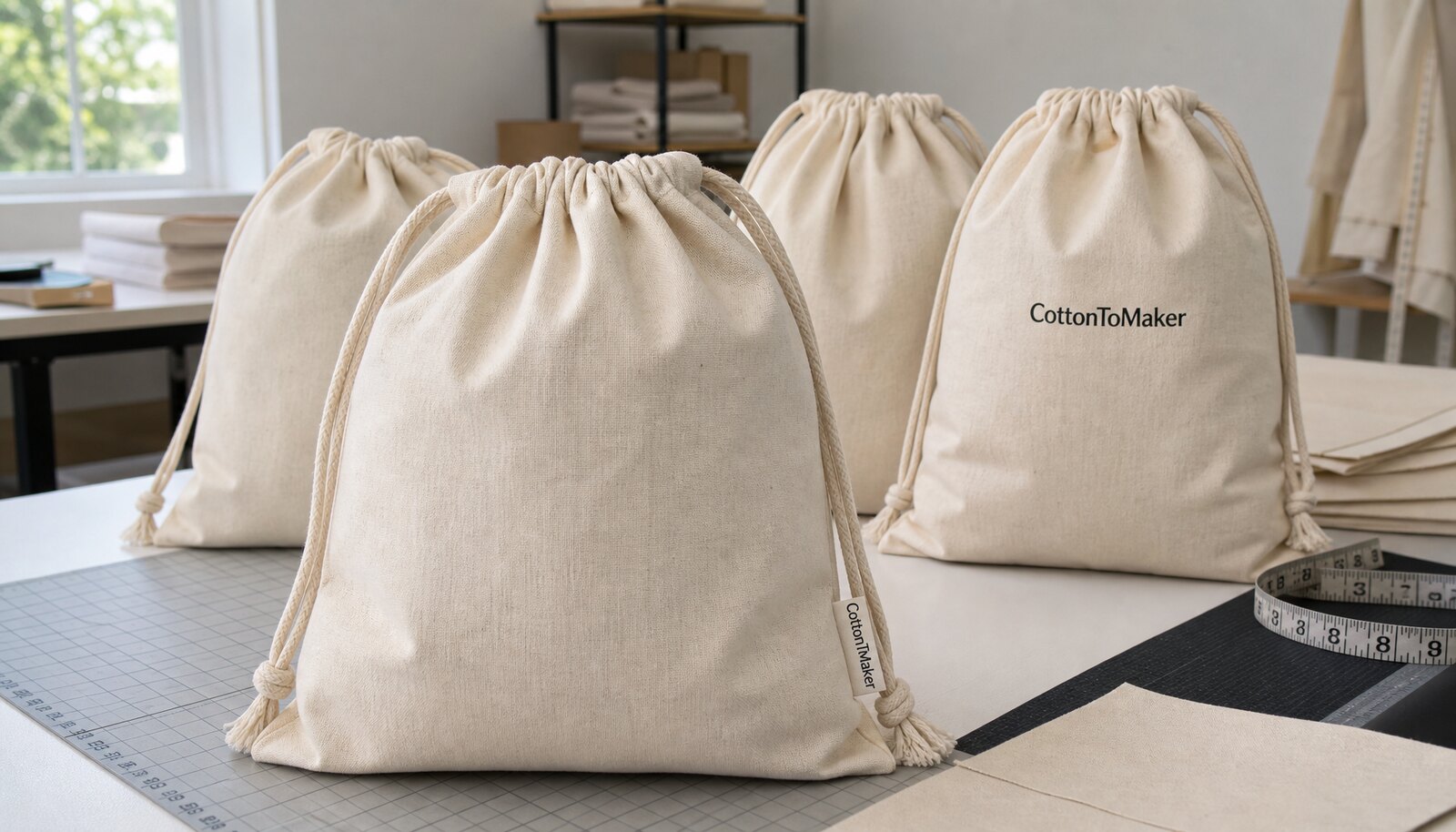
Start with the use case, not the price
Custom canvas drawstring bags look simple, which is why they are often sourced too loosely. A procurement team that starts with unit price usually gets quotes built on different assumptions: different fabric weights, different cord quality, different packing formats, and different decoration methods. That makes comparison noisy and, in some cases, meaningless. The better starting point is the use case. A retail pouch, a gift bag, a sample kit insert, and a reusable accessory bag do not need the same build.
The use case determines how much structure the bag needs, how often it will be handled, and what failure looks like. If the bag will carry cosmetics or small retail goods, a lighter canvas may be acceptable. If it will be resold with a premium product or reused many times, buyers should care more about body, seam integrity, and print wear than about shaving a few cents off the quote. The supplier can only price correctly when the product definition is stable.
- Define the bag's job before asking for a quote.
- Match the build to handling frequency, not just to the artwork.
- Treat the bag as a controlled component with measurable acceptance criteria.
Choose canvas weight for feel, structure, and print performance
Canvas weight is the first spec that should be pinned down. For most custom canvas drawstring bags, 280-320 GSM is the safest middle ground because it gives enough body for retail and gifting while still sewing cleanly on standard lines. Lighter 240-260 GSM canvas can work for low-cost promotions or secondary packaging, but it tends to collapse more easily, show wrinkles sooner, and offer less visual premium. Heavier 340 GSM and above brings a firmer feel and better structure, but it also raises material cost, slows sewing, and can make the drawcord channel feel stiff on smaller bags.
Weight alone is not enough. Buyers should ask about weave density, surface finish, and whether the fabric is raw, washed, or pre-shrunk. Raw canvas can move after steam, rain, or humid storage. Pre-shrunk or washed fabric generally gives more stable finished dimensions and a cleaner post-pack appearance, but it may add cost and can slightly alter the feel of the print surface. If your brand cares about exact dimensions on arrival, do not leave this unstated.
- 240-260 GSM: lighter promotion, lower cost, less structure.
- 280-320 GSM: most balanced choice for retail, gifting, and repeat use.
- 340+ GSM: premium feel and better shape retention, but higher sewing and freight cost.
Construction details matter more than the sales photo
Two bags can look identical in a catalog and perform very differently in production. Flat construction is cheaper, faster, and easier to inspect. It also packs efficiently and works well for smaller items or accessory pouches. A gusseted or boxed-base version gives more capacity and shelf presence, but it adds cutting and sewing steps, which means more places for variation. If the bag needs to stand on shelf or hold bulkier contents, the extra structure may be worth it. If not, buyers should avoid paying for unnecessary complexity.
The drawcord system is another area where default choices can create avoidable problems. Cotton cord gives a softer hand and usually matches the look of canvas, but cotton-poly can offer better strength and more stable friction through the tunnel. Diameter should match the tunnel width, because a cord that is too thin feels cheap and slips easily, while a thick cord can drag, twist, or slow the closing action. Ask the factory to confirm the tunnel width, seam allowance, and cord diameter as one system rather than three separate assumptions.
- Flat build: lower labor, lower freight, simpler QC.
- Gusset or boxed base: better capacity and shelf presence, but more sewing risk.
- Cord and tunnel must be engineered together, not selected independently.
Decoration choice should follow artwork complexity and durability requirements
Decoration is where many buyers overpay or under-specify. Screen print is usually the best choice for one to three spot colors, simple logos, and repeat programs. It gives solid coverage on canvas and is generally the most cost-efficient option once the setup is amortized. It also tends to look cleaner on textured fabric than many buyers expect. The tradeoff is setup: each color adds screens, alignment checks, and risk of registration drift if the factory rushes the job.
For short runs or complex art, digital print or transfer can be useful, but the buyer needs to ask the right durability questions. A design that looks sharp at approval can still crack, fade, or abrade unevenly after handling if the ink system or curing process is weak. Embroidery can work for smaller logos and can feel premium, but it is slower, heavier, and not ideal for very fine detail. The right method is the one that supports the art, the order quantity, and the way the bag will actually be used.
- Screen print: best for flat logos, lower cost at volume, good on canvas texture.
- Digital or transfer: better for short runs, gradients, or detailed art, but verify wear resistance.
- Embroidery: premium appearance and good abrasion resistance, but higher labor cost and design limits.
MOQ is usually a production problem, not a sales tactic
MOQ for custom canvas drawstring bags is rarely a single number. Factories build it from material availability, line efficiency, and decoration setup. If the supplier has stock fabric and a standard body, the MOQ can be fairly low. If the order requires custom dyeing, a new cut pattern, a special cord, or retail-ready packing, the MOQ rises because the factory has to absorb more setup and handling cost. This is why one quote can say 500 pieces while another says 3,000 for what looks like the same bag.
Procurement teams should ask what drives the MOQ. Is it fabric minimums, print setup, color count, or packing? If the factory gives a low price but requires a large MOQ, there may be a hidden setup burden or a packaging assumption that has not been surfaced. In many cases, the cheapest route is not the fully custom route; it is a stock base bag with controlled decoration and a clear re-order path. That is especially true for pilot programs, seasonal campaigns, and product launches where the design may still change.
- Stock base bags usually support the lowest MOQ.
- Custom dye, multiple print colors, and retail packing usually raise MOQ.
- Ask whether MOQ is per design, per color, per size, or per shipment.
Supplier type changes control, speed, and price transparency
A direct factory is usually the strongest route when repeatability matters. You get closer visibility into the fabric source, the sewing line, and the inspection process, which makes it easier to control quality over time. That matters for branded retail lines or programs that reorder. The downside is that a direct factory may expect a cleaner spec package and may not help much if your internal team wants a one-stop solution for multiple product categories.
A trading company can be useful when you need coordination across mixed SKUs or do not have the bandwidth to manage each factory directly. The tradeoff is price opacity and the risk that the quote is one step removed from the actual production site. A stock-program route is often the fastest for samples, events, and launch tests because the base bag already exists. It is the right answer when speed matters more than exact customization, but buyers should verify stock consistency, because stock color and texture can shift between replenishment cycles.
- Direct factory: best for repeat orders, traceability, and tighter spec control.
- Trading company: useful when you need coordination and less internal sourcing workload.
- Stock program: fastest route, but it limits customization and can vary by lot.
Write the spec sheet so the factory can actually build the bag
If the RFQ is vague, the supplier will fill the gaps with defaults. Those defaults may be reasonable for the factory but wrong for your brand. A usable spec sheet should name the finished dimensions, fabric GSM, weave or finish type, cord diameter and material, decoration method, print size, placement margin, packing format, and carton configuration. It should also define what counts as acceptable variation. Without that, the factory can make a product that is technically close but commercially off-target.
The most useful spec sheets include a visual reference and a measured sample route. For example, use a sealed golden sample or an approved strike-off, then define how the bulk order must match it in appearance and function. If the bag has a sewn label, barcode, hangtag, or retail fold, include that as part of the spec rather than as a last-minute packing note. The goal is not to over-document everything. The goal is to remove interpretation from the build.
- Lock finished size with measurement points and tolerance.
- State GSM, finish, cord diameter, and print placement margin.
- Include labels, pack-out, carton marks, and the sample route in the same document.
Build a QC plan with real acceptance thresholds
QC guidance needs to be measurable or it will not hold in production. A practical starting point is an AQL plan such as 2.5 for major defects, 4.0 for minor defects, and 0 for critical defects, but the exact sampling plan should be written into the purchase order. Size should be measured against the same points every time, and the tolerance should be defined before the bulk order starts. For a small to mid-size canvas drawstring bag, a starting tolerance of +/-0.5 cm on compact sizes and +/-1.0 cm on larger sizes is workable, provided both sides agree in advance.
Stitching and function deserve the same attention. A medium-canvas bag should usually show clean seam lines, no skipped stitches, no seam puckering that distorts the shape, and no open tunnel ends. A sensible target is 8-10 stitches per inch on the main seams and 6 SPI minimum on less critical areas, with 8-10 mm seam allowance on side seams and 10-12 mm at stress points. For function, test the drawcord on multiple pieces from different cartons. The bag should open and close smoothly, the cord should not slip, and the tunnel should not tear under a simple load test.
- AQL 2.5 major / 4.0 minor / 0 critical is a common starting point.
- Use written size tolerances, not vague language like 'close enough'.
- Add stitch-density, seam-allowance, and pull-test criteria to the PO.
Sample approval should mirror the real production route
A sample is useful only if it reflects the actual bulk process. A polished sales sample made from a different fabric or print method can hide the real production risk. Buyers should ask for a pre-production sample, strike-off, or gold-seal reference that uses the same canvas, cord, decoration route, and packing style planned for the order. If the supplier cannot do that, the sample should be treated as indicative only, not approval-ready.
When the sample arrives, review it against the spec sheet line by line. Measure finished size, check the placement and clarity of the artwork, feel the cord tension, inspect seam accuracy, and confirm the bag closes without binding. If the order is retail-facing, also check the fold direction, polybag clarity, barcode readability, and the placement of any required warnings or labels. The sample is the cheapest place to discover a mismatch. If a factory cannot hit the sample consistently, the bulk order is at risk.
- Approve only samples made from the same production route as the bulk order.
- Measure the sample instead of relying on appearance alone.
- Use the sample as the reference for any later dispute on color, size, or build.
Packing, freight, and timeline decisions affect landed cost
Packing is not a finishing detail; it changes labor, damage risk, and freight efficiency. Bulk packing usually gives the best cost profile for wholesale and internal distribution, but it must be handled carefully to avoid corner crush, dust, or scuffing on printed canvas. Retail-ready polybags, barcode labels, and header cards improve shelf presentation and e-commerce readiness, but they add cost and can stretch the lead time if the supplier does not have the materials on hand.
Lead time should be broken into stages so the buyer can see where the schedule can slip. A good timeline separates sample development, material booking, production, inspection, and dispatch. A short total lead time is not useful if the factory has not confirmed screen readiness, fabric availability, or carton stock. For seasonal orders, the safest move is to reserve time for sample approval and one round of correction. Freight planning matters too: heavier canvas can change carton weight, pallet count, and the final landed cost more than buyers expect.
- Bulk pack is cheaper; retail-ready pack is slower and more expensive.
- Ask for lead time by production stage instead of a single headline number.
- Check carton weight and cube early so freight does not erase the price advantage.
Specification comparison for buyers
| Spec decision | Recommended option | Typical MOQ / cost impact | Buyer risk to check |
|---|---|---|---|
| Fabric weight | 280-320 GSM canvas for most retail, gifting, and repeated-use orders | Usually the most balanced option; lighter 240-260 GSM can reduce cost, while 340+ GSM often adds 10-25% to material and sewing cost depending on market and finish | Too light will feel flimsy and can show print distortion; too heavy can make the tunnel stiff and raise freight weight |
| Canvas finish | Natural, bleached, or pre-shrunk canvas with a stable weave | Pre-shrunk or washed fabric can increase unit cost but reduces size drift after steaming, packing, or minor moisture exposure | Raw canvas may shrink or skew after first wet exposure, which can trigger size disputes if you do not specify the accepted tolerance |
| Decoration method | Screen print for 1-3 spot colors; digital or transfer for complex art or short runs | Screen print usually has the lowest per-piece decoration cost at scale; digital and transfer reduce setup friction but often cost more per bag on larger orders | Fine lines, gradients, and full-coverage art can crack, blur, or lose color density if the method does not match the design |
| Cord construction | Cotton cord or cotton-poly cord matched to bag weight and tunnel width | Standard cord is usually included in base pricing; thicker cord, dyed cord, or custom tips can add cost and may raise MOQ if sourced separately | Thin cord can fray or slip, while oversized cord can create poor closing action and slow production |
| MOQ route | Stock base bag + custom print for smaller tests; fully custom sewn pattern for repeat programs | Stock-program MOQ is often the lowest route for launch orders; full custom patterning usually needs more volume to absorb cutting, sewing, and setup costs | Low-MOQ quotes may hide screen fees, packaging fees, or color-change charges; full custom can be cost-efficient only when the spec stays stable |
| Decoration placement | Front-center or lower-right front panel with clear margins from seams and the drawstring tunnel | Standard placement is usually the easiest and cheapest to execute consistently; off-center placements can add setup checks and rework risk | Artwork too close to the seam or tunnel can distort during sewing or be partially hidden when the bag is cinched |
| Packing method | Bulk pack for wholesale; individual polybag or barcode labeling for retail/e-commerce | Bulk packing is the lowest-cost route; retail-ready packing adds labor, materials, and inspection time, often increasing the landed unit cost noticeably | Bulk-packed canvas can scuff if carton lining or interleaving is not planned, and retail packs can fail compliance if labels are missing or illegible |
| Supplier route | Direct factory for repeat orders; trading company for mixed-category sourcing; stock program for speed | Direct factory is usually best on repeat price control; trading companies can simplify coordination but often carry a markup; stock programs reduce lead time but limit customization | The cheapest quote is not useful if the supplier cannot trace the fabric, print method, or pack-out assumptions |
| QC standard | AQL-based inspection with written size, stitch, print, and function criteria | Most buyers use AQL 2.5 for major defects, 4.0 for minor defects, and 0 for critical defects, but the exact plan should be written into the PO | Without measurable acceptance rules, small deviations become shipment disputes after bulk production is already complete |
Buyer checklist before sampling
- Define the end use first: retail resale, gift packaging, event giveaway, product pouch, or shipping insert, because each one changes fabric weight, decoration durability, and packing requirements.
- Lock the finished size and measurement points, including whether the bag is flat or gusseted and whether the dimensions are taken before or after pressing.
- Specify the canvas weight, weave density, and finish state: raw, bleached, dyed, washed, or pre-shrunk.
- State the cord material, cord diameter, drawcord length, and end finish, including knots, metal tips, heat seal, or sewn stops.
- Provide vector artwork, Pantone references, minimum line thickness, print size, and the acceptable color variation range.
- Set the decoration margin from seams and the drawstring tunnel so the logo does not distort or disappear when the bag is pulled closed.
- Choose the packing format: bulk pack, inner polybag, retail barcode label, hangtag, or header card.
- Write the acceptance criteria for size, seam appearance, stitch density, print registration, and drawcord function before the supplier quotes.
- Ask for a pre-production sample or strike-off that uses the actual fabric, cord, and print method planned for bulk.
- Confirm carton count, carton dimensions, gross weight target, and whether the shipment needs palletization or export marks.
Factory quote questions to send
- What is the exact GSM, weave density, and finish state of the canvas, and can you confirm whether the fabric is pre-shrunk or raw?
- Is this quote based on a stock base bag with custom decoration, or on a fully custom cut-and-sew pattern?
- What print method is included, how many colors are covered, and what setup, screen, plate, or file-prep charges apply?
- What is the MOQ for each price tier, and does the MOQ change by size, color count, decoration method, or packing format?
- What finished size tolerance do you commit to after sewing, pressing, and packing?
- What cord material, diameter, and end finish are included in the base price?
- What seam allowance do you use at the side seams and tunnel, and what stitch density do you target on load-bearing areas?
- What packing is included per unit and per carton, and what extra cost applies for polybags, barcodes, hangtags, or retail inserts?
- Can you provide a measurement sheet, production photo, and inspection checklist from a similar order?
- Which inspection standard do you use, and what AQL levels do you apply for major, minor, and critical defects?
Quality-control points to confirm
- Use a written inspection standard such as ISO 2859-1 or GB/T 2828.1, and set the plan in the PO. A common starting point is AQL 2.5 for major defects, 4.0 for minor defects, and 0 for critical defects.
- Define finished size tolerance before production. For small canvas drawstring bags, a practical starting point is +/-0.5 cm for compact sizes and +/-1.0 cm for larger bags, unless the fabric is intentionally washed or shrunk.
- Specify seam allowance and stitch density. A practical target for medium canvas is 8-10 stitches per inch on main seams, with at least 6 SPI on non-critical areas, and seam allowance of 8-10 mm on side seams and 10-12 mm at stress points or the tunnel.
- Reject any hole, open seam, broken stitch run, oil stain, or miscut panel. Minor weaving variation can be acceptable if it is visually consistent and pre-approved against a sealed sample.
- Test the drawcord function on samples from different cartons. The bag should open and close smoothly, the cord should not bind in the tunnel, and the cord ends should not fray excessively or unravel under normal handling.
- Run a simple pull test on the seam and cord structure. For standard small-to-mid canvas pouches, hang or load the bag to its intended use weight, or 3-5 kg where appropriate, for 30 seconds. Reject if stitching opens, the tunnel tears, or the cord slips.
- Check print placement, edge sharpness, and registration under normal daylight. A practical acceptance rule is no visible blur at the logo edge, no major color bleed, and placement within the agreed artwork window, typically within 3 mm of the approved target for logo position.
- For surface print, add a rub check on a sealed sample. If the artwork is solid or dark, inspect for transfer after repeated dry rubbing with a white cloth. Use the same method on the first production pieces before approving the whole lot.
- Verify carton accuracy, pack count, and barcode legibility. If the bags are retail packed, check that each unit has the correct insert, label, warning text, and seal quality before shipment release.