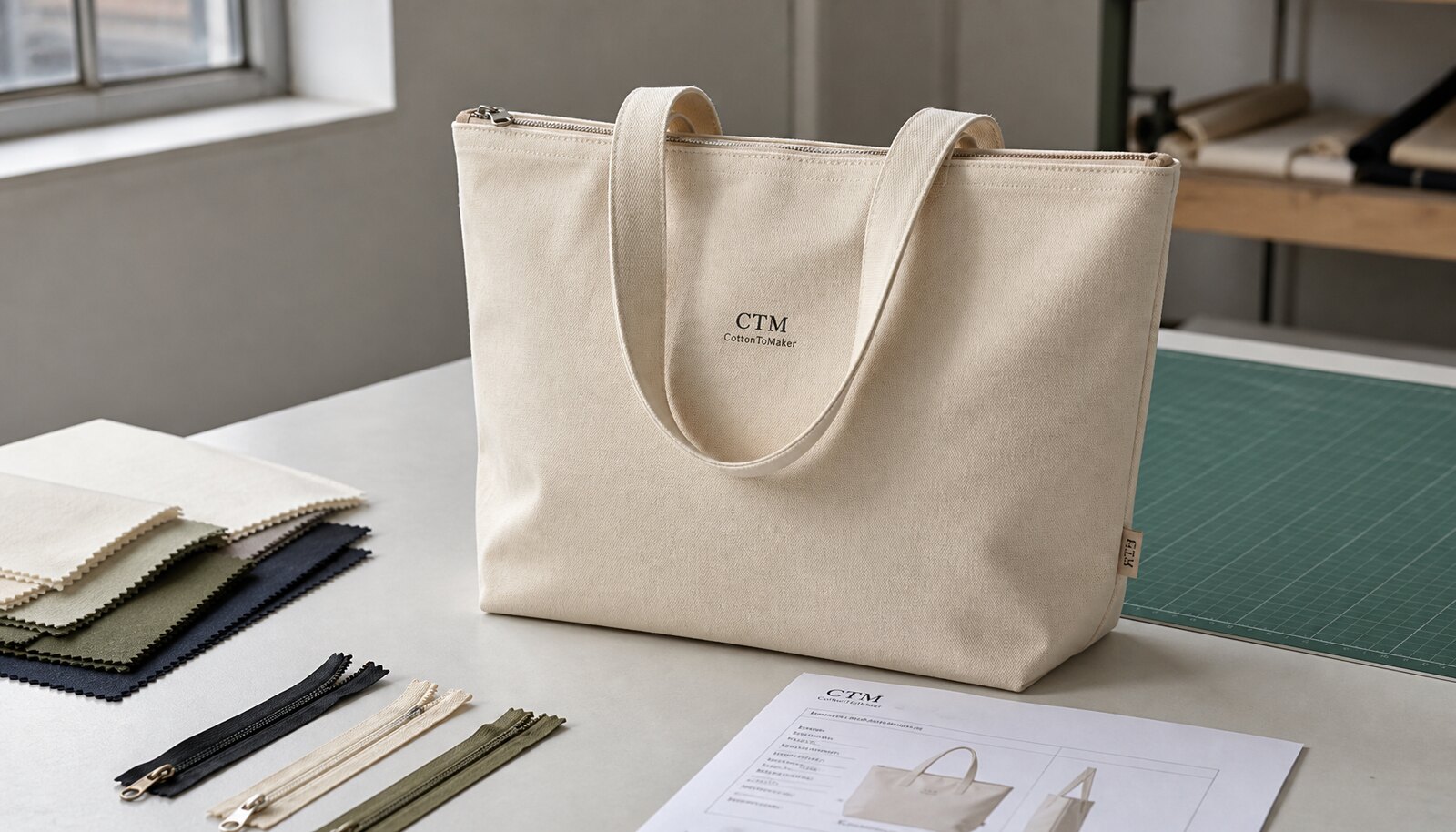
Why the zipper changes the buying decision
A custom canvas bag with zipper is a different procurement item from a basic open-top tote. The zipper adds a second system to buy, approve, and inspect. That means the quote is not only about bag size and decoration. It is also about zipper grade, tape width, slider quality, stitch path, and how the top opening holds shape after the bag is packed. If those details are vague, two suppliers can give the same price for very different products.
For B2B buyers, the risk is not that the bag looks wrong in a sample photo. The risk is that the bag looks acceptable but behaves inconsistently in production: the zipper tracks crooked, the top edge puckers, or the print sits too close to a seam and cracks after folding. A clean procurement spec reduces that risk because it tells the factory exactly what to build and what will be rejected.
- Treat the zipper as a functional component, not just an accessory.
- Use one approved sample as the reference for size, color, zipper action, and decoration.
- Ask the supplier to price the actual construction, not a similar tote they already make.
Start with the build spec, not the logo
The fastest way to get an accurate quote is to define the bag structure before you talk about artwork. Start with finished dimensions, canvas weight, lining requirement, zipper style, handle length, and whether the top opening needs a facing or internal binding. Those choices control labor, material use, and how well the bag holds its shape. If the buyer waits until later to decide these points, the supplier will either re-quote or quietly assume a cheaper build.
Canvas weight should match the use case. Lighter promotional bags usually sit in the 8 oz to 10 oz range, while retail and heavier-use programs are often better served by 12 oz to 14 oz canvas. That does not mean heavier is always better. Heavier fabric can improve structure, but it also increases cost, affects foldability, and can make zipper sewing less forgiving if the top edge is not stable.
Lining is another decision with real cost consequences. A lined bag often looks cleaner inside and supports the zipper area better, but it adds material, sewing steps, and inspection points. An unlined bag is simpler and cheaper, but the buyer must accept a more utilitarian interior finish. The right choice depends on the product position, not on whether the supplier prefers one method over the other.
- Choose canvas weight based on load and brand positioning, not only unit price.
- Decide on lining early because it changes the sewing method and finished size.
- Specify handle length and attachment method so the bag hangs and carries correctly.
Specify the zipper like a procurement item
Zipper language in supplier quotes is often too broad. A usable spec should name the zipper type, size, tape color, slider finish, puller style, and whether the zipper is exposed, recessed, or hidden. Nylon coil is usually the most flexible option for curved or lightly structured openings. Metal can feel more premium, but it needs tighter alignment and tends to be less forgiving during sewing. Molded plastic can be useful when the buyer wants a sportier look or a color match that metal cannot easily provide.
The buyer should also decide whether the zipper needs a branded puller, custom logo pull tab, or a standard puller. Custom pullers improve brand presence, but they introduce more setup work and another point of failure if the finish chips or the puller rattles against the canvas. If the order is price-sensitive, a standard puller is usually safer unless the brand value clearly justifies the custom piece.
The most important practical point is fit. If the zipper tape width is too narrow, the opening can distort. If it is too heavy, it can overpower the canvas and make the bag feel stiff in the wrong way. Ask for a clear statement of the zipper construction and inspect the ends closely on the sample. The zipper should close smoothly, sit straight, and not create tension marks where it meets the seam.
- Name the zipper type, size, tape material, color, slider, and puller in the RFQ.
- Check whether the zipper sits exposed, recessed, or hidden.
- Test the sample zipper with repeated open-close cycles before approving bulk.
Use the right comparison frame for the build
A useful comparison table for this product should compare construction choices, not just supplier routes. Procurement buyers need to know how a nylon coil zipper compares with metal, or how a lined bag compares with an unlined one. That is where cost, appearance, and quality risk actually change. A sourcing route can be relevant later, but the first comparison should make the product tradeoffs obvious.
This matters because the cheapest-looking quote is often the one with the weakest construction detail. A factory can quote a low number by swapping to a lighter canvas, a cheaper zipper, or a simpler packing method. If the buyer does not compare build options directly, the quote appears competitive while the finished bag is weaker than intended. Comparing the product spec line by line keeps the team focused on what is being bought, not just who is selling it.
The practical rule is simple: compare like with like. If one quote includes a lined interior, a branded puller, and folded retail packing, and another quote does not, the numbers are not competitive until the build is normalized. Buyers should ask suppliers to restate the quote back in the same template before any final commercial decision.
- Compare construction choices first, then compare supplier price.
- Normalize every quote to the same canvas, zipper, print, and packing spec.
- Use the approved sample as the baseline if a supplier proposes substitutions.
Compare build options before you lock the RFQ
The comparison table below is meant to help buyers choose the right construction, not just the lowest price. It is easier to manage risk when the team agrees on the build direction before sample approval. If the bag is meant for retail, a cleaner zipper finish and a more stable fabric weight often matter more than shaving a small amount off the unit price. If the bag is for promotion, simplicity and freight efficiency may matter more than premium detailing.
There is no universal best option. The right build depends on the use case, the expected load, the desired shelf appearance, and how much time the buyer has for sample rounds. What matters is that the buyer can explain why one option was chosen and why another was rejected. That creates a stronger approval record and fewer arguments when a supplier later says a substitution is equivalent.
A good RFQ should therefore describe the preferred build and list any acceptable alternates. For example, nylon coil may be the preferred zipper type, but metal may be acceptable if the buyer confirms the price and sample look. That is more useful than a vague request for a "high quality zipper" that different suppliers interpret differently.
- State the preferred build and any acceptable alternates.
- Tie each alternate to a specific approval requirement.
- Do not let suppliers quietly mix material grades across samples and bulk orders.
Control decoration near the zipper opening
Decoration can create a quality problem if it is placed too close to the zipper line. A logo printed over an area that flexes repeatedly may crack, crease, or show ghosting once the bag is loaded and folded. The same issue can happen with dense embroidery. Stitching too close to the opening can distort the panel and make the zipper harder to close. That is why decoration choice should be tied to the bag construction, not selected in isolation.
Screen printing remains the most predictable option for simple logos and larger volume orders. It is usually the best balance of cost and appearance when the artwork is flat, bold, and not crowded against seams. Heat transfer can work for more complex graphics, but buyers should test whether the print stays intact after folding and rubbing. Embroidery is attractive on heavier canvas, but it needs enough clearance from the zipper and enough panel area to avoid puckering.
For a more premium look without loading the zipper area, a woven label or small patch is often the safer choice. It can carry branding without forcing the front panel to behave like a billboard. If the buyer wants the logo to sit close to the zipper, the sample should be tested in both empty and loaded conditions so the team can see how the print behaves after use, not just on the table.
- Keep decoration away from the zipper seam unless the sample proves it will hold.
- Use a curing and rub-resistance check for printed bags.
- Treat embroidery near the opening as a structural decision, not only a branding decision.
Ask for supplier qualification, not just a price
The buyer should qualify the factory before comparing quotations in detail. Ask whether the factory controls sewing in-house, how zipper and fabric inventory are managed, and who signs off on pre-production samples. If the supplier is a trader or sourcing agent, clarify whether they control the production line or are only coordinating the order. That distinction matters because responsibility for defects becomes blurry when the product moves through several hands.
A strong supplier should be able to show similar construction experience, explain how they check zipper function, and describe how they handle substitutions. Buyers should also ask what happens if zipper color, fabric shade, or puller stock changes after order placement. A good answer is not simply "we will inform you." It should identify who approves the substitution and what sample or photo evidence is required before production continues.
Procurement teams should also ask for the factory's inspection method, not only its promise of quality. If a supplier cannot explain how they inspect sewing, carton count, and print finish, the quoted price is less meaningful. The goal is not to over-audit a simple tote bag. The goal is to ensure the factory has enough process control to make the same bag repeatedly.
- Confirm whether the seller is the factory, a trader, or a sourcing agent.
- Ask who owns sample approval and who approves any substitution.
- Check that the supplier can explain in-line inspection and final inspection on this exact build.
Quote the commercial terms clearly
Incoterms and freight responsibility need to be explicit in the quote. A unit price is not useful if the buyer does not know whether it is EXW, FOB, CIF, or DDP. EXW may look cheap, but it places more work and risk on the buyer. FOB gives the buyer more control over freight booking, while CIF and DDP move different parts of the transport burden into the supplier's price. The right choice depends on whether the buyer wants control, simplicity, or landed-cost predictability.
For custom canvas bags with zipper, freight can shift the economics quickly because the carton pack, folding style, and bag weight all affect cubic volume. A small change in packing method may reduce the number of cartons, lower freight cost, and improve warehouse handling. Buyers should ask for carton dimensions, gross weight, and cartons per SKU so landed cost can be calculated honestly instead of guessed from the unit price alone.
If the order crosses borders, the quote should also state who handles export documentation, import duty assumptions, customs clearance, and last-mile delivery. A bargain price can become expensive if the buyer discovers the supplier has excluded charges that are not obvious at first glance. This is especially important on repeat programs where freight terms need to stay stable across reorder cycles.
- State the Incoterm in the RFQ and the PO.
- Ask for carton dimensions and gross weight before comparing landed cost.
- Clarify who pays export freight, duties, customs clearance, and local delivery.
Set measurable QC checks before bulk production
Quality control should be concrete enough that the factory can act on it. General language like "good workmanship" does not prevent claims. Buyers should define the defects that matter most on a zippered canvas bag: crooked zipper installation, weak top-stitching, loose thread tails, dirty marks, print misregistration, and zipper drag. If the buyer knows the intended use, the inspection plan can be tailored to that use instead of relying on generic bag QC language.
A practical QC plan starts with the sample. Check the fabric shade, zipper action, stitch consistency, logo placement, and folded appearance under real loading conditions. Then move to production control: in-line checks for zipper alignment, seam allowances, and thread trimming, followed by final random inspection for overall appearance and packing accuracy. On larger orders, the buyer should ask for carton photos, count verification, and a sealed approved sample that the factory must match.
Testing should be simple enough to repeat. For zipper durability, ask the supplier to cycle open and close the sample several times under normal handling and then inspect for snagging or separation. For print adhesion, use a cured sample and apply a tape pull or rub test in the logo area. Buyers do not need a laboratory for every order, but they do need a repeatable shop-floor method and a clear pass/fail rule.
- Define the defect list before production starts.
- Use a zipper cycle test and a print adhesion test on the sample.
- Tie final random inspection to the approved golden sample, not to a verbal description.
Build packing into the spec
Packing is part of the product because it affects both freight and presentation. A zippered canvas bag can be folded flat, but if the fold is too tight it can leave a visible crease along the zipper line or pressure marks on the print. If the bag is packed too loosely, freight cost climbs and cartons waste space. Buyers should specify fold direction, whether the zipper puller needs protection, and whether a polybag or paper insert is required.
Retail programs often benefit from a cleaner presentation pack, even if that adds a small cost. Promotional orders may prefer flat bulk packing if the bag is not meant to sit on a shelf. The decision should be intentional. It is common for buyers to spend weeks discussing fabric and decoration and then leave packing open, only to discover later that the carton count or finished look is not what they wanted.
Ask the supplier for packed carton photos before shipment and verify that carton marks match the SKU, color, quantity, and purchase order. That is a low-effort control that prevents warehouse confusion and makes inbound receiving much easier. If the buyer needs a maximum carton weight or carton size, include it in the order spec so the factory does not overpack to save freight at the expense of handling.
- Specify fold style, packing material, and carton weight limits.
- Ask for packed carton photos before shipment.
- Keep carton labels aligned to SKU, quantity, and PO details.
Specification comparison for buyers
| Build option | Best fit | Cost and lead-time effect | Buyer risk to check |
|---|---|---|---|
| Nylon coil zipper on unlined canvas | Promotional runs and lighter retail bags that need flexible sewing | Usually the lowest-risk construction and the easiest to source; keeps lead time manageable | Check zipper gauge, end-stop finish, and whether the opening still lies flat after loading |
| Metal zipper on heavier canvas | Retail bags where a more premium handfeel matters | Raises material cost and can slow sewing and approval because alignment is less forgiving | Confirm slider smoothness, tape color match, and seam allowance at the zipper end |
| Hidden or recessed zipper | Clean, premium-looking bags with a more finished top edge | Often increases labor and sample revisions because the top opening is more complex | Inspect whether the zipper is still easy to operate and whether the lining or facing shifts |
| Lined bag with internal zipper tape covered | Programs where inside appearance and structure matter | Adds fabric, sewing steps, and inspection points; useful when the bag needs body | Ask who controls lining shrinkage and whether the lining changes the finished size |
| Unlined bag with exposed zipper tape | Cost-sensitive orders where the interior can remain simple | Simpler to sew and easier to pack flat; usually improves price competitiveness | Check whether exposed tape and thread ends look clean enough for the intended market |
| Custom puller or branded pull tab | Retail or premium gifting programs | Adds tooling or setup cost and may extend sample approval | Verify artwork placement, metal finish, and whether the puller increases snag risk |
| One-color screen print | High-volume repeat orders with simple branding | Best unit economics at scale and usually the most predictable on canvas | Confirm cure method, print position tolerance, and rub resistance after folding |
| Woven label or patch instead of heavy print | Brands that want cleaner seams and lower risk near the zipper opening | Can reduce print-adjacent defect risk, though label sewing adds a small labor step | Check label size, stitch coverage, and whether the patch interferes with opening and closing |
Buyer checklist before sampling
- Lock the finished size, canvas GSM, lining yes/no, zipper type, zipper size, puller style, and handle length before asking for price.
- State the print area in millimeters and provide vector artwork so the supplier is not estimating placement from a screenshot.
- Ask the supplier to name the zipper construction clearly: nylon coil, molded plastic, or metal, plus tape color and slider finish.
- Request photos or a physical sample of the zipper end, inside seam finish, and handle bar-tack before approving bulk.
- Define size tolerance, print position tolerance, and acceptable zipper function on the purchase order, not only in email.
- Ask for pricing breaks at 500, 1,000, 3,000, and 5,000 pieces so setup cost is visible.
- Confirm whether cartons include polybags, tissue, inserts, desiccant, or any shelf-ready packing.
- State the required Incoterm and who pays for export freight, import duty, and local delivery.
- Require a pre-production sample and, for larger orders, keep a sealed golden sample for reference.
- Ask the supplier which substitutions are allowed if fabric color, zipper color, or puller stock is unavailable.
Factory quote questions to send
- What exact fabric are you quoting, including canvas GSM, weave feel, finish, and any pre-shrink or wash treatment?
- What zipper construction is included in the price, and what is the zipper size, tape material, slider type, and color code?
- Is the quote based on a lined or unlined bag, and how does pricing change if we add an internal pocket or facing?
- What print method are you pricing, what setup charge applies, and what is the maximum print area you can hold within tolerance?
- What are your production tolerances for finished size, zipper placement, seam alignment, and print position?
- How many zipper cycles and loading checks do you perform during sample approval or in-line QC?
- Can you show a bag with the same or similar construction, including the inside finish and zipper ends?
- What is your MOQ for this exact build, and what changes if we switch zipper color, puller style, or decoration method?
- What sample stages are included: lab dip, strike-off, pre-production sample, or top-of-production sample?
- What is the packing configuration, carton size, gross weight, and carton count per master carton?
Quality-control points to confirm
- Finished dimensions should stay within an agreed tolerance, such as plus or minus 5 mm on the key width and height measurements, so the bag packs consistently.
- The zipper should open and close smoothly through repeated cycles on a sample bag without catching, separating, or dragging at the seam.
- Set a functional cycle test on pre-production samples, such as 20 to 30 full open-close passes under normal handling, before approving bulk.
- The zipper end should be secured cleanly with no loose tape, exposed sharp edges, or weak back-tacking at the stop.
- The top opening should sit flat and not ripple noticeably when the bag is empty or when it carries the intended load.
- Print placement should stay within the agreed print box, with a practical buyer tolerance such as 3 mm for a simple logo if the artwork is small and centered.
- Print adhesion should be checked after the recommended cure period with a tape pull or crosshatch-style shop test on a sample panel.
- For screen print, rub resistance should be checked with a dry white cloth after curing so buyers can see whether ink smears or cracks near folds.
- Stitching at handle joins, zipper ends, and stress corners should be even, with no skipped stitches or broken thread tails left untrimmed.
- Carton inspection should verify piece count, SKU label accuracy, carton marking, and that folded bags are not crushed hard enough to deform the zipper line.