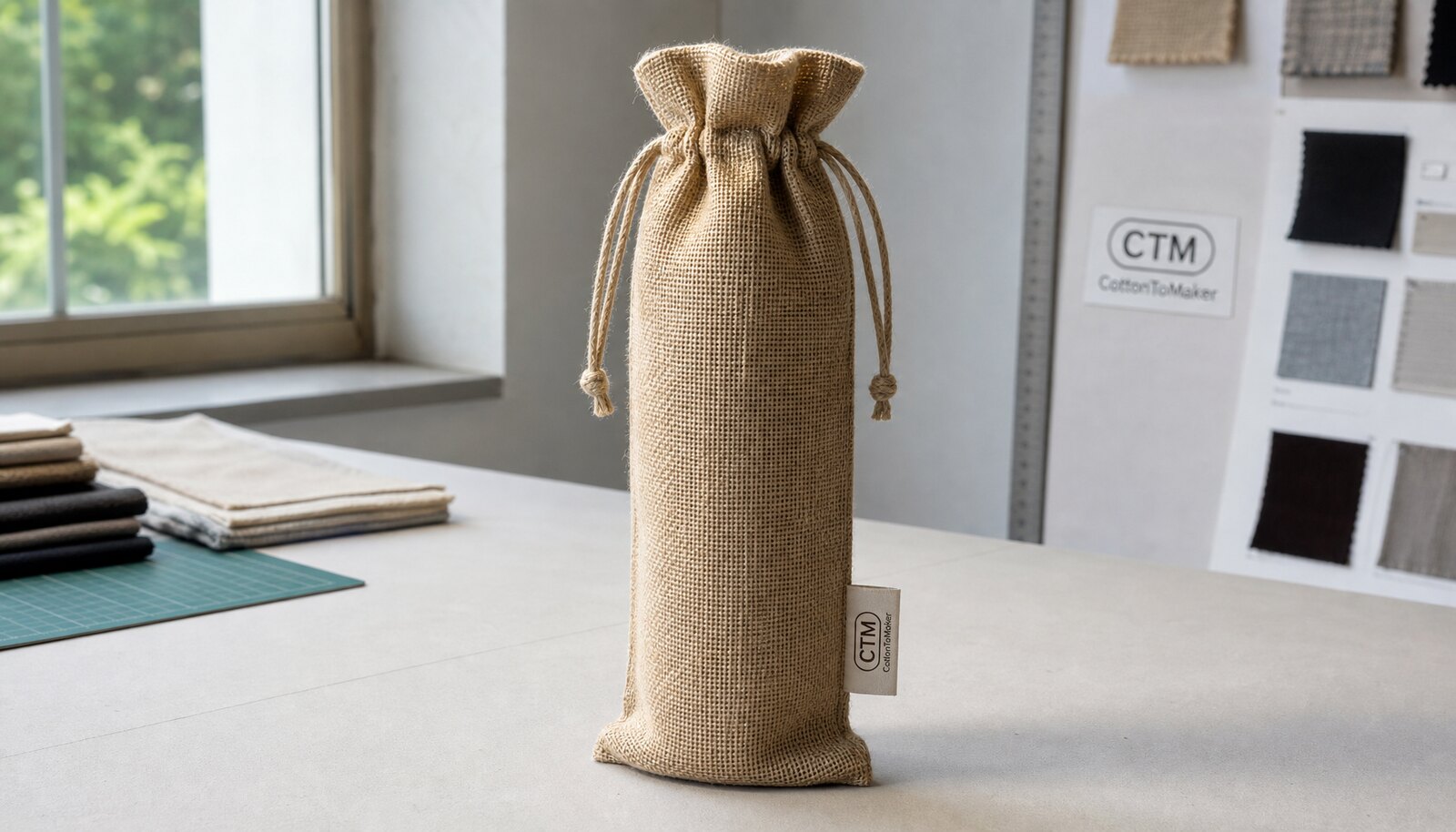
Start With the Real Buying Problem
Most custom burlap wine bag bulk order problems start with a vague RFQ. Buyers ask for "a burlap wine bag with logo" and the factory fills in the blanks with its own fabric weight, structure, and packing method. The quote looks competitive at first, but the sample comes back with the wrong stiffness, a logo that is too faint, or a fit that is too tight for the bottle.
The fix is to treat the bag like a production spec, not a gift item. If you define the bottle size, fabric weight, decoration method, closure, lining, and pack format up front, you can compare suppliers on the same basis and avoid the usual back-and-forth that slows bulk approval.
- State whether the bag is for a 750 ml bottle, magnum, or set pack.
- Separate fabric choice from printing and packing in the RFQ.
- Ask the factory to quote the same structure across all options.
Build the Size Around the Bottle, Not the Other Way Around
A wine bag should start with bottle dimensions, then add allowance for seams, thickness, and closure. A common starting point for a standard 750 ml bottle is a bag around 13 x 36 x 10 cm, but that is only a reference point. A Bordeaux bottle, Burgundy bottle, or tall sparkling bottle will each need a different tolerance, especially if the bag has a drawstring or flap.
If the bag is too tight, the bottle scrapes the seams and the closure looks stressed. If it is too loose, the bottle shifts in transit and the bag loses the premium feel that buyers expect from gift packaging.
- Give the supplier the bottle drawing or a physical sample if the shape is unusual.
- Confirm the neck height needed above the bag opening.
- Ask for finished size and cut size in the same quote.
Choose Fabric Weight and Structure With the End Use in Mind
For burlap wine bags, fabric weight usually sits in a practical range rather than an extreme one. Many bulk programs start around 230-320 GSM woven jute or burlap. Lighter fabric can work for low-cost promotional packs, while heavier fabric gives a more structured, premium look and usually improves print stability. The right choice depends on whether the bag is sold as a giveaway, a retail gift pack, or a brand presentation item.
Lining is a separate decision and should never be hidden inside a generic quote. An unlined bag is cheaper and more natural-looking, but a cotton-lined or reinforced bag can improve hand feel, reduce interior fiber shedding, and help the bag sit flatter on retail shelves.
- Use unlined fabric for simple promo programs and price-sensitive sets.
- Use lining or reinforcement when the bag is sold through retail or needs a cleaner inside finish.
- Ask the supplier to state whether the quoted GSM refers to base fabric only or finished construction.
Select a Print Method That Will Hold on Rough Burlap
Burlap is not a smooth cotton tote surface. The weave is open, textured, and uneven, so print detail will never behave like it does on a fine canvas bag. For most bulk wine bag orders, a 1-2 color screen print is the most practical option because it is cost-effective and works well with bold artwork. A sewn woven label is often better when the brand wants a cleaner premium look and the logo has fine detail.
Avoid overcomplicated artwork. Thin serif fonts, small gradients, and hairline strokes are common reasons for rejected samples. If the logo must stay detailed, consider a sewn patch or woven side label instead of trying to force the design directly into the burlap texture.
- Keep line thickness strong enough to survive the weave.
- Ask for print placement in millimeters from the edge or seam.
- Request a strike-off or digital mockup only as a preview, not as proof of final print quality.
Understand MOQ Logic Before You Compare Quotes
MOQ is not just a factory preference; it is usually tied to setup labor, cutting efficiency, print screens, and packing labor. A bag with one size, one color, and one logo position will usually support a lower MOQ than a program with multiple sizes, multiple artworks, or mixed closures. The quote should show whether the MOQ is per style, per color, or per print version.
This is where many buyer comparisons fail. One supplier may quote a lower unit price but include only blank bags, while another may include printing, a woven label, and carton packing. The result is not a fair comparison unless each line item is separated.
- Ask for separate pricing for blank, printed, and fully packed versions.
- Check whether screen setup or label tooling is one-time or repeatable.
- Confirm if mixed-color orders increase the MOQ or just the unit cost.
Approve Samples in Three Steps, Not One
For a custom burlap wine bag bulk order, sample approval should be staged. First, approve the base fabric and structure with a blank sample. Second, approve logo size, placement, and color with a printed or labeled sample. Third, approve the pre-production sample using the actual bulk material, because burlap lots can vary in shade and weave density.
A sample that looks good in isolation can still fail in production if the seam allowance is too narrow or the closure rubs the bottle neck. The approval step should check both appearance and function.
- Check stitch density, corner reinforcement, and closure alignment.
- Compare the sample against the approved artwork and measurement sheet.
- Keep one approved reference sample for the production line and one for receiving.
Pack the Order So the Bag Arrives Clean and Counted
Packing details matter more than many buyers expect. Burlap sheds more than smooth fabrics, so bulk packs should be folded consistently and protected from moisture and abrasion. If the bags are for retail resale, inner packing may need tissue, belly bands, or individual polybags. If the bags are for warehouse distribution, bulk pack by carton count may be the better option.
Lead time should be listed separately for sample production and bulk production. As a practical example, many factories will quote around 7-10 days for samples and 25-40 days for bulk, depending on order size, artwork complexity, and season. Use those figures only as a reference, not as a promise.
- Confirm the number of bags per inner pack and per master carton.
- Ask whether cartons are single-wall or double-wall for export handling.
- Add moisture protection if the route includes long sea transit or humid storage.
Compare Supplier Quotes Line by Line
The best way to compare wine bag quotes is to force every supplier into the same spec sheet. A clean quote should separate fabric, printing, stitching, lining, packing, and sample charges. If the supplier gives only one lump sum, it becomes hard to see where cost differences come from or which detail is driving the price gap.
Pay attention to what is missing. A low quote without defined tolerance, pack count, or sample cost can become the most expensive option once rework starts. The quote should be detailed enough that a production team could begin cutting from it without asking follow-up questions.
- Reject quotes that do not specify size, GSM, and decoration method.
- Compare sample terms before comparing unit price.
- Ask for the same packing format from every supplier you are reviewing.
Specification comparison for buyers
| Spec decision | Recommended option | When it fits | Buyer risk to check |
|---|---|---|---|
| Fabric weight | 230-320 GSM woven jute or burlap | Single-bottle sleeves and standard gift packaging | Too light can fray and show through; too heavy can make the bag stiff and increase cost |
| Decoration method | 1-2 color screen print or sewn woven label | Simple logos, repeat bulk runs, and controlled branding | Fine lines can fill in on rough weave; confirm artwork thickness before quoting |
| Lining | Unlined or 120-150 GSM cotton lining | Low-cost retail bags or premium packs that need cleaner interior finish | Lining changes size, sewing time, and material cost; do not compare lined and unlined quotes together |
| Closure | Open top, drawstring, or flap with button | Display packs, gift sets, or more secure retail presentation | Closure choice affects bottle access, labor time, and neck clearance |
| Packing style | Bulk packed with carton count confirmed | Export orders and warehouse intake where unit packing is not needed | Missing pack counts cause recount delays, scuffing, and carton disputes |
Buyer checklist before sampling
- Confirm the bottle type, bottle diameter, overall height, and neck clearance before asking for size quotes.
- State the fabric construction and target GSM, or ask the supplier to nominate one and show it in the quote.
- Approve the logo art in vector format and specify the number of print colors, placement, and print size.
- Define whether the bag is unlined, lined, or reinforced, because this changes both cost and finished dimensions.
- Ask for a blank sample first if the fabric, color, or seam structure is new.
- Request a pre-production sample for final logo placement, stitch quality, and bottle fit.
- Specify inner pack count, carton count, carton marks, and any retail labeling before production starts.
- Get sample lead time and bulk lead time listed separately so the schedule is not confused with shipping time.
Factory quote questions to send
- What exact burlap or jute construction and GSM are included in your quote?
- Is the price based on unlined, lined, or reinforced construction?
- Which decoration method is quoted: screen print, woven label, sewn patch, or another option?
- What is the MOQ per size, per color, and per artwork version?
- What setup charges apply for screens, labels, or special stitching?
- What size tolerance and seam allowance do you use for bulk production?
- Can you quote blank sample, printed sample, and pre-production sample separately?
- What packing count, carton size, and master carton marks are included in the quote?
- What are the stated sample lead time and bulk lead time for this order size?
Quality-control points to confirm
- Check the jute weave for loose fibers, thin spots, odor, and color inconsistency before approving bulk.
- Measure the finished width, height, and gusset after sewing, not only the cut size.
- Inspect logo placement against the approved artwork for position, scale, and edge clarity.
- Rub-test the print to confirm the ink does not powder off or crack on the rough surface.
- Pull-test seams, handle attachments, and drawstring channels for early weakness.
- Fit the actual bottle type into the sample bag to verify neck clearance and closure function.
- Confirm carton count, outer marks, and pack method to avoid shortages and transit damage.