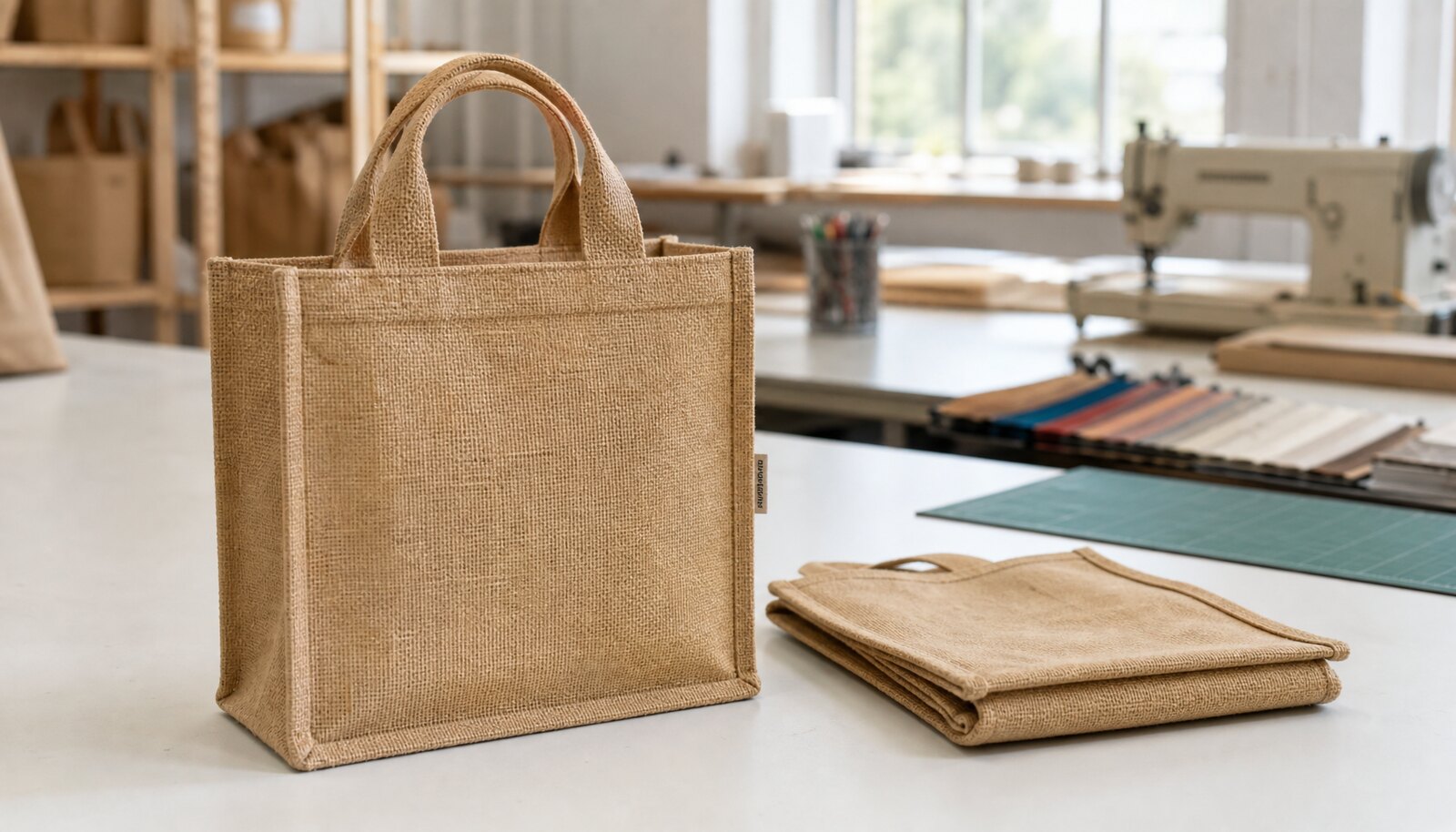
Start with the use case, not the aesthetic
Custom burlap tote bags are not interchangeable with generic totes. The same outer size can hide different cloth weights, weave openness, lining choices, handle anchors, and print methods. For procurement, the first job is to decide what the bag must do in the market: carry weight, sit on shelf, survive transit, or support a premium brand presentation. If the use case is unclear, every supplier will optimize a different tradeoff and the quotes will not be comparable.
A retail carry bag usually needs better shape retention and a cleaner finish than a promo giveaway. A wine or gift bag may need a narrower footprint, reinforced bottom, and a calmer print area. An event bag can tolerate lighter cloth, but only if the logo and packing are simple. Define the performance target first, then let the structure follow. That keeps the brief short, the sample review disciplined, and the final landed cost easier to defend.
- State the end use: promo, retail, gift, seasonal, or event.
- State the load target and whether the bag must stand upright.
- State which matters most: low unit cost, faster lead time, or shelf appearance.
Choose the construction before you negotiate price
Fabric weight is the first commercial lever. For simple burlap or jute tote bags, 320-380 GSM is a reasonable starting point for lightweight promo work, 400-450 GSM fits retail and gift carry, and 450 GSM plus reinforcement is better when the bag must hold shape or carry heavier contents. Lower weight keeps price and freight down, but it increases transparency, fray risk, and distortion once the bag is filled.
Construction choices change more than buyers expect. Unlined bags are cheaper and lighter, but the inside finish is visible and the body is softer. Partial lining can improve appearance without adding as much cost or cube as a full lining. Handle options also matter: self-fabric handles are low cost, cotton webbing is usually more comfortable, and jute tape keeps the material story consistent. If a bag needs a bottom board, reinforced seam, or double stitching at the handle anchor, say so before quoting.
- Freeze size, fabric weight, lining, handle type, and bottom reinforcement before price requests.
- Ask for finished dimensions and tolerance in both flat and open form.
- Require the supplier to state if any part of the bag is coated, laminated, or softened.
Branding on burlap needs coarse-fiber rules
Burlap is a rough print surface. Fine lines, small type, soft gradients, and tight registration look good in a mockup and then disappear into the weave. For most custom burlap tote bags, one or two-color screen print is the most reliable choice because it gives a predictable cost, acceptable durability, and fewer surprises at bulk scale. If the artwork needs subtle detail, ask whether the supplier can switch to a woven label, sewn patch, or side label instead of forcing detail onto the body.
Set artwork rules that fit the substrate. A practical minimum line thickness is usually around 0.75 to 1.0 mm, and print placement should be allowed to move only a few millimeters before it becomes obvious on a natural fiber surface. If you need a full-bleed or edge-to-edge look, burlap is usually the wrong base. Ask for an actual sample with the intended method, then check rub resistance and color density under normal handling conditions, not just in a photo.
- Use bold shapes and generous spacing around text.
- Ask for a white-cloth rub check on the approved sample.
- Compare the cost of extra colors against a sewn patch or woven label.
Supplier route changes the economics
India and Bangladesh are common sourcing regions for base jute and burlap programs, especially when the order is built around natural-fiber cloth and straightforward sewing. China can be competitive on mixed-material bags, faster trim coordination, or highly finished programs, but the economics are not always better on raw natural fiber. Domestic decorators using imported blanks usually buy speed and lower coordination risk at the cost of a higher unit price.
Use quote ranges as a sanity check. For a basic 35 x 40 cm unlined bag with one-color print, market quotes often land in a rough band of about $0.70 to $1.40 EXW or FOB at 3,000 to 10,000 pcs from lower-cost export factories, while domestic blank-based programs can move into roughly $1.50 to $3.50 or more depending on labor and freight. Sample lead time is often 7 to 14 days, and bulk lead time is commonly 25 to 45 days, with an extra 10 to 15 days if the order lands in a peak season. Treat those numbers as a quote-check, not a commitment.
- Ask where the sewing, print, and final pack actually happen.
- Compare the same incoterm, not a mix of EXW, FOB, and DDP.
- Ask for the source country of the cloth if origin matters for customs or sustainability records.
Write the RFQ so quotes are comparable
A useful RFQ forces every supplier to answer the same question. State the finished size, cloth weight, lining status, handle material and drop, print method, print colors, packing format, carton count, destination port, and the milestone that starts the clock. If you skip any of those, the quote is not clean enough to compare. The point is not to write a long brief. The point is to remove the supplier's freedom to assume a different product.
Separate recurring cost from one-time cost. Screen setup, pattern making, sample charges, carton artwork, and special inserts should be shown as distinct line items. Ask for price breaks at 1,000, 3,000, and 10,000 pcs on the same spec so you can see where the curve flattens. If the supplier only gives a single number, you cannot tell whether the price is attractive because the run is efficient or because key costs were left out.
- Quote the same spec in the same units across suppliers.
- Ask for optional items outside the base bag price.
- Request quote validity, payment terms, and lead time milestone in writing.
Use the sample as a production control
The pre-production sample is the most valuable control point in the whole order. Approve against a dated golden sample, not just an image or a verbal yes. Measure the finished size, compare the handle drop, confirm the print position, and load the bag with something close to the real use case. A burlap bag can look acceptable when empty and then twist, sag, or expose the wrong area once it is filled.
Good sample review is part measurement, part manufacturing test. A small bag may be acceptable within plus or minus 5 mm, while larger bags can often tolerate plus or minus 10 mm, but your acceptable range should be written before bulk starts. The same goes for print location: if the logo can drift 2 to 3 mm without harming the design, say that explicitly. Once the factory knows the tolerance, you reduce argument later and make the production check much faster.
- Keep one signed sample with the buyer and one with the factory.
- Test the bag under realistic weight and handling, not empty.
- Mark the approved print zone directly on the sample.
Set QC thresholds that match burlap behavior
QC for burlap should focus on the defects that actually affect saleability. Critical defects are wrong artwork, missing or detached handles, open seams, severe size error, or contamination that cannot be cleaned. Major defects are handle twist, print misregistration, visible stains, broken stitches, or seam slack that threatens the load path. Minor defects are loose threads or cosmetic roughness that does not change function. Define those categories before inspection, then enforce them the same way across all cartons.
For many retail-facing orders, an AQL framework of 0 for critical, 1.5 for major, and 4.0 for minor is a reasonable control target. Promo work may tolerate a slightly looser minor defect plan, but the bag must still survive the load and the logo must remain readable. A useful physical check is to inspect 10 units from at least 3 cartons, compare them against the sample, and confirm there is no visible print rub-off after normal handling. If the supplier cannot show the final inspection report, the QC plan is not complete.
- Check handle anchors, side seams, and bottom corners first.
- Reject odor, mildew, damp cartons, and oily stains immediately.
- Record defect photos by carton so corrective action is possible.
Packing is part of the product
Packing is part of the product, especially with natural fiber. Burlap compresses well, but the rough surface can snag and shed, so the pack method should protect the bag without adding unnecessary cost. Bulk pack is usually acceptable for internal promo programs, while retail programs often need a neat fold, individual polybag, or insert card so the bag opens cleanly at point of sale. If the print sits against a rough seam or staple during transit, the customer may receive a bag that looks scuffed before it is even used.
Carton and pallet details should be part of the quote. Ask for carton dimensions, gross weight, carton count, and pallet pattern before production starts. For humid lanes or sea freight, request a moisture-control plan with desiccant or a barrier pack where appropriate. If the bag is destined for a warehouse or a retail DC, ask for a carton stack limit and a crush check. A cheap bag can become expensive when the carton fails and the receiving team starts rework.
- Confirm whether bags ship flat, folded, or lightly stuffed.
- Specify carton marks, barcode location, and retail inserts before packing starts.
- Match the carton count to freight cube and warehouse handling rules.
Use landed cost and risk, not price alone, to decide
A buyer-ready price decision combines unit price, freight, QC risk, and the likelihood of rework. If one supplier is 10 percent cheaper but needs two sample revisions, slower artwork approvals, or heavier inspection support, the advantage can vanish quickly. For a launch or seasonal program, a reliable 2 to 3 week schedule difference may be worth more than a small unit-cost gap. For a repeat replenishment order, the best supplier is usually the one that can hold the same construction across batches with the least drift.
Use order size to shape the sourcing strategy. A pilot order of 300 to 1,000 pcs is often enough to validate artwork, pack, and handling. A retail test run of 1,000 to 3,000 pcs is usually better for measuring defect rate, carton performance, and actual landed cost. Repeat orders above 3,000 pcs start to show the value of locking a dedicated spec sheet and golden sample. If the first batch comes in above 2 percent major defects, do not scale until the cause is documented and corrected.
- Compare landed cost, not factory price alone.
- Weigh schedule risk against small unit-cost differences.
- Keep the first order simple so the next replenishment can repeat it.
Avoid the common sourcing mistakes
The most common buyer mistakes are also the easiest to avoid. Buyers often compare a factory quote to a trading-company quote without normalizing the pack spec, or they approve artwork before the cloth and print method are fixed. Another frequent miss is treating burlap like canvas, which leads to fine typography, weak rub performance, and unnecessary revision rounds. The procurement team should force the conversation back to measurable build choices: cloth, handle, decoration, packing, and acceptance criteria.
If you are buying custom burlap tote bags for a brand or retailer, keep the file set simple: one spec sheet, one golden sample record, one QC standard, and one quote comparison sheet. That is enough to keep the sourcing team aligned and enough detail to support a replenishment order later. The more the program grows, the more value there is in consistency. Natural-fiber bags are forgiving on style, not on process.
- Compare like for like, or stop the comparison until the specs match.
- Keep one source of truth for measurements and tolerances.
- Require the supplier to sign off the same spec sheet you use internally.
Specification comparison for buyers
| Decision point | Recommended spec or benchmark | Why it wins | QC threshold or buyer check |
|---|---|---|---|
| Supplier route | Direct factory with sewing and print in-house | Usually the best fit for repeat orders of 3,000 pcs+ where construction consistency matters more than convenience | Ask for the actual production site, line photos, and a named QC owner |
| Supplier route | Trading company with an audited factory partner | Useful for multi-SKU programs, mixed packing, or buyers who want one contact for labels, inserts, and cartons | Confirm who owns raw material purchase, production priority, and final inspection |
| Supplier route | Domestic decorator using imported blanks | Good for urgent runs or very small orders when speed matters more than unit cost | Check the blank bag spec separately, because the decorator may not control it |
| Sourcing region | India or Bangladesh for base jute and burlap programs; China or Vietnam for mixed-material or finishing-heavy programs; domestic supply for rush jobs | Helps set a realistic price and lead-time expectation before you compare quotes | Ask for country of origin on cloth, sewing, and final pack |
| Fabric weight | 320-380 GSM unlined | Works for light promo use and keeps the starting price lower | Accept only if the intended load is light and the bag does not need to stand upright |
| Fabric weight | 400-450 GSM with partial lining or reinforcement | Better for retail, gift, or shelf-facing bags that need shape retention | Check finished weight, cube, and whether the bag still folds cleanly |
| Branding method | 1-2 color screen print | Usually the most reliable option on a rough burlap surface | Require registration within 2-3 mm and no visible rub-off on a white-cloth test |
| Branding method | Woven label, sewn patch, or side label for premium programs | Cleaner than forcing fine detail into coarse fibers | Check edge lift, puckering, and stitch security after flexing |
| MOQ strategy | One spec family, one handle style, one print layout | Keeps setup cost visible and makes tier pricing easier to compare | Ask for price breaks at 1,000, 3,000, and 10,000 pcs on the same build |
Buyer checklist before sampling
- Finished size stated in flat and open dimensions, with a written tolerance of plus or minus 5 mm for smaller bags or plus or minus 10 mm for larger bags.
- Exact fabric weight in GSM or oz, plus whether the burlap is unlined, partially lined, coated, washed, or reinforced.
- Handle material, width, drop length, and attachment method, including bartack length or stitch pattern.
- Logo file format, Pantone reference, minimum line thickness, print placement, and acceptable registration tolerance.
- Pre-production sample approved against a dated golden sample, with one sample retained by the buyer and one by the factory.
- Load target, seam test, and whether the bag must stand upright, collapse flat, or hold shape on shelf.
- Packing method confirmed: bulk, flat pack, individual polybag, insert card, or retail-ready pack.
- Master carton size, carton count, gross weight, pallet pattern, and carton marks agreed before the PO is issued.
- MOQ per design, per size, per color, and per handle style stated separately so hidden setup cost does not get buried.
- Incoterm, country of origin, destination port, and lead time milestone aligned across all quotes.
Factory quote questions to send
- What is the exact GSM or oz weight of the burlap, and can you share whether it is standard weave or reinforced weave?
- Is the bag lined, coated, laminated, or softened anywhere, and if so, which panels are affected?
- What handle width, handle drop, and stitch or bartack pattern are included in the quote?
- Which print method is being quoted, how many colors are included, and what is the setup fee for each color or screen?
- What is the unit price at 1,000, 3,000, and 10,000 pcs on the same spec, and what changes the tier pricing?
- What costs are one-time, such as screens, patterns, and sample fees, versus recurring on every order?
- Does the unit price include labels, inserts, polybags, carton marks, and master carton packing?
- Is lead time counted from PO receipt, artwork approval, or pre-production sample approval?
- What final inspection standard do you use, and can you share a recent report for a similar burlap or jute program?
- Which factory actually sews and prints the order, and can you share photos or a short video of that line?
Quality-control points to confirm
- Measure finished size on at least 10 units pulled from 3 cartons, and keep the result within the written tolerance.
- Verify the approved fabric weight, weave appearance, and any lining, coating, or reinforcement placement.
- Inspect handles for width, symmetry, twist, bartack length, and seam security at the stress points.
- Check print placement, print density, registration, and rub resistance on the rough burlap surface.
- Reject bags with holes, broken yarns, open seams, loose stitching, oil marks, damp spots, mildew smell, or stains.
- Inspect interior seams and corners for skipped stitches, weak turns, or raw edges that could fray in use.
- Confirm the bag survives the agreed load target without seam failure, handle pullout, or severe distortion.
- Verify carton counts, barcode placement, carton marks, and any retail insert content before release.
- Check odor and moisture level before packing, especially for sea freight or humid destination lanes.
- Retain a signed golden sample and one production reference sample for dispute resolution.