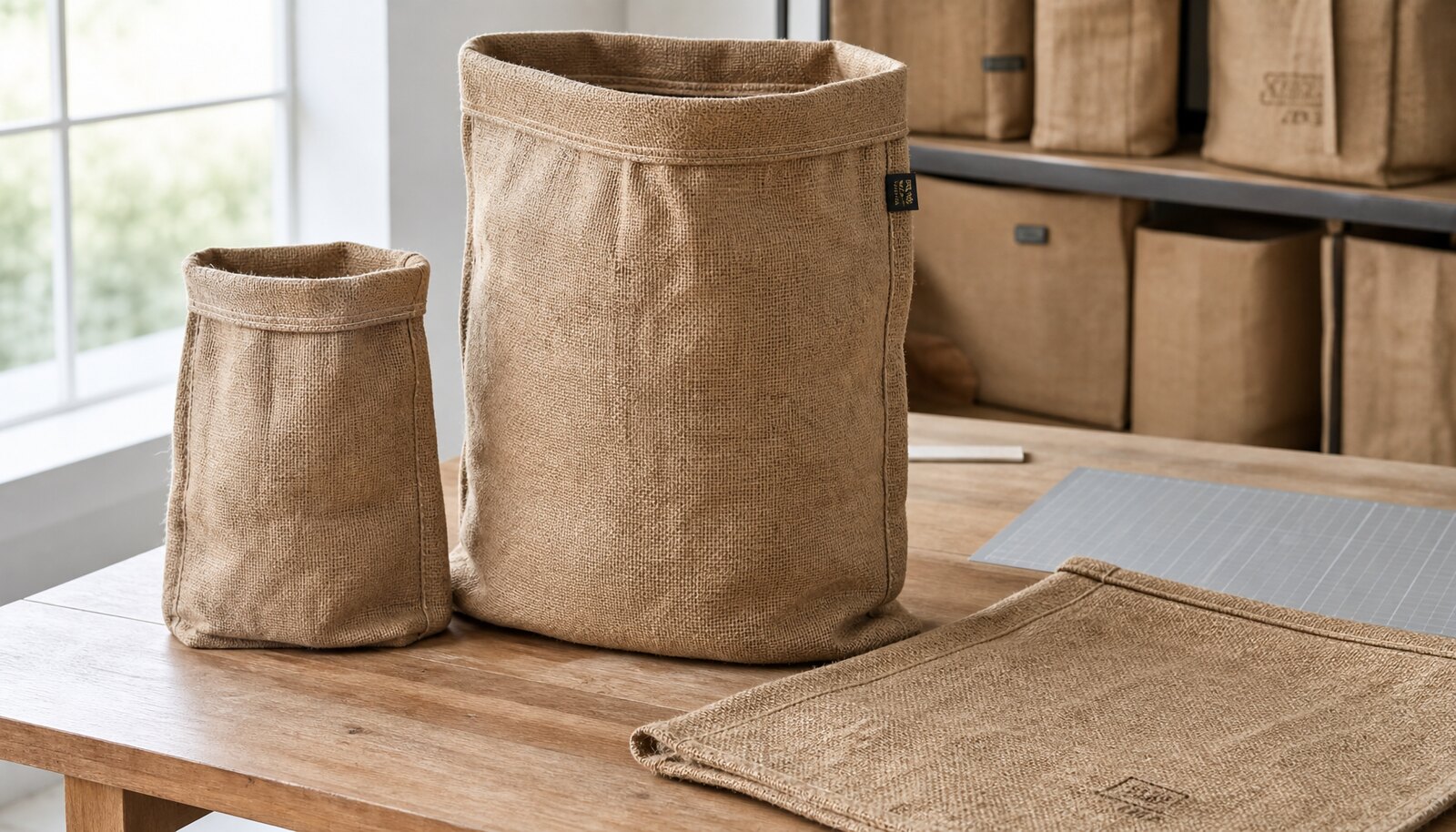
What Custom Burlap Sacks Really Are
Custom burlap sacks are usually made from woven jute, although some markets use burlap as a loose term for any rough natural-fiber sack. That distinction matters because the buyer is rarely paying for a name; the buyer is paying for the weave, fiber length, finishing, and how stable the bag is once it is cut and sewn. A clean quote should describe the fabric, size, closure, print, and packing format. If those points are vague, the supplier can still give a number, but it will not be a comparable number.
For procurement teams, the main buying problem is not whether the sack looks rustic. It is whether the sack survives the actual use case: retail display, gift packaging, produce, dry goods, sample kits, or event packs. Burlap behaves differently from cotton or canvas. It frays, sheds dust, and can vary more from batch to batch. That means the RFQ must remove guesswork early. If you do not define the finish and the acceptance target, you end up comparing quotes that are not built to the same product.
- Define the end use before you ask for a unit price.
- Treat burlap as a construction spec, not just a look.
- Lock size, GSM, closure, print, and pack format before sample approval.
Fabric Weight, Weave, and Construction
For custom burlap sacks, GSM is one of the fastest ways to shape cost and performance, but only if everyone uses the same definition. In practice, many buyer programs work in the 280-320 GSM range for standard retail sacks, then move up to 320-380 GSM when the bag must stand better, feel denser, or support heavier fill. If the sack is only for decorative packaging, you can sometimes stay lighter. If the sack will be handled often or filled with dense contents, light fabric usually becomes a QC problem later.
Construction matters as much as fabric weight. Single-layer sacks are cheaper and lighter, but they show print on rough fibers and may collapse when filled. Lined sacks cost more, but they improve hand feel, reduce fiber shed, and make printing cleaner. Bottom construction, seam allowance, top hem, and cord channel all affect durability. A supplier that only quotes fabric weight without construction details is giving you a partial answer. The buyer should ask how the sack is cut, how the seams are reinforced, and what tolerance is held on the finished size.
- Use a heavier GSM when the sack must carry weight or look structured.
- Use a lining when the customer will handle the bag directly or when print clarity matters.
- Ask whether the quoted GSM refers to greige fabric, washed fabric, or finished fabric.
Branding That Works on Rough Fiber
Burlap is not a friendly surface for every print method. A simple screen print is usually the most reliable option for custom burlap sacks because it gives solid coverage and tolerates the natural texture of jute. One or two colors are usually the practical limit if you want consistent results and a sane MOQ. Woven side labels also work well when the brand needs a cleaner finish than the main panel can offer. Embroidery can look premium on a denser sack, but it adds cost and is not always stable on loose weave.
Photo-real graphics, fine gradients, and tiny text are where many programs fail. The rough surface softens edges and can make the logo look dirty or broken if the art is too detailed. If the brand needs strong shelf impact, put the logo in a larger simple block and keep the copy short. Ask the factory to show the exact print area, the usable margin from seam edges, and whether the artwork must be adjusted for fabric stretch. A good sample should prove that the logo reads cleanly at arm's length, not just on a computer screen.
- Choose screen print for simple logos and controlled unit cost.
- Use woven or sewn labels when the brand needs cleaner identification on the edge or side seam.
- Do not approve tiny fonts or fine gradients unless the sample proves they survive the weave.
MOQ Logic and What Actually Drives Price
MOQ is not just a factory preference; it is a reflection of setup cost, raw material loss, and the number of process changes in the order. A plain one-size burlap sack with one print color is easier to run than a mixed pack with different closures, labels, or special packing. That is why the quote often steps up sharply when you add a second color, a custom cord, a liner, or a washed finish. The supplier is not only charging for more material. They are also charging for extra machine setup, slower line speed, and higher scrap risk.
If you want a usable quote, ask for the cost structure by line item. You need to see the base unit price, any sample fee, plate or screen fees, carton cost, label cost, and special packing cost. The most common buyer mistake is to compare a low unit price that excludes all the extras against a higher quote that is actually more complete. For repeat programs, a slightly higher unit price can still be the better total cost if it lowers rework, short counts, and art revision cycles.
- Expect MOQ to rise when you add extra print colors, liner work, or custom cords.
- Compare total landed production cost, not just the quoted unit price.
- Separate one-time setup costs from repeat-order unit costs.
Which Supplier Route Fits the Order
There are four practical sourcing routes for custom burlap sacks: direct factory, trading company, sourcing agent, and integrated converter. Direct factory usually gives the clearest cost base and the best control over construction, but it works best when the buyer can provide a tight spec and wait for production. Trading companies are easier when you need mixed products or small quantities, but the real factory may be hidden behind the quote. A sourcing agent can be valuable if you need multiple suppliers, coordinated packaging, or stronger inspection control across a broader program.
The evidence matters more than the label. Ask for current production photos, not generic catalog images. Ask for machine capability, sample room workflow, and the factory name behind the quote. If the supplier says they can do custom burlap sacks but cannot explain the stitch construction, print setup, or packaging line, they are probably brokering the order rather than controlling it. That is not always a problem, but it changes how you should review lead time, QC, and accountability.
- Direct factory fits repeat volume and tight cost control.
- Trader or agent routes fit mixed programs and faster coordination.
- Request real production evidence before you compare capacity claims.
Sampling and Approval Without Rework
Sampling is where most avoidable cost gets locked in. You want a pre-production sample made from the same fabric, the same print method, and the same closure or lining that will be used in bulk. A sales sample is useful for shape and size direction, but it is not enough to approve a production run. If the sample is not made from the actual bulk material, you still do not know how the sack will sew, print, or fold. That is especially important with burlap because the weave can change the way seams sit and how the logo lands.
The approval step should be practical, not ceremonial. Measure the sample, weigh it if needed, test the closure, and inspect print clarity under normal light. Write down what is acceptable and what is not. If the factory needs to move the logo, widen the seam allowance, or adjust the top hem, do it before the line starts cutting bulk. Rework on burlap is expensive because the fabric is not forgiving. Once a seam is off or the print is misaligned, the bag often cannot be recovered cleanly.
- Approve only a sample made from the actual bulk fabric and process.
- Measure size, closure function, and print placement before sign-off.
- Keep a signed reference sample tied to the PO and QC file.
QC Thresholds That Catch the Real Failures
The quality standard for burlap sacks should be written in buyer language, not factory language. Size tolerance, print position, seam strength, odor, and count accuracy are the basics. If the order is for retail, appearance defects matter more than they would on a plain industrial sack. If the order is for promotional or event use, pack consistency and logo clarity often matter more than absolute fabric perfection. If you use AQL, define it in the purchase order instead of assuming the supplier will apply your standard by default.
The most common failures are predictable. Poor stitching at the mouth or bottom, weak or fuzzy print edges, crooked labels, short cords, and cartons that arrive damp or overpacked. Burlap also picks up warehouse odors and moisture quickly, so carton condition matters more than buyers expect. A good inspection plan includes an in-line check on first output and a pre-shipment check on packed cartons. That catches process drift early instead of discovering it only after the container is on the water.
- Set tolerances for size, print position, and seam quality in the PO.
- Inspect the first output before bulk continues.
- Watch for moisture, odor, and loose thread problems during packing.
Packing, Cartons, and Import Handling
Packing looks secondary until the cargo arrives damaged or uncounted. Most custom burlap sacks should be flat-packed in bulk with clear bundle counts and carton labels. That keeps freight efficient and makes warehouse receiving easier. If the sacks are stuffed, nested too tightly, or compressed without control, the shape can deform and the print can crease. If there is any chance of moisture exposure, ask how the factory protects the goods before carton sealing. Burlap will absorb a bad storage environment faster than coated fabric would.
Carton spec should be part of the quote, not an afterthought. Ask for gross weight, net weight, carton dimensions, and units per carton. If the sacks are going to a retail distribution center, barcode or SKU labels may need to be on each carton and sometimes on each inner bundle. Palletizing can help on long-distance freight, but only if the supplier uses clean pallet wraps and does not crush the cartons. The goal is simple: the carton should arrive in a state that lets the buyer count, scan, and shelve without rework.
- Use flat-packed cartons unless the product design requires another format.
- Keep carton count, bundle count, and SKU labels aligned with the PO.
- Protect against moisture and odor during warehouse storage and export handling.
Lead Time and Landed Cost
A realistic lead time for custom burlap sacks usually includes artwork confirmation, sampling, bulk material preparation, production, packing, and export booking. For repeat programs, 25-35 days after sample approval is a common planning window, but that can stretch if the order needs special dyeing, washing, or peak-season booking. The buyer should not treat the first quoted date as final until the supplier confirms raw material availability and the sample sign-off date. Every day lost in approval usually pushes the container date later than expected.
Landed cost needs a fuller comparison than just FOB. Add sample and tooling costs, inland transport, carton upgrades, inspection, freight, duty, and any rework allowance. A lower factory price can become a higher landed cost if the supplier ships poor cartons or misses the pack count. In contrast, a slightly higher quote from a stronger factory can save money if it reduces inspection failures and short shipment risk. For burlap sacks, the most expensive problem is often not the fabric itself; it is re-cutting, re-printing, or re-packing a batch that should have been right the first time.
- Plan the schedule from sample approval, not from the day you send the inquiry.
- Compare FOB, packing, freight, duty, and inspection as one landed-cost view.
- Peak season and special finishes usually extend the timeline.
A Better RFQ for Comparable Quotes
A quote is only useful if every supplier is pricing the same product. The RFQ should start with the exact size, target GSM, closure style, print art, quantity split by size or color, and the packing requirement. Add one clear reference image or approved sample note if you have it. If you want a clean commercial comparison, ask suppliers to answer in a line-by-line format with unit price, setup cost, sample cost, carton cost, lead time, and exclusions. That forces the hidden costs into the open before the negotiation starts.
The RFQ should also say what matters most. If you care about appearance, say that print fidelity and stitch straightness are priority points. If you care about cost, say that the supplier may propose standard fabric or standard carton sizes to reduce expense. If you care about reorders, say that future runs must match the approved sample. That one sentence can save an enormous amount of back-and-forth later. For custom burlap sacks, a sharp RFQ is usually the difference between a quote you can use and a quote you have to decode.
- Attach size, GSM, artwork, packing, and destination market details.
- Demand line-by-line pricing with exclusions written out.
- State which factor matters most: cost, appearance, or reorder consistency.
Specification comparison for buyers
| Spec decision | Recommended option | When it fits | Buyer risk to check |
|---|---|---|---|
| Fabric weight / GSM | 280-320 GSM natural jute for most retail and promo sacks; 320-380 GSM if the bag must stand upright or carry heavier fill | Use for standard custom burlap sacks that need a balance of cost, body, and durability | Confirm whether GSM is quoted before or after finishing, because finishing loss can change the real hand feel and strength |
| Sack style | Open-top sacks with drawstring, tie cord, or stitched mouth depending on use | Use drawstring versions for gift, produce, or sample packs; use open-top versions for display or bulk fill | Check cord material, cord length, and whether the mouth can close evenly without puckering |
| Branding method | Single- or two-color screen print on the front panel, plus a woven side label for brand identity | Best for rough burlap surfaces where simple artwork and strong brand visibility matter | Ask for print registration tolerance and proof that the chosen ink holds on coarse fiber without flaking |
| Supplier route | Direct factory for repeat volume, trader for mixed baskets, sourcing agent for multi-vendor control | Use direct factory when you want price control and consistent specs; use trader or agent when the program is moving fast | Make sure the quote names the real factory or conversion site so capacity and QC responsibility are clear |
| MOQ structure | One size, one fabric, one print setup per production run | Fits first orders, retail tests, or seasonal programs with limited SKU risk | Ask how MOQ changes for extra print colors, custom cord colors, lining, or washed finishes |
| Sample type | Pre-production sample made with the same fabric, print method, and construction as bulk | Use when print placement, seam allowance, or closure function affects saleability | Do not approve a sales sample that uses different fabric or a different print process from bulk |
| Packing format | Flat-packed bulk with inner bundles, carton labels, and count marking | Best for import efficiency, warehouse receiving, and low carton volume | Check carton weight, bundle count, and whether sacks are nested, folded, or compressed |
| Quote basis | FOB unit price with separate lines for tooling, sampling, cartons, and any testing or labelling | Best when you need apples-to-apples supplier comparison | Watch for hidden add-ons such as plate fees, color matching fees, inspection charges, or export packing surcharges |
Buyer checklist before sampling
- Final sack size in centimeters with tolerance, including body height, width, gusset, and cord length if there is a closure
- Target fabric weight or GSM, plus whether you want natural, bleached, washed, lined, or reinforced burlap
- Artwork file, print colors, print size, and the exact panel or position where the logo must sit
- Target use case, such as retail gift, produce, dry goods, event kit, or promotional pack, because that changes build strength
- Packing spec, including bundle count, polybag use, carton count, carton mark format, and whether pallets are needed
- Target MOQ, annual volume, and expected reorder pattern so the supplier can quote realistic production economics
- Market compliance needs, such as odor control, azo-free ink, or any destination-specific labeling or testing requirement
- Sampling and approval rule, including who signs off, what counts as a defect, and whether a signed sample is held against bulk production
Factory quote questions to send
- What exact GSM do you use, and is it measured before or after any finishing process?
- What is the fabric composition and weave style, and can you show the same material you will use for bulk production?
- Which print method is included in the quote, and what are the setup or plate charges for each color?
- What MOQ applies per size, per color, and per print version, and how does that change if I add a label or liner?
- What sample type will you send first, and how long does sampling take before bulk approval?
- What are your standard carton dimensions, bundle count, and master carton weight for export packing?
- What tolerances do you hold for size, seam alignment, drawcord length, and print placement?
- What shipping terms, production lead time, and document set are included in the quote, and what is excluded?
Quality-control points to confirm
- Measure body size, mouth opening, and cord length against the approved sample and PO tolerance, not against the supplier's internal standard
- Check GSM or fabric weight consistency across the lot, especially if the order depends on stiffness or upright shape
- Inspect side seams, bottom seams, and cord channels for skipped stitches, broken thread, weak backtacks, or loose seam ends
- Confirm print position, color density, and edge sharpness; rough jute can blur weak ink or expose poor registration quickly
- Verify that closures work smoothly and that knots, toggles, or cord stops do not slip under light pull testing
- Reject odor, oil stains, foreign fibers, mildew, or wet cartons because burlap absorbs warehouse issues fast
- Count units per bundle and per carton, and make sure carton marks, SKU labels, and PO references match the packing list
- Use an in-line check on first output and a pre-shipment check on packed cartons so defects are found before full dispatch