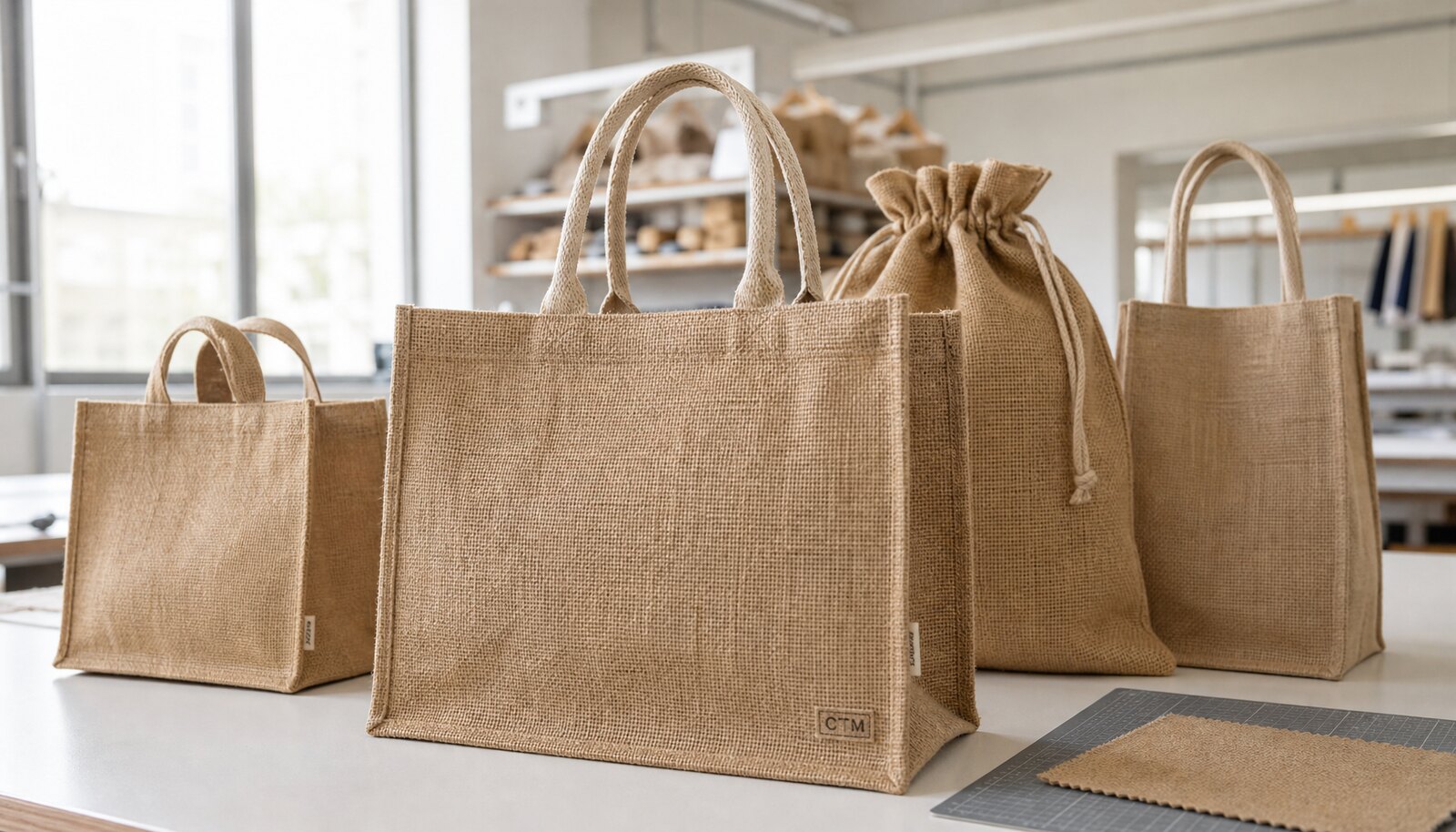
Why Burlap Bags Miss The Spec
Custom burlap gift bags look simple from the outside, but most quote problems come from the parts buyers do not see in a product photo. Burlap and jute are naturally textured, slightly irregular materials, so a bag can look acceptable in a sales sample and still behave differently once it is cut, sewn, printed, folded, and packed for export. That is why procurement teams need to treat the item as a construction buy, not as a generic decorative pouch.
When a buyer says "custom burlap gift bags," the supplier may be thinking of a stock pouch with a logo, a fully custom retail bag, or a simple promotional bag for seasonal use. Those are different buying scenarios. If the RFQ does not define size, lining, closure, and print method, the price conversation becomes meaningless because each supplier can quietly quote a different product.
- The lowest unit price is often attached to the most limited build, not the most useful one.
- Burlap can shed, smell, or look uneven if the fiber quality and finishing are not controlled.
- A good sample is not enough unless the sample matches the sewing line, print method, and pack-out that will be used in production.
Start With The Bag Use Case
The right spec depends on what the bag has to do. A favor bag for a wedding promotion, a retail pouch for a premium candle, and a carry bag for a bottle set all need different seam strength, opening width, and interior finish. Before asking for prices, define the contents, target presentation, and whether the bag is meant to be reused, displayed, or discarded after one event.
For procurement, the use case is more important than the decorative style. If the bag is mainly holding lightweight gifts, the design can stay simple and cost-efficient. If it is holding glass, food gifts, or cosmetics, then structure matters more than decoration. Buyers should write that requirement into the RFQ so suppliers do not optimize only for appearance.
- Describe the item that goes inside the bag, not just the bag itself.
- State whether the bag must stand upright on a shelf or only protect the contents in transit.
- Decide whether the bag is a promo pouch, a retail presentation item, or a protective carrier before you compare quotes.
Choose The Right Construction
The biggest price differences usually come from fabric weight, lining, and closure design. Many buyers start by asking for a general GSM number, but the more useful approach is to ask the supplier to quote at a target weight and explain what changes if you move lighter or heavier. In practice, buyers often compare bands such as 180 to 220 GSM, 220 to 280 GSM, and 280 to 320 GSM, but the real answer depends on weave density, finish, and how much body the bag needs to hold its shape.
Lining is the clearest example of a tradeoff. An unlined burlap bag is cheaper and gives a strong rustic look, but the interior can shed more and feel rough against the product. A lined bag costs more and adds sewing steps, but it is usually better for retail presentation, fragile contents, and repeat handling. Lamination is a different decision again: it can improve structure or moisture resistance, but it changes the feel and can make the bag less natural in appearance.
- Unlined: lowest cost, fastest build, but rougher inside and more prone to visible fiber release.
- Cotton or nonwoven lined: cleaner finish, better for retail and gifts, but higher labor and more sewing complexity.
- Laminated: useful when the bag needs extra structure or barrier performance, but it should be specified explicitly because it changes the hand feel.
- Heavier fabric: better shape retention and stronger print contrast, but it also increases cost and carton weight.
Print Method Should Match The Weave
Burlap is a difficult surface for fine decoration, so the artwork has to match the substrate. For most B2B programs, a one-color screen print is still the safest and most repeatable choice because it deposits enough ink to stay visible on the open weave. If the design is bold and simple, screen print is usually easier to control than a method that depends on very smooth fabric.
Transfers, digital decoration, embroidery, and sewn labels can all work, but each one has a different risk profile. Small text, thin lines, and gradients become unreliable on coarse burlap. If you need a premium look, you should test the decoration on the exact production fabric rather than assuming the artwork that works on paper or cotton will work the same way on jute.
- Screen print is usually the best default for bulk logo work on burlap.
- Heat transfer can work for short runs, but it should be tested for adhesion and surface compatibility.
- Embroidery creates a premium look, but it can pucker the weave and add cost quickly.
- A woven label or sewn patch is useful when the bag itself should stay natural and unprinted.
Size, Closure, And Pack-Out Drive Usability
Size is where many quotes become hard to compare. Two suppliers can both say "6 x 9 inch bag" and still be quoting different usable dimensions, different seam allowances, and different opening widths. Buyers should ask for finished size, cut size, and the actual internal space that remains after the seams and closure are built. That is especially important if the bag has to hold a flat insert, bottle, or boxed item without distorting the shape.
The closure should fit the use case rather than the supplier's default pattern. Drawstrings are the most common option, but ribbon ties, cord locks, and fold-over tops each affect labor, appearance, and packing speed. If the bag will be filled at a co-packing line or in a warehouse, the opening should be wide enough to pack efficiently. If it is going into a retail shelf display, the closure has to look neat even after repeated handling.
- Write the intended contents into the RFQ so the bag is sized to the actual item.
- Ask for a measured opening width, not just a nominal bag size.
- Specify how the bag should be folded, nested, or polybagged before carton packing.
- If contents are odor-sensitive or dusty, require clean pack-out materials and clear handling rules.
Use A Quote Structure You Can Compare
The supplier quote should be built in the same structure every time. A procurement team should not be comparing one supplier's all-in price against another supplier's base bag price plus hidden extras. Ask for a separate line for fabric, lining, print, trim, sampling, and pack-out. If the supplier cannot break down the price, it becomes difficult to know whether the difference is a real cost advantage or just a different quote style.
For custom burlap gift bags, the total landed cost is affected by more than the factory price. Carton size, gross weight, CBM, and any inner packing method can move the freight number materially. That is why a quote should always include the shipping-ready version of the bag, not just the naked unit price. A low piece price can disappear once the bag is folded into a bulky carton format.
- Ask for the same build in two versions if you want to compare freight impact, such as bulk packed versus individually polybagged.
- Require carton dimensions and estimated CBM before deciding between suppliers.
- Get the setup charge, sample fee, and re-order pricing in writing so the first order does not hide one-time costs.
- If the supplier offers multiple fabric options, quote them side by side instead of relying on a single suggested spec.
Compare Supplier Routes By Sourcing Scenario
There is no universal best supplier type for custom burlap gift bags. A direct factory is usually the best choice when you need control over size, sewing detail, repeatability, and packaging. A trading company can be useful when the program has multiple packaging items and one buyer wants a single point of contact, but only if the factory behind the product is clearly identified. A local decorator or reseller is practical for urgent small runs, though the unit cost is usually higher and the bag options are limited by the blanks they can source.
The right decision depends on how much control the buyer needs versus how much speed the program requires. If the bag is part of a retail line, the bag itself must be repeatable. If the bag is only for an event or a short test run, a stock bag with printed branding may be enough. Procurement teams should compare supplier routes based on the real sourcing scenario, not just on a quoted price sheet.
- Use a direct factory when repeatability, custom size, and construction control matter.
- Use a stock-and-print route when you need speed and can accept standard dimensions.
- Use a trading company only if they can name the actual manufacturer and inspection owner.
- Use a domestic decorator when timeline risk matters more than unit cost.
Sample Approval Is A Production Gate
The first sample is rarely the final answer. A hand sample can help with size and basic appearance, but the pre-production sample is the one that should match the real sewing line, print process, and pack-out. Burlap behaves differently once it is cut and stitched, so buyers should treat sample approval as a gate, not a courtesy. If the sample is not built from the final materials and trims, it is not a valid basis for mass production.
When reviewing a sample, test the actual use scenario. Put the intended gift, bottle, or retail item into the bag, close it, and check the presentation from a normal viewing distance. If the bag will be displayed in a store, check how it looks when standing, leaning, and stacked. If it will be shipped to consumers, check how it folds and whether the closure stays neat after handling.
- Approve a golden sample that includes final fabric, thread, closure, print, and pack-out.
- Verify print placement with a measured template rather than visual judgment alone.
- Check whether the bag wrinkles, collapses, or twists when filled with the intended contents.
- Keep the approved sample on file for reorders, inspections, and dispute resolution.
QC Needs To Catch Burlap-Specific Failures
Quality control on burlap bags should focus on the failures that are easy to miss in a quick inspection. Loose weave, weak seam transitions, dusty fibers, crooked prints, and poor closure finishing are common reasons a bag looks fine in photos but fails in use. The acceptance criteria should be written before production starts so the factory knows what will be rejected and the inspection team knows what to measure.
QC should also be stage-based. Inspect fabric before cutting, inspect sewn bags before print if the process is separate, then inspect finished bags after packing. If the order is large enough, use a clear inspection method that includes size checks, appearance checks, and pack-out checks. The point is not to build a lab-style test plan; the point is to stop preventable defects from leaving the factory.
- Reject fabric with visible contamination, off-odor, tears, or major density variation.
- Measure finished size and opening width against the approved sheet.
- Check seam strength at corners, gussets, handles, and drawstring tunnels.
- Verify print coverage, alignment, and rub resistance on the actual burlap texture.
- Inspect inner packaging, carton count, and shipping marks before carton sealing.
Lead Time, Freight, And Reorders
Lead time for custom burlap gift bags is usually driven by sample approval, material readiness, and print setup, not by the date the purchase order is sent. A simple stock bag with one-color print can move faster than a fully custom build with lining and branded trim. The more parts the bag has, the more it depends on coordinated supply of fabric, cord, labels, and packing materials. Procurement teams should ask the supplier what is on the critical path instead of accepting a single generic lead-time promise.
Freight deserves as much attention as the piece price because burlap bags are bulky relative to their weight. Carton dimensions, nesting method, and inner packaging can change the shipping cost materially. For reorders, the risk is often spec drift rather than production failure. If the supplier changes fabric lot, closure trim, or packing without approval, the second order can look different from the first even if the quote looks identical.
- Get lead time from sample approval, not from PO date.
- Request carton size, gross weight, and CBM before approving the order.
- Store the approved spec sheet, artwork, and golden sample together for the next buy.
- Ask the supplier to confirm what cannot change on a reorder without written approval.
Specification comparison for buyers
| Sourcing scenario | Best construction fit | Pricing tradeoff | QC watchout |
|---|---|---|---|
| Stock burlap bag with one-color overprint | Unlined or lightly lined, standard size, simple logo | Lowest setup burden and fastest turnaround, but limited size and decoration control | Confirm the actual stock bag dimensions, fabric feel, and print position because batches can vary |
| Direct factory for a custom program | Custom size, custom closure, lined or unlined, repeat order | Better unit economics once the spec is stable, but sample and setup work takes longer | Verify that the sample reflects the real production line, not a hand-finished one-off |
| Trading company managing a mixed packaging program | Multiple bag sizes, tags, inserts, and coordinated packaging | Convenient for one PO across several SKUs, but the markup can hide where value is added | Ask which factory sews the bag, who prints it, and who performs final packing |
| Domestic decorator or local reseller | Small replenishment, event-driven orders, urgent resupply | Higher unit cost, but lower import complexity and easier communication | Check whether they are printing on imported blanks and whether the blanks match your spec |
| Private-label converter | Retail-ready construction with labels, inserts, tissue, and outer packaging | Best when the bag has to feel like a finished branded item, not a promo pouch | Confirm every component source, because the bag, label, and pack-out can come from different vendors |
| Low-MOQ printer using imported blanks | Simple logo-only programs, test runs, pilot launches | Good for validating artwork cheaply, but the blank controls the final hand feel and quality | Inspect blank consistency across sizes and reorders before you treat the print quote as final |
| Factory with lining and trim capability | Premium gifts, glass, cosmetics, or heavier contents | Higher sewing cost, but the better structure can reduce damage and improve shelf presentation | Test seam strength, opening size, and fold behavior with the real item inside |
| Sourcing agent with inspection support | First-time imports, multi-factory comparison, or buyers without a local team | Useful for quote normalization and factory access, but fees should be explicit | Ask for inspection scope, sample chain, and named factory responsibility before awarding the order |
Buyer checklist before sampling
- Lock the finished bag size, acceptable tolerance, and the actual item the bag must hold before requesting pricing.
- Specify burlap or jute fabric type, target GSM, and whether the bag is unlined, lined, or laminated.
- State the closure type, cord or ribbon material, knot or stopper requirement, and minimum opening width.
- Define the decoration method, print area, color count, artwork placement, and whether a measured proof is required.
- Request quotes for the same bag with the same pack-out: folded or flat, inner polybag or no polybag, carton quantity, and shipping marks.
- Ask for separate pricing for sample, tooling, print setup, and re-order production so the first buy is not distorted by one-time charges.
- Require a pre-production sample that uses the final fabric, final thread, final closure, and final print method.
- Ask for carton dimensions, gross weight, and estimated CBM so freight can be compared across suppliers on the same basis.
- Set an acceptable defect definition before mass production starts, including size tolerance, print registration, seam quality, and odor or contamination limits.
- Keep a signed golden sample and construction sheet for reorders so the factory does not quietly change fabric lot, trim, or packing later.
Factory quote questions to send
- What is the exact fabric composition, weave type, and target GSM of the burlap or jute you are quoting?
- Is the bag lined, laminated, or unlined, and what is the lining material if one is used?
- What is the finished size, cut size, seam allowance, and tolerance you are quoting against?
- Which print method are you pricing, how many colors or passes are included, and what is the maximum print area?
- What setup, plate, screen, tooling, or embroidery charges apply, and at what quantity do they change?
- Can you quote the same bag with alternate pack-outs, such as flat-folded, bulk packed, or individually polybagged?
- What closure material is included, and what is the quoted cord or ribbon length per bag?
- What is the minimum order quantity by size, color, and print method, not just the total order quantity?
- What sample types are available before mass production, and which one matches the production line most closely?
- What inspection standard do you use for fabric defects, seam quality, print placement, and finished size?
Quality-control points to confirm
- Inspect incoming fabric for holes, loose weave, oil spots, off-odor, visible contamination, and uneven density before cutting starts.
- Measure finished size against the approved spec and reject bags that fall outside the agreed tolerance window.
- Check symmetry, seam allowance consistency, and stitch integrity at side seams, gussets, bottom corners, and drawstring tunnels.
- Verify print placement, registration, opacity, and rub resistance on the rough burlap surface, where defects are easier to miss and harder to fix.
- Confirm cord or ribbon length, end finishing, knot security, and smooth draw without snagging in the tunnel.
- If the bag is lined, check that the lining does not twist, bunch, or expose raw edges at the opening.
- Review carton pack count, inner pack method, shipping marks, and any barcode or label placement before sealing cartons.
- Pull a random sample for load and handling checks using the real intended contents, not an arbitrary generic weight.
- Inspect odor, dust release, and fiber shedding if the bag will hold food gifts, cosmetics, or premium merchandise.
- Keep one approved golden sample from the first run and compare later lots against it before accepting reorders.