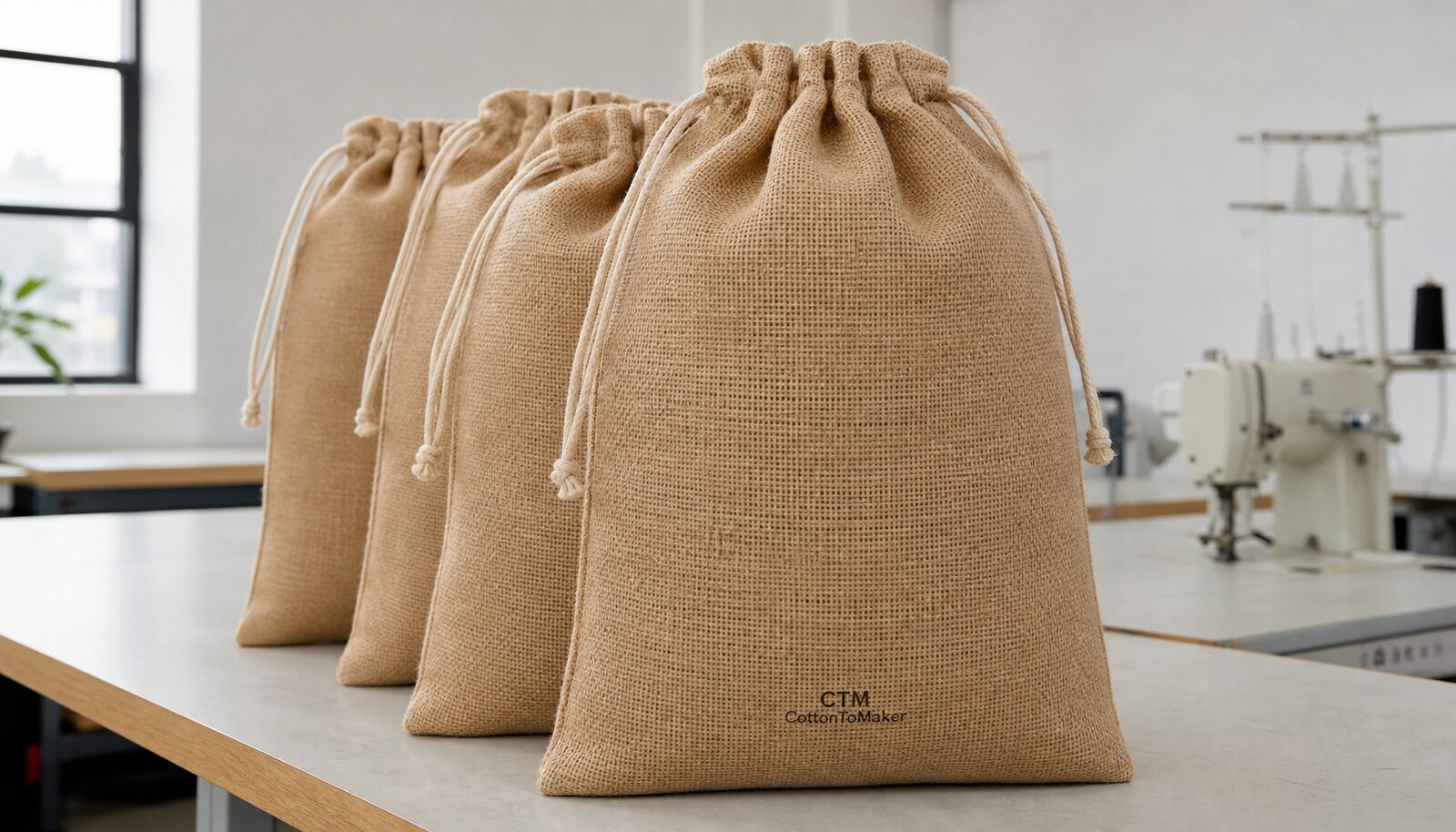
What custom burlap drawstring bags are actually buying for you
Custom burlap drawstring bags are a packaging format, not a single fixed product. Buyers use them for gift packaging, retail presentation, promotional kits, wedding favors, and light protective packing, but each use case asks the bag to do something different. A favor bag only needs to look clean and close reliably. A retail bag needs to survive handling on shelves and in fulfillment. A kit bag needs to hold mixed shapes without tearing or shedding fibers onto the contents. That is why the first sourcing mistake is treating burlap like a generic pouch fabric.
For procurement, the right starting point is the contents and the channel, not the logo artwork. If the item inside is sharp, delicate, dusty, or premium-priced, the bag may need lining or an inner wrap. If the bag is part of a resale program, the visual standard rises quickly: edges must be straight, branding must sit consistently, and the bag needs enough structure to present well when filled. The right spec is the one that fits the product, the channel, and the margin, not the cheapest one that can be sewn.
- Best for seasonal retail, gift sets, promotional kits, and rustic presentation
- Not a default choice for sharp-edged or dust-sensitive products unless the interior is protected
- The bag spec should be driven by the contents, not by the logo artwork alone
Start with dimensions, contents, and the way the bag has to close
A useful quote starts with usable capacity. Flat width and height alone do not tell the factory what the bag must hold. A 10 x 15 cm pouch for small favors and a 25 x 35 cm retail bag may both look simple on paper, but they behave very differently in sewing, packing, and final presentation. The buyer should state the actual contents or at least a representative load, because the factory needs to understand whether the bag must stand upright, fold flat, or draw shut around a bulky item.
Closure detail matters just as much. A stitched tunnel with a simple cord is acceptable on low-cost runs, but repeat-open retail use usually benefits from a reinforced top hem and better cord retention. If the product is going through warehouse picking or customer handling, the mouth needs to close evenly and stay closed without fighting the user. A bag that closes badly feels cheap even if the print looks good. That is why the spec should include the closure style, cord length, cord exit point, and whether the top channel must be reinforced.
- Define the bag by what it must hold and how full it will be when closed
- Specify whether the bag needs to stand upright, collapse flat, or stay soft and flexible
- Call out closure structure and cord retention in the RFQ, not only in sample review
Fabric choices: burlap, jute blend, and the GSM range that changes the quote
For custom burlap drawstring bags, the fabric number matters more than the marketing description. In buyer terms, a practical range is often around 240 to 280 GSM for standard bags that need to look presentable and survive handling. Below that range, the cloth can feel weak, and the weave can open too much once the bag is filled or printed. Above that range, the bag gains body but also gets stiffer, heavier, and more expensive to sew. That extra stiffness is not always a benefit for gift packaging, where buyers often want a natural, softer appearance.
The other issue is terminology. Some factories use "burlap" to describe multiple rustic-looking fabrics, including jute blend options or treated weaves that behave differently. Procurement should not accept the term by itself as a spec. Ask for the actual material description, the GSM range, and a sample that shows the hand feel after folding, printing, and filling. If the bag will sit on a shelf, you also need to know whether the cloth helps the bag stand or whether it collapses unless the contents prop it open. That difference affects both customer perception and shipping efficiency.
- 240 to 260 GSM is usually the lower-cost zone for light presentation and short-use packs
- 260 to 280 GSM is the practical middle ground for retail resale and repeated handling
- Heavier fabric can improve body, but it can also raise cost and slow sewing
Branding on burlap is a print problem before it is a design problem
Burlap is a coarse surface, so the branding method has to work with the weave rather than fight it. For most buyers, one-color screen print is still the most dependable option because it is stable, understandable to factories, and usually the cleanest balance of cost and repeatability. The limitation is that the logo needs to be simple enough to survive the texture. Fine lines, tiny text, and gradients often look better in a file than on the bag. On rough cloth, they can fill in, break, or shift slightly out of registration.
If the artwork is more detailed, a woven label, sewn patch, or hang tag often gives a more controlled result than trying to force every element onto the fabric. Heat transfer can work for some short-run projects, but buyers should treat it as a special-case process, not the default. The practical rule is simple: if the logo is not legible at a glance on the approved sample, the artwork is too busy for the fabric. The RFQ should state logo width, color count, placement tolerance, and the minimum line weight the supplier must hold.
- Use screen print for simple logos and repeat programs
- Use sewn or woven branding when the design must stay crisp on a coarse weave
- Avoid tiny text and thin lines unless they have already been approved on the exact material
Commercial comparison: which supplier route gives the best value
The sourcing route changes the economics of custom burlap drawstring bags as much as the spec does. A direct factory, a trading company, and a local decorator do not price or control the product the same way. A direct factory is usually the best option when the bag will be reordered and QC consistency matters. A trading company can help when the buyer wants to combine multiple product lines in one shipment or needs language support across several factories. A local decorator can be the fastest route for small urgent runs, but usually gives up control over fabric source and seam consistency.
The comparison table is not just a channel comparison; it is a commercial comparison. The cheaper route is not always the better one if it introduces hidden rework, longer sample cycles, or weaker claim handling. Buyers should compare the same size, same fabric, same print method, same packing, and same QC scope before deciding. If one quote looks far lower, the first question is whether the supplier is omitting lining, print setup, or carton labeling rather than offering a genuine cost advantage.
- Direct factory usually wins on repeatability and total control
- Trading company can help with consolidation but may hide the actual producer
- Small local runs can be fast, but they often carry a premium and less process control
MOQ, setup cost, and why the first order should stay simple
MOQ is not only a policy number; it is a reflection of how many variables the supplier has to manage. Each size, color, print screen, label version, and packing format adds setup work and waste. That is why a small order with several variants often costs more per unit than a larger order with a simpler spec. Procurement teams sometimes interpret a low MOQ as flexibility, but on this product it is often just a signal that the supplier expects to recover cost through higher unit pricing or narrower spec allowances.
The first order should usually be as plain as the business will allow: one size, one print location, one color, one cord style, and standard bulk packing. If the goal is to test demand, this is the safest way to learn without paying for unnecessary complexity. Compare quotes on the full landed picture, not just the unit price. A slightly higher unit price from a factory that includes sampling, screen storage, and cleaner packing can be better value than a cheap quote that forces you to pay again on the next reorder.
- Single-size, single-artwork orders usually produce the best entry economics
- Each added size or color raises setup cost and inspection burden
- Ask whether tooling, screens, or artwork files are retained for repeat production
How to read a quote without missing the real cost drivers
A useful quote for custom burlap drawstring bags should show enough detail to make the differences obvious. At minimum, the factory should identify material, size, print method, cord type, packing method, and any setup charges. If the quote is just a single number, you do not know whether the supplier is pricing a real production spec or a stripped-down version that will not match the sample. That is where procurement gets burned: the sample looks acceptable, but the mass order arrives with thinner cloth, simpler cord, or lighter packing than expected.
For this product, the main cost drivers are easy to see once they are broken out. Heavier cloth raises material cost and freight weight. Lining adds pieces and sewing time. Screen print is usually cheaper than detailed transfer work, but only if the art is simple enough to survive the weave. Unit price also depends on how much labor the packing requires. A bulk-packed bag with a simple carton label is a very different job from a unit-packed, barcode-ready retail item. Compare quotes only after every supplier has been asked to use the same reference spec.
- Check whether print setup, labels, and packing labor are included or charged separately
- Confirm if sample costs are refundable or credited against the bulk order
- Verify that the quoted spec matches the actual sample, not just the product description
Sample approval: what should be checked before bulk cutting starts
A sample should be treated like a production gate, not a design exercise. The bag has to be judged on how it behaves when filled, closed, and handled. Inspect the logo position, stitch straightness, tunnel symmetry, cord movement, and how the bag sits when the contents are inside. Burlap can hide small defects in a flat photo, so the real check is whether the structure still looks deliberate once the bag is in use. If the sample sheds excessively, smells strong, or binds at the top, that problem usually gets worse, not better, in bulk production.
The best practice is to approve a sample against a written sheet and the actual contents. Use the real product kit or the real gift item, not a guessed fill. If the artwork is close to a seam, check that exact geometry. If the bag needs a particular folded look on shelf, photograph the approved sample from the required angles and keep that reference with the PO. This avoids the classic dispute where the factory says the bulk was made to the approved sample, but the buyer never locked the sample in writing.
- Approve the sample with the real product load inside the bag
- Check the top channel, cord movement, and logo placement under handling
- Keep the approved sample, artwork file, and spec sheet tied to the purchase order
Packing, moisture control, and warehouse receiving problems
Burlap and jute materials are sensitive to storage conditions. If the bags are packed wet, stored in damp cartons, or sealed without enough dry time, they can arrive with odor or visible discoloration even when the sewing is acceptable. That is why packing should be part of the quote and the spec. Bulk pack is usually the lowest-cost option, but it only works if the receiving team is ready to count and sort. Inner poly-bag grouping gives better order control and protects the fabric from warehouse dust, but it adds labor and changes the carton fill pattern.
Warehouse compatibility matters more than many buyers expect. Mixed-size cartons, unlabeled inner packs, or missing PO references slow down receiving and create avoidable disputes. If the bags are going into a barcode-controlled warehouse, the label format should be confirmed before production starts. If they will be stored for a while before use, ask the factory how they prevent moisture pickup and whether they condition the cartons before sealing. Good packing is not cosmetic; it protects the bags from losing value before they even reach the line.
- Require dry packing conditions and clean master cartons
- Confirm whether bags are bulk packed, inner-bag grouped, or unit packed
- Align carton labels with warehouse receiving and barcode rules before shipment
QC thresholds that a buyer can actually enforce
For custom burlap drawstring bags, QC should focus on a few failure points that affect resale value and function. Dimensional accuracy is the first one: if the bag is too small, the product will not fit; if it is too large, the presentation looks loose and unfinished. The second is construction. Side seams need to be even, the top channel must not twist, and the cord should close the mouth without snagging. The third is appearance after filling, because some bags look acceptable empty but distort badly once the contents are inside. Buyers should set thresholds that are easy for the factory to understand and the inspector to measure.
A practical inspection approach is to define which issues are critical, major, and minor. A critical defect is one that makes the bag unusable, such as a torn seam, missing cord, severe odor, or damp carton. A major defect is one that makes it unsellable or unsuitable for brand presentation, such as obvious print misalignment, a loose tunnel, or a size miss beyond tolerance. Minor defects are the cosmetic issues that do not affect use, such as small thread ends. If you want the supplier to take QC seriously, put those categories in the PO or the quality spec and require an in-line check before the lot is packed.
- Measure size against the approved tolerance, not against a rough visual impression
- Run a drawstring pull test on sample pieces before carton sealing
- Reject bags with weak tunnel stitching, severe fray, odor, or obvious print shift
Specification comparison for buyers
| Spec decision | Typical ex-works cost band | Best fit | Supplier example | Tradeoff / what to verify |
|---|---|---|---|---|
| 10 x 15 cm, unlined, 240-260 GSM, 1-color screen print, bulk pack | $0.18-$0.32 at 3,000-5,000 pcs | Small favors, gift inserts, light promotional packs | Direct factory with in-house cutting and printing | Lowest-cost route, but verify actual GSM, seam allowance, and whether the bag still closes cleanly when filled. |
| 12 x 18 cm, unlined, 260-280 GSM, reinforced top hem, 1-color screen print | $0.26-$0.45 at 3,000 pcs | Retail presentation, event kits, mid-size gift packs | Factory with stable sewing line and sample room | This is often the practical middle ground. Confirm hem width, cord diameter, and logo placement tolerance. |
| 15 x 20 cm, lined, 260-280 GSM outer fabric, 1-color print, bulk pack | $0.40-$0.68 at 3,000 pcs | Cosmetics, food gifts, fragile contents | Factory that can sew lining cleanly and control lint | Lining raises labor and scrap. Verify whether the liner is fully enclosed and how much the size changes after lining is added. |
| 20 x 30 cm, 280-300 GSM, 2-color print, unit pack | $0.62-$1.05 at 3,000 pcs | Premium retail, larger kits, resale programs | Factory or trading company with print supervision | Higher cloth weight and second-color setup drive cost. Ask for exact setup charges and print registration tolerance. |
| Any size, woven label or sewn patch branding instead of direct print | $0.48-$1.20 depending on label type and sewing complexity | Brands that need sharper logo edges on coarse burlap | Cut-and-sew factory with label attachment control | Often better visually than tiny print, but verify label placement, stitch count, and whether the label frays. |
| Any size, individual polybag, barcode label, carton marks | Add $0.03-$0.12 per bag depending on packing complexity | Warehouse-controlled retail distribution | Factory with packing discipline and carton labeling | Packing is a real cost driver. Confirm unit pack count, moisture protection, and carton dimensions before approving the quote. |
| Low MOQ trial run, simple spec, no lining, one print color | $0.30-$0.75 at 500-1,000 pcs, often with higher setup sensitivity | Pilot launch, buyer testing, small seasonal programs | Local decorator or trading company aggregating small lots | The per-unit price is usually less efficient. Check whether screens, sample costs, and packing are charged separately. |
| Sample and setup charges, one color | Sample $15-$50; screen/setup $25-$80 per color is a common quote pattern | New artwork, first-order approval | Factory or decorator with in-house printing | Confirm whether sample charges are credited on bulk PO and whether revised artwork triggers a second setup fee. |
| Air-shipped urgent order | Landed cost can run 1.5x-3x ex-works on small runs | Rush replacement, event deadlines, small volumes | Local supplier or expedited factory shipment | Useful for urgency, but the shipping premium can erase unit-price savings. Ask for landed-cost comparison, not just ex-works pricing. |
Buyer checklist before sampling
- Define the bag by usable interior capacity, not only by flat width and height.
- State the exact fabric type, GSM range, and whether the bag should feel soft, rustic, or structured.
- Confirm whether the contents require lining, an insert, or an inner wrap to prevent snagging and dust transfer.
- Specify logo size, print location, number of colors, and the minimum acceptable line thickness.
- Lock the drawstring material, cord diameter, cord length, and whether the cord ends must be knotted or heat-sealed.
- Ask the factory for a physical sample on the intended production fabric before bulk cutting starts.
- Compare quotes on the same basis: size, fabric, print method, cord, packing, and QC scope.
- Align packing format, carton count, labels, and barcode needs with warehouse receiving rules before the PO is issued.
- Build schedule buffer for sample comments, artwork correction, and pre-production signoff.
- Reserve a rejection path for odor, moisture, print misplacement, weak top-hem construction, or loose seams.
Factory quote questions to send
- What exact fabric are you quoting, and what is the GSM range or weave specification?
- Is the bag made from true burlap, jute blend, or a similar rustic-texture fabric?
- What is included in the price: printing, screen setup, labels, cord, lining, packing, and carton marks?
- What is the MOQ per size, per artwork version, and per color, and how does unit price change at 500, 1,000, and 3,000 pieces?
- Are you making the bags in-house or subcontracting sewing, printing, or packing?
- Can you provide a pre-production sample photo or video on the actual production material before mass cutting?
- What QC checks do you run for seam strength, print placement, cord pull, odor, and moisture before carton sealing?
- What is the lead time after sample approval, and what conditions would extend it?
- How are the bags packed, how many per carton, and are cartons marked by size and PO reference?
- If there is a repeat order, do you keep screens, labels, or pattern files for consistent reorders?
Quality-control points to confirm
- Fabric weight must fall within the approved GSM range; reject fabric that feels overly loose, brittle, or paper-thin compared with the signed sample.
- Cut size tolerance should be set in the spec and checked on a random sample from each lot; a practical buyer standard is +/- 0.5 cm for bags under 20 cm and +/- 1.0 cm for larger formats.
- Top hem or tunnel stitching must be straight and secure, with no visible skipped stitches, broken thread, or twisted channel.
- Print placement should stay within 3 mm on small logos and 5 mm on larger placements; reject major blur, cracking, ghosting, or color inconsistency across the lot.
- Cord pull should work smoothly for at least 5 open-close cycles on a sample bag without slipping, snagging, or pulling out of the tunnel.
- Seam allowance should be consistent on both side seams; a practical target is 8-10 mm with no open seams, edge fray, or loose corner stitching.
- Odor and moisture should be acceptable at packing; reject cartons that smell moldy, oily, or strongly chemical, or that show visible dampness.
- Carton count, size labels, and buyer reference numbers must match the packing list exactly; count mismatch is a receiving hold issue.
- For commercial programs, a reasonable acceptance plan is 0 critical defects and a defined cap on major defects, with the exact AQL written into the PO or quality agreement.