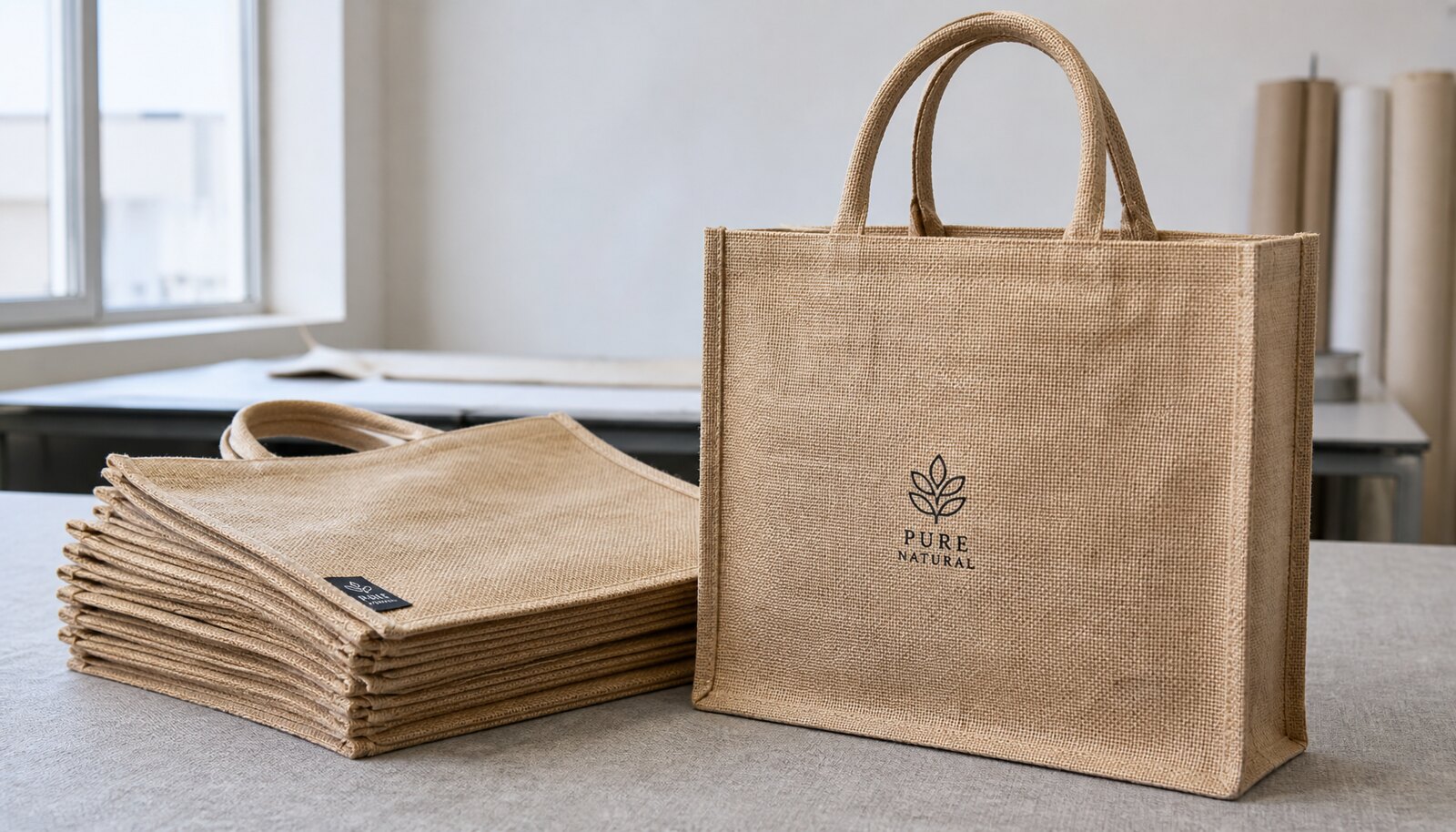
Why custom burlap bags wholesale need a tighter spec than they look
Custom burlap bags wholesale is a simple search term, but the buying job is not simple. Burlap, usually sold as jute in export sourcing, is a rough natural fiber with more variation than cotton canvas or polypropylene. That means two bags that look similar in a photo can behave very differently in sewing, printing, load bearing, and carton packing.
If you are buying for retail resale, gift programs, or branded packaging, the main risk is not price alone. The risk is approving a bag that looks acceptable in a sample photo but fails on print quality, handle strength, or moisture-sensitive packaging once bulk production starts.
- Decide early whether the bag is decorative, reusable, or load-bearing.
- Use the term jute or burlap consistently in the RFQ so the factory quotes the right fabric.
- Treat weave quality and stitching as cost drivers, not just cosmetic details.
Choose the right jute weight before you compare suppliers
For wholesale bags, the first hard decision is fabric weight. A common workable range is 12 oz to 14 oz jute for retail carry bags and gift bags that need to hold shape. At 10 oz, the bag may be fine for lightweight giveaways, but it can look less substantial and may show more distortion at the seams and corners.
Ask for the fabric in either oz or GSM, but do not accept a vague answer like “good quality jute.” For comparison, a factory should quote the same unit across suppliers, include whether the bag is single-layer or lined, and state if the jute is natural, bleached, or dyed. That removes a lot of quote confusion later.
- 10 oz: low-cost, light-duty promotional use.
- 12 oz: balanced option for most retail and gift applications.
- 14 oz+: better structure, better print presentation, higher sewing cost.
Print method changes cost, clarity, and production risk
Most custom burlap bags wholesale programs work best with one-color or two-color screen printing. Burlap’s texture is uneven, so screen print is usually the most economical route for bold logos, simple text, and large marks. If your artwork has thin lines, shading, or many colors, the quote will rise quickly because the factory either needs more setup or a different print process.
Heat transfer can work for short runs or detailed artwork, but it is not the best default for rough jute. The ink film sits on top of the texture and can crack or peel under repeated handling. Embroidery and woven labels are possible, but they usually belong in premium positioning rather than low-cost wholesale. In RFQs, specify the visible print area, ink color, and whether the logo can sit slightly off the seam line to avoid distortion.
- Screen print: best for simple logos and repeat wholesale orders.
- Heat transfer: useful for low-volume or complex artwork, but less durable on rough jute.
- Embroidery / woven label: premium look, slower production, higher unit cost.
MOQ logic: why the cheapest quote is often not the real deal
The real MOQ is not just the minimum factory is willing to run. It is the point where fabric cutting, screen setup, print preparation, and packing efficiency stop making the order uneconomic. A quote for 300 pieces may look attractive, but the supplier may have padded the price, used simpler stitching, or excluded setup items that come back as extras later.
A practical wholesale range for standard custom burlap bags is often 500 to 1,000 pieces per design and color. If you need custom size, dyed fabric, lining, or more than one print color, the MOQ usually rises. The right comparison is not “who can do the smallest order,” but “who can meet the approved spec at a clean cost curve as quantity increases.”
- Compare 500 / 1,000 / 3,000 piece tiers, not only the first quote line.
- Separate setup charges from unit price so you can see the true repeat-order cost.
- Be careful with low MOQ offers that quietly reduce fabric weight or packaging quality.
Compare factory, trading company, and mixed sourcing routes
Not every buyer should use the same sourcing route. A direct factory is usually the best fit for repeat wholesale programs because it gives you better control over fabric, stitching, and print approval. A trading company can be useful when you need multiple product types, mixed sizes, or a small test run while you are still refining the spec.
For procurement teams, the key question is evidence. A real factory quote should identify the fabric source, print process, lead time by stage, and packing method. If a supplier cannot explain how the bag is made, they may still be able to source it, but you will have less leverage when something shifts in production.
- Direct factory: better for repeat SKUs, stronger cost control, clearer QC ownership.
- Trading company: useful for mixed sourcing, but verify actual production site and material origin.
- Mixed route: good for program testing, but keep the spec sheet strict to avoid drift.
How to read a quote without missing hidden production costs
A clean quote for custom burlap bags wholesale should show the fabric spec, print method, handle type, MOQ, unit price by quantity tier, sample cost, packing style, and lead time. If any of these are missing, the quote is not truly comparable. The most common gap is the print setup charge, which may be hidden in the unit price on one supplier’s offer and listed separately on another.
You should also compare the unit price against the packing and freight profile. Burlap is bulky, so carton count affects ocean freight efficiency. A supplier quoting a low factory price but poor carton optimization can produce a higher landed cost than a slightly more expensive competitor. That is why landed cost, not ex-works price, is the right decision metric.
- Ask for unit price at multiple quantity tiers.
- Separate sample cost, setup cost, and packaging cost.
- Check carton quantity and packed CBM before approving the order.
Use a sample approval process that catches bulk problems early
Do not approve based on a photo alone. For burlap bags, the approved sample should include actual fabric, actual print, and actual stitching because all three affect the final result. If possible, ask for a pre-production sample that is built from the same material lot or a matching lot so you can see how the weave, color, and print behave together.
A useful sample review should measure size, strap length, top hem width, and base depth if there is a gusset. It should also inspect the cut edges, thread trimming, print alignment, and whether the bag sits flat or twists. If the sample is for brand approval, keep one signed-off sample sealed for reference and have the factory keep one as the bulk benchmark.
- Measure every critical dimension on the physical sample.
- Test one sample by loading it with the intended product weight.
- Keep a sealed approved sample for bulk reference.
QC thresholds that matter for rough jute bags
Burlap is more forgiving than some synthetics, but the rough material can hide quality drift. The usual defects are uneven sewing, loose fibers, misaligned print, weak handle attachment, stains, and odor from poor storage. You need a clear acceptance standard before bulk starts, especially if the bags are going into retail or premium packaging.
A practical QC plan includes random carton checks, seam pull tests, measurement checks, and a visual defect limit. For example, you can require consistent print position, no visible oil stains, no broken threads at the handle base, and no carton damage or moisture risk on export packing. For high-value programs, add a simple load test on the assembled bag rather than relying on appearance alone.
- Check stitching at handles, gusset corners, and top hem.
- Reject bags with active stains, strong odor, or print bleed.
- Set a defect threshold and a rework rule before shipment.
Packing and lead time: where wholesale orders usually slip
Burlap bags are bulky, so packing matters almost as much as stitching. Most wholesale orders should be bulk packed in export cartons with clear outer labeling. Individual polybags only make sense if the bag is going straight into retail shelves or ecommerce fulfillment. Otherwise, polybags add cost, labor, and waste without improving the bag itself.
Lead time usually includes material sourcing, cutting, printing, stitching, finishing, QC, and packing. A typical standard run may take 25 to 35 days after sample approval, but dyed fabric, lining, or peak-season scheduling can push that longer. If you are planning a promotion date, leave buffer time for sample revision and freight booking, not just production.
- Confirm carton count and carton marking before production starts.
- Agree on whether moisture protection is needed for sea freight.
- Build time for sample approval into the overall launch calendar.
A simple landed-cost view for buyer comparison
When you compare supplier quotes, use a landed-cost model rather than staring at the ex-works price. Add sample cost, setup cost, carton cost, inland transport, export documentation, and freight. For bulky bags like burlap, freight can change the ranking between suppliers even when the factory price looks close.
This matters most when you are choosing between a low-MOQ supplier and a larger factory run. The low-MOQ offer may look easier to approve, but if the carton efficiency is poor or the print setup is underquoted, the real cost per sellable unit can end up higher. Procurement teams should compare the cost per delivered, approved bag, not the cost per quoted bag.
- Use the same landed-cost template for every supplier.
- Include freight based on packed carton volume, not just weight.
- Compare cost per approved unit after QC reject allowance.
Specification comparison for buyers
| Spec decision | Recommended option | When it fits | Buyer risk to check |
|---|---|---|---|
| Jute fabric weight | 12 oz to 14 oz natural jute for retail carry bags; 10 oz only for light gift use | You want a bag that holds shape, prints cleanly, and survives store handling | Too-light fabric can wrinkle, show weave variation, and create weak seam margins |
| Lamination / inner lining | Unlined for dry, simple packaging; laminated PP or cotton lining only if product dust or moisture matters | Food gifts, pantry sets, or premium presentation packs | Lamination changes hand feel, sewing time, and recycled-content claims |
| Print method | 1-2 color screen print for bold logos; heat transfer only for short runs or photo-style art | Most wholesale programs with clear logos and repeat orders | Fine details can fill in on rough jute; heat transfer may crack if overhandled |
| Handle construction | Reinforced self-fabric handles or cotton webbing handles stitched through the top fold | When the bag carries 2-5 kg of light retail goods or gifts | Short bar-tacks and thin handle tape are common failure points |
| MOQ route | 500-1,000 pcs per color/design for standard wholesale runs; higher MOQ for custom weave or special dye | You need factory pricing without overcommitting inventory | Low-MOQ quotes may hide setup charges, oversized packaging, or weak QC |
| Supplier type | Direct factory for repeat volume; trading company only if you need mixed factory sourcing or very small test runs | You already have a spec and want better control over cost and quality | Trading quotes can obscure fabric source, print method, and actual lead time |
| Packing style | Bulk packed in export cartons with clear quantity labels; individual polybags only if retail presentation requires it | Wholesale distribution, warehouse replenishment, or ecommerce fulfillment | Overpacking raises carton cost and freight; underpacking risks scuffing and moisture pickup |
| Sample approval | Pre-production sample with approved fabric swatch, print strike-off, and measurement sheet | Any first order or any change in fabric, print, or handle | Approving only a photo sample hides color drift, rough seams, and print registration issues |
| Lead time planning | 25-35 days after sample approval for standard orders; longer for dyed jute, custom lining, or busy seasons | You have a normal replenishment schedule with planned inbound freight | Rush orders often cut drying time, QC time, and packing accuracy |
Buyer checklist before sampling
- Define the end use: retail giveaway, grocery carry, gift packaging, or branded resale, because the bag size and fabric weight change with the use case.
- Lock the fabric spec in writing: jute GSM/oz, weave density, and whether the bag is natural, bleached, dyed, or laminated.
- Set the print standard: number of colors, print area, Pantone target if needed, and whether print should stay away from seams and folds.
- Confirm construction details: handle width, handle length, seam allowance, top hem, bar-tacks, base gusset, and lining requirements.
- Request a pre-production sample, not just a digital proof, before production starts.
- Agree on packing count, carton size, carton marking, and whether inner polybags or moisture bags are required.
- Get a written QC standard for measurements, print alignment, stitching, odor, needle damage, stains, and carton drop tolerance.
- Compare landed cost, not just ex-works unit price: cartons, inland haulage, export docs, and ocean/air freight can change the real margin.
Factory quote questions to send
- What is the exact jute fabric weight, weave count, and whether the material is natural, bleached, or dyed?
- Is the price based on screen print, heat transfer, embroidery, or woven label, and what setup charge applies per color?
- What is the MOQ by size, color, and print design, and how does price change at 500, 1,000, and 5,000 pieces?
- What handle construction and stitching method are included in the quoted price?
- Will you provide a pre-production sample with actual fabric and print before bulk production?
- What is the standard lead time after sample approval, and what steps can delay it?
- How are the bags packed per carton, what is the carton spec, and are moisture bags or polybags included?
- What QC standard do you use for print misalignment, seam strength, measurement tolerance, and acceptable defects per carton?
Quality-control points to confirm
- Fabric weight should match the agreed spec within a reasonable factory tolerance; ask for a cut-size weigh check on the approved sample and one from bulk.
- Jute weave should be even enough that the bag body stands without major distortion; excessive loose weave can affect print clarity.
- Print registration should stay within a defined tolerance, especially on multi-color logos and centered placements.
- Stitching should be straight, with no skipped stitches, broken threads, or exposed seam ends at load points.
- Handle attachment should use reinforced stitching or bar-tacks at both ends; pull test the handle area on sample units.
- Finished bag dimensions should remain within the agreed tolerance after pressing and packing.
- Cartons should arrive dry, flat, and clearly labeled with SKU, quantity, PO number, and carton count.
- Check for odor, staining, oil marks, and loose fibers before goods are released for shipment.