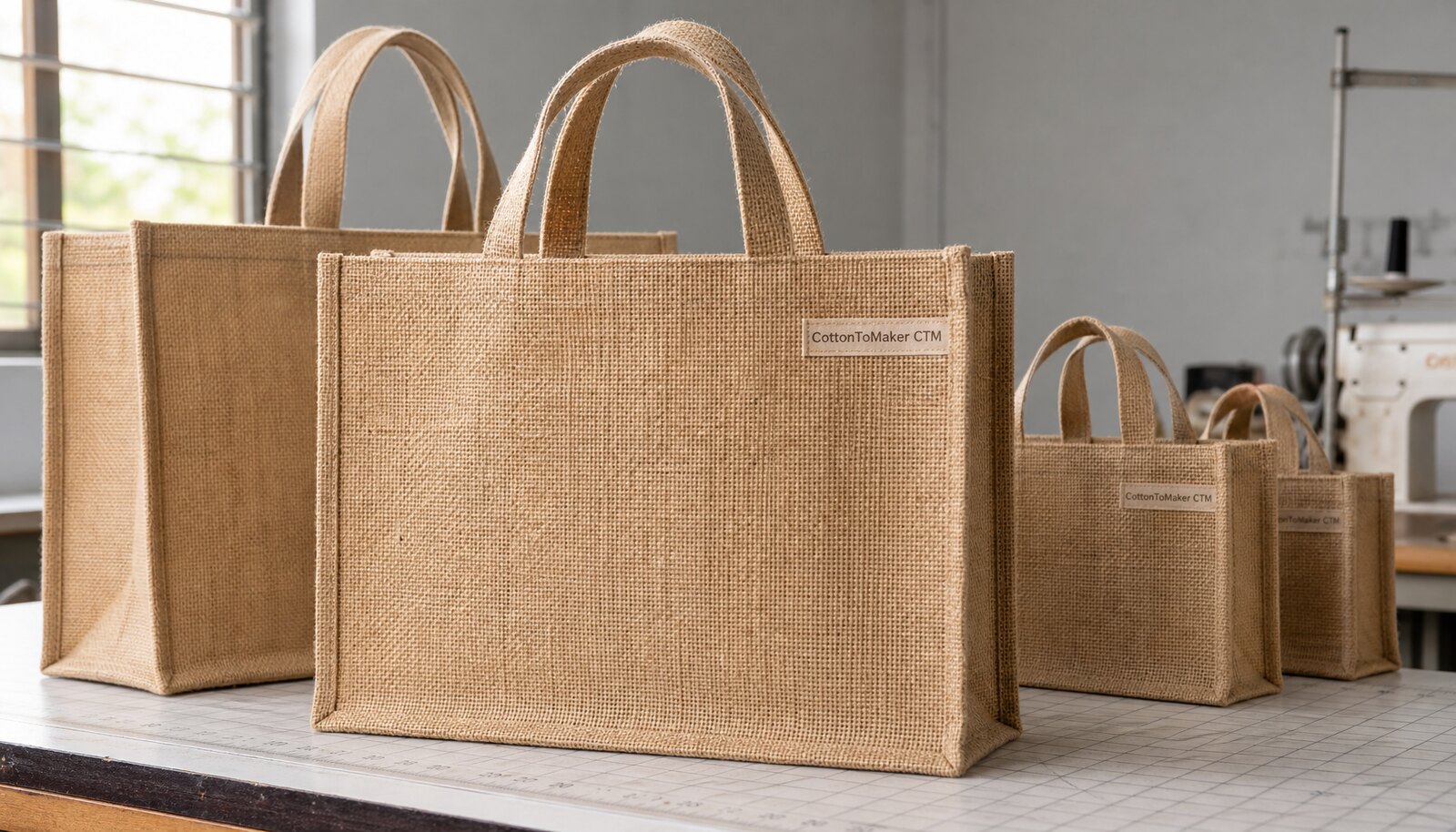
What buyers are really paying for in custom burlap bags
Custom burlap bags look simple, but they are not a commodity item in procurement terms. The buyer is paying for fabric behavior, sewing quality, decoration control, packing accuracy, and the supplier's ability to repeat the same result across lots. If any one of those variables is vague in the RFQ, the factory will make assumptions, and the quote comparison becomes unreliable. That is why a generic request for "custom burlap bags" usually produces three very different offers that are not actually equivalent.
The commercial decision starts with end use. A giveaway pouch, a wine bag, a retail tote, and a branded gift sack all need different build choices. A low-cost promotional bag can tolerate looser weave and simpler finishing. A retail-facing bag usually cannot. Procurement teams should define the function before they discuss artwork, because the function determines the right cloth weight, reinforcement, and packing method. If the use case is unclear, the factory will default to the cheapest safe construction, which is often not the one you need.
Natural-fiber bags also behave differently from smoother materials. Burlap has visible weave, surface irregularity, and natural variation in tone. That creates a premium rustic look, but it also makes print quality more sensitive to artwork choice and setup control. Buyers get better results when they treat the product as a packaging component with measurable requirements, not as a generic accessory that can be quoted from a photo.
- Write the RFQ around the actual use case: retail, gift, wine, display, or packaging insert.
- Compare suppliers on fabric, construction, and packing control, not just unit price.
- Ask for one clear reference sample before the order is awarded.
Fabric weight, weave, and finish set the cost and the appearance
Fabric specification is the first real procurement lever. In the market, lighter promotional bags often sit around 180-220 GSM, while more durable retail or gift formats commonly move into the 230-300 GSM range. That is not a rule, but it is a useful buying band. If a supplier quotes a very light cloth for a bag that will carry bottles or heavier inserts, the bag may look acceptable in a photo and still fail in use. If the cloth is made too heavy without adjusting the sewing method, the bag can become stiff, bulky, and expensive to assemble.
Weave density matters almost as much as GSM. A looser weave gives the classic rustic burlap appearance and lower material cost, but it can also increase lint, surface irregularity, and print distortion. A tighter weave improves consistency and gives the printer a better surface, but it usually costs more and can reduce the rough natural look that some buyers want. Ask the factory to quote at least two fabric options if the program is price-sensitive, because the difference between "acceptable" and "retail-ready" often starts here.
Finishing changes the product more than many RFQs reflect. Washed, calendared, or coated burlap will alter color tone, odor, hand feel, and shrink behavior. Unlined raw burlap is the cheapest path, but it sheds more and can feel rough on the inside. If the bag touches apparel, cosmetics, food packaging, or premium gifting, a lining or clean inner finish is usually worth the added cost. For buyers, the key question is not whether burlap is "thick enough" but whether the selected fabric and finish support the product experience the bag is supposed to deliver.
- Request at least two GSM options so you can compare unit cost against durability.
- If the contents are sensitive, ask for lining or an inner finish to reduce shedding.
- Ask whether the fabric is pre-shrunk or whether some dimensional drift is expected after packing.
Construction should match the real load, not the catalog shape
Burlap bag failures usually come from a mismatch between the construction and the loading pattern. A flat pouch can be fine for small samples or inserts, but a tote, bottle bag, or retail sack needs a different structure. Buyers should specify finished dimensions, gusset depth, handle drop, and top fold allowance because those details determine how the bag behaves in hand and how stress is distributed across seams. If the bag closes with a drawstring, the cord channel and eyelet position matter as much as the body size because they control the closure action and the load on the top edge.
The load case should be written into the RFQ. If the bag is for brochures, the concern is stacking efficiency and clean presentation. If it is for wine or jars, the concern is vertical stability, base support, and seam strength. If it is for seasonal retail goods, the concern is repeated opening and closing without fraying or handle failure. That is why a generic "standard bag" request is weak sourcing language. The factory needs to know how the buyer expects the bag to be used, not just what shape it should look like.
Small construction choices can change the entire cost and quality profile. A turned top hem, double-needle seam, reinforced corner stitch, boxed bottom, or handle bar-tack can meaningfully improve durability. The same is true for closures: drawstring channels are simpler than custom cord stops or metal eyelets. Buyers should ask the factory to mark which details are standard and which are add-ons. That prevents quote drift after the sample stage and makes supplier comparisons cleaner.
- State the intended fill weight or contents instead of saying the bag is for general use.
- Give handle drop in finished form, not only raw handle length before sewing.
- If the bag must sit flat on a shelf, ask for a boxed bottom or reinforced base panel.
- Ask whether seam allowance is included in the finished dimensions or excluded from them.
Decoration on burlap works best when the art is simplified
Printing on burlap is not the same as printing on smooth cotton canvas or coated paper. The open weave breaks up fine detail, so small type, thin line work, and soft gradients can fail even when the artwork file is technically correct. Screen printing is still the most practical method for many custom burlap bags because it delivers stronger coverage and better control on the rough surface. For detailed branding, buyers often get a cleaner result with a sewn patch, woven label, or a printed panel attached to the bag body than by forcing a complex image directly onto raw burlap.
Artwork should be built for the substrate. Bold shapes, fewer colors, and thicker strokes print more reliably. If the brand wants a premium retail result, a woven label or stitched side label may be more effective than a large, highly detailed print. If direct print is the right answer, define Pantone targets, allow for slight ink spread, and require a strike-off or pre-production print approval on the actual cloth before bulk sewing starts. That one step catches a large share of avoidable issues, especially around registration and edge clarity.
The decoration method affects both quality and cost. Screen printing usually has setup cost per color but is predictable for volume. Heat transfer and digital methods can work for smaller runs, but they may look less natural on coarse burlap and may not age as well under handling. Buyers should choose based on viewing distance and retail context. If the bag is meant to be noticed from across a room, a simpler logo is usually enough. If it will be handled closely, the finish quality of the label or print becomes a real part of the product specification.
- Keep the logo bold enough to survive the weave texture.
- Avoid ultra-thin text, tiny registration marks, and fine halftone gradients.
- Approve a strike-off on the actual fabric before bulk print approval.
- Ask for a color reference under the same lighting that will be used for final approval.
Supplier route changes control, speed, and the shape of the quote
A direct factory, regional converter, and trader can all quote the same custom burlap bags, but they do not control the same parts of the process. A direct factory can usually give better control over cloth, sewing, and packing, especially on repeat orders. A regional converter can be faster on samples and easier to work with for artwork changes, but the convenience may come with a higher landed cost or less visibility into production. For procurement, the right route depends on how much control the program needs, not on the sales pitch.
The decision should follow order profile. For a simple large run, direct factory sourcing often gives the best cost structure. For a pilot program or a launch with uncertain demand, a converter can reduce risk and move quicker. For mixed packaging programs where the bag is one element among inserts and cartons, an integrated supplier can reduce coordination failures. The priority is to choose the sourcing route that can actually hit the approved sample and ship date with the least hidden rework.
You also need clarity on who controls what. Some suppliers source fabric from one mill, outsource sewing to another line, and pack at a separate site. That can work, but it makes quality ownership harder to trace. If the supplier cannot explain who owns cloth inspection, decoration, sewing, packing, and final release, the quote is not yet operationally clean. Procurement teams should ask for the actual production chain, not just the name on the quotation.
- Compare suppliers on control, speed, and risk, not just unit price.
- Ask who owns fabric, print, sewing, and packing in the actual production chain.
- If the supplier cannot explain the route clearly, the quote is not yet comparable.
- Confirm who owns corrective action if the bulk run misses the approved sample.
RFQ structure should force like-for-like pricing
MOQ for custom burlap bags is almost never a single fixed number. It moves with size, fabric availability, print count, lining, closure style, and packing. A plain one-color bag can usually support a lower MOQ than a lined retail bag with multiple labels and custom carton marks. That is why buyers should ask for MOQ by spec, not by product family. The supplier should show where the threshold changes and why, so procurement can decide whether the added complexity is worth it.
The quote should separate the true cost drivers. At minimum, the supplier should show the bag spec, print setup, sample cost, packing method, carton spec, and shipping basis. If that information is hidden inside one unit price, you cannot compare offers in a meaningful way. A low unit price with vague packing can turn into a higher total spend once labels, liners, or freight are added. The better the quote structure, the less time you spend chasing clarifications after award.
A strong RFQ reads like a production instruction. Include finished dimensions, material spec, artwork, packing count, shipping destination, and approval milestones. Then ask the supplier to restate the same inputs in the quotation. If the supplier changes the spec while quoting, that is a signal to stop and reconcile assumptions before the order is placed. The goal is not paperwork for its own sake. The goal is to make the commercial comparison real.
- Require the quote to state GSM, dimensions, print count, and packing count on the same line as unit price.
- Separate sample fee, plate or screen fee, and bulk price so startup cost is visible.
- Ask for price tiers if you expect repeat orders, not only the first order quantity.
- If the supplier answers with one lump-sum price, push back until the quote is itemized.
Sample approval is where most avoidable defects can be removed
For burlap bags, the sample stage should do more than confirm the logo exists. The pre-production sample needs to prove the fabric hand feel, print clarity, seam build, and packing method in one physical reference. A useful review starts with dimensions and then moves into handling: does the bag sit correctly, does it open cleanly, does the print sit where the brand expects, and do the handles or drawstring feel balanced. If the sample already looks rough, the bulk lot will not repair itself later.
The safest control method is to keep a signed master sample and inspect production against that sample during bulk review. Check color under the same lighting that matches your warehouse or retail environment, because burlap can shift noticeably between warm and cool light. If the bag will go through brand, retail, and procurement approval, get sign-off before cutting bulk cloth. Late changes after sewing starts are expensive because they affect cloth, labor, and packing all at once.
Packaging should be locked at sample stage too. If the finished bag needs an individual polybag, tissue wrap, or a specific fold orientation, the sample should show it. Approving only the bag body and postponing packing details is how teams end up with a correct bag that cannot be accepted by the warehouse or store team. For procurement, the sample is not a nice-to-have. It is the production standard for the order.
- Approve one master sample for construction and one reference sample for color and print.
- Measure width, height, and gusset on the sample, not just the appearance.
- Reject samples with loose fibers, weak handle stitching, or unreadable logo edges.
- Lock packing style at sample stage if the bag will ship directly to retail or end users.
QC for burlap should cover fabric, stitching, print, and presentation
Quality control has to start with the cloth. Buyers should check whether production fabric matches the approved sample in weight, weave density, tone, and odor. Burlap is a natural-fiber material, so some variation is normal, but the supplier should still keep the lot within an agreed visual band. If the base fabric is inconsistent, the rest of the inspection has less value because the product will never look fully uniform from unit to unit.
After fabric verification, the next control point is sewing. Burlap frays more readily than smoother textiles, so seam quality matters. Inspect side seams, gussets, top hems, handle anchors, and any reinforcement stitching for skipped stitches, loose yarns, and uneven tension. If the bag has a drawstring, cycle the closure several times and check whether the cord binds, twists, or pulls unevenly. A simple pull test is practical here because it shows whether the stress point is the seam, the anchor, or the fabric itself.
Presentation defects are often the ones that hurt the buyer most in retail programs. Check for loose lint, stains, oil marks, foreign fibers, or odor at unpacking. Confirm that print edges are clean, the logo is centered according to the approved placement, and carton marks match the order line exactly. If the bags go directly to end users or retail shelves, QC must include the open-carton presentation, not only the bag's performance in hand.
- Use the approved sample as the control for fabric weight, weave, hand feel, and surface color.
- Finished dimensions should stay within the agreed tolerance band for width, height, gusset, and handle drop.
- A practical starting point is AQL 2.5 for major defects and 4.0 for minor defects, tightened for retail-critical programs.
- Major defects include broken seams, open stitches, missing handles, unreadable logos, or out-of-tolerance dimensions.
- Minor defects include slight thread tails, mild print misalignment inside the accepted band, or cosmetic marks that do not affect use.
- Print checks should cover registration, edge clarity, and color density on lot samples and random carton opens.
- Seam and handle checks should include skipped stitches, loose yarns, uneven tension, and a pull test at expected fill weight.
- Odor, mold, moisture, oil marks, and loose lint should be checked at unpacking, especially for sea freight or humid storage.
- Packing count, carton marks, barcode labels, and pallet count should reconcile exactly with the packing list and PO.
- If the shipment is retail-bound, inspect how the bag looks folded, labeled, and opened from carton.
Packing and carton control affect shelf readiness and freight cost
Packing is not a back-office detail for burlap bags. Natural-fiber goods can pick up moisture, dust, and odor if they are packed carelessly, so the packing plan should fit the destination and the retail presentation. Some buyers need individual polybags to keep the product clean and uniform; others prefer more breathable packing to reduce trapped moisture. The right choice depends on the channel, the route, and whether the bag is going straight to shelf or being used as an insert.
Carton data matters because it changes freight, warehouse handling, and receiving accuracy. Specify the number of pieces per inner bag or master carton, carton dimensions, gross weight, and carton marks before production starts. If you need barcodes, country-of-origin labels, or customer-specific carton marks, include them in the artwork pack. A common sourcing mistake is leaving packing decisions until the end and then discovering that the carton size pushes the shipment into a worse freight bracket or creates receiving problems at the DC.
Moisture control deserves attention on burlap because odor complaints are often packing issues, not product issues. If the route includes sea freight or long warehouse dwell time, ask about desiccants, carton liners, or ventilated packing. Not every program needs them, but the supplier should be able to explain the default packing environment and how goods are protected from damp storage before dispatch. That is a practical quality issue, not an optional upgrade.
- State whether each unit needs an individual polybag, tissue wrap, or no inner wrap.
- Confirm carton count and outer marks before bulk packing starts.
- If the bags are for retail shelf display, ask for a clean fold and consistent logo orientation.
- Ask whether moisture absorbers or carton liners are standard for export shipments in humid seasons.
Lead time and landed cost depend on approvals, not only production days
A realistic lead time for custom burlap bags includes sample development, artwork approval, fabric allocation, bulk sewing, packing, and export booking. If the design is simple and cloth is available, production can move quickly. If you add lining, custom labels, multiple print screens, or unusual packing, the schedule stretches because each added element needs approval and line setup. Procurement should separate factory lead time from shipping time so the total project timeline is not underestimated.
Landed cost is where the real comparison happens. The unit price is only part of the picture once you add sample charges, print setup, packaging, inland trucking, freight, duty, and warehousing. A quote that looks cheaper at the factory gate can end up more expensive if the carton size is inefficient or if the supplier charges separately for every small change. The best comparison is based on the same spec, same packing count, same shipping term, and same destination.
A useful control step is to build the cost model before the PO is issued. List the expected extras: screens, plates, labels, hangtags, barcode labels, special folding, and any carton marking changes. Then compare quotes against that model instead of relying on memory. If the supplier cannot explain how the landed cost changes when artwork or packing changes, the commercial basis is not yet stable enough for award.
- Build the schedule around sample approval first, then bulk production, then freight booking.
- Compare total landed cost, not just ex-factory price.
- Treat carton size, packing count, and freight class as cost drivers.
- Ask the supplier to quote optional upgrades separately so you can see the true base bag cost.
Specification comparison for buyers
| Spec decision | Recommended option | When it fits | Buyer risk to check |
|---|---|---|---|
| Lowest unit cost at scale | Direct factory, standard burlap base bag, one print screen, bulk order 5,000+ units | Forecasted replenishment or rollout across multiple SKUs | Ask whether the quote includes seam reinforcement, trim, inner packing, and export docs; low base quotes often exclude these |
| Fastest sampling | Regional converter with local stock base bags and in-house decoration | You need a strike-off or pre-production sample in 3-7 days | Stock cloth may not match bulk cloth in GSM, color tone, or shrinkage; require a bulk fabric reference |
| Better retail finish | Factory with lining, clean top hem, and controlled packing | Shelf-ready gift, wine, or seasonal retail programs | Confirm lint control, carton presentation, and whether the bag is packed flat or folded to avoid crush marks |
| High-coverage branding | Supplier that prints on flat panels before final sewing | Large logos, repeated marks, or branded patterns | Coarse weave can distort fine detail; simplify artwork and approve a strike-off on the actual fabric |
| Small pilot run | Local converter or decorator, usually 300-1,000 units | You want to validate demand before a larger commitment | Piece price is higher and color consistency can drift across lots |
| Mixed packaging program | Integrated packaging supplier managing jute, paper, inserts, and cartons | One team needs to coordinate bag, insert, and outer pack | Verify the bag line is in-house, not an unvetted subcontract |
| Export consolidation | Established exporter with document and freight coordination | You ship to multiple ports or combine several SKUs | Lead time can stretch if approvals go through a sales office instead of the production team |
| Repeat replenishment | Factory holding greige cloth or common trims in reserve | You expect recurring orders with small artwork changes | Ask for evidence of allocated inventory, not just a verbal promise |
Buyer checklist before sampling
- Finished dimensions: width, height, gusset depth, handle drop, and acceptable tolerance band
- Fabric spec: GSM, weave style, fiber source, and whether the bag is lined, coated, or left raw
- Decoration spec: print method, artwork file format, Pantone targets, number of colors, and placement
- Construction spec: closure style, handle reinforcement, top hem, corner stitching, and bottom structure
- Packing spec: units per inner bag, units per carton, carton marks, barcode labels, and pallet requirement
- Commercial terms: destination port, Incoterm, sample fee, plate or screen fee, and payment milestones
- Timeline: sample approval date, bulk approval date, and required ship window
- Forecast: expected reorder volume and whether the supplier should quote a laddered MOQ tier
Factory quote questions to send
- What exact burlap or jute fabric are you using, including GSM, weave density, and any blend or finish?
- Is the decoration printed before or after sewing, and how many colors or screens are included in the price?
- What is the MOQ by size, by color, and by decoration method, and does a second artwork version change it?
- What sample types do you provide, what is the sample lead time, and is there a sample charge or refundable deposit?
- What packing is included per dozen, per inner bag, and per carton, and what are the carton dimensions and gross weight?
- What seam reinforcement and handle reinforcement are standard for this construction, and what is optional?
- What costs are separate from the unit price, such as plates, labels, hangtags, testing, or export documents?
- What is the bulk lead time after sample approval and deposit, and what usually causes delay?
- Can you show the approved trim list, fabric swatch, and master sample reference that production will follow?
- What inspection standard do you use for burlap bags, and do you accept buyer-specific AQL or defect criteria?
Quality-control points to confirm
- Use the approved sample as the control for fabric weight, weave openness, hand feel, and surface color, not only the written spec
- Finished dimensions should stay within the agreed tolerance band, with separate checks for width, height, gusset, and handle drop
- A practical starting point is AQL 2.5 for major defects and 4.0 for minor defects, tightened if the bags are retail-critical or brand-sensitive
- Major defect examples include broken seams, open stitches, missing handles, unreadable logos, or dimension failure beyond tolerance
- Minor defect examples include slight thread tails, mild print misalignment within the accepted band, or small cosmetic marks that do not affect use
- Print checks should cover registration, edge clarity, color density, and rub resistance on at least one lot sample and random carton opens
- Seam and handle checks should include skipped stitches, loose yarns, uneven tension, and a pull test at the expected fill weight
- Odor, mold, moisture, oil marks, and loose lint should be checked at unpacking, especially for sea freight or humid storage
- Packing count, carton marks, barcode labels, and pallet count should reconcile exactly with the packing list and PO
- If the shipment is for retail, inspect how the bag looks folded, labeled, and opened from carton, not only how it performs in hand