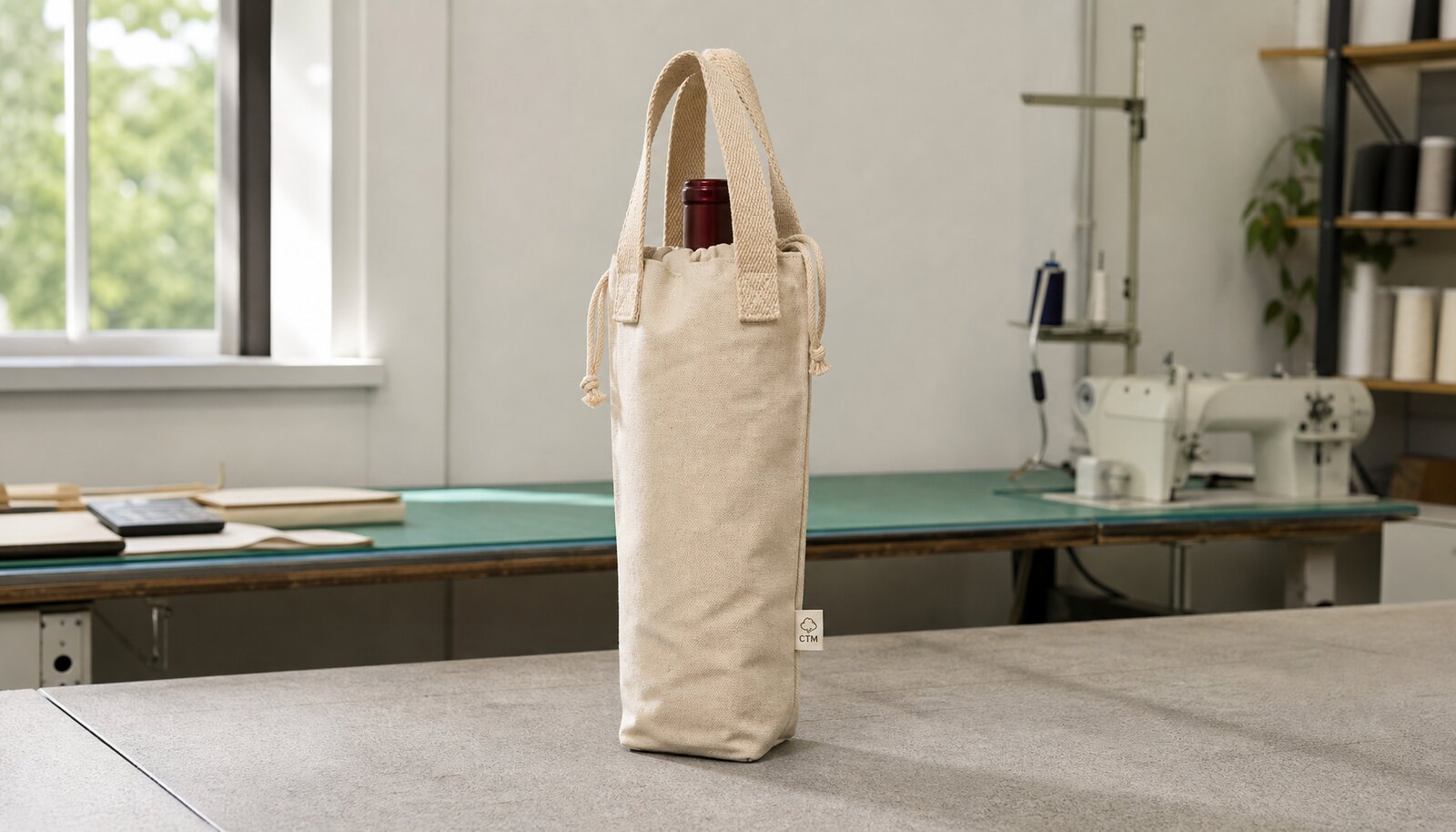
What Buyers Actually Need From Custom Bottle Bags
Custom bottle bags are usually bought for one of three jobs: retail presentation, gift packaging, or secondary protection during hand carry. Those uses overlap, but they do not create the same product. A bag that looks elegant on a shelf can still fail in the field if the bottle neck sits too high, the base sags, or the handle stretches after the first lift. The right sourcing approach is to define the use case first, then build the bag around it.
For procurement teams, the real task is not finding a vendor who can print a logo. It is getting a repeatable bottle bag that fits the bottle, survives packing and carry, and lands at a cost the business can actually use. That means freezing the bottle profile, fabric weight, decoration method, and packout before you start comparing quotes. If those inputs are vague, supplier pricing will also be vague.
- Retail use favors visual consistency, fast packing, and a clean printed surface.
- Gift use favors heavier cloth, better hand feel, and tighter finishing around the mouth and seams.
- Protection use favors close fit, stronger handles, and fewer decorative features that can fail in use.
Start With Bottle Geometry and Fit Envelope
Fit starts with measurement, not artwork. Buyers should capture bottle height, maximum diameter, shoulder shape, neck height, and closure type, then check whether the label stack or capsule makes the bottle wider than the glass alone. Square bottles, tall champagne bottles, and premium spirits bottles often need more allowance than standard Bordeaux shapes. If you only size around one reference bottle, the bag may look fine on paper and fail on the warehouse floor.
A useful starting point is to define a fit envelope, not a single nominal size. For soft bottle bags, allow enough room for insertion without forcing the bottle, but not so much room that the bottle slides around or looks underfilled. Many buyers use a tighter allowance for retail presentation and a slightly looser allowance for bulk gift programs. If the bag has a gusset or lining, make sure the approved dimensions include seam allowance and not only the visible face size.
- Measure the widest bottle in the line, not only the standard wine bottle.
- Confirm whether the bag must fit bottles with capsules, collars, or thicker labels.
- Ask the factory to show the exact bottle used during sample development.
Choose Fabric, Lining, and Handle Structure
Fabric weight drives both look and performance. Light cotton around 6 oz to 8 oz can work for low-cost promotional bottle bags, but it tends to drape, wrinkle, and show the bottle profile more clearly. Midweight canvas around 8 oz to 12 oz is the most practical range for custom bottle bags because it balances cost, print stability, and structure. Heavier cloth gives a more premium feel, but it also increases sewing difficulty, carton weight, and freight cost.
Do not separate fabric choice from handle choice. A bottle bag that carries glass needs more than a decorative strap. Self-fabric handles are fine for lighter packs, but cotton webbing, reinforced top seams, and bartacks become important once the filled weight rises or the bag is intended to be reused. If the bag must stand up during display, ask for a stiffer cloth, a tighter weave, or a construction that supports the bottle body instead of collapsing around it.
- 6 oz to 8 oz cotton: lower cost, softer drape, weaker structure.
- 8 oz to 12 oz canvas: balanced option for most retail and gift programs.
- Heavier than 12 oz: stronger form and premium feel, but higher sewing and freight cost.
- If the filled bag is heavy, require webbing handles and reinforced bartacks rather than simple fold-over straps.
Pick the Decoration Method Based on Volume and Risk
Decoration should match the order size and the brand risk, not the supplier's default machine. Screen printing is usually the best choice for simple logos, solid blocks of color, and repeat programs where setup cost can be spread across volume. Heat transfer works for short runs or more complex artwork, but it needs tighter control over temperature, pressure, and fabric texture. Woven labels and sewn patches are better when the goal is long-life identification and a cleaner premium look rather than a large printed panel.
The important test is not whether the artwork can be reproduced on a screen. It is whether the decoration will stay legible and presentable after the bag is handled, folded, packed, and shipped. For dark fabric, ask how the supplier builds opacity and whether the print needs an underbase. For light fabric, ask about bleed-through, edge sharpness, and rub resistance. Always approve the decoration on the real bag fabric, not on a paper proof.
- Screen print: best for simple logos, larger volumes, and stable repeat orders.
- Heat transfer: useful for multicolor artwork and shorter runs, but inspect edge durability carefully.
- Woven label or sewn patch: stronger choice for premium bags or brands that want a durable mark without large ink coverage.
Build the Quote Around Clear Specs and Cost Drivers
A useful quote separates real manufacturing cost from one-time setup cost. Buyers should ask for the fabric price, sewing price, decoration setup, optional packaging, and any charge for extra artwork revisions or special packing. When the supplier quotes only one all-in unit price, it becomes hard to see what changed between 500 pieces and 3,000 pieces, or why a second color suddenly doubles the cost. Compare quotes on the same spec, not on whatever each supplier found easiest to manufacture.
Low MOQ pricing deserves extra scrutiny because bottle bags often hide cost in setup, finishing, or packing assumptions. One supplier may be quoting a simple natural cotton bag with no closure and loose pack, while another includes a printed insert card, more precise folding, and stronger cartons. The cheapest line item is not necessarily the best landed cost. Ask the supplier to show what changes at each quantity break so you can see how fixed cost is being spread across the run.
- Request pricing at 500, 1,000, 3,000, and 5,000 pieces on the same construction.
- Separate artwork setup, sample charges, packing, and freight assumptions from the unit price.
- Ask whether a color change, print location change, or closure change creates a new MOQ.
Verify the Supplier Before You Price the Order
A factory quote is only useful if you know who is actually making the bag. Buyers should verify the seller's legal entity, production address, and role in the supply chain. If the seller is a trader, ask which factory will sew the order, who books the fabric, who approves the sample, and who performs final inspection. The goal is to avoid a quote from a middle layer that cannot control the actual construction or material quality.
Traceability matters because custom bottle bags often depend on fabric lot, dye lot, and print batch consistency. Ask for the fabric composition declaration, lot or roll identification, and any material records the factory can share. If your program needs compliance paperwork, ask for those documents before the PO is issued, not after production ends. A credible supplier should be able to explain where the cloth came from, how the artwork will be applied, and what quality checks happen before packing. Red flags are vague answers, stock photos, refusal to share the actual production site, or a quote that changes materially once you ask for documentation.
- Request the business license, factory address, and the name on the invoice and bank account.
- Ask for production-floor photos or a live walkthrough if the order is large or time-sensitive.
- Require material lot information and a retained sample so reorders can be matched later.
- Treat any seller who cannot explain traceability as a risk until proven otherwise.
Sample Approval Should Prove Fit and Finish
Sample approval should follow a ladder, not a single photo. Start with a blank sample if the structure is still being defined, then review a printed sample once the art is frozen, and use a pre-production sample when the order value justifies it. The sample should match the intended bulk build as closely as possible, including the same fabric, stitch pattern, handle construction, and decoration method. If the sample is overbuilt or made from different cloth, it can approve a product that the bulk line cannot actually reproduce.
The most useful sample review includes physical fit testing and re-pack testing. Put the exact bottle or bottle set into the bag, then fold and repack it the same way your warehouse or fulfillment team will. Keep one sealed golden sample with the approval date, version number, and a clear note of what was accepted. That sample becomes the reference point for production, receiving, and any later dispute.
- Test the widest and tallest bottle in the range, not only the standard wine bottle.
- Check that the bottle inserts cleanly and sits correctly without forcing the seams open.
- Keep a sealed golden sample and a signed spec sheet as the production reference.
QC Criteria Buyers Can Put in the PO
Quality control on custom bottle bags should be written in terms the factory can execute. The cleanest approach is to define the exact measurement tolerance, load condition, print standard, and defect class before production starts. A workable starting point is critical defects at zero tolerance, major defects at an agreed AQL level such as 2.5 if your program uses AQL sampling, and minor defects at 4.0 only when they do not affect function or saleability. The key is to write the rule into the PO or spec sheet, not to negotiate it after inspection.
QC should also cover how the bag behaves under real use, not only how it looks in the carton. That means a load test on the actual bottle or an equivalent weight, a visual check for stitch security at the handle joins, a rub test for the print, and a carton check for count accuracy and traceability. The acceptance limits do not need to be elaborate, but they do need to be measurable. If the buyer and supplier agree on what passes and what fails, inspection becomes a process instead of a dispute.
Packing, Cartons, and Freight Details
Packing choices can change both shipping cost and receiving speed. Ask whether each custom bottle bag is folded flat, inserted with a card, polybagged, or packed loose. The fold direction matters because a sharp crease can damage a premium printed area, especially on darker fabric or a bag with a large front panel. If the bag is being sold in retail channels, also check whether the fold position keeps the logo visible when the bag is unpacked.
Carton details are part of the product spec, not an afterthought. Request carton count, carton dimensions, gross weight, outer carton strength, and carton markings before approving production. For export or warehouse-heavy programs, ask for item codes or barcodes on each carton so receiving teams can match the shipment without hand sorting. If the order will move through multiple handoffs, ask the factory to pack and label in a way that reduces scuffing, crushing, and count errors.
- Specify flat-pack dimensions if warehouse cube efficiency matters.
- Confirm whether the factory uses polybags, tissue, or separators to protect the print surface.
- Require carton counts, SKU marks, and lot labels on the outer carton.
Reorder Planning and Long-Term Color Control
Reorders are where many custom bottle bag programs drift. The second run may use a different cloth lot, a slightly different print setup, or a revised folding method, even when the SKU code stays the same. If your program needs consistency, keep a complete spec pack with the approved sample, artwork file, fabric swatch, carton spec, and the exact version history. That lets the factory recreate the bag instead of approximating it.
Landed cost should be evaluated over the life of the program, not only on the first order. A slightly higher unit price can make sense if it reduces damage, rejects, or rework, or if it gives you a supplier who can match the second and third runs without color surprises. For seasonal wine and spirits packaging, lock the spec early, book material early, and keep the same approval chain. That is usually cheaper than trying to recover quality after launch.
- Keep one golden sample, one fabric swatch, and one print reference for every active SKU.
- Freeze the spec before reordering so the second run does not drift in cloth shade or print placement.
- Compare suppliers on total landed cost per sellable unit, not only on factory price.
Specification comparison for buyers
| Spec decision | Recommended option | When it fits | Buyer risk to check |
|---|---|---|---|
| Direct factory vs trading company | Direct factory when you need material traceability, repeat runs, and tighter spec control | You already know the construction and want the lowest repeat-order risk | Verify the legal entity, production site, and who signs the sample and QC documents |
| Single-bottle vs multi-bottle format | Single-bottle bag for most retail, gift, and promo use; multi-bottle only for bundled sets | You need one bag per bottle and a cleaner shelf presentation | Check bottle diameter, shoulder shape, and whether the bag still closes cleanly when loaded |
| Main fabric | 8 oz to 12 oz cotton canvas for most programs; heavier only when structure matters | You want a reusable bag with enough body for printing and handling | Ask for finished weight, weave type, finish, and expected shrinkage or prewash status |
| Print route | Screen print for simple logos, heat transfer for short-run multicolor, woven label or patch for premium branding | Artwork is stable and the order volume supports setup cost | Inspect registration, opacity, edge sharpness, and rub resistance on the actual fabric |
| Handle construction | Cotton webbing or self-fabric handle with bartacks and reinforced top seam | The bag must carry glass bottles without stretch or seam pullout | Confirm handle width, bartack count, stitch density, and seam allowance |
| Closure style | Open top for speed, drawstring or tab closure for a more finished look | The pack must either protect the bottle or present it as a gift item | Check snag risk, closure durability, and packing speed impact |
| Supplier route | Factory direct for exact custom dimensions; trader only if they can prove factory control | You need fast quotes but still want real production accountability | Ask who owns the material booking, sample approval, and final inspection |
| MOQ strategy | Lock one construction first, then scale colors or artwork later | You need to control setup cost and avoid too many low-volume SKUs | Look for hidden charges in tooling, sampling, packing, or color changes |
Buyer checklist before sampling
- Exact bottle profile with measurements for height, maximum diameter, shoulder shape, closure type, and whether the fit must work for wine, champagne, or spirits bottles
- Use case definition: retail display, gift packaging, promotional giveaway, or protective carry, because each one needs a different structure and finish level
- Fabric target with GSM or ounces, weave, color, finish, and whether you want raw, bleached, dyed, or prewashed cloth
- Decoration plan with art file format, color count, print area, and whether the brand mark must stay visible after repeated handling
- Handle and seam spec with handle material, width, bartack count, seam allowance, and any reinforcement needed at the mouth of the bag
- Closure requirement with the exact mechanism, expected cycle life, and whether the closure must be decorative or functional
- Packing spec with fold method, polybag requirement, insert card, carton count, carton label, barcode, and palletization needs
- Quantity ladder with first order volume, reorder forecast, and target price breaks so the supplier can quote setup cost honestly
- Supplier documents with business license, actual factory address, material traceability, and any compliance or inspection paperwork your program requires
- Approval standard with a sealed golden sample, agreed measurement tolerance, defect classes, and replacement terms in writing
Factory quote questions to send
- What are the exact finished dimensions, including seam allowance, and what bottle profile did you use as the fit reference?
- What is the fabric weight in GSM or ounces, and is the cloth raw, prewashed, dyed, or finished with any shrink control?
- Which print method is included, how many colors are covered, and what is the setup charge for artwork revisions or extra locations?
- What are the MOQ and price breaks by size, color, and print version at 500, 1,000, 3,000, and 5,000 pieces?
- What is the handle construction, including material, width, bartack count, and reinforcement at the stress points?
- What closure style is included, and are any cords, snaps, buttons, or tabs supplied by the factory or sourced separately?
- What sample stages do you offer, what does each stage cost, and how long does blank, printed, and pre-production sampling take?
- What packing is included in the unit price, including fold direction, polybag, carton count, carton size, and outer carton strength?
- What are your major and minor defect definitions, and what is your replacement policy if the first shipment misses the approved standard?
- Can you provide factory documents, material lot information, and evidence that the seller controls the actual production line rather than only acting as a trader?
Quality-control points to confirm
- Set a dimensional tolerance in the PO before production starts. A practical starting point is plus or minus 0.5 cm for finished dimensions under 40 cm and plus or minus 1.0 cm above that, unless your fit is intentionally loose.
- Test fit with the widest, tallest, and heaviest bottles in the range, not just a standard wine bottle. Pass only if the bottle inserts cleanly, sits correctly, and does not bind at the shoulder or neck.
- Run a load test on the actual bottle or an equivalent weight. A simple acceptance check is three 30-second hangs by the handles with no seam opening, no handle slippage, and no stitch failure.
- Define critical defects as zero tolerance. Use major defects for open seams, broken handles, missing parts, or any condition that prevents normal use. Minor defects should cover loose threads, small fold marks, or slight cosmetic variation only if they do not affect saleability.
- Inspect stitch quality on load-bearing seams, handle joins, and top edges. Reject if there are skipped stitches, broken stitches, or any seam opening greater than 2 mm.
- Check print registration on the real fabric, not on paper. A useful rule is to reject if the artwork is shifted more than 1.5 mm on key elements, if text is blurred, or if the logo is cut off at the edge.
- Run a dry rub test on the printed area with a white cotton cloth for 10 passes. Reject if color transfer is visible on the cloth or if the printed edge smears.
- Compare fabric shade against the approved physical standard under consistent light. Reject any carton lot with visibly mixed shades, off-tone reorders, or a finish that differs from the sealed sample.
- Test closures for function if the bag uses a drawstring, snap, button, or tab. A simple pass condition is 10 open-close cycles without snagging, detachment, or distortion.
- Check packing accuracy on packed cartons, not only on loose goods. Every carton should match the approved count, item code, and label, with lot numbers or date codes if your program needs traceability.