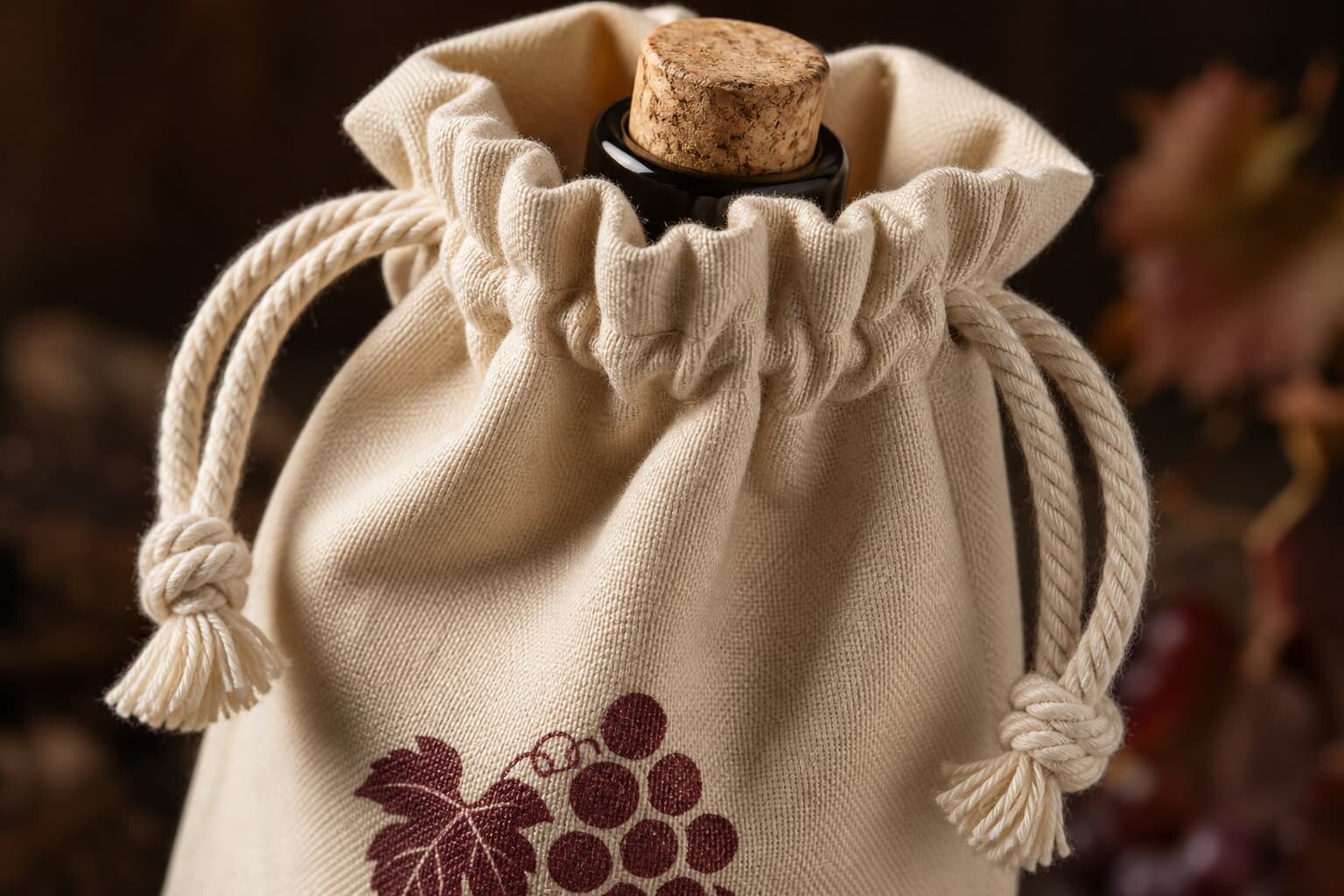
Start With the Bottle, Not the Bag
The most common sourcing mistake is choosing a material before confirming the bottle. A custom bottle bag for a slim 750 ml wine bottle does not automatically fit a wide champagne bottle, a square olive oil bottle, a spirits bottle with a gift box, or a tall insulated water bottle. Material choice depends on how the bag wraps around the bottle, where the pressure sits, and whether the bag must stand upright on a retail shelf.
For an RFQ, give the supplier the bottle height, body diameter, base shape, shoulder shape, and filled weight. If the bottle will be inserted inside a paper box or sleeve, provide that size too. A few millimeters can decide whether the bag closes cleanly or looks stretched. Buyers should avoid vague wording such as standard wine bag unless they are comfortable with the factory using its own pattern.
- For standard 750 ml wine bottles, many buyers start around 15 x 35 cm flat size, then adjust for bottle diameter and closure style.
- For champagne or sparkling bottles, allow more body width and stronger bottom seams because the bottle is wider and heavier.
- For boxed bottles, quote based on the box dimensions, not the glass bottle dimensions.
- For two-bottle carriers, confirm divider material, center stitch strength, and whether the two bottles can knock against each other.
Match Material to Use Case and Sales Channel
The right material is not always the most expensive one. A trade show giveaway bottle bag may need low cost, fast production, and acceptable logo visibility. A retail wine gift bag needs better structure, neater stitching, and a material that still looks good after handling in a store. A corporate gift bottle bag may need premium branding and a cleaner finish because the bag is part of the gift experience.
Procurement teams should define the commercial job of the bag before comparing quotes. If one supplier quotes 5 oz cotton and another quotes 10 oz canvas, both may be correct for different goals, but the prices cannot be compared directly. A clear use case helps the factory recommend fabric weight, print method, handle type, and packing without guessing.
- Use 5-6 oz cotton for lightweight promotional bottle packaging where budget and natural appearance matter.
- Use 8-10 oz canvas for reusable gift bags and brand merchandise with better body and print surface.
- Use jute for rustic shelf presentation, food gifting, farm shops, wine clubs, and natural retail displays.
- Use felt when light cushioning, shape, and a premium tactile impression are more important than washability.
- Use laminated non-woven for large campaigns needing bright artwork, lower cost, and basic moisture resistance.
Understand Fabric Weight Before Comparing Prices
Fabric weight is one of the biggest cost drivers in custom bottle bag production. Cotton and canvas may be quoted in ounces per square yard or GSM. Jute is often discussed by ounce weight or density, while non-woven is usually quoted in GSM and felt in millimeters. If the RFQ only says cotton bottle bag, suppliers may quote different weights to make the price look attractive.
A lighter material reduces fabric cost and carton weight, but it can make the bag collapse, reveal the bottle shape, or feel too promotional. A heavier material improves structure and durability but increases cutting waste, sewing time, shipping weight, and sometimes MOQ. Buyers should request the material basis clearly and ask whether the quoted weight is nominal or actual tested range.
- 5 oz cotton is economical and soft but may be semi-transparent with dark bottles or bold print.
- 8 oz cotton canvas gives better print coverage and more reusable value for gift packaging.
- 10-12 oz canvas feels stronger but can create bulkier folded packing and higher freight cost.
- 80-100 GSM non-woven suits short-use campaigns; 120 GSM feels more stable for bottle weight.
- 2 mm felt is lighter and more flexible; 3 mm felt has better body but may require cleaner cutting control.
Choose a Construction That Supports the Bottle Weight
A bottle bag is a small product, but the load is concentrated. The bottom seam, side seam, handle attachment, and drawstring channel do most of the work. A nice fabric will still fail if the sewing construction is too weak for a filled bottle. For glass bottles, buyers should treat seam strength as a functional requirement, not a cosmetic detail.
The construction should match the way the bag is carried. A drawstring-only bag is mainly presentation packaging. A handled bag must support lifting and movement. A two-bottle carrier needs divider control and bottom stability. If the bag will be used in retail checkout, delivery, or event distribution, request a simple load test method in the quote and sample approval process.
- For drawstring bags, check the channel height, cord thickness, knot security, and whether the closure catches on the bottle neck.
- For handle bags, request reinforced box stitching or adequate stitch density at the handle tabs.
- For gusseted bags, verify the bottom width with the bottle inserted, not only the flat pattern measurement.
- For two-bottle bags, ask whether the divider is stitched into the bottom or only attached at the top.
- For jute bags, check if inner lamination, lining, or overlocked seams are needed to reduce fiber shedding.
Select the Print Method by Artwork and Material
Print selection should not be left until after price approval. Screen printing, heat transfer, digital printing, embroidery, woven labels, and patches all behave differently on cotton, canvas, jute, felt, and laminated materials. A supplier may quote the cheapest print method unless the RFQ states the expected artwork result and durability requirement.
For simple one or two color logos, screen printing is often practical on cotton and canvas. On rough jute, small text and thin lines can break because the yarn surface is uneven. Felt can accept embroidery, labels, or selected transfer methods, but print edges may not look as sharp as on smooth fabric. Full-color artwork usually needs a different process and should be reviewed with actual artwork files before final costing.
- Use screen print for solid logos, simple text, and medium-to-large print areas on cotton or canvas.
- Use heat transfer when artwork has gradients, multiple colors, small details, or requires a smoother surface result.
- Use embroidery for premium canvas or felt bags, but confirm stitch count, backing, and whether the fabric puckers.
- Use woven labels when the bag material is too textured for fine logo details or when a reusable brand finish is needed.
- Use patches or debossed labels for higher perceived value, but quote them as separate components with their own MOQ.
Control MOQ by Standardizing Smartly
MOQ is not only about how many bags the sewing line can produce. It is affected by fabric color, dyeing, printing setup, trim color, label production, carton marking, and artwork versions. A natural cotton bottle bag with one-color print may have a lower practical MOQ than a custom-dyed canvas bag with multiple logo versions and matched drawstrings.
Buyers can often control MOQ by standardizing the base bag and varying the branding. For distributors handling several customer logos, it may be more efficient to keep one approved material, one size, and one drawstring color, then print different logos in batches. For retail programs, grouping SKUs by material and construction reduces sample cycles and production risk.
- Natural cotton, natural canvas, and natural jute usually support lower MOQ than custom-dyed materials.
- Changing only the print artwork is easier than changing material color, trim, handle, and label at the same time.
- Custom fabric dyeing can trigger higher MOQ and longer lead time because mills require minimum batch volume.
- Embroidery and woven labels may have their own MOQ even when the bag sewing MOQ is lower.
- Mixed-carton packing, multiple barcodes, or many store allocations can add handling cost even if the bag is unchanged.
Build a Sample Approval Process That Prevents Rework
A bottle bag sample should answer more than whether the logo looks nice. It should confirm material feel, bottle fit, closure function, seam strength, print appearance, and packing behavior. If the sample is made from substitute fabric or a different print method, buyers should treat it as a reference sample, not a production approval sample.
For reliable approval, request a pre-production sample using the intended bulk fabric, bulk trim, final artwork, and final sewing pattern. If timing does not allow a full pre-production sample, separate the risks: approve a fabric swatch, then a print strike-off, then a finished construction sample. This creates a clearer approval trail and helps avoid disputes during final inspection.
- Insert the actual bottle and check whether the neck, shoulder, and base sit naturally inside the bag.
- Pull the drawstring several times to see if the channel twists, frays, or becomes difficult to close.
- Check print color in daylight and indoor light, especially on natural cotton or jute where base color affects ink.
- Fold the sample the same way it will be packed and see whether print cracking, creasing, or deformation appears.
- Keep one signed sample with the buyer and one with the factory so inspection has a common reference.
Define Packing Before the Final Price Is Locked
Packing affects cost, labor, freight volume, and product condition. Bottle bags can be bulk packed, bundled, individually polybagged, inserted with tissue, or packed by retail display requirements. A heavy canvas or felt bottle bag takes more carton space than thin cotton, even when the finished flat size looks similar. If packing is not defined, quotes may look cheaper but become unstable later.
For importers and distributors, carton data is especially important because it affects landed cost and warehouse planning. Ask suppliers to estimate units per carton, carton dimensions, gross weight, net weight, and whether cartons are single-wall or double-wall. If the bags have retail labels or barcodes, specify placement and scan requirements before mass production.
- Bulk packing is economical but may allow more wrinkling, dust, and mixed orientation inside cartons.
- Individual polybags protect the bag but add labor, material cost, and sometimes sustainability concerns.
- Felt and structured canvas bags may need lower carton compression to avoid deformation.
- Jute bags should be kept dry and ventilated to reduce odor and moisture-related issues.
- Retail programs should define barcode label, hang tag, carton mark, inner pack quantity, and SKU separation.
Use Lead Time as a Risk Map, Not One Date
Lead time for custom bottle bags includes artwork confirmation, material sourcing, sample making, sample approval, bulk fabric preparation, printing, cutting, sewing, trimming, inspection, packing, and shipment booking. If a supplier gives one total lead time without assumptions, procurement should ask what is included and what can delay the schedule.
Material selection changes the timeline. Stock natural cotton can be faster than dyed canvas. Jute availability can fluctuate by weave and width. Embroidery, woven labels, patches, custom cords, and retail packaging add separate supplier steps. A practical RFQ asks for sample lead time, production lead time after deposit and approval, and the deadline for final artwork.
- Separate digital proof time, physical sample time, and bulk production time in the sourcing calendar.
- Ask whether material is in stock or requires weaving, dyeing, lamination, or special finishing.
- Confirm whether printing happens before or after sewing, because this affects capacity and rework risk.
- Allow extra time for multi-SKU assortment packing, barcode labeling, or distributor routing instructions.
- Do not approve bulk production until bottle fit, material, print, and packing are all confirmed.
Make Supplier Quotes Comparable
A useful quote for custom bottle bags should show the specification behind the price. Without material weight, size basis, print method, trim details, packing, MOQ, and validity period, the buyer cannot tell whether one supplier is genuinely more competitive or simply quoting a lighter construction. The cheapest line item may become expensive after upgrades are added.
Procurement teams should ask suppliers to quote a base option and optional upgrades. For example, request one price for 8 oz cotton with one-color screen print and a separate line for 10 oz canvas, heat transfer, woven label, individual polybag, or reinforced handle stitching. This gives the buyer a cost map and makes internal decisions faster.
- Size: finished flat size, gusset if any, tolerance, and bottle size used for fit checking.
- Material: composition, weight, color, lining or lamination, and whether fabric is stock or custom made.
- Branding: print method, print size, number of colors, logo position, and setup charges if applicable.
- Construction: drawstring, handle, divider, seam type, stitch density, trim material, and reinforcement.
- Packing: units per carton, carton dimensions, gross weight, polybag or no polybag, and carton marks.
- Commercial terms: MOQ, price validity, sample cost, production lead time, payment terms, and Incoterm.
Specification comparison for buyers
| Spec decision | Recommended option | When it fits | Buyer risk to check |
|---|---|---|---|
| Economy single-bottle giveaway | 5-6 oz cotton or 140-180 GSM cotton | Promotional wine, olive oil, vinegar, or beverage gifting where soft handfeel and low freight weight matter | Thin fabric can show bottle outline and may not hide dark glass; confirm print opacity and seam strength |
| Retail-ready reusable bottle bag | 8-10 oz cotton canvas or 280-340 GSM canvas | Brand stores, winery gift sets, corporate gifting, and premium beverage launches | Higher fabric weight increases unit cost and carton weight; check handle reinforcement and folding method |
| Rustic natural presentation | 10-14 oz jute with cotton webbing or rope drawstring | Wine, spirits, farm shop, gourmet food, and sustainable-looking retail packs | Jute yarn variation affects print detail; request fabric photos and test logo size before approval |
| Clean color printing on budget | Non-woven polypropylene 80-120 GSM | Large event quantities, supermarket promotions, short-use campaigns, and distributor giveaways | Heat sealing or stitching quality varies; confirm load test and whether material feels too thin for glass bottles |
| Protective premium bottle carrier | 2-3 mm felt with stitched seams | Gift sets, employee gifts, subscription boxes, or bottles that need light cushioning | Felt edges and die-cut handles must be clean; confirm thickness tolerance and lint control |
| Moisture-resistant outer surface | Laminated non-woven or laminated jute | Chilled beverage promotions, outdoor events, and wipe-clean retail displays | Lamination changes ink adhesion and folding behavior; request rub test and crease test on printed samples |
| Detailed full-color artwork | Cotton canvas with heat transfer, digital print, or laminated material with offset print | Complex logos, gradients, QR codes, illustrations, or multi-SKU artwork | Color matching and wash/rub resistance need defined acceptance standards, not only a photo approval |
| Minimal premium branding | Heavy canvas, jute, or felt with embroidery, woven label, PU patch, or debossed label | Brand gift bags where the bag should look reusable after the bottle is removed | Logo size, needle density, patch placement, and label stitch margin can change final appearance |
Buyer checklist before sampling
- Confirm bottle type, diameter, height, shoulder shape, and whether the bag must fit one bottle, two bottles, or a boxed bottle.
- State the target use: one-time promotion, retail sale, gift packaging, delivery carrier, or reusable brand merchandise.
- Specify material type and weight, such as 5 oz cotton, 10 oz canvas, 12 oz jute, 100 GSM non-woven, or 3 mm felt.
- Define the closure: drawstring, rope tie, cotton tape, handle only, flap, window, divider, or no closure.
- Provide artwork files with print size, Pantone references, logo position, and whether color tolerance is critical.
- Ask for sample photos of fabric, seam, drawstring, handle attachment, and finished bag with a real bottle inserted.
- Request carton packing method, folded size, units per carton, gross weight, and whether bags are individually polybagged.
- Clarify inspection criteria for size tolerance, seam strength, print registration, color, odor, dirt marks, and loose threads.
- Separate sample lead time, bulk production lead time, and transit time in the RFQ instead of asking for one total date.
- Ask suppliers to quote optional upgrades separately so procurement can compare cost impact without restarting the RFQ.
Factory quote questions to send
- What exact material composition, fabric weight, and thickness are included in your quotation?
- Is the quoted size internal usable size or flat finished size, and what bottle dimensions does it support?
- Which print method do you recommend for this artwork and material, and what are the print size limits?
- What is the MOQ for the bag itself, and what is the MOQ impact if we change material color, drawstring color, or logo version?
- Can you provide a pre-production sample using bulk material, bulk trim, and the final print process?
- What are the normal size, GSM, print position, and color tolerances for this product type?
- How many units fit in one export carton, and what are the estimated carton dimensions and gross weight?
- Are cartons packed by SKU, artwork version, or mixed assortment, and can you apply customer carton marks?
- What defects are considered critical for bottle bags, such as broken seams, weak handles, misprinted logos, or dirty fabric?
- What information do you still need from us before your price and lead time can be considered firm?
Quality-control points to confirm
- Measure finished width, height, gusset, and drawstring channel against approved sample and tolerance.
- Insert the actual bottle or a matching dummy bottle to check fit, closure, standing shape, and stress points.
- Perform a seam pull check at the bottom corners, side seams, handle tabs, and drawstring channel.
- Check fabric GSM, thickness, color shade, odor, stains, slubs, lamination bubbles, and visible weaving defects.
- Verify logo size, position, color, registration, ink coverage, embroidery density, label stitching, and print rub resistance.
- Review cutting accuracy, loose threads, skipped stitches, raw edges, and whether bottom corners are evenly formed.
- Confirm packing quantity, carton strength, carton marks, SKU separation, barcode labels, and moisture protection.
- Compare production goods with the signed pre-production sample before authorizing shipment.