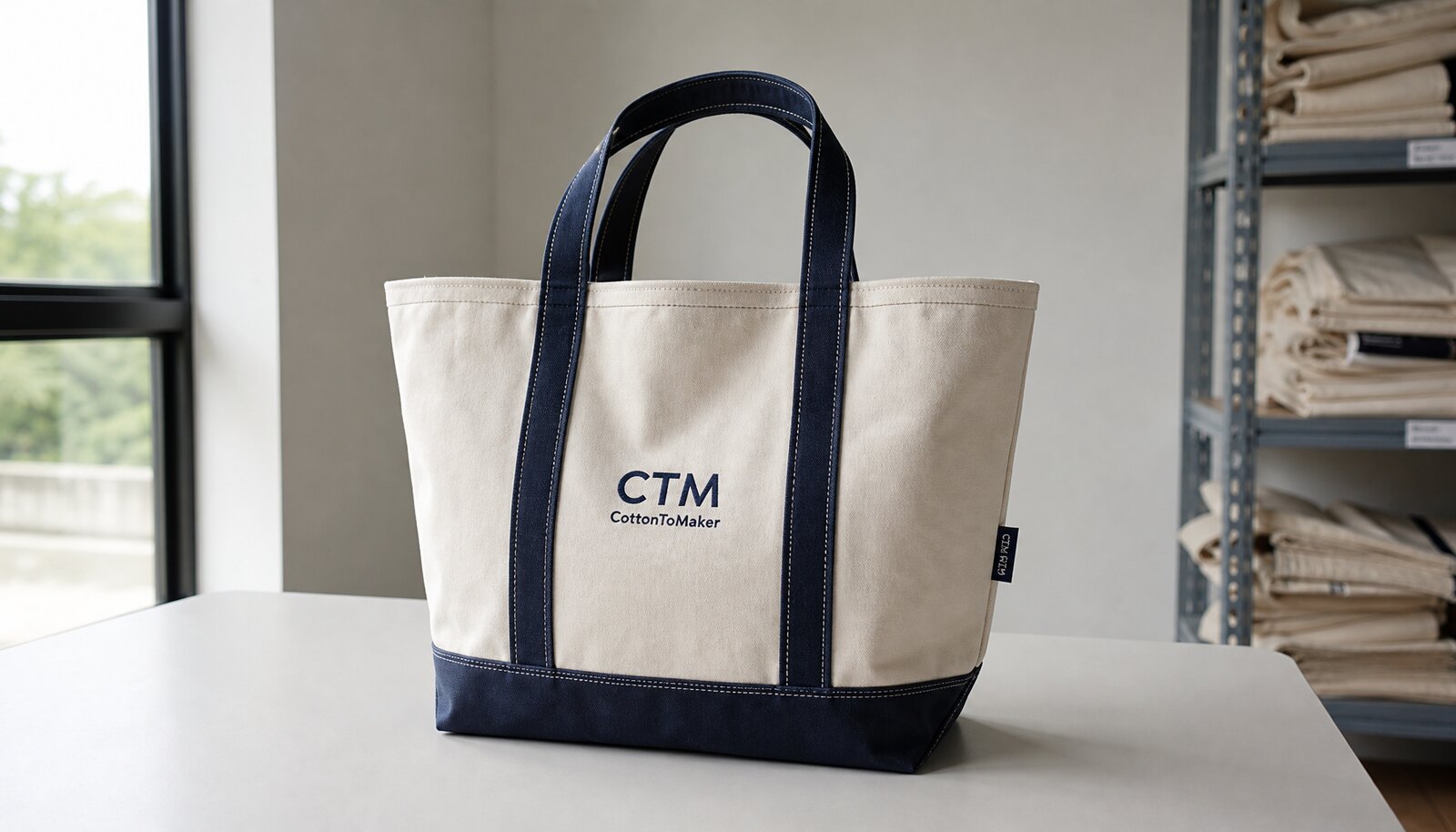
Why Boat And Tote Specs Break Quotations
A custom boat and tote looks simple until the quote starts. Buyers often send only a logo and a target quantity, then get back three prices that are impossible to compare because one supplier priced a soft 10 oz bag, another priced a structured 14 oz version, and a third added a baseboard and woven label. The shape creates hidden choices: how stiff the body should be, whether the bag needs to stand up, how much reinforcement goes into the handles, and whether the bottom panel is one piece or built from multiple panels.
If your RFQ does not lock those points, the supplier will fill the gaps with their standard build. That is where most production mistakes start. The wrong canvas weight makes the bag feel cheap or overly rigid. The wrong handle reinforcement creates returns after first use. A vague print request can move the artwork onto a seam line or push the logo too low for retail display. The first job is not asking for a price. It is making sure every supplier is pricing the same bag.
- Lock the finished size, gusset depth, handle drop, and print area before collecting quotes.
- Define whether the bag must stand upright or can remain soft and collapsible.
- Separate the base bag from the decoration and packing so each cost driver is visible.
Choose Fabric Weight And Body Structure
For most custom boat and tote programs, the right starting range is 12 oz to 14 oz canvas, or roughly 408 gsm to 475 gsm. That range usually gives enough body for a retail-ready shape without turning the bag into a stiff promotional item. A 10 oz canvas can work for light use, events, and lower-cost giveaways, but it will show more distortion under load and may collapse at the top opening. A 16 oz canvas gives a premium heavy-duty feel, but it also raises sewing difficulty, increases freight weight, and can make the handles and corners more demanding on the line.
Do not buy off yarn count alone. Ask for finished fabric weight after any washing, coating, or softening. If the bag is meant for retail or higher-value gifting, you also need to decide on the internal structure. A baseboard improves shelf presentation and carton protection. A light lining can clean up the inside seam finish and reduce fray risk. If the bag must be washable, keep the structure simple and avoid inserts that complicate care instructions.
- 10 oz or about 340 gsm: light promo use, lower cost, softer body, more shape loss.
- 12 oz or about 408 gsm: balanced default for branded programs and resale.
- 14 oz or about 475 gsm and above: premium feel, stronger structure, higher sewing and freight cost.
Set The Handle, Trim, And Reinforcement Rules
Handle design has more effect on usability than most buyers expect. A boat and tote usually needs long shoulder carry, so the handle drop must be defined in the spec, not left to the factory. For many programs, 9 to 11 inches of drop is a practical range, but the right number depends on the finished bag height and whether the bag will sit under the arm or be carried by hand. Handle width also matters. Wider handles distribute weight better and reduce cutting into the hand, but they add fabric and sewing time.
The weakest point in a tote is usually the handle attachment, not the print. Ask for bartacks or X-box reinforcement at the load points and make sure the handle ends are sewn into the body, not just top-stitched lightly onto the seam. If the bag has a side panel or contrasting bottom, the corner seam should be cleaned up so the product does not twist under load. For a retail program, the trim package should also include the side label placement, the stitch color, and any binding on the top edge.
- Require bartacks or X-box reinforcement at every load point.
- Specify handle width and handle drop as finished measurements.
- If the bag will carry heavier items, ask for a reinforced bottom seam and corner support.
Pick The Decoration Method With Real Use In Mind
Screen print is still the default choice for most custom boat and tote orders because it gives a clean logo, durable ink coverage, and manageable cost at volume. It works best for one to three spot colors and a design that can sit cleanly on the front panel. For simple brand marks, screen print is usually the strongest commercial option. If the logo is small and premium-looking matters more than a large graphic, a woven label, sewn patch, or embroidery can work better. Those methods usually look more elevated, but they need tighter placement control and can create a stiffer hand feel.
Heat transfer can be useful for complex artwork or lower quantities, but buyers should treat it carefully. Some transfers look good on the first sample and then fail under repeated folding or abrasion. That is why artwork data matters. Give the factory a vector file, a Pantone reference if color accuracy matters, and exact placement dimensions measured from the top edge and side seam. If the logo will cross a seam or a pocket line, say so up front; otherwise the factory may shift the art to make sewing easier.
- Use screen print for simple, durable, repeatable branding.
- Use woven labels or embroidery for a premium small-mark look.
- Use heat transfer only when the artwork complexity or order size justifies the tradeoff.
Understand MOQ Logic Before You Compare Unit Prices
MOQ on a custom boat and tote is usually driven by setup, not by sewing alone. Fabric cutting, screen preparation, print alignment, label sourcing, and carton packing all create minimum run economics. A supplier may quote one MOQ for the bag body, another for the print color, and a third for the woven label. That does not mean they are trying to confuse you; it means different parts of the build have different setup costs. The danger is taking only the headline MOQ and ignoring the part that actually constrains production.
A clean quote should separate the cost of the blank bag, the decoration, the trim, and the packing. That lets you see whether a higher unit price is simply the result of a smaller run or whether the supplier is padding on the pack line. If you need multiple colors or multiple logos, ask whether the MOQ applies per SKU or for the combined order. A good buyer will also ask what happens if one color sells faster than another. If the supplier cannot split the run logically, your replenishment plan may get stuck behind a single slow-moving variant.
- MOQ can apply per color, per size, per logo version, or per packing format.
- Higher weight canvas, custom dyes, and premium trim usually push MOQ upward.
- Quotes must show setup charges separately from recurring piece cost.
Compare Supplier Routes Before You Compare Quotes
The best sourcing route depends on speed, control, and volume. A domestic decorator using stocked blanks is often the fastest route for a small launch or a tight event deadline, but it gives you less control over canvas weight, body shape, and trim. A direct tote factory is usually the strongest choice for repeat retail or wholesale programs because it can control cutting, sewing, printing, and packing in one place. A trading company can help when the project has many moving parts, but you should expect another margin layer and one more place where specs can drift if the paperwork is loose.
For a custom boat and tote, the route matters as much as the spec. A local print shop can be right for a short test run, but it is a poor benchmark for a factory quote on custom fabric and sewn structure. A factory-direct quote is usually the most useful reference when you care about landed cost at scale, especially if you need custom base panels, stitched labels, and retail-style folding. The best buyers ask each route to price the same complete spec and then compare not just unit cost, but control, lead time, and risk of rework.
- Use a domestic decorator for speed and small test runs.
- Use a direct factory for repeat volume, better control, and lower landed cost at scale.
- Use a trading company only when it adds real coordination value, not just another margin layer.
Approve Samples Like A Production Buyer, Not A Retail Shopper
A sample is not proof of quality by itself. It is proof that the supplier can build the agreed spec once. Start with a pre-production sample or golden sample and compare it against the purchase order line by line. Measure the body size, handle drop, gusset depth, and print placement. Check the fabric weight, the firmness of the base, and the sewing on every high-stress seam. If the bag has multiple components, make sure the sample shows the exact final materials, not a mix of sample stock and future production materials.
Set a tolerance before bulk starts. A useful starting point is to allow a small size tolerance and a tighter print-placement tolerance, because buyers usually care more about logo position than a few millimeters of bag height. For higher-value programs, agree an inspection standard such as AQL and define which defects are major, minor, or critical. A bag with a crooked handle, loose bartack, or ink bleed should fail sample approval even if the overall look is acceptable from a distance.
- Measure the sample against the tech pack, not against memory or a previous order.
- Check print placement, handle symmetry, seam quality, and fabric shade under daylight.
- Keep one approved sample sealed as the bulk reference.
Pack It For Retail, E-Commerce, Or Warehouse Handling
Packing is often treated as a small detail until the first carton arrives crushed or the retailer rejects the fold. A custom boat and tote needs a packing method that protects shape without adding avoidable labor. If the bag is going to a store, ask for a clean retail fold, a consistent insert, and a carton count that keeps the bag flat. If it is going direct to distribution, you may prefer simpler bulk packing, but the outer carton still needs clear SKU marks and a count that can be received quickly. The wrong fold can wrinkle the print or distort the base.
For e-commerce or mixed-channel programs, the carton spec should include net and gross weight, carton dimensions, and barcode location. If the bag uses a polybag, define whether it is individually bagged, bundled, or left open for breathable cotton storage. Ask for moisture protection if the route is long or humid. The point is not making the pack expensive. The point is making it consistent enough that receiving and shelf-ready work do not consume the savings created by the supplier quote.
- Define inner pack count, outer carton count, and carton dimensions in the RFQ.
- Require consistent folding so the logo and handles are not crushed in transit.
- Match packaging to the channel: retail, wholesale, or direct-to-consumer fulfillment.
Build The Schedule Around Real Production Steps
Lead time for custom boat and tote bags is usually a chain of small steps, not one fixed number. Fabric sourcing, cutting, printing, sewing, inspection, and packing each take time, and one delayed approval can stop the next stage. A simple stock-fabric print run can move faster than a custom-dyed or heavily trimmed build. As a planning range, a straightforward order can often move in a few weeks after sample approval, while a more customized program can take longer if the fabric or labels need separate sourcing. The exact window depends on order size and seasonal load.
The main schedule risks are easy to identify if you ask for them early. Artwork changes after sampling, late label approval, carton artwork revisions, and peak-season congestion are the usual causes of slippage. If the order needs to ship for a launch date, build a buffer between production finish and your in-market date. Also ask the factory what happens if one component arrives late. A good supplier can tell you whether the bag body can start before the label arrives or whether the whole line waits. That answer tells you how real the schedule is.
- Ask for a dated production calendar, not just a single lead-time estimate.
- Separate sample approval time from bulk production time.
- Add buffer for artwork changes, carton proofing, and peak-season freight delays.
Compare Landed Cost, Not Just Factory Price
The cleanest way to judge a custom boat and tote quote is to build landed cost from the start. That means separating the ex-factory price from freight, import duty, inland delivery, and any destination handling. A quote that looks cheaper on paper may become more expensive once it includes a stronger box, better folding, or a more realistic freight mode. If one supplier quotes FOB and another quotes EXW, they are not directly comparable until you add the missing pieces. Buyers lose money when they compare incomplete numbers and call it sourcing discipline.
A practical RFQ should ask suppliers to quote the same build on the same terms and then list every included item. If a supplier offers a lower price by removing carton inserts, downgrading the canvas weight, or changing the print method, that is not a savings. It is a different product. The final decision should come from a simple lens: does the quote support the sell price, the channel expectations, and the defect risk you can tolerate? If not, the cheapest quote is just an expensive mistake waiting to happen.
- Compare like for like: same canvas weight, same print method, same pack format, same trade terms.
- Ask for line-item pricing on bag body, decoration, label, packing, and freight if possible.
- Use landed cost per sellable unit, not unit price alone, to choose the supplier.
Specification comparison for buyers
| Spec decision | Recommended option | When it fits | Buyer risk to check |
|---|---|---|---|
| Order size and sourcing route | Factory-direct offshore production for 1,000 to 10,000 pcs; domestic decorator for very small rush runs | Repeat retail, wholesale, or branded program with a defined launch window | A low unit price can hide setup, freight, and domestic handling costs |
| Fabric weight | 12 oz to 14 oz canvas as the default buying range | Retail or premium promo bags that need structure without becoming too heavy | A quote on 10 oz fabric is not comparable to 14 oz if the bag must stand upright |
| Decoration method | Single or two-color screen print for volume; woven label or embroidery for premium small logos | Simple brand marks, repeat orders, and bags that will be folded and handled often | Heat-transfer art may look sharp on sample bags but crack faster on heavy daily use |
| Handle construction | Double-folded handles with bartack or X-box reinforcement | Everyday carry and grocery-style use where load stress matters | Thin handles save cost but create return risk when the bag is loaded |
| Side panels and base | Reinforced base panel or baseboard for structured boat shapes | Retail presentation, display stacking, and bags that must stand upright | A soft base can distort the silhouette and reduce perceived quality |
| Supplier type | Factory with cut-and-sew control and in-house printing | Programs that need fabric, trim, label, and pack control in one place | A trading layer can add margin and slow approvals if the spec is not tight |
| Lead time target | Use blank stock plus local print for the fastest launch; use factory-direct for planned programs | Promotions, seasonal drops, and wholesale replenishment | Rush orders often force compromise on print complexity, packing, or carton mix |
| Landed-cost strategy | Compare FOB or EXW line items plus freight, duty, and inland delivery | Any order where quotes come from different countries or supplier types | The cheapest ex-factory quote is often not the cheapest landed quote |
Buyer checklist before sampling
- Fix the finished size, gusset depth, handle drop, and acceptable tolerance before requesting quotes.
- State the canvas weight in oz and gsm, and say whether the fabric must be pre-washed, brushed, or stiffened.
- Specify the decoration method, print size, color count, and artwork placement measured from seams.
- Confirm whether you need a structured base, lining, baseboard, or only a single-layer canvas body.
- Request the MOQ by color, by artwork version, and by pack format, not just one headline MOQ.
- Ask for sample stages: strike-off, pre-production sample, and top-of-production sample if the order is important.
- Define pack format, carton count, barcode position, and any retail folding or tissue requirement.
- Set the quote basis clearly: EXW, FOB, CIF, or delivered, so freight is not mixed into the unit price.
- Agree the quality standard, inspection method, and defect limits before bulk production starts.
- Confirm lead time with a dated production schedule that includes artwork approval and packing approval milestones.
Factory quote questions to send
- What is the finished canvas weight in oz and gsm after coating, washing, or finishing?
- Is the bag a single-layer body, or does it include lining, baseboard, binding, or extra reinforcement?
- What is the exact print method, print size, number of colors, and artwork placement on the bag?
- What is the MOQ per color, per size, and per artwork version?
- What is included in the unit price: bag, print, label, polybag, carton, and master carton marking?
- Can you quote the same spec on EXW, FOB, and CIF terms so the freight layer is visible?
- What sample stages are included, what is charged, and how many sample revisions are allowed?
- What is your normal lead time after sample approval, and what changes it during peak season?
Quality-control points to confirm
- Finished size matches the approved sample within the agreed tolerance for height, width, and gusset.
- Fabric weight and hand feel match the approved reference, with no visible thin spots or weave defects.
- Handles are the correct length, evenly sewn, and secured with bartacks or reinforced box stitching.
- Print placement, color, and coverage match the approved artwork with no smearing, pinholes, or edge bleed.
- Seams are straight, stitch density is consistent, and there are no skipped stitches or loose threads at stress points.
- Corners, base, and side panels keep the intended shape after filling and light handling.
- Carton count, SKU label, barcode, and outer marks match the packing list and purchase order.
- Pre-production sample and top-of-production sample are signed off before bulk packing starts.