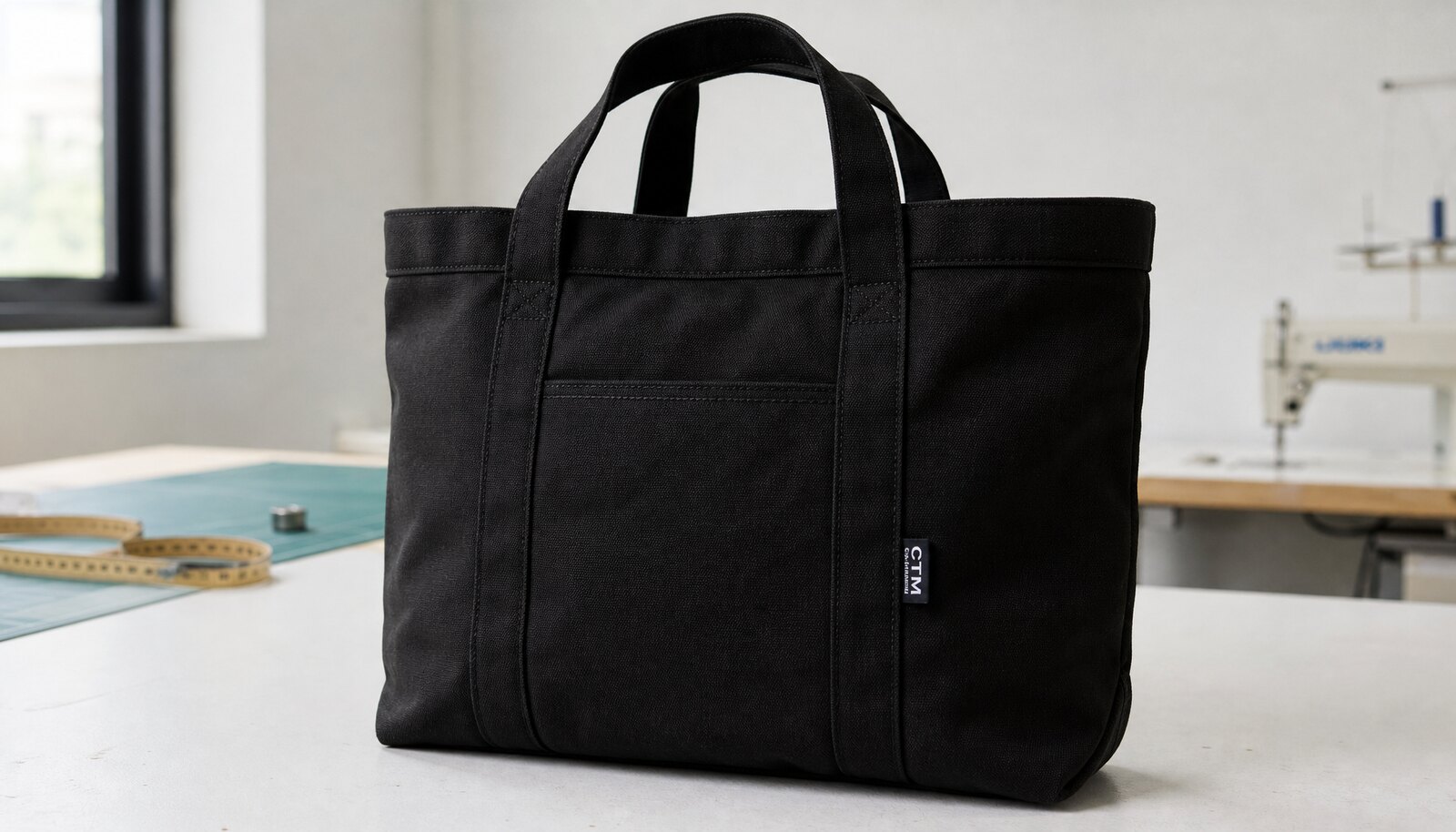
Start With The Use Case, Not The Bag
A custom black canvas tote bag is easy to describe and easy to mis-specify. Black hides some flaws and exposes others. A weak handle, a loose seam, or a slightly off black tone may look acceptable in a quick photo, then fail when the bag is packed, carried, or displayed under retail lighting. That is why the first procurement decision is not the decoration method or the supplier. It is the use case.
A giveaway bag for a conference, a store carrier, a branded gift, and a repeat-use staff tote do not need the same construction. If the bag only needs to survive one event, a lighter canvas and simpler pack-out may be fine. If it needs to carry laptops, catalogs, or bottles on a daily basis, the bag must be built around load, handle stress, and repeat handling. Put that in the RFQ before you ask for a price, or the quotes will optimize the wrong thing.
- Define the job first: promo, retail, internal use, or reusable carrier.
- State the expected load, not just the look.
- Separate one-time event bags from repeat-use bags.
- Match the bag build to the downstream customer, warehouse, or retail shelf.
Lock The Base Spec Before You Price Anything
For black canvas, the body spec matters more than buyers usually expect. As a practical sourcing range, 8oz canvas works for light promo use, 10oz is a common middle ground for general reuse, and 12oz or heavier is better when the bag needs more structure or a premium hand feel. That is only a starting point. Black dye can make a light cloth appear denser, flatter, or harsher than the weight number suggests, so a physical swatch is more reliable than a catalog description.
The RFQ should pin down finished dimensions, gusset depth, handle length, handle width, top hem, stitch count, and any internal reinforcement. If the tote will carry heavier contents, specify bar-tacks or box stitching at the handle root. If the buyer wants a more retail-ready look, define whether you need a lining, pocket, binding, or structured base. Every one of those choices affects cost, lead time, and inspection risk.
- Use a retained swatch to confirm the actual black tone and weave.
- Write the finished size and handle dimensions into the quote request.
- Specify reinforcement at load points instead of assuming the factory will add it.
- Add lining or structure only when the use case justifies the cost.
Choose A Decoration Method That Holds Up On Black
Black canvas changes the decoration problem. Light logos need opacity and edge control, and the cheap option is not always the safe option. For simple one- to three-color artwork, screen print is often the most predictable route because it can build coverage on dark fabric and hold line sharpness. If the logo is small and premium, embroidery or a sewn label can feel more durable than a large printed panel, provided the fabric weight can take the needle density without puckering.
Transfer methods such as DTF or heat transfer can work for small runs and complex artwork, but the factory should prove them on the actual black canvas, not on a random substitute cloth. Thin fonts, gradients, and fine details can survive in artwork software and fail on fabric. Ask for the exact decoration method in the quote, the number of colors, whether a white underbase is needed, and the test used to prove print durability. If the order is sustainability-led or retail-facing, you should also ask what the print system contains and whether it changes the claim story or the care instructions.
- Use screen print for clean, repeatable artwork on dark canvas.
- Use embroidery or labels for small premium marks when the fabric supports it.
- Test transfers on the exact black canvas, not on a substitute material.
- Require a rub-durability check before approving any print method for bulk.
Write An RFQ Suppliers Can Price Cleanly
Most quote disputes come from missing details, not from bad math. A clean RFQ for a custom black canvas tote bag should say the finished size, canvas weight, color standard or physical reference, handle spec, print method, print area, number of colors, packaging format, destination, and Incoterm. If one supplier prices a sewn label and another prices a one-color screen print, the unit price is not comparable even if the total looks close. The same is true for carton count, inner packing, and whether the bag is folded or stuffed.
Ask for line-item pricing rather than a single all-in number. Setup charges, screens, digitizing, label tooling, sample fees, carton artwork, and special packing often sit outside the headline unit price. Also give the supplier your exact reorder quantity, not just a generic target. MOQ logic often changes by process, and a supplier can accept a low body MOQ while pricing the decoration setup as if the run were much larger. That is not a mistake; it is a cost structure the buyer needs to see before approving the order.
- Send one finalized spec to every supplier in the same format.
- Request setup, sample, packing, and freight assumptions as separate lines.
- State the exact reorder quantity so MOQ logic is visible.
- Keep the shipping basis identical across quotes or the comparison is not real.
Vet The Factory, Not Just The Price
A low quote is not useful if the supplier cannot document what they are making. For procurement buyers, factory vetting should start with the boring documents: business license, export capability, relevant audit report if required by your company, and the scope certificate for any certification the supplier claims to hold. If the order involves certified or recycled content, ask whether the printing, sewing, and packing site is actually inside the certificate scope. A certificate that applies to a parent company or a different site is not enough.
For fabric origin proof, do not accept a vague sustainability sentence. Ask for the mill name, composition declaration, lot traceability, and the document chain behind any claim. If the tote is promoted as recycled cotton or organic cotton, ask how the claim is calculated, whether it refers to pre-consumer or post-consumer content, and which transaction or chain-of-custody documents support it. If the supplier cannot produce those documents quickly, the claim should not be written into the product copy or the purchase order.
- Request business license, export capability, and relevant audit evidence.
- Confirm that any certification scope covers the actual sewing and packing site.
- Ask for mill name, lot traceability, and fiber-content proof for any claimed fabric.
- Treat sustainability language as a document exercise, not a marketing sentence.
Approve Samples For Production, Not For Display
A sample for a black canvas tote bag should prove the production process. The right sequence is usually swatch, pre-production sample, then bulk. If the shade matters, compare the black swatch under daylight and indoor light because black fabric can shift from neutral black to blue-black or brown-black depending on the dye lot and finish. If the factory uses a different cloth, thread, or print system for the sample, the approval is not meaningful and should be rejected as a display sample only.
When you sign off a sample, record dimensions, handle length, print placement, seam quality, stitch appearance, and the exact black standard used. Keep one master sample sealed and labeled with the approval date and version number. That gives production and inspection teams one benchmark, which matters when the order moves across shifts, warehouses, or subcontracted processes. Without that control point, disputes about what was approved are almost guaranteed.
- Approve a swatch first if black tone or fabric hand is critical.
- Use a pre-production sample that matches the planned bulk materials.
- Inspect the sample in both daylight and indoor light.
- Seal and label one final master sample for production reference.
Set QC Thresholds Before Bulk Sewing Starts
QC for a black canvas tote should be based on what the buyer will actually see and feel. A useful starting point is AQL 0 for critical defects, AQL 2.5 for major defects, and AQL 4.0 for minor defects, unless your buyer standard is tighter. That puts a number behind the inspection plan instead of leaving the factory to decide what is acceptable. Major defects should include open seams, broken handles, serious print misregistration, visible stains, and dimension failures that affect use or presentation.
For black goods, shade control needs a real method. The cleanest approach is to retain a physical master sample and use a spectrophotometer under D65 light when available, with a buyer-set Delta E tolerance, commonly no more than 1.5 against the approved standard. Also set practical performance thresholds: a handle-root pull test with no failure at 15 kg for 60 seconds is a reasonable minimum for many reusable totes, and 20 kg is a better target for heavier retail use. If the bag is intended for repeated carry, ask for a simple seam pull or load test before release, not after shipment.
- Use AQL 0 for critical, AQL 2.5 for major, and AQL 4.0 for minor unless your program requires tighter limits.
- Set finished-size tolerance at plus or minus 1 cm for the body and handle length.
- Use D65 and a retained master sample for black shade control, with a buyer-set Delta E threshold.
- Require a handle-load test and a seam integrity check before bulk release.
Test Print Durability And Pack-Out Together
A print that looks good on day one can still fail in the carton. On black canvas, rub resistance matters because the surface can show scuffing, powdering, or ink transfer more visibly than lighter fabrics. Ask the factory what ink system they use, what curing method they use, and what rub test they run on the actual fabric. For most buyers, a practical acceptance target is no visible transfer after 20 dry double rubs on white cotton, with a stricter retail target of 50 dry rubs and 20 wet rubs. If the logo is embroidered or patched, ask for pucker control and edge stability instead of only color retention.
Packing is part of the product, not an afterthought. Black canvas attracts lint and shows scuffs, so the fold method, inner protection, and carton count need to be fixed before shipping. If the bags are going into retail or warehouse storage, require a clean inner pack or bundle that prevents rubbing during transit. Define barcode placement, hangtag format, carton marks, and any warehouse carton size limits. A bag that passes sewing QC can still arrive saleable only if it was packed correctly.
- Ask for the actual ink or decoration system and its curing method.
- Use a rub test on the same black canvas that will ship in bulk.
- Require a clean fold or inner pack that prevents scuffing in transit.
- Lock barcode, hangtag, and carton-mark format before production starts.
Manage Lead Time And Change Control Like A Buyer
Lead time on a custom black canvas tote bag is usually driven by more than sewing capacity. Fabric sourcing, black dye lot approval, screen making, sample approval, carton procurement, and freight booking all sit on the critical path. If artwork changes after sample sign-off, the supplier may need new screens or new labels. If the body fabric changes, the shade approval may need to restart. Buyers should ask the supplier to show which steps can run in parallel and which steps reset the clock if they change.
This is where a simple revision-control rule saves money. The order file should name the approved version of the artwork, bag dimensions, fabric weight, decoration method, packing spec, and carton spec. Any change after sign-off should be written as a revision, not handled by email side conversation. That may sound strict, but it prevents the common failure where the factory silently swaps a material or finishes a batch against an older instruction. If the order is tied to a launch date, event, or replenishment promise, build buffer time because one missed approval can move the whole schedule.
- Map the critical path: fabric, decoration, sewing, packing, freight.
- Treat post-approval artwork or material changes as schedule resets.
- Ask which steps can run in parallel and which require sign-off.
- Use version control on the order file so the factory cannot rely on outdated instructions.
Compare Landed Cost And Claim Risk, Not Just Unit Price
A cheap quote is not cheap once setup, packing, freight, duty, and destination handling are added. For black canvas totes, the main cost drivers are fabric weight, handle reinforcement, print coverage, number of colors, lining, labels, and pack-out. A heavier body or more opaque print may be the right commercial decision, but it will change the price structure. Buyers should compare landed cost per usable bag, not the factory gate number alone. That is the only metric that reflects what actually arrives at the warehouse.
If the order includes sustainability-led claims, also compare the risk cost of substantiation. A recycled-content or certified-cotton claim is only useful if the supplier can support it with mill documents, scope certificates, transaction certificates where applicable, and wording that matches what the documentation can actually prove. Do not let sustainability language leak into the product page or customer proposal before the paper trail is checked. In procurement, unsubstantiated claims are not a brand flourish; they are a liability.
- Compare total landed cost per usable bag, not only the unit price.
- Add setup, packing, freight, duty, and handling before choosing a supplier.
- Require proof documents for any recycled or certified fiber claim.
- Match the claim wording to the documents, not the other way around.
Specification comparison for buyers
| Bag option | Typical spec | Best use | Price and lead-time implication | Buyer risk to check |
|---|---|---|---|---|
| Stock blank promo tote | 38 x 42 cm, 8oz canvas, no gusset or shallow gusset, self-fabric handles, local print | Urgent giveaways, event merch, short test runs | Lowest unit cost; fastest if blanks are in stock, but shade and weave are less controlled | Blank bag consistency can vary by batch, and print area may be limited |
| Standard cut-and-sew tote | 38 x 42 x 10 cm, 10oz canvas, 60 x 2.5 cm handles, top hem, one-color screen print | Corporate orders, repeat promotions, general retail use | Mid-range unit cost; usually 20-30 days after sample approval | Need clear reinforcement rules so the quote includes the same build across suppliers |
| Reinforced retail tote | 38 x 42 x 12 cm, 12oz canvas, bar-tacked handles, tighter stitching, optional pocket or lining | Retail shelves, heavier daily carry, premium brand programs | Higher unit cost; more sewing steps and longer sample cycle, often 25-40 days | Check handle attachment strength and whether extra structure changes pack-out and freight |
| Structured premium tote | 40 x 45 x 12 cm, 12-14oz canvas, lining or base board, woven label, detailed finishing | Brand launches, higher perceived value, gift-with-purchase programs | Highest unit cost; setup and sampling add time, usually the slowest option | Watch for hidden costs in lining, labels, and extra trim that make quotes hard to compare |
| Sustainability-claimed tote | 10-12oz canvas with documented recycled or certified cotton content, same size rules as above | Buyer-led sustainability programs, retailer compliance, brand claims | Can cost more if documentation and testing are required; lead time may extend for proof documents | Do not accept vague claims without mill certificates, chain-of-custody papers, and claim wording approval |
| Imported blank plus local decoration | Imported black blank bag, local print or embroidery, final packing closer to market | Fast replenishment, regional fulfillment, small runs | Can reduce logistics time on decoration, but landed cost depends on blank availability and local labor | The body spec and decoration spec may come from different suppliers unless the order file is very tight |
Buyer checklist before sampling
- Finished size, gusset depth, handle length, and tolerances are written in the RFQ and repeated in the approval sample record.
- Canvas weight, weave, hand feel, and black shade reference are approved against a retained physical standard, not only a photo.
- Fabric composition, mill source, and lot traceability are stated if the order includes recycled, organic, or certified content claims.
- Logo artwork, Pantone reference, print method, print area, placement, and required underbase are locked before price comparison.
- The RFQ includes a line item for setup, screens or digitizing, sample fees, packing, and the freight basis used for quoting.
- Reinforcement at handle roots, stitch type, top hem, and any pocket or lining details are specified in writing.
- Packing instructions cover inner pack count, master carton count, carton dimensions, barcode format, and retail label requirements.
- The buyer states the target quantity, reorder quantity, and Incoterm before asking for quotes.
- QC uses one approved master sample and one written defect standard, including AQL, color tolerance method, and rub-test requirement.
- Any change after sign-off follows a revision control rule so the factory cannot switch fabric, print, or packing without approval.
Factory quote questions to send
- What exact canvas weight, weave, and black dye lot will you use for the bulk order, and how do you control lot-to-lot shade?
- Is this tote cut-and-sewn to our spec or made from a stock blank, and which parts of the build are fixed versus optional?
- What print method do you recommend for black canvas on this artwork, and what rub or abrasion test do you use to confirm durability?
- Can you quote body cost, print setup, sample fees, packing, cartons, and any label or hangtag charges as separate line items?
- What is the MOQ for the body, the print method, and the packing format, and do any of those MOQs differ from the headline MOQ?
- Which documents can you provide for factory vetting, including business license, export capability, recent audit, and relevant certification scope?
- If we need recycled or certified cotton, what proof do you have from the mill, and can you support chain-of-custody documents or transaction certificates?
- What pre-production sample steps do you follow, and how long from artwork approval to a sealed sample that matches bulk production?
- What final inspection standard do you apply, including AQL levels, defect classification, and what counts as a critical defect?
- What are your lead time, Incoterm, and freight assumptions, and what happens to time and cost if we change artwork or packing after approval?
Quality-control points to confirm
- Use AQL 0 for critical defects, AQL 2.5 for major defects, and AQL 4.0 for minor defects unless the order risk profile requires a tighter buyer-set standard.
- Set finished-size tolerance at plus or minus 1 cm for body dimensions, plus or minus 0.5 cm for gusset depth, and plus or minus 1 cm for handle length.
- Check black color against the approved master sample under D65 light with a spectrophotometer when possible; target Delta E no greater than 1.5 from the approved standard.
- Require no visible shade jump between panels, handles, labels, and pockets unless the spec intentionally uses mixed materials or trim colors.
- Require handle attachment to survive a 15 kg static load for 60 seconds without seam opening, bar-tack failure, or root tearing; raise the target to 20 kg for heavier retail use.
- Require seam construction to remain intact after a practical pull test, with no open seams, skipped stitches, broken tension, or needle damage at the stress points.
- Require print alignment within plus or minus 5 mm of approved placement and no blur, ghosting, pinholes, cracking, or visible edge lift at first inspection.
- Require dry-rub performance with no visible color transfer after 20 double rubs on white cotton; for retail-grade black print, use 50 dry rubs and 20 wet rubs as the buyer target.
- Reject bags with oil marks, dye stains, lint contamination, loose threads that affect appearance, or puckering that changes the panel shape.
- Confirm carton count, inner pack count, barcode format, and outer carton marks match the packing instruction sheet exactly.