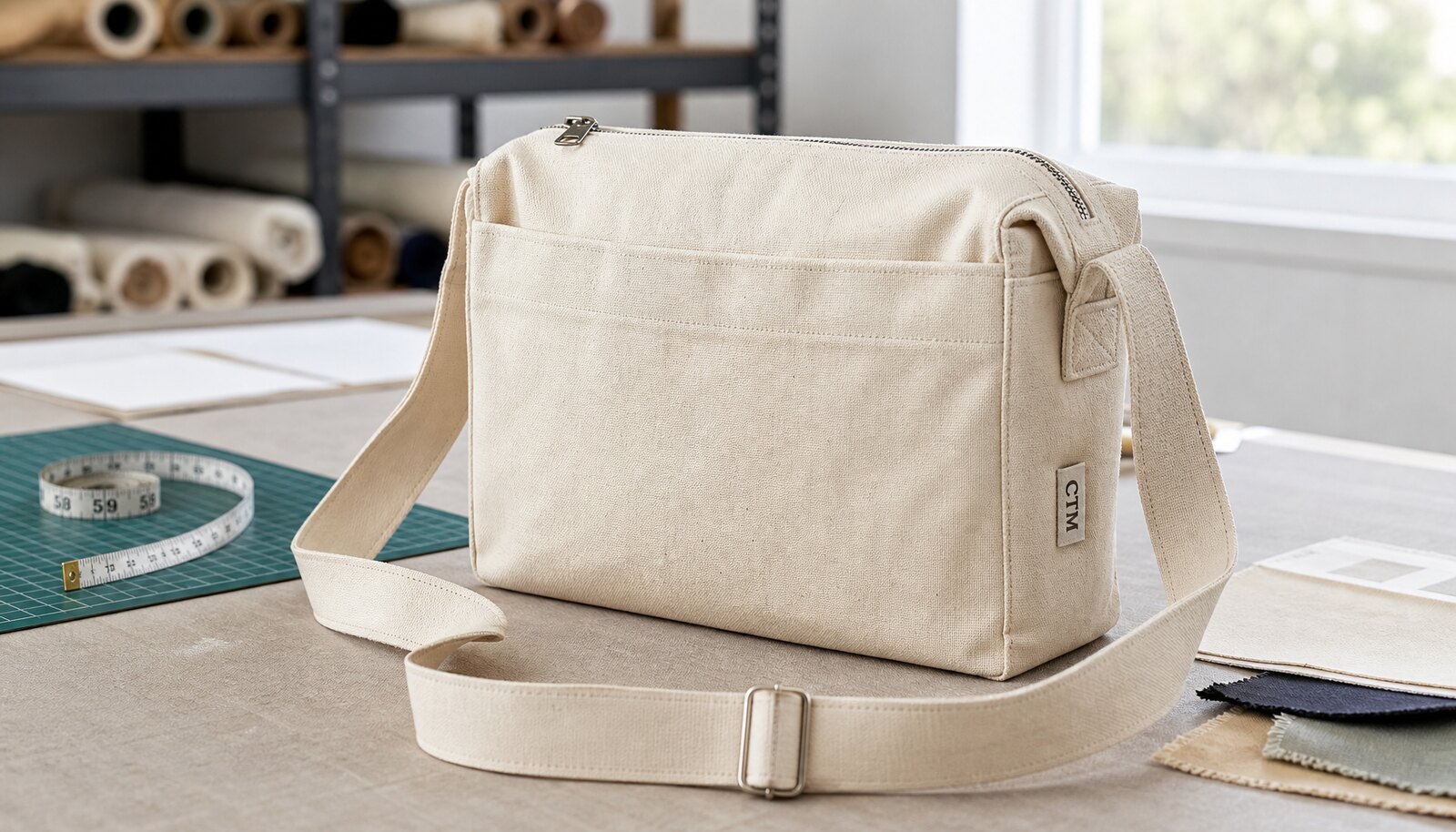
Start with the event use case and the contents it must carry
Crossbody canvas bags for events are not just small totes with a strap. The buying problem is usually hands-free carry, fast access, and a clean brand surface, not general daily use. At a conference, trade show, festival, museum activation, or staff briefing, the bag has to hold practical items without getting in the way: phone, wallet, badge, power bank, sanitizer, sunglasses, pen, and a few pieces of swag. If the bag is too shallow, too narrow, or too flimsy, it creates friction the first time it is used. That is why the first procurement decision is the use case, not the decoration.
The use case changes the build. Attendee giveaways usually need a flatter profile, simpler branding, and the lowest practical unit cost. Staff bags need faster access, better carry comfort, and often a pocket for a badge, pen, or small tool. Premium or retail-style event merch can justify heavier canvas, lining, cleaner topstitching, and upgraded hardware because the bag will be inspected more closely and may be reused after the event. If the team cannot agree on who will use the bag and what it must carry, the quote will drift and the factory will fill in missing details with its own defaults.
- For attendee kits, optimize for speed of use and a clean front panel for branding.
- For staff kits, prioritize strength, pocket access, and strap comfort over extra decoration.
- For premium or resale programs, treat the bag like a small consumer product, not a giveaway.
Set the base construction: fabric weight, size, strap, and closures
Fabric weight is the first real divider between a cheap event bag and one that survives repeat use. For most event programs, 14oz to 16oz canvas is the practical middle ground because it gives the bag enough body to hold shape without feeling overly rigid or adding unnecessary freight weight. Around 12oz can work for very light giveaways, but it tends to feel softer, show contents more easily, and crease faster. Above 18oz, the bag starts to feel more premium and structured, but cost, cutting effort, and shipping weight rise. If a supplier quotes only the word canvas without an oz or GSM reference, the quote is not comparable.
Finished size should follow the content list, not the logo layout. A common event crossbody bag lands around 22 to 30 cm wide, 16 to 22 cm high, and 5 to 10 cm deep, depending on whether it needs to hold only flat items or also a notebook or water bottle. Strap design matters as much as the shell. A strap width of about 25 to 38 mm is common for event use, with 50 mm or a padded section reserved for heavier loads or longer wear times. A practical adjustment range is often about 70 to 135 cm total length, but the right range depends on whether the bag is meant to sit high on the torso or lower at the hip. If the bag includes a zipper, ask for a specific zipper gauge and pull style rather than leaving it to chance. If it is flap-closure only, confirm the closure can survive repeated handling in crowded settings.
- Use 12oz canvas only for very light promo use, not for heavier carry.
- Use 14oz to 16oz canvas for most event programs that need both durability and cost control.
- Specify strap width, adjustment range, hardware finish, and zipper style instead of saying standard strap or standard closure.
- If the bag will carry heavier contents, require bartacks at stress points and confirm seam allowance in the spec sheet.
Choose decoration that survives handling and still looks intentional
Decoration is where many event bag programs become weak. Screen printing is usually the best option when the artwork is simple, the print area is large, and the order is big enough to absorb setup. It gives crisp edges, solid opacity on natural canvas, and predictable repeatability. Heat transfer or digital transfer can be better for smaller runs, gradients, or multi-color art, but it needs testing for edge lift, cracking, and abrasion. Embroidery looks premium, but on canvas it works best for small logos or secondary marks because high stitch density can stiffen the panel and change drape.
Placement matters as much as the method. Keep the primary logo away from seams, zipper tape, and strap stitch lines unless the pattern is built around those features. A logo printed too close to a fold or bartack can distort after sewing and create a mismatch between the proof and the bulk goods. If you want a stronger retail signal, add a woven side label or a small back-tab rather than forcing oversized artwork onto a panel that cannot carry it cleanly. Buyers should also ask for the print tolerance in writing. For canvas event bags, a practical acceptance range is often within 3 to 5 mm for logo position and registration unless the brand standard is tighter. That gives both sides a measurable rule instead of a vague approval conversation.
- Screen print works best for one to two solid colors on flat canvas panels.
- Heat transfer is useful for smaller runs but should be tested for fold, peel, and abrasion resistance.
- Embroidery should stay small unless the fabric weight and panel shape can support the stitch density cleanly.
- Ask the supplier to define placement tolerance and color match method before production starts.
Compare sourcing routes before you compare unit prices
Crossbody canvas bags for events are often sourced through very different channels, and that is why the lowest number on a quote can be misleading. A direct factory can usually control fabric weight, strap build, stitching, and packing more reliably, but it expects a clean specification and does not enjoy vague requests. A trading company or sourcing agent can help when the buying team needs bilingual coordination or consolidation across several products, but the buyer still needs proof of the actual factory and the QC flow. A local decorator working on imported blanks can move quickly when the deadline is tight, but the blank bag itself becomes the risk point.
The table below is a control chart, not a vendor ranking. To compare routes fairly, you need the same finished size, same fabric weight, same decoration method, same strap width, same closure, and same packing count. If one quote is for a 12oz blank with a simple print and another is for a 16oz sewn-to-order bag with zipper and lining, you are not comparing substitutes. Procurement should insist on apples-to-apples pricing before any supplier is evaluated on unit cost alone. The cheapest quote often hides the most assumptions.
- Match fabric weight, decoration, packing, and shipping term before comparing prices.
- Ask who owns QC and who physically touches the bags before carton close.
- Treat marketplace listings as lead generation, not as production evidence.
- Ask for one or two photos of the exact build, not just a similar style image.
Build a quote that exposes the real cost drivers
A usable RFQ for crossbody canvas bags should read like a compact bill of materials, not a slogan. Include finished dimensions, fabric weight, color, weave type, closure type, strap width, strap material, lining, pocket layout, print method, print size, label type, carton count, and any inserts or kitting. The supplier should be able to price each part of the build with minimal guessing. If the quote arrives as a single number with no breakdown, you will not know whether the zipper, slider, inner pocket, or packaging was included. That becomes a problem when you compare alternate suppliers or reopen the order later.
MOQ is usually driven by setup, not just sewing time. One size in one fabric with one print position is the easiest structure to scale down. Add a second colorway, a different zipper, a lining, a second decoration location, or custom carton marks and the supplier has more cutting, stocking, and approval work. Ask for price tiers at 500, 1,000, and 3,000 units if the program may grow, but also ask what changes the MOQ. For event buyers, a slightly higher unit price can be the better decision if it prevents overbuying a style that will not repeat. Procurement should also ask whether the quoted price includes export carton packing or only loose bulk packing, because that difference changes the real landed cost.
- Request separate pricing for sample fee, setup or tooling, unit price, and packaging add-ons.
- Ask for price by quantity tier so you can see where setup cost gets absorbed.
- State acceptable overrun or shortage tolerance before the factory writes the quote.
- Ask whether the carton price includes inner polybags, desiccant, barcode labels, or carton markings.
Use a sample process that proves the build, not just the look
The sample is the only way to test whether the factory understood the build and can repeat it. Ask for a preproduction sample that uses the actual fabric weight, actual print method, actual zipper, and actual strap hardware. A hand-cut mockup made from different materials does not protect you on bulk production. Compare the sample against the tech pack and mark any mismatch before approval. For repeat programs, keep one sealed gold sample tagged by style, color, and print version so future reorders can be checked against the same standard.
Sample approval should focus on the points that are expensive to fix later. Check that the logo sits where the buyer expects it to sit, that the bag dimensions stay within tolerance, that the zipper runs smoothly, and that the strap attaches evenly on both sides. Look for puckering at seam intersections, loose threads at bartacks, and any difference in fabric shade between panels. If the bag carries a lot of visual brand weight, define the acceptance rule for print alignment and color match in writing. A small sample mistake becomes a large carton rejection once bulk starts, especially when the event date is fixed and there is no time for rework.
- Approve the same fabric lot or a clearly signed equivalent before bulk cutting.
- Test the bag with the actual event contents, not with an empty shell.
- Keep the sealed gold sample with the buyer, not only with the supplier.
- Use the sample to confirm strap length in the worn position, not only on a flat table.
Specify packing, carton specs, and kitting for the real distribution path
Event buyers often care more about how the bag arrives at the warehouse or venue than how it ships from the factory. That is why packing needs to be part of the quote, not an afterthought. Decide whether the bag ships flat, semi-folded, stuffed for presentation, in a polybag, with a barcode sticker, or with an insert card. Polybag protection can help with dust and transit marks, but it adds labor and slows down venue distribution. If the bag will be handed out immediately, the most efficient pack may be flat-packed with a clear outer label and no extra wrapping.
Carton logic matters because the order will often move through multiple handling points. Ask for carton dimensions, gross weight, units per carton, and whether there is a carton weight cap you need to respect for warehouse handling. A common event carton target is roughly 10 to 15 kg gross weight so receiving teams can move it easily, but the right number depends on your distribution model. If the bags will be kitted with inserts, lanyards, tickets, or product cards, define whether that work happens at the factory or at a 3PL. The labor split changes cost and can change schedule, especially when the event date is fixed and the receiving window is narrow.
- State whether the bag should ship flat, semi-folded, or fully stuffed for presentation.
- Require carton marks that match your SKU and warehouse labels.
- Document insert count and kitting responsibility before the PO is issued.
- Ask for a carton spec that includes dimensions, gross weight, and unit count so the warehouse can plan receiving.
Plan compliance and regional sourcing detail before you commit
For procurement teams buying across regions, compliance is not just paperwork. If the bags are going into the EU or UK, ask for restricted substance information aligned to the destination market, especially if the bag uses coatings, prints, synthetic trims, or metal hardware. For the US, brands often also request a California Proposition 65 review when products are distributed there, and if the bags are for children, the buyer should check CPSIA-related requirements, including lead limits and any applicable testing expectations. None of this is automatic; the buyer has to define the market and ask for the relevant documentation early.
Regional sourcing also changes landed cost and risk. China, Vietnam, India, and Southeast Asia can all be strong sourcing bases for canvas bags, but the right choice depends on order size, print complexity, port access, and the supplier's track record with your required build. If you are moving goods into North America, sea freight can be cost-efficient for larger runs but needs more schedule buffer. If you are shipping into Europe, customs classification, VAT handling, and port congestion can affect the final delivered cost more than the factory quote suggests. Ask suppliers to quote on the same Incoterm, then compare the same delivery point, or the numbers will not line up. Social compliance is worth requesting as well, but it should be treated as one input among many. BSCI, SMETA, or similar audit records can help, yet they do not replace product-specific QC or material compliance.
- Define the destination market before requesting compliance documents.
- Ask for restricted substance declarations when the bag includes coatings, prints, or metal hardware.
- Compare quotes using the same Incoterm and the same delivery point.
- Request audit evidence if your policy requires it, but still verify product-specific QC.
Use landed cost, not unit price, to make the final choice
The right buying decision is not always the lowest ex-factory number. For crossbody canvas bags for events, landed cost includes the bag, setup, packing, inland movement, international freight, duty, and any kitting or relabeling. A slightly more expensive factory quote can still win if it reduces rework, lowers defect risk, or arrives in a carton format that saves labor at the warehouse. Procurement teams should compare not just unit cost but the total cost to deliver a ready-to-distribute bag at the event site or fulfillment center.
A simple illustrative example helps. Suppose Supplier A quotes $2.10 ex-factory for a 14oz bag with one-color print, flat pack, and standard carton loading. Supplier B quotes $2.45 ex-factory for the same apparent style but includes a zipper upgrade, stronger strap attachment, carton labels, and better print placement control. If freight, handling, and rework on Supplier A add even a small amount per unit, the gap can narrow quickly. In event programs, hidden labor is often more expensive than visible unit price. That is why the best order is the one with the fewest assumptions and the clearest delivery standard.
- Compare total landed cost, not only ex-factory price.
- Reward suppliers that can document the same build across repeat orders.
- Prefer the route that reduces rework when the event date is fixed.
- Ask for an all-in estimate that includes freight, duty, carton packing, and any warehouse relabeling.
Specification comparison for buyers
| Spec decision | Recommended option | When it fits | Buyer risk to check |
|---|---|---|---|
| Direct factory | Best when you need custom dimensions, custom pocket layouts, and repeatable QC | Repeat event programs, private label merch, and larger annual buys | Confirm the factory has actually produced crossbody bags, not only totes or simple pouches |
| Trading company or sourcing agent | Useful when you need bilingual coordination, multi-category consolidation, or support across several suppliers | Small internal teams or mixed accessory programs | Verify who owns QC, who signs off on specs, and whether audit evidence is available |
| Local decorator on imported blanks | Fastest route for short event deadlines and simple logo work | One-off campaigns, conference deadlines, and rapid replenishment | Validate the blank bag construction before decoration, not after |
| Stock blank bag + factory print | Good for pilot runs or market testing with modest customization | When you want lower development risk and shorter lead time | Stock color, strap length, and zipper style may not match future reorders |
| Domestic cut-and-sew supplier | Works when logistics speed and low communication friction matter most | Short lead times, local compliance, or smaller reorders | Unit cost can rise quickly once lining, hardware, or custom packaging are added |
| OEM factory with accessory focus | Best balance for custom closures, internal pockets, and cleaner finishing | Retail-ready event merch or premium attendee kits | Require a preproduction sample and written spec sheet |
| Marketplace reseller | Use only for early price discovery, not final production control | Very small trial orders or concept validation | The source is often hidden and listing photos may not reflect actual build quality |
| Factory plus 3PL kitting | Best for event packs with inserts, labels, or venue-specific sorting | Conference bundles, VIP kits, and retail promo boxes | Document every insert, count, and carton label in writing |
Buyer checklist before sampling
- Define the event use case: attendee giveaway, staff kit, VIP pack, or retail merch.
- Lock the finished size, target contents, and required pocket or closure layout.
- Specify fabric weight or GSM, color, weave style, and whether the canvas is plain, duck, or washed.
- Choose one decoration method and one primary logo placement before requesting quotes.
- State strap width, adjustment range, hardware finish, and whether the strap is matching or contrasting.
- Confirm packing format, carton count, barcode label needs, and any kitting work.
- Request sample, setup, and tooling costs separately from the unit price.
- Set acceptable tolerances for size, print placement, color, and carton count.
- Ask for a landed-cost estimate that includes freight, duty, and any warehouse relabeling or kitting.
- Confirm compliance needs by destination market before production starts.
Factory quote questions to send
- What fabric weight, weave, and finish are included in this quote, and is it measured in oz or GSM?
- Are the zipper, slider, lining, strap hardware, and inner pocket included or treated as extras?
- What is the MOQ by color, by print method, and by decoration placement?
- What is the sample cost, sample lead time, and what sample type will you send first?
- What is the finished bag size, strap width, strap adjustment range, and seam allowance you are pricing against?
- What print tolerance do you hold for logo placement, color match, and registration on canvas?
- How will you control seam alignment, bartacks, and zipper tape stitching on production units?
- What packing configuration, inner count, carton size, and gross weight are included in the quote?
- Can you provide photos or video of a similar crossbody canvas bag already in production?
- What is the lead time by quantity, and what part of the timeline is most likely to move?
Quality-control points to confirm
- Verify fabric weight, weave density, and color against the approved sample or standard swatch.
- Check finished bag dimensions, pocket placement, and strap length on random units from the lot.
- Inspect logo size, position, and print sharpness under normal viewing distance and under raking light.
- Measure print placement tolerance; for most event bags, a practical target is within about 3 to 5 mm from the approved artwork position unless your brand standard is tighter.
- Test zipper movement, zipper tape stitching, and pull strength through repeated open-close cycles.
- Review seam straightness, bartacks, loose threads, and stress points at strap attachment.
- Check for stains, holes, shading, lint, and visible canvas weave defects.
- Load-test the bag with the expected event contents and confirm it hangs and carries correctly.
- Confirm carton marks, label placement, unit count, and overrun or shortage tolerance before release.
- Check inner bag consistency across cartons so one lot does not mix strap lengths, zipper colors, or print shades.