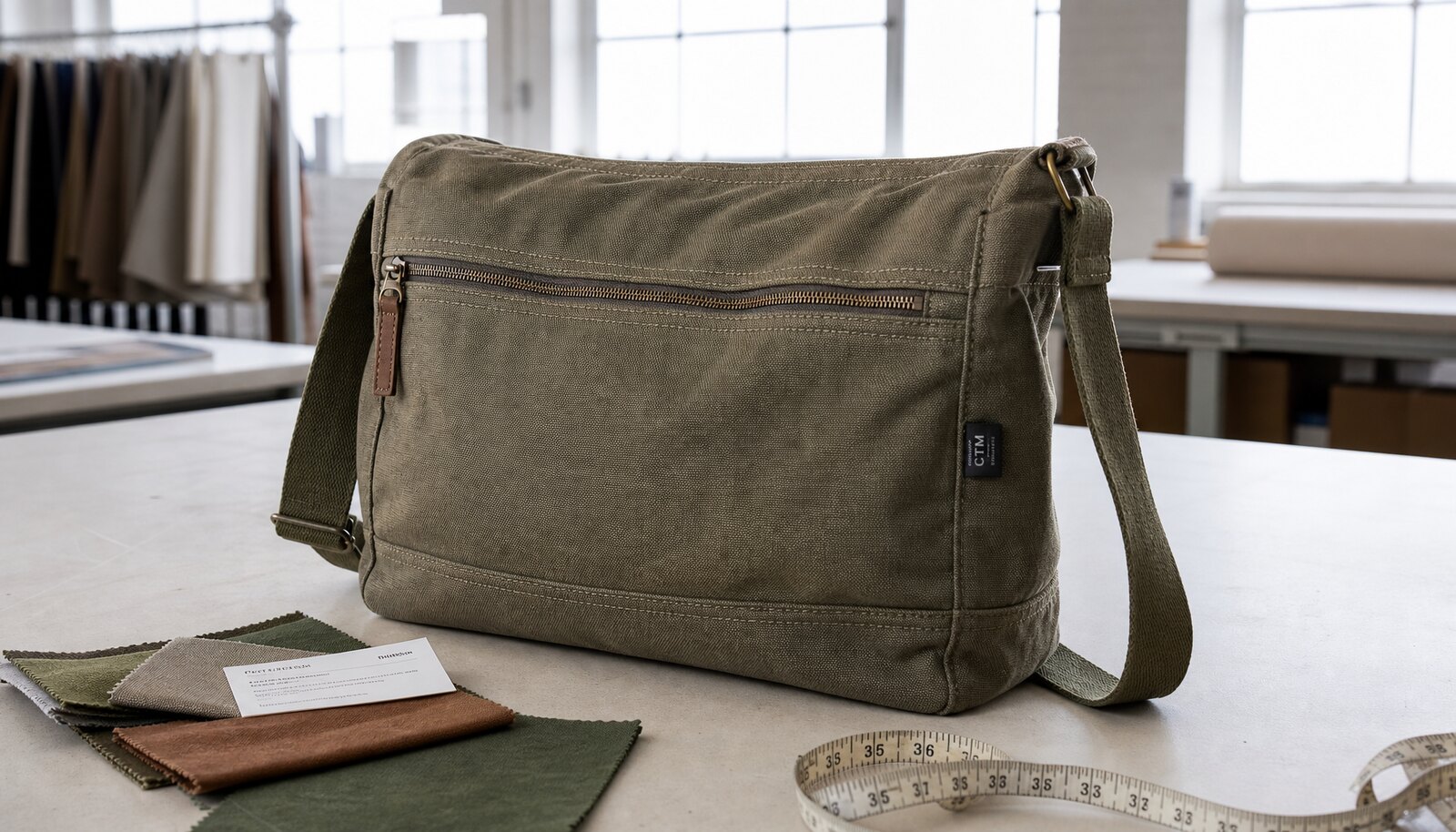
Why Crossbody Canvas Bags Work for Corporate Gifts
Crossbody canvas bags sit in a useful middle ground for corporate gifting. They carry more perceived value than a flat pouch, feel more useful than a logo-only giveaway, and stay visible after the event instead of disappearing into a drawer. That makes them a strong fit for procurement teams that want repeated brand exposure without moving into expensive leather or molded premium goods.
The format also gives buyers a lot of control over cost. Canvas is easy to print, easy to sew, and available in enough weights and finishes to fit both budget campaigns and more polished gift programs. The risk is that this category looks cheap very quickly if the fabric is too light, the strap hardware is weak, or the logo is applied without enough ink or stitch density. For corporate gifts, the bag has to survive actual use and still look intentional.
- Best fit: trade shows, onboarding kits, client appreciation boxes, conference packs, and travel-friendly gifts
- Poor fit: highly formal executive gifts, very bulky gift sets, or campaigns that need a rigid retail box presentation
- Key buyer value: large printable surface, predictable sewing labor, and broad control over cost and presentation
Lock the Spec Before You Ask for Quotes
Most poor quotes start with a vague request like crossbody canvas bags with logo. That is not enough for a factory to price accurately, and it is not enough for a buyer to compare suppliers. A usable RFQ needs the bag dimensions, canvas weight, lining choice, closure type, strap construction, logo method, and packing format. If one supplier assumes an 8 oz body and another prices a 12 oz body, the numbers are not comparable even when the totals look close.
For corporate gifts, the sweet spot is usually a medium-bodied canvas that holds shape without feeling stiff. Many programs land around 10-12 oz canvas, or roughly 340-420 gsm, depending on weave and finish. If the gift needs a more premium feel, add a lining, a reinforced base, or stronger strap anchors. If the goal is a light event giveaway, reduce weight carefully, but the bag still needs to carry a notebook, a bottle, and small accessories without collapsing.
- State the exact body size and gusset depth instead of saying large or medium
- Specify canvas weight in oz or gsm, not just cotton canvas
- Define strap material, strap width, and the minimum and maximum strap drop
- Include pocket count and closure type if the bag must be secure for travel
- Ask for the same spec sheet to be used across every supplier so quotes can be compared on equal terms
Compare Supplier Routes, Not Just Unit Prices
A direct factory is usually the strongest option when the spec is fixed and the buyer wants control over fabric weight, stitching, print placement, and packing. You are buying production discipline, not a sales promise. That works well when you can consolidate volume, approve one master sample, and keep the artwork stable across reorders. The tradeoff is that direct factories often want a clearer MOQ and less last-minute change.
A trading company or sourcing agent can make sense when the program is smaller, the SKUs are mixed, or the buyer wants one point of contact across formats. That convenience can be real, but it should not hide the fact that someone else is handling factory allocation and sometimes also packing. On a landed-cost basis, a trading company often comes in 5-15% above a direct factory quote, while a local distributor is usually the fastest but also the most expensive route.
- Direct factory: best for repeat orders, stronger control, and lower hidden markup
- Trading company: useful for coordination, but verify factory identity and process ownership
- Local distributor: useful for speed, but usually weaker on spec depth and price control
- Ask every supplier to state which steps are in-house and which are outsourced
Read the Quote Like a Production Document
A useful quote for crossbody canvas bags should break down more than one total unit price. It should tell you which fabric is included, whether the strap is cotton webbing or polyester, whether the zipper is branded or generic, and whether the bag includes lining, interfacing, or a front pocket. If all you get is one line with a price and delivery window, you still do not know what you are buying. That is where procurement teams get trapped in apples-to-oranges comparisons and end up paying more later for corrections.
The real cost drivers are usually not mysterious. Fabric weight, bag size, number of seams, print color count, hardware quality, and packing format are the usual levers. For planning, many RFQs fall into three rough ex-works bands at common corporate-gift quantities of 300-1,000 pcs: under $3.50 for a minimal build, $3.50-$6.50 for a better standard bag, and $6.50-$10+ for a more finished or gift-style build. Use those numbers as budgeting guardrails, then confirm with current quotes and freight.
- Confirm whether tooling, plates, screens, or embroidery setup are included
- Separate unit price from packing, carton, and domestic handling charges
- Ask whether the quote assumes natural canvas, dyed canvas, or washed canvas
- Request a second price break at a realistic reorder quantity
- Compare the quote as landed cost, not only as ex-works price
Branding Choices That Hold Up in Real Use
For this product, branding method changes both cost and appearance more than many buyers expect. Screen print is usually the cleanest option for simple one- or two-color logos on natural or dyed canvas. It gives you a direct cost advantage on larger runs, but it only works when the artwork is built for print, not when the logo contains tiny text or thin gradients. Embroidery looks premium, but on lighter canvas it can pucker, and dense stitching adds labor time.
A woven label or sewn side label is often the safest route when the logo needs to stay subtle and the bag should still read as a corporate gift rather than a promotional giveaway. The quote should show the branding method, the number of colors, the placement, and whether setup or tooling fees are included. If the supplier is quoting heat transfer or digital print, ask how the ink behaves on folded canvas and whether the finish will crack or fade after handling.
- Use screen print for large simple logos and repeat programs
- Use embroidery when the gift is supposed to feel more premium and the logo is not too detailed
- Use woven or sewn labels when you want lower risk on textured canvas
- Ask for artwork guidelines before approval so line weight and text size are set correctly
- If the logo has fine text, ask the supplier to show the minimum readable size on canvas
Use Samples to Remove Avoidable Risk
For this category, the sample is not a formality. It is the fastest way to catch weak strap attachments, poor logo placement, and material handfeel that does not match the buyer's expectation. A digital proof can only show artwork position. It cannot prove how the canvas sits, how the zipper closes, or whether the strap anchors survive load. The approval process should therefore include a pre-production sample or at least a fully built strike-off on the correct fabric with the correct print or embroidery method.
Before approving bulk, make the sample do real work. Load it with a notebook, a bottle, and a tablet sleeve; check whether the strap length is comfortable across the body; look at print clarity from arm's length; and inspect the seam lines where the strap meets the body. If the bag has lining, turn it inside out and confirm that the internal seams are trimmed cleanly. A sample that only looks acceptable on a desk is not enough for corporate gifting.
- Approve sample color under daylight and under indoor light
- Test strap drop with a realistic load, not an empty bag
- Check zipper pull, pocket size, and logo placement before signing off
- Keep the approved sample or signed sample card as the production reference
- Treat any change after sample approval as a controlled revision, not a casual tweak
Set QC Thresholds That a Factory Can Actually Follow
Good QC language is specific enough that a line supervisor can use it without guessing. For crossbody canvas bags, that means defining size tolerance, stitch consistency, logo placement tolerance, acceptable color variation, and the level of cosmetic defects that are allowed. If the bag is going to a corporate audience, the buyer should be strict on visible defects like skipped stitches, crooked logo placement, or dirty marks on the front panel. These are not minor issues; they are the first things a recipient sees.
It is also worth setting functional acceptance criteria. Zippers should run smoothly. Strap hardware should not twist under normal use. Bartacks should hold at the strap anchor points. If you are using metal sliders or clips, plating should not flake or rust in transit. For natural canvas, some shade variation is normal, but the buyer should define what counts as acceptable panel-to-panel consistency so the shipment does not arrive with a mixed look that feels unplanned.
- Define the tolerance for dimensions and logo placement before inspection starts
- Reject visible stains, crooked stitching, and broken zipper function
- Set a clear rule for acceptable color variation across panels and cartons
- Use a pre-shipment inspection on packed goods, not only on loose samples
- For gift programs, treat visible front-panel defects more strictly than hidden inside defects
Packing Choices Change Presentation and Freight Cost
Corporate gift bags do not always need retail-style packaging, but they do need controlled presentation. Bulk packed canvas bags can arrive with wrinkles, rub marks, and dust if the packing method is too loose or if the factory uses a carton count that compresses the product excessively. For a campaign where recipients open the bag directly, a simple polybag with a clean insert card can be enough. For higher-value gifting, tissue paper, a branded belly band, or a small hangtag can lift the perception without turning the bag into an expensive retail box item.
Packing also affects freight efficiency. A low-cost bag that ships in a poor carton plan can lose its cost advantage in cubic volume. Ask the supplier for carton dimensions, units per carton, gross weight, and whether the bags are nested, flat packed, or filled to hold shape. If the bag has a structured front pocket or a stiffened base, the carton plan should preserve that structure rather than crush it flat. The best packing choice is the one that protects the product and still gives you a reasonable cube.
- Bulk pack for cost control and efficient shipping
- Polybag plus insert card for a cleaner gift presentation
- Tissue or belly band when the bag is handed out without outer packaging
- Confirm carton load so the bag shape is not crushed
- Ask for carton measurements early because freight cost often changes more than the unit price does
Plan Lead Time and Reorders Around Change Control
Lead time on crossbody canvas bags is not just sewing time. It is fabric sourcing, print or embroidery setup, sample approval, line scheduling, packing, and final inspection. The biggest schedule risk usually comes from delayed artwork or a late change to the logo method. If the supplier has to re-cut, re-screen, or re-sample after approval, the shipment date moves even if the factory is otherwise efficient. That is why a tight RFQ should include the target delivery date, the sample approval deadline, and the allowed date for artwork lock.
A practical schedule for standard custom bags is often 7-15 days for a sample and 20-35 days for production after approval, with embroidery, dyeing, or more complex packing pushing the window longer. Reorders are faster only when the spec remains unchanged. If you want reorder stability, spell out what stays fixed: canvas weight, strap width, logo file, packaging, and carton pack count. That protects you from quote drift when the next event or campaign comes around.
- Include target ship date, sample date, and artwork lock date
- Send one reference spec to every supplier so pricing is comparable
- Ask suppliers to confirm what changes will trigger a revised quote
- Require a landed-cost view if freight and duty matter to the budget
- Put reorder pricing in writing if the program is expected to repeat
Review Supplier Quotes for Red Flags, Not Just Line Items
The last step is not comparing totals. It is checking whether each supplier answered the same questions with the same level of precision. A strong quote should name the fabric weight, branding method, packing format, sample charge, sample lead time, production lead time, and the specific assumptions behind the unit price. If one supplier is vague about any of those, the apparent price advantage is probably not real. It is just unpriced uncertainty.
Watch for red flags that usually show up later in production. If the supplier will not separate factory price from service fee, ask why. If the sample is only a digital proof, expect more risk. If the quote is unusually low but omits carton details, setup charges, or packing, it is probably not a clean comparison. For procurement, the right answer is not the cheapest number. It is the quote that can survive sample approval, inspection, and distribution without surprise costs.
- Reject quotes that do not state fabric weight, logo method, and packing format
- Push back when sample fees, setup fees, or carton costs are hidden in the total
- Ask for a second quote that keeps the spec fixed and changes only quantity
- Treat vague answers about inspection or outsourcing as a risk signal
- Prefer the supplier who gives precise assumptions over the supplier who only gives the lowest price
Specification comparison for buyers
| Spec decision | Recommended option | Typical MOQ / sample / lead time | When it fits | Buyer risk to check |
|---|---|---|---|---|
| Fabric weight | 10-12 oz canvas, or 340-420 gsm equivalent | MOQ 300-500 pcs; sample fee often $20-$80; production 20-35 days after approval | Most corporate gift programs that need a bag with enough body to look premium and survive repeated use | Too light looks soft and cheap; too heavy raises cost, makes sewing harder, and can slow production |
| Supplier route | Direct cut-and-sew factory | MOQ 300-1,000 pcs; custom sample $20-$80; lead 3-5 weeks after sample approval | Medium to large programs with stable specs, repeat orders, and a need for tighter control on fabric and stitching | MOQ may be higher and communication must be precise; confirm who owns printing, packing, and carton loading |
| Supplier route | Trading company or sourcing agent | MOQ 100-500 pcs; sample fee $20-$100; lead 3-6 weeks | Smaller or mixed-product programs where one buyer wants easier coordination across formats | Often 5-15% higher landed cost than a direct factory quote; verify factory identity and separate service fees |
| Supplier route | Local promotional distributor | MOQ 25-100 pcs; stock sample or $0-$30; lead 1-3 weeks | Rush campaigns, event deadlines, or domestic compliance needs where speed matters more than unit cost | Highest landed cost of the three routes; limited customization and less visibility into factory process |
| Branding method | 1-2 color screen print | MOQ 100-300 pcs; strike-off $15-$40; lead 7-14 days | Simple logos, large repeats, and cost-sensitive corporate gift runs | Ink hand feel, print alignment, and color density must be controlled; fine details can fill in or blur |
| Branding method | Embroidery or woven label | MOQ 100-300 pcs; sample $30-$120; lead 10-20 days | Premium gifting, executive sets, or logos that must keep a more tactile retail look | Embroidery can pucker on thin canvas; woven labels need clean placement and accurate thread color matching |
| Packing route | Bulk pack plus individual polybag plus master carton | Low added unit cost, but carton size and count affect freight; sample pack usually not needed | Large corporate distributions where unit cost and cube efficiency matter | Scuffing, dust, and print abrasion can occur if bags are packed too tightly or without inner protection |
| Structure choice | Single compartment with one front pocket or no pocket | Lowest labor complexity; sample and lead time are usually fastest | Campaigns that need clean branding, better speed, and lower cost | Too many pockets, zippers, or linings can push the bag out of budget and create more QC failure points |
Buyer checklist before sampling
- Define the end use first: event giveaway, employee welcome kit, client gift, or retail resale. That decision drives bag size, strap comfort, and presentation level.
- Lock the dimensions in writing, including body width, height, gusset depth, strap width, strap drop, and pocket layout. Use measurable tolerances rather than words like medium or roomy.
- Specify canvas weight in oz or gsm, plus finish and color intent. State whether you want natural, dyed, washed, or recycled-looking canvas.
- Choose one branding method per RFQ set so the pricing is comparable across suppliers. Do not ask one supplier to quote print, embroidery, and woven label in the same line item without separation.
- Request a physical pre-production sample or strike-off before bulk approval. A digital proof cannot show stitch behavior, zipper action, or strap feel.
- State packing requirements clearly: bulk pack, polybag, tissue, belly band, insert card, hangtag, or gift box. Ask the supplier to quote each change separately.
- Ask for carton pack count, carton size, gross weight, and loading estimate if freight cost matters. Small carton changes can move your landed cost more than a small unit-price change.
- Build in objective acceptance limits for size, color, logo placement, and stitch quality. Inspection should not depend on subjective language.
- Set the delivery date, sample approval deadline, and artwork lock date before you ask for the quote. A quote without schedule assumptions is not comparable.
- Keep the approved sample, signed artwork, and approved packaging plan together as the production reference for reorders and inspection.
Factory quote questions to send
- What exact canvas weight, weave, and finish are you quoting, and is the fabric pre-shrunk or washed?
- What is the MOQ for this exact bag size, strap construction, and branding method, and does the MOQ change with color count or packaging?
- What is included in the unit price: material, cutting, sewing, print, lining, strap, packing, and carton, and what is excluded?
- What is your sample fee for a custom pre-production sample, and is it refundable or creditable against the bulk order?
- What are the sample lead time and production lead time after sample approval, and what changes add extra days?
- Which steps are in-house and which are outsourced, especially printing, embroidery, packing, and carton loading?
- What artwork format do you need, and what are your rules for logo size, line thickness, and minimum text height?
- What are the acceptable tolerances for body size, strap length, and logo placement, and how do you inspect them?
- What carton pack count, carton size, and gross weight do you recommend to protect the bags and keep freight efficient?
- What quality checks do you perform before shipment, and can you share the inspection checklist or rejection criteria?
Quality-control points to confirm
- Measure body width, height, gusset depth, strap length, and strap width against the approved spec. Use recorded tolerances, not approximate fit. A practical target is plus or minus 5 mm on smaller dimensions and plus or minus 10 mm on larger panels, with strap length held within plus or minus 20 mm.
- Inspect the front panel logo position against the signed sample or artwork map. Require placement within plus or minus 5 mm of the agreed centerline or reference point, with no visible blur, double image, or color mismatch.
- Check canvas surface quality for stains, grease marks, holes, thick slubs, weave skips, and obvious dye variation. For gift programs, any visible mark on the front panel should be treated as a major defect.
- Run each audit zipper through at least 10 open-close cycles. Reject any zipper that catches, splits, jumps teeth, or leaves a crooked pull track.
- Load-test the strap and anchor points with a representative carry load. The anchors should not shift, fray, or open, and bartacks should remain tight and even after repeated lifting.
- Inspect seam allowance and stitch consistency on visible seams. Ask the factory to state stitches per inch or cm and keep that level consistent on the same seam family.
- Verify hardware finish for scratches, burrs, rust spots, loose plating, or uneven color if the bag uses sliders, clips, rings, or buckles.
- Check odor, lint, and dust levels on packed goods. Bags for gift distribution should not arrive with mold odor, oil smell, or heavy packing dust.
- Audit carton counts, carton labels, and SKU separation before shipment. Cartons should match the purchase order quantity exactly, unless a clearly labeled overrun or split shipment was approved in writing.
- Review at least one sealed carton per batch for compression damage, print rub, and pack consistency. The goal is to catch damage before the container closes, not after delivery.