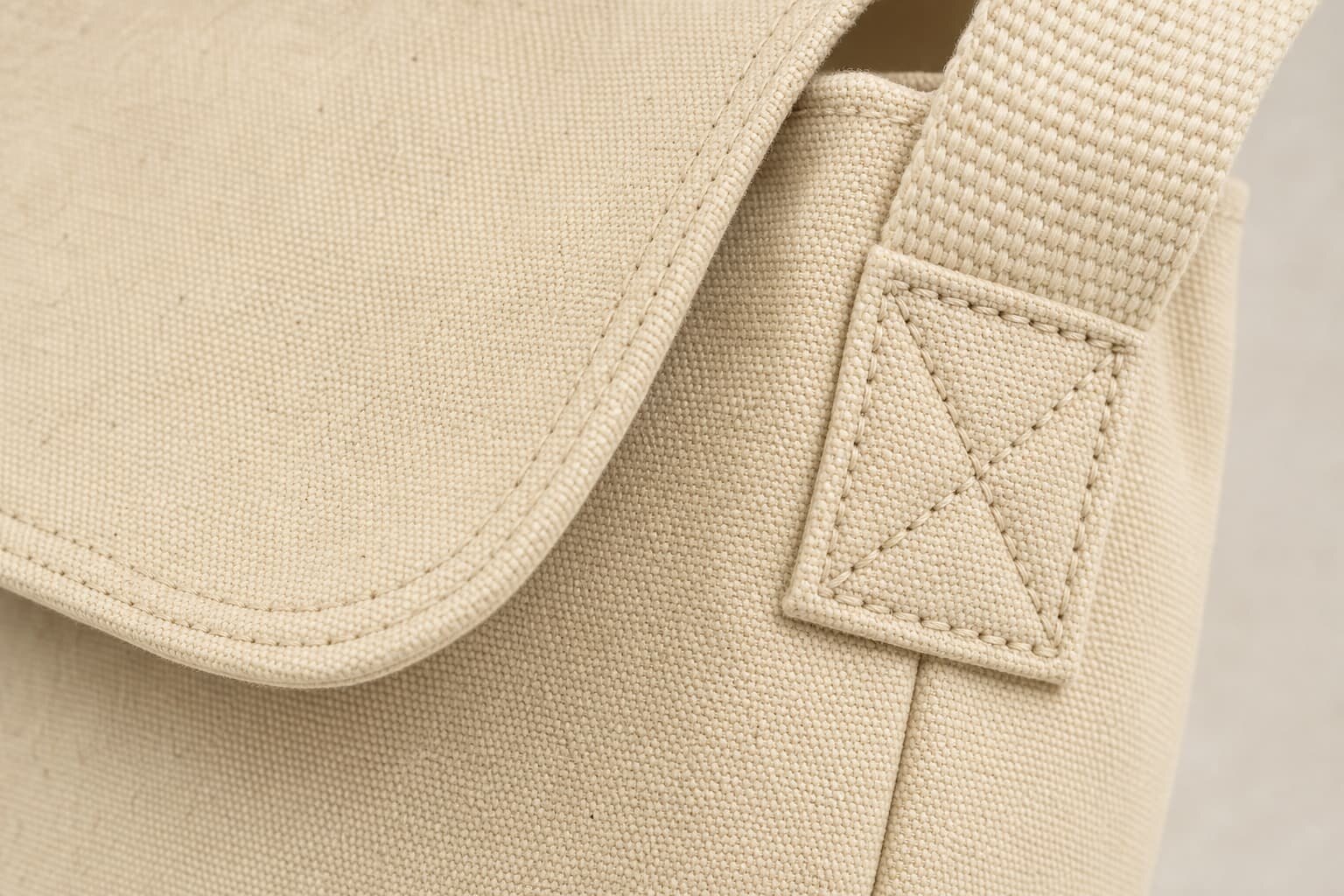
Why a crossbody bag RFQ needs tighter specs than a simple tote quote
A crossbody canvas bag looks simple from a distance, but the quote changes quickly when you define how it is carried, closed, branded, and packed. The same body size can turn into three different factories' prices depending on whether the bag uses a webbing strap, a zipper top, a lining, an inner pocket, or a printed logo that wraps across a seam. If the RFQ is vague, suppliers will fill in the blanks with their own assumptions, and the quotes will not be comparable.
For procurement teams, the job is not just collecting numbers. It is removing ambiguity before the factory cuts fabric, orders trims, or sets up print screens. A clean RFQ gives each supplier the same product story and the same commercial assumptions, so the spread between quotes reflects real capability rather than different interpretations. That is the only way to compare labor, materials, and risk without wasting rounds on clarifications.
- Define the use case first: commuter, retail, promotional, travel, or gift.
- Lock the closure, strap, lining, and logo method before asking for price.
- State whether you want prototype samples, pre-production samples, or only bulk quotes.
- Ask the factory to quote on one named specification, not on a reference image alone.
Start with the product definition the factory can actually price
The first RFQ page should read like a product brief, not a mood board. Give the supplier the finished dimensions, intended capacity, carry style, fabric family, and target look. For crossbody canvas bags, the common mistake is to describe only the exterior shape and logo, then leave out the internal build. The factory may then choose a different canvas weight, skip reinforcement, or price a cheaper strap construction that changes both appearance and durability.
If you already have a sample, send it with a marked-up sheet that identifies what must match and what may change. If you do not have a sample, state the priority order: lower cost, retail appearance, heavier load support, or faster production. That priority helps the supplier choose the right canvas weight, stitch density, and reinforcement method. When buyers skip this step, the quote often looks attractive but the bag arrives either too soft, too bulky, or too expensive to scale.
- Give finished size in inches and centimeters if you sell across multiple markets.
- Specify whether the bag is meant to hold tablets, notebooks, bottles, cosmetics, or light apparel.
- Name the carry expectation: light daily use, moderate retail use, or heavier utility use.
- State if the sample should follow the same packaging and label treatment as bulk units.
Fabric weight, lining, and reinforcement decide the real unit cost
Canvas weight is one of the easiest places for quote drift. A supplier can say canvas and still mean very different constructions. For most crossbody canvas bag bulk programs, 12 oz to 14 oz canvas is the practical middle ground because it balances body, print quality, and cost. Lower weights can work for promotional orders, but the bag may collapse too much, show more seam distortion, and feel less structured once packed. Heavier weights can improve hand feel, but they increase cutting waste, sewing effort, and freight weight.
Lining is another hidden cost trigger. An unlined bag is faster to make and easier to price, but the interior will show raw seam logic more clearly. A light lining, such as 210D or a similar polyester lining, improves the inside finish and can support pockets and cleaner embroidery backing, yet it adds material, labor, and inspection points. Reinforcement at the strap anchor, base corners, and zipper ends also changes cost. If your RFQ does not ask for those details, the quote is usually not good enough for final sourcing.
- Use 10 oz to 12 oz for low-cost utility or event programs where softness is acceptable.
- Use 12 oz to 14 oz for mainstream retail or brand programs where shape matters.
- Use heavier canvas only when load support or premium hand feel is part of the selling point.
- Ask the factory to state whether fusible backing, interfacing, or edge binding is included.
Pick the print and label method before you compare prices
Printing is not a decoration afterthought on a crossbody bag. It changes setup work, sample approval, and often the appearance standard for the entire order. Screen print is usually the simplest answer for bold logos and one- or two-color artwork. Heat transfer can help when the artwork has finer detail or multiple colors, but it can feel more like a surface application and may need stricter wash testing. Embroidery, woven labels, and sewn patches each create a different labor path and different buyer expectations.
The key is to force the same branding method across all supplier quotes. If one factory prices a woven label and another prices a screen print, the comparison is meaningless. Ask for artwork size, placement, Pantone or color reference, number of print passes, and whether the logo sits on the front panel, pocket, strap tail, or side label. For more premium programs, require a real strike-off or print proof so you can judge density, edge sharpness, and how the logo sits on canvas grain.
- Screen print works best for strong logos, simple text, and larger quantities.
- Embroidery adds perceived value, but it can distort on soft canvas if backing is weak.
- Woven labels and sewn patches help retail packaging and reduce ink-related variance.
- Ask whether the print setup fee is separate from the unit price.
Use MOQ logic to separate real capacity from polite guessing
MOQ on a crossbody canvas bag is not only a factory policy; it is a production math problem. The order may be split by fabric color, logo color, print screen, hardware finish, zipper color, and packing method. A supplier can usually handle a lower total volume if the design is simple and the colors are limited. Once the order includes several colors or mixed decoration methods, the MOQ should rise because the factory needs more fabric lots, more setups, and more line changes.
The buyer mistake here is asking only for one total number. You need MOQ by color, by logo design, and by packing variation. If the order is 3,000 pieces total but divided into six colors, the effective MOQ may be 500 per color, or the supplier may want to surcharge the short runs. A practical RFQ asks the factory to show where the breakpoints are: at what volume the unit price drops, at what point a print setup is amortized, and when a special lining or hardware color becomes economical.
- Ask for MOQ by color, by artwork, and by carton assortment if relevant.
- Confirm whether the factory accepts mixed sizes or mixed strap lengths in one order.
- Request price tiers at two or three volumes so you can see the cost curve.
- Separate sample quantity from bulk MOQ; do not let one hide inside the other.
Sample requests should test fit, finish, and production repeatability
A sample is only useful if it proves the factory can repeat the product in bulk. For crossbody canvas bags, that means checking more than the logo placement. Review the strap length range, slider function, top opening, seam quality, pocket shape, and how the bag stands or collapses when filled. A good sample should tell you whether the bag can be sewn efficiently without forcing workers into risky manual corrections. A bad sample may look acceptable in a photo but hide uneven topstitching, weak bar-tacks, or a print location that shifts when the bag is loaded.
Make the sample plan part of the RFQ. Tell the supplier if you want a plain proto, a first article with correct materials, or a pre-production sample built from bulk-intended fabric and trims. Ask who pays sample fees, what changes trigger a second sample, and whether the approved sample becomes the golden reference for bulk inspection. Without that control point, buyers often approve one version and receive another because the factory treated the sample as a concept rather than a production standard.
- Check strap adjustability with the bag loaded, not empty.
- Inspect corners, top edge, and pocket openings for symmetry.
- Look for print shift, ink bleeding, or puckering after stitching.
- Treat the approved pre-production sample as the reference for bulk QC.
Packing, carton data, and shipping assumptions can change the quote a lot
Many quote disputes come from packing, not from the bag itself. If one supplier quotes bulk packed in a carton and another quotes individual polybagging with barcode stickers, the price gap is not a true product gap. Crossbody canvas bag orders need clear instructions on how each unit is packed, whether the bag is folded or stuffed, and whether inserts, hangtags, or warning cards are included. The factory should also state carton pack count, carton size, and carton weight because those numbers affect freight and warehouse handling.
For importers and distributors, packing format also affects shelf readiness and damage risk. A retail program may need individual polybags, desiccant, and master carton marks, while a promotional program may only need bulk packing with a simple label. If you are comparing quotes, ask each supplier to use the same packing assumptions. Then compare not just the unit price, but the landed effect of extra labor, more cartons, and higher cubic volume. A low unit price can become the most expensive option once packing is made retail-ready.
- State whether units should be folded flat, lightly stuffed, or shipped as sewn flat pieces.
- Ask for master carton dimensions, units per carton, and net and gross weight.
- Confirm if barcode stickers, inner polybags, silica gel, or hangtags are included.
- Match the packing format to your warehouse and retail handling plan.
Build the quote comparison around the right cost breakdown
When you compare factory quotes, separate the product cost from the commercial terms. A useful quote should show material, labor, printing, packaging, sampling, and any setup or tooling charges. If the supplier only gives a single number, the order may still be workable, but you cannot tell what changes if the logo size changes or if the strap finish needs a revision. That matters because crossbody canvas bag orders often evolve after artwork review or sample approval.
A cleaner comparison is to ask every supplier to quote the same line items. Then you can see which factory is charging more for heavier fabric, which one is including a better zipper, and which one is hiding setup costs in a low sample offer. For procurement teams, the real objective is not the cheapest quote; it is the quote with the fewest hidden assumptions. That is especially important if the bag will be sold in a retail channel where return rate, appearance, and consistency matter more than a small penny difference.
- Compare fabric, lining, strap, print, label, packing, and setup separately.
- Ask for one quotation on sample development and one on bulk production.
- Require the same incoterm, destination, and currency across suppliers.
- Watch for quotes that omit carton marks, labels, or decoration setup fees.
Turn the RFQ into an inspection plan before you release the PO
The strongest RFQ ends with acceptance criteria, not just a price. Tell the factory what will be inspected on arrival: dimensions, print placement, seam quality, strap attachment, zipper function, color consistency, and packing accuracy. If the bag is a retail item, add appearance checks for wrinkles, thread ends, and logo sharpness. If it is a utility item, focus more on load-bearing areas, strap security, and overall symmetry. This keeps the production team aligned with the buyer's actual risk.
A practical workflow is to approve the sample, lock the golden reference, and then use the same checkpoints for pre-shipment inspection or in-line verification. That does not need to be complicated. It just needs to be specific enough that both sides know what failed and what passed. The RFQ should tell the supplier that any material swap, trim change, or logo placement adjustment requires written buyer approval. If you do that before the PO, you reduce the chance of a last-minute production surprise.
- Define pass-fail points for size, color, print, and stitch quality.
- Set a rule for what changes require re-approval before mass production.
- Ask the supplier to keep one sealed reference sample for inspection.
- Use the same checklist for sample approval, in-process review, and final inspection.
Specification comparison for buyers
| Spec decision | Recommended option | When it fits | Buyer risk to check |
|---|---|---|---|
| Body fabric | 12 oz to 14 oz canvas, roughly 340 to 475 gsm | General retail, promo, and everyday carry bags where shape and print quality matter | Ask whether the gsm is measured greige or finished; low gsm can feel thin after wash and print |
| Lining | Unlined for low-cost programs; 210D or 230T lining for cleaner interior finish | Unlined for trade show giveaways or simple utility; lined for retail or gift programs | Unlined bags can show loose fibers and poor seam appearance; lined bags need a clearer stitch allowance |
| Closure | Top zipper for retail and travel; open top only for low-price utility use | Zipper fits commuter and daily-use products; open top fits merch or event bags | A zipper changes labor, lead time, and failure risk; confirm zipper gauge and puller style |
| Strap | 1 inch or 1.5 inch webbing with adjustable slider | Crossbody carry, heavier contents, or buyers who need one size to fit more users | Self-fabric straps can twist and stretch; check strap break strength and adjustment range |
| Print method | Screen print for bold logos, heat transfer for small-color logos, embroidery for premium feel | Screen print suits larger runs; heat transfer suits detailed art; embroidery suits premium branding | Different methods change MOQ, hand feel, and wash durability; get a print proof and placement spec |
| Packing format | Bulk polybag with carton marks, or individual polybag if retail ready | Bulk for distributors and B2B; individual packing for shelf-ready retail orders | Packing assumptions affect carton count, labor, and shipping volume; ask for carton net and gross weight |
Buyer checklist before sampling
- Confirm the exact bag type: crossbody, shoulder, or convertible strap, and state the finished carry length you expect.
- Define body fabric weight in gsm or oz, plus whether the number is for greige fabric, dyed fabric, or finished bag weight.
- State the target size with tolerance, including body width, height, gusset depth, strap length, and zipper opening if used.
- Choose the branding method before asking for price, because screen print, embroidery, woven label, and embossing are not interchangeable in cost or lead time.
- Specify whether you want a lined bag, inner pocket, phone pocket, zipper pocket, or only a plain open cavity.
- Tell the factory your expected order mix by color and design so they can quote real MOQ logic, not a vague average.
- Ask for sample status, sample fee, and sample lead time separately from bulk production lead time.
- Confirm packing method, carton pack count, master carton size, and whether hangtags, barcodes, or retail inserts are required.
- Ask the supplier to quote on the same incoterm and same destination assumption so freight and export handling do not distort comparison.
- Request a pre-production sample or sealed golden sample approval step before bulk cutting starts.
Factory quote questions to send
- What exact fabric construction, weight, and finishing are you quoting for the body and lining?
- Is your quote based on a finished sample, a spec sheet, or only a reference photo?
- What is the MOQ by color, by print design, and by total order volume?
- Which print or decoration method is included in the quoted price, and what setup fees apply?
- What strap material, width, slider type, and hardware are included?
- What is the sample fee, sample lead time, and can the fee be refunded after bulk order confirmation?
- What packing method, carton pack, and carton dimensions are used in the quote?
- What are the lead time assumptions for bulk production, sample approval, and shipping document preparation?
- Which parts of the product are excluded from the quote, such as labels, hangtags, polybags, or testing?
- If we change logo size, lining color, zipper color, or strap length, how will the price move?
Quality-control points to confirm
- Measure finished dimensions after stuffing and flattening, not only when the bag is empty on the table.
- Check canvas weight, weave density, and surface finish against the approved sample or fabric swatch.
- Inspect strap attachment points, bar-tacks, and seam allowance on both left and right sides.
- Verify logo placement, size, ink coverage, registration, and edge sharpness on every production panel.
- Test zipper travel, slider alignment, and puller strength if the design includes a closure.
- Check inside seam trimming, thread ends, and lining attachment so the interior does not shed or fray.
- Confirm carton pack count, polybag type, barcodes, and master carton marks against the PO.
- Spot-check random units for odor, stain, color variation, and shape recovery after folding.