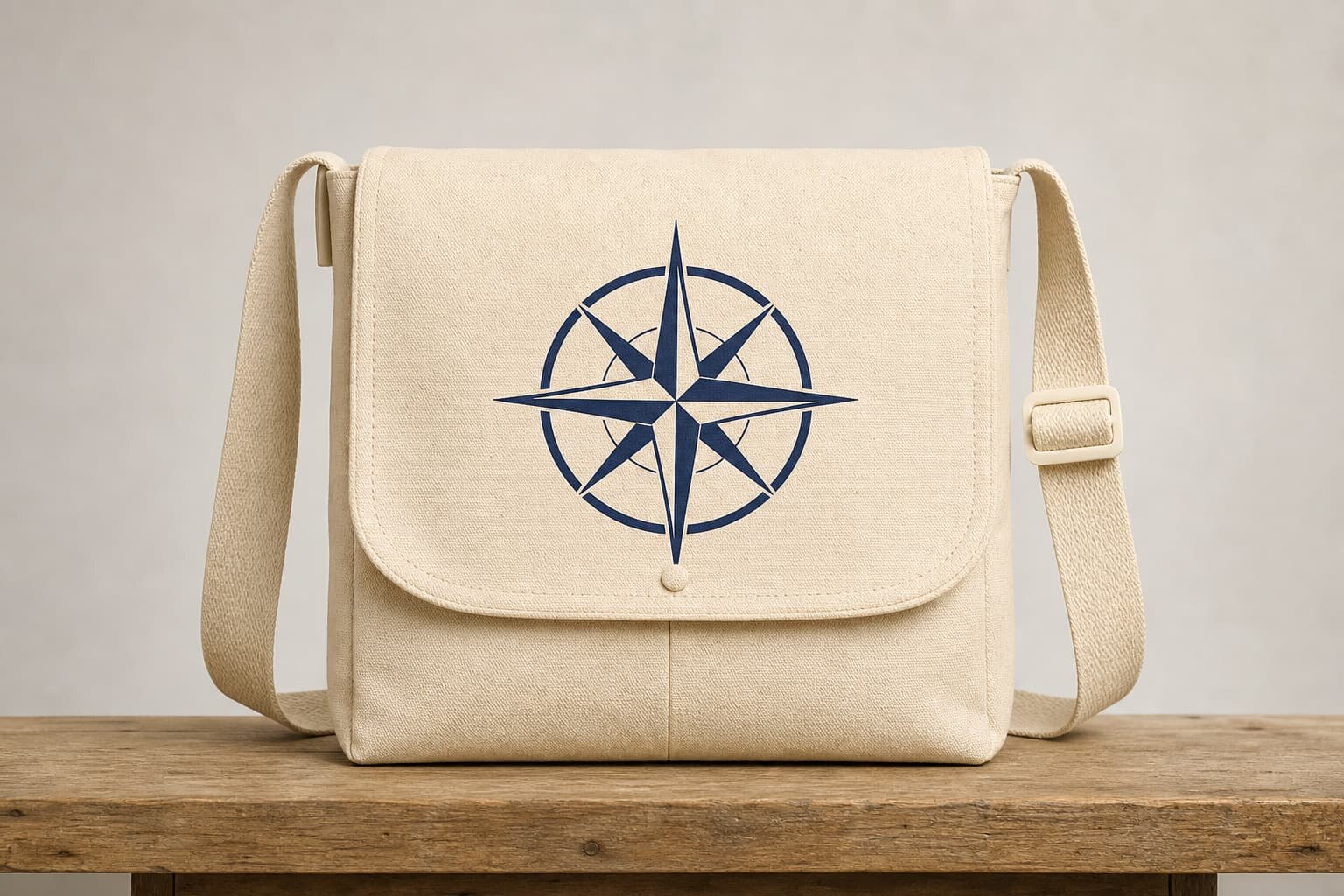
Why Logo Color Matching Decides How the Bag Sells
For a crossbody canvas bag, logo color is not just a design choice. It controls legibility, shelf impact, and whether the bag looks premium or cheap once the fabric texture and light conditions are added. A logo that looked sharp on a screen can turn muddy on coarse canvas, while a logo that looked subtle in artwork can disappear on a dark body fabric. Buyers who treat logo color as a production spec, not a branding afterthought, usually get cleaner samples and fewer quote revisions.
The right color decision also affects cost and sourcing risk. A simple one-color screen print on light canvas is usually easier to control than a multi-color print on dark dyed fabric. But if your brand needs a small, refined mark, a woven label or embroidery may be a better commercial fit than trying to force tiny details through a thick ink layer. The job of the buyer is to decide what must match exactly, what can vary slightly, and what decoration method gives the most stable result at bulk scale.
- Treat logo color as part of the technical pack, not only the artwork file.
- Choose the decoration method based on fabric color, logo detail, and target retail position.
- Expect visual change between screen, swatch, and sewn product unless you specify the substrate.
Start With the Base Fabric, Not the Logo Artwork
Canvas color drives how every logo color reads. A 12oz to 16oz canvas, roughly 340 to 450 GSM, has enough body for a messenger-style crossbody bag, but the weave still affects ink absorption and line clarity. Ecru or natural canvas usually gives the highest flexibility because most logo colors will contrast clearly. Black, navy, olive, and washed shades look more premium in some programs, but they make light logo colors harder to control and increase the chance of underbase or multiple print passes.
Ask the factory to quote the bag body, the lining, and the logo as one system. A 340 GSM canvas may allow a neat print with less ink spread, while a heavier 400 to 450 GSM canvas can take embroidery or patches better because the structure resists puckering. If the bag includes gussets, flap overlays, or front pockets, the logo position matters too. A logo across a seam will distort faster than one placed on a flat front panel.
- For clean print clarity, many buyers start with 12oz to 14oz natural canvas.
- For premium structure and heavier use, 14oz to 16oz canvas often performs better.
- Avoid placing fine logos across seams, darts, or folded edges unless the factory confirms the pattern layout.
Choose the Print Method Before You Lock the Color
The logo color matching method changes with decoration type. Screen printing gives the best control for solid, opaque brand colors, especially for one- or two-color logos. Heat transfer or digital transfer can handle more detail, but the finish may look more like a patch than a direct print. Embroidery changes the visual color completely because thread sheen, stitch density, and direction all affect the final look. Woven labels are useful when the logo is too fine for print, but they are not a true color match to printed artwork because the weave and yarn palette limit detail.
If your brand color is strict, ask the factory what the print system can actually hold on the chosen canvas. A PMS callout is not enough by itself. The supplier should tell you whether the logo is printed direct, built with a white underbase, heat transferred, embroidered, or woven. Each method changes MOQ, setup time, and acceptance tolerance. If the buyer wants a matte retail look, the factory should know whether a glossy ink finish is acceptable or must be avoided.
- Screen print is usually the best choice for flat, solid logo colors.
- Embroidery works best for simple marks with thicker strokes and minimal fine detail.
- Woven labels help when the logo is small, text-heavy, or too detailed for print.
How to Write a Color Spec a Factory Can Actually Quote
A usable RFQ needs more than a brand PDF. It should include the bag fabric color, the logo color target, the exact print or decoration method, artwork size, placement, and whether the factory must match a Pantone reference or only stay within a general brand range. Add a note for what matters most: exact hue, brightness, contrast, or finish. If the logo sits on natural canvas, the supplier may only need a single-pass screen print. If the same logo must appear on black canvas, the factory may need an underbase or different ink system, which changes cost and lead time.
You should also specify the sample stage. A paper proof is not enough for canvas bags because paper does not show ink spread, fabric texture, or stitch tension. Ask for a strike-off, sew-out, or pre-production sample on the actual fabric and in the actual logo size. If the bag will be sold in different channels, note whether the same color must work in retail stores, wholesale showrooms, and e-commerce photography, because the lighting environment can expose weak contrast.
- Include artwork file format, logo size in mm, and allowed placement tolerance.
- State whether Pantone matching is mandatory or only a reference point.
- Ask for the sample to use the same canvas, same thread, and same ink curing process as bulk.
Comparing the Main Logo Color Strategies
The most reliable choice is often the simplest one: a high-contrast logo on a light or natural canvas. That route keeps setup low and makes bulk inspection easier. If your brand requires darker bodies, the next best option is usually a white or light logo with a controlled underbase, but you need to watch for ink thickness and cracking. Embroidery and woven labels shift the look into a more premium lane, but they can introduce their own color drift because yarn and thread lines do not behave like printed ink.
The table below is the practical comparison buyers should use before requesting quotes. The right decision depends on what is more important: visual sharpness, brand fidelity, lower MOQ, or a more elevated retail finish. If your team asks three factories for the same artwork but does not lock the decoration method, you may get three very different interpretations and no apples-to-apples quote.
- Use direct print when you need the lowest cost and clearest quote comparison.
- Use embroidery or woven labels when the logo is small or the brand wants a softer premium finish.
- Avoid giving suppliers only a screenshot, since color intent is easy to misread.
Sample Approval: What to Check Before You Commit to Bulk
A sample should prove more than appearance. It should show how the logo looks after curing, sewing, folding, and packing. Check the bag in natural daylight and under store lighting. Look at the front panel, corners, and any curved surfaces where the decoration may stretch. If the logo sits near a pocket edge or top zipper, verify that opening and closing the bag does not distort the artwork. For stitched decorations, inspect thread tension and back-side clean-up so the reverse does not scratch the lining or look messy through a thin fabric panel.
Pay attention to sample repeatability. One good sample does not guarantee bulk consistency. Ask whether the sample came from the same fabric lot as expected for production, and whether the factory used a production-grade machine setup or a hand-made prototype. A buyer should confirm at least three things: the logo color itself, the placement accuracy, and the surface finish after handling. If any of those are unstable in sample stage, the bulk order is at risk.
- Check the sample after folding and unpacking to see if the logo creases or transfers.
- Compare the approved sample to the artwork at actual size, not just on screen.
- Mark the acceptable variation before bulk starts, especially for multi-SKU orders.
MOQ Logic and Why Color Changes Affect Price
Logo color changes can alter MOQ more than buyers expect. A factory may accept a lower MOQ for a one-color print on natural canvas, but require a higher MOQ when the logo uses multiple ink colors, embroidery thread changes, or a special woven label. If the base bag color also changes, the supplier may need separate fabric dye lots or separate cutting runs, which raises minimums again. Buyers comparing quotes should ask whether MOQ is driven by fabric stock, decoration setup, or carton packing efficiency.
The quote should separate base bag cost, logo decoration cost, sample cost, and any setup charges. That is the only way to compare suppliers fairly. For example, one supplier may quote a low unit price but charge more for art setup, while another includes setup in the piece price and requires a larger run. A disciplined buyer asks for cost by colorway, not only cost by style, because the real commercial question is what happens when you place two body colors or two logo colors in the same program.
- Ask if each logo color requires a separate screen, plate, or stitch program.
- Check whether the quoted MOQ is per colorway, per artwork, or per total order.
- Separate one-time setup charges from recurring unit cost before comparing suppliers.
Lead Time, Packing, and Transit Risks That Can Ruin the Color
Lead time for a crossbody canvas bag with logo color matching usually has two parts: sample approval and bulk production. If the buyer changes artwork after sample sign-off, the timeline resets. More importantly, the ink curing or embroidery setup may need another round of confirmation. Build the schedule around real checkpoints: artwork approval, strike-off approval, pre-production sample approval, bulk cutting, decoration, sewing, packing, and final inspection. Color-sensitive orders should not be rushed through the sample stage just to protect a shipping date.
Packing is part of color control. A bright print can scuff in transit if the bags are packed too tightly without tissue or polybag protection. Heavy stacking can also leave fold marks across the logo panel. Ask how the factory packs the bags, whether desiccant or moisture control is needed, and whether each bag is individually polybagged before carton packing. For dark bags with light prints, rubbing between layers can create visible transfer if the ink is not fully cured or if the packing is too compressed.
- Confirm whether the factory uses tissue, polybag, or both.
- Ask for final carton count, carton size, and stacking method in the packing plan.
- Protect against transfer, crease marks, and moisture during ocean transit and warehouse storage.
A Buyer Workflow That Reduces Requotes and Rework
The cleanest sourcing workflow starts with a clear decision tree. First, lock the bag color and fabric weight. Second, decide whether the logo should be printed, embroidered, woven, or applied as a patch. Third, define the exact color reference and whether the factory can match it on canvas with the chosen method. Fourth, request the sample and compare it in realistic light. Only after those steps should the buyer ask for bulk pricing. If this order has multiple SKUs, repeat the same sequence for each colorway instead of assuming the same logo spec will work everywhere.
Final acceptance should be simple enough for purchasing, quality, and the supplier to understand the same way. A good approval note says what is acceptable, what is not, and what needs sign-off if the factory proposes a substitution. If a supplier wants to move from screen print to heat transfer, or from printed logo to woven label, that is not a minor change. It affects look, feel, durability, MOQ, and often the retail story. Buyers who write that line into the RFQ reduce arguments after production starts.
- Lock fabric first, then decoration method, then color reference.
- Use one approval sample as the production standard for the full order.
- State in writing whether substitutions need buyer approval before bulk begins.
Specification comparison for buyers
| Spec decision | Recommended option | When it fits | Buyer risk to check |
|---|---|---|---|
| Natural ecru canvas + one-color screen print | Use a dark PMS logo with a flat ink stroke | Best for clean brand marks and mid to high MOQ | Weave show-through, ink opacity, and shade variation between fabric lots |
| Black or navy canvas + white or light print | Add a white underbase if the logo has fine detail | Works when the logo must stay readable from a distance | Cracking on heavy ink films, ghosting, and poor edge sharpness |
| Dyed canvas + woven side label | Move the logo into a woven label when print contrast is weak | Useful for premium looks or small logos with fine lines | Label size, fray control, and whether the label survives abrasion |
| Washed canvas + embroidery | Use low-stitch-density embroidery for simple marks | Fits fashion-forward retail or gift sets | Puckering, logo distortion on seams, and thread color drift |
| Two-color logo on light canvas | Keep the palette to one spot color plus black if needed | Good when the brand mark needs hierarchy but still low risk | Extra setup cost, alignment between colors, and higher MOQ per colorway |
Buyer checklist before sampling
- Confirm the base bag color, fabric GSM, and finish before choosing logo color.
- Send Pantone references and a printed logo file with stroke widths, not only a PDF mockup.
- State the print method you want quoted: screen print, heat transfer, embroidery, woven label, or debossed patch.
- Ask for a pre-production sample on the same fabric lot and the same ink or thread system.
- Define where color matching is critical and where a near-match is acceptable.
- Request carton and polybag packing details so finished color is protected from rub and dust.
Factory quote questions to send
- What fabric weight, weave density, and finishing do you recommend for this logo color and print method?
- Can you match the logo to a Pantone reference on the actual canvas, and what tolerance do you quote?
- What is the MOQ by fabric color and by logo color or decoration method?
- What are the setup charges, sampling charges, and whether they are refundable against bulk order?
- How many days do you need for artwork confirmation, sample making, and bulk production?
- Will the same color be repeated across all cartons and production lots, or can shade variation happen?
- What packing method protects the logo from rubbing, creasing, or transfer during transit?
- If the bulk sample is out of tolerance, what is your rework or remake policy before shipment?
Quality-control points to confirm
- Approve the logo against the actual canvas fabric, not against a paper swatch only.
- Check logo color under daylight, indoor LED, and warehouse light to catch contrast problems early.
- Measure print placement against the approved spec, especially on pocket centers and flap edges.
- Inspect edge sharpness, ink coverage, and thread tension for bleeding, pinholes, or puckering.
- Confirm that the first bulk carton matches the approved sample before the rest of the order ships.
- Check packing for scuffing, transfer, moisture, and crease marks after compression in cartons.