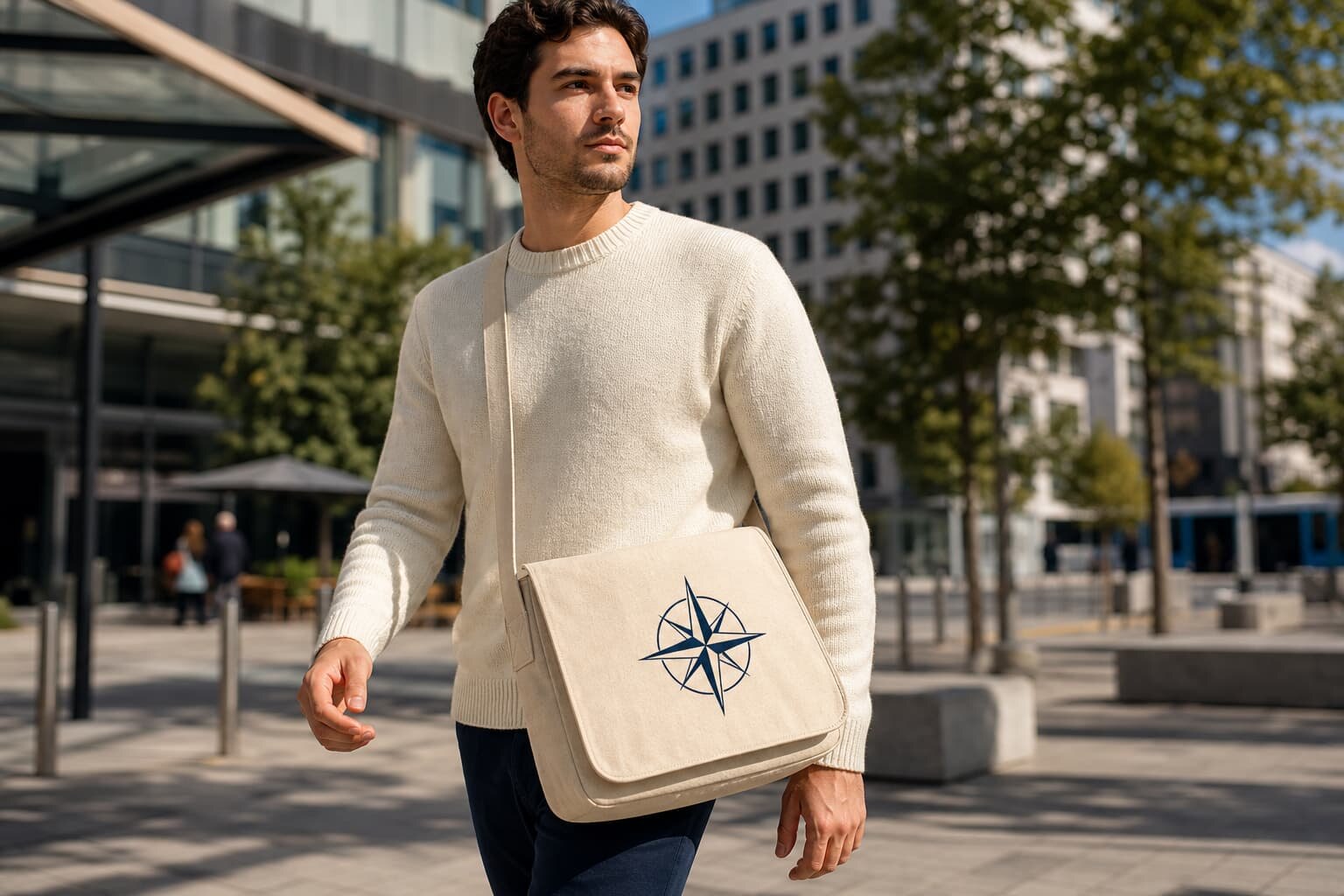
Why handle strength fails in crossbody canvas bags
Most handle failures are not caused by the canvas body alone. They usually start at the anchor point, the stitch line, the fold where the strap turns, or the hardware connection if the strap is detachable. A buyer who only asks for canvas thickness can miss the real weak spot. For crossbody bags, the long strap also creates leverage, so a bag that feels fine in hand can still fail when it swings, is dropped onto a shoulder, or is lifted with a full load.
The first job in sourcing is to define the carrying mode. A light retail crossbody bag for a notebook and wallet needs a different build from a commuter bag that carries a water bottle, charger, catalog, or tablet. If the bag is meant to be worn crossbody all day, the handle and strap system must survive repeated lift cycles, not just one static pull. The supplier should understand that the buyer is testing the complete load path, not only the body fabric.
- Look for failure at the anchor first, not only in the body panel.
- Separate hand-carry use from crossbody wear when you write the spec.
- Treat detachable hardware as part of the strength system, not decoration.
- Ask for a sample photo after testing, not only a pass statement.
Set the load target before you ask for quotes
Do not let the supplier guess the use case. Put the expected load in the RFQ so every quote is based on the same target. A small promotional bag may only need a light load, while a retail messenger bag can face several kilos of books, devices, and samples. If the load target is vague, one factory will quote a thin webbing strap, another will propose heavier reinforcement, and you will compare prices that are not really equivalent.
The useful way to define the load is to link it to real content, not a random number. State what the buyer expects the user to carry, then tell the factory whether the bag should survive a single lift test, repeated lift cycles, or a hang test while fully loaded. That lets the supplier size the canvas GSM, webbing width, stitch density, and reinforcement patch correctly. It also helps the buyer avoid over-specifying a heavy build for a low-load retail item.
- Use real contents in the spec: bottle, notebook, laptop sleeve, catalog, or tools.
- Ask the supplier to quote against one stated load target, not a range with no context.
- Separate short-term lift strength from long-term wear strength.
- Match the handle build to the bag's actual retail use, not the sample-room demo.
Match the fabric, strap, and reinforcement to the use case
For crossbody canvas bags, the body fabric and the strap should be engineered together. A body fabric around 10 oz to 14 oz canvas can work for many retail programs, but the right answer depends on what the buyer expects the bag to hold and how the handle is constructed. A self-fabric strap can look premium, yet it needs good folding, controlled seam allowance, and a stronger anchor. Webbing is usually easier to control in production and often performs better at abrasion points.
The reinforcement is where many suppliers try to save labor. That is a mistake. A hidden patch, extra layer, or internal facing spreads the load across a wider area and reduces stitch tear-out. If the handle passes through a fold, buckle, ring, or label, the reinforcement must extend past the visible edge so the load is not concentrated at one line. If print or embroidery is near the anchor, keep it outside the high-flex zone so the surface treatment does not create stiffness or cracking.
- 10 oz to 14 oz canvas is common for lighter retail use; heavier carry often needs more structure.
- Webbing is usually safer for abrasion, while self-fabric needs better reinforcement.
- Keep logos and labels away from the fold line and stitch stress point.
- Ask for a reinforcement sketch, not just a verbal assurance.
Use a test plan that mirrors real use
A good handle test is not just one quick pull. You need a test plan that matches the bag's real life. For a crossbody bag, that usually means a static hang test, a repeated lift or swing cycle, and an inspection after the bag has been loaded for a period of time. If the bag has hardware, check that the hardware does not open, twist, or cut into the strap under load. If the handle is sewn into a side seam, check seam slippage as well as stitch breakage.
The buyer should define the test method before the factory samples. Ask the supplier whether the test will be done in-house or by a third-party lab, what load will be used, how long the bag must hold, and what visible damage is acceptable. Do not leave pass/fail open to interpretation. A factory may call a bag pass if it only held for a short static hang, while the buyer may expect no stitch rupture, no distortion, and no loosened anchor after repeated handling.
- Use both static and repeated-use testing when the bag will be carried daily.
- Check anchor stitching, seam slippage, and hardware behavior separately.
- Define visible damage limits in writing before sample approval.
- Keep the test method consistent across all factories so quotes compare fairly.
Turn the requirement into an RFQ spec
A handle strength RFQ should read like a build sheet, not a marketing brief. Include the bag size, canvas GSM, lining if any, strap width, strap material, reinforcement patch size, stitch pattern, bartack count, hardware type, print method, and target load. If the handle is detachable, state the ring or hook style and the finish. If the bag has one top grab handle and one crossbody strap, quote both systems separately so the factory does not underbuild the secondary one.
Ask the supplier to show the cost of each major element. Fabric, labor, hardware, print, and packing should not be buried in one lump sum if you want to understand where the handle strength is coming from. MOQ logic matters here too. A different handle width, material, or print method can create a separate material setup or sewing line change, which raises the minimum order. A clear RFQ helps the buyer spot that before sample approval, not after the first bulk quote arrives.
- Specify finished strap width and handle drop, not only overall bag dimensions.
- State the exact stitch pattern or ask for a drawing with measurements.
- Request separate pricing for standard and strengthened handle builds.
- Make MOQ dependent on the exact strap and print combination.
Check samples for weak handles before approval
The sample stage is where buyers catch most handle mistakes. Do not approve from photos alone. Pull the PP sample by hand, load it with the intended contents or a realistic weight, and inspect the strap anchor after the bag is lifted several times. Look for stitch opening, seam ripple, edge curl, strap twist, and hardware movement. A handle can pass one static test and still feel wrong in hand if the anchor area is too stiff or the strap length creates an awkward carry angle.
It helps to keep a simple sampling routine. Compare the first sample, revised sample, and pre-production sample against one retained golden sample, then check all three with the same load. If the bag will be printed, make sure the artwork is on the final material build because ink, embroidery, or a woven label can change stiffness and flex. If the factory changes the handle material or reinforcement after approval, ask for a new pull check before bulk release.
- Use the same load and same inspection order on every sample.
- Check comfort as well as failure, because a strong but awkward handle still gets rejected.
- Re-test if the factory changes strap material, thread, or reinforcement size.
- Keep one sealed golden sample at the buyer and one at the factory.
Know the cost drivers behind stronger handles
Handle strength affects cost in more places than the strap itself. Wider webbing, extra reinforcement layers, bartacks, thicker thread, and more careful alignment all add labor or slow the line. Hardware also changes the quote quickly. A fixed sewn handle is usually simpler than a detachable strap with rings, hooks, and adjusters. If the bag must look premium, clean binding, edge finishing, or embroidery near the strap can add both time and reject risk.
The smartest buyer request is a split quote. Ask for base bag cost, handle upgrade cost, print cost, and packing cost instead of one number. That makes it easier to compare options like self-fabric versus webbing or fixed versus detachable. It also helps when the buyer is balancing price against retail returns risk. In many programs, a small increase in sewing time is cheaper than a high failure rate after launch, especially if the bag will be hung in store or carried daily by end users.
- Wider webbing and extra bartacks usually affect labor more than material.
- Detachable hardware can raise both material and inspection cost.
- Premium surface finishes near the strap often increase reject risk.
- Ask for a split quote so you can see where the strength upgrade sits.
Build QC checkpoints into cutting, sewing, and packing
Handle strength is not only a final inspection issue. The factory should check the build while cutting, sewing, and packing. In cutting, confirm the strap width and grain direction. In sewing, confirm that the reinforcement patch is placed correctly and that the bartack is long enough to lock the load path. In final inspection, check for skipped stitches, thread tension issues, loose ends, and any hardware defect that could damage the strap under tension.
Packing also matters more than many buyers expect. If the handles are folded too sharply or compressed in a tight carton, the strap can deform before it reaches the retailer. That does not usually create an immediate break, but it can create a weak crease or a permanent bend at the anchor. Tell the factory how the bags should be folded, how many units go in each polybag or carton, and whether the handle should be laid flat, tucked inside, or wrapped with a paper insert.
- Inspect handle placement during cutting, not only after sewing.
- Reject samples with skipped stitches, loose bartacks, or strap twist.
- Define packing fold direction so the strap does not crease in transit.
- Ask for carton loading photos if the handle shape is sensitive.
Write clear acceptance criteria for the PO
The purchase order should say what happens when a handle passes or fails. If you leave the standard too broad, the factory may think the bag is acceptable even when the handle shows slight stitch damage or permanent distortion. Good acceptance criteria are practical: the strap must hold the stated load, the anchor must not tear, the stitching must not open, and the bag must remain usable after testing. If the bag is for retail display, add a check for appearance after hanging so the handle still sits flat and the bag still presents well on shelf or peg.
Use simple language that a production manager can follow without guessing. State the test load, hold time or cycle count, inspection method, and what visual damage is unacceptable. If the buyer wants a third-party report, say so in the PO before sampling starts. If the buyer is approving from factory test data, require the raw record, not only a summary. Clear acceptance criteria reduce argument later and make it easier to decide whether a failed sample needs a repair, a rebuild, or a full spec change.
- Write pass/fail criteria into the PO, not only the email thread.
- Add appearance requirements if the bag hangs on retail pegs.
- Require raw test records when a factory claims the sample passed.
- Treat any hidden material or stitch change as a new approval item.
Use a simple sourcing workflow to close the order
The best buying workflow is easy to repeat. Start with a use-case brief, then send one RFQ that includes the load target, strap build, reinforcement drawing, print method, MOQ, sample quantity, and desired lead time. Compare supplier replies line by line, not just on unit price. Once you choose a factory, review the PP sample with the same load method you will use in bulk, then freeze the golden sample before cutting starts. That sequence keeps the handle specification stable and reduces the chance of late changes.
Lead time should also be broken into parts. Ask the factory how long the first sample takes, how long revisions take, and when bulk production starts after approval. Handle upgrades can add sewing time, hardware sourcing time, or extra inspection time, so do not let the factory hide that inside one bulk promise. When the buyer asks the right questions up front, the handle strength conversation becomes a sourcing control tool instead of a post-shipment complaint.
- Send one RFQ with load target, build detail, sample quantity, and lead time expectations.
- Compare quotes by spec, not by headline price alone.
- Freeze the golden sample before bulk cutting starts.
- Ask for separate timing on first sample, revised sample, and bulk run.
Specification comparison for buyers
| Spec decision | Recommended option | When it fits | Buyer risk to check |
|---|---|---|---|
| Handle width | 32-38 mm webbing or folded strap | Daily carry and retail bags with moderate load | Too narrow a strap cuts into the shoulder and can overload one stitch line |
| Strap material | Polyester or poly-cotton webbing | Bags that see frequent abrasion or long carry times | Slippery webbing, edge fray, or color mismatch against the body fabric |
| Anchor reinforcement | Internal patch plus bartack or box-x pattern | Medium to heavy load bags and repeated lift use | Patch shift inside the seam or weak stitch density at the fold |
| Attachment method | Fixed sewn anchor for lower cost; D-ring or swivel hook for detachable straps | Fixed for simple commuter bags; detachable for multi-use retail lines | Hardware pull-out, gate opening, or rattling in transit |
| Handle finish | Turned edge with binding or clean webbing edge | Mid to premium programs where appearance matters | Bulkiness at the anchor and hidden failure from stacked layers |
| Print placement | Keep print away from the bend and anchor zone | Any bag with logo on strap or near the top edge | Ink cracking, stiffness, or reduced flex where the handle folds |
Buyer checklist before sampling
- State the maximum loaded weight and what the bag will actually carry in use.
- Confirm canvas GSM, strap width, and whether the handle is self-fabric or webbing.
- Request a drawing or photo showing reinforcement size, stitch pattern, and bartack count.
- Ask the supplier to define the pull test method, cycle count, and pass/fail rule in writing.
- Check that print, embroidery, or labels are not placed in the main flex or anchor zone.
- Verify MOQ by size, color, strap material, and print method instead of one lump number.
- Ask for PP sample approval before bulk cutting and keep one sealed golden sample.
- Confirm packing so folded handles do not crease, crush, or distort before delivery.
Factory quote questions to send
- What exact canvas GSM, strap material, reinforcement patch, and thread specification are included in the quote?
- Is the handle built from self-fabric, webbing, or a hybrid structure, and what is the finished width?
- How many bartacks or what stitch pattern will be used at each anchor point?
- What pull test or lift cycle test will you run on samples, and what is the pass/fail standard?
- What is the MOQ for each color, size, strap option, and print method?
- Which print method is quoted, and does the artwork touch the handle fold or reinforcement area?
- What are the sample fee, revision fee, and the lead time for first sample, revised sample, and bulk production?
- Can you break out fabric, labor, hardware, printing, packing, and testing as separate quote lines?
Quality-control points to confirm
- Check incoming canvas GSM and strap width before cutting starts.
- Verify reinforcement patch placement under the handle anchor on both sides.
- Inspect bartack length, stitch density, and thread tension on each sample batch.
- Pull-test at least one sample from each material or handle variant before PP approval.
- Check that hardware is secure, closes properly, and does not twist under load.
- Measure handle drop and symmetry so both sides carry weight evenly.
- Inspect print, embroidery, or labels near the anchor to confirm they do not stiffen the flex point.
- Review packing so handles are folded consistently and are not crushed in the carton.