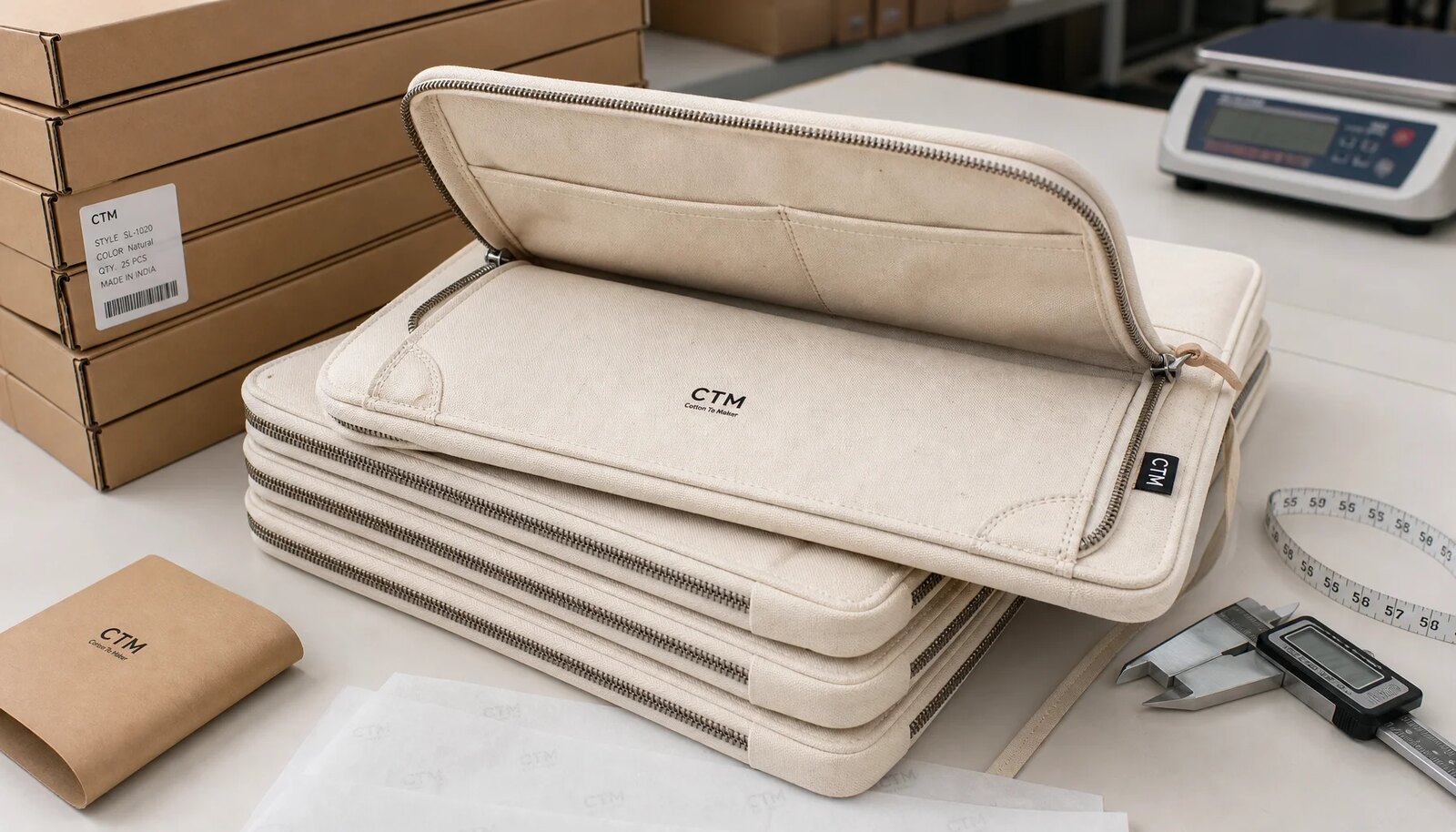
Why Carton Planning Belongs in the RFQ
A custom canvas zipper portfolio can look simple on a sample table: two canvas panels, a zipper, a logo, and perhaps a side label. The commercial risk usually appears later, after units are stacked, counted, labeled, shipped, opened, and distributed. A well-sewn portfolio can still arrive with crushed zipper pulls, ink transfer between panels, bowed cartons, wrong artwork mixed into the same carton, or master cartons that craft fair staff dislike lifting all day.
For craft fairs, maker markets, workshop kits, school fundraisers, museum shops, and distributor replenishment, the carton is part of the product system. Goods may move from factory packing to forwarder receiving, export freight, domestic warehousing, event sorting, van loading, booth setup, and leftover storage. Each handoff rewards clear carton marks, a realistic gross weight, and a packing method that protects both the printed face and the zipper hardware.
Treat product specs, individual packing, and export cartons as one controlled RFQ package. Every supplier should quote against the same fabric, zipper, print method, label set, pieces per carton, carton dimensions, gross weight, CBM, and inspection scope. If one quote includes only loose portfolios and another includes tissue, barcode labels, inner packs, and 5-ply cartons, the cheaper unit price is not necessarily the cheaper landed cost.
- Require FOB unit price plus packing material cost, carton dimensions, gross weight, net weight, and CBM per carton.
- Use one SKU code across artwork files, sample tags, PO lines, barcode labels, carton marks, packing lists, and inspection reports.
- Set a maximum carton gross weight before suppliers decide how many pieces to pack per master carton.
- Approve the packing method with real or production-equivalent samples, not only a spreadsheet carton count.
- Mark cartons by SKU, artwork version, destination, quantity, PO number, and carton sequence so event teams do not need to open every carton.
Start With the Product, Then Do the Packing Math
Carton math only works after the portfolio spec is stable. Finished size, internal usable space, canvas weight, lining, pocket construction, zipper length, puller thickness, seam allowance, print area, retail labels, and any board insert all change the stack height. A plain 12 oz flat portfolio packs very differently from a lined 14 oz version with a wide puller and an inner pocket.
For many craft fair programs, a practical baseline is 12 oz cotton canvas, approximately 380-420 GSM, with a nylon coil zipper, reinforced zipper ends, and a one-color screen print on one side. A 10 oz fabric can work for paper-only inserts or low-cost promotional use. A 14 oz fabric may improve perceived value for retail or kit programs, but it also raises carton weight and increases the chance of pressure marks if too many units are packed together.
Size wording needs discipline. 'A4 size' or 'letter size' can mean the outer panel size, the internal usable space, or simply the document the buyer wants to insert. If the portfolio must hold workshop papers, craft patterns, catalogs, certificates, swatches, or sponsor cards, send the insert dimensions and the required clearance. The usable opening is usually smaller than the outer width because zipper ends, seam allowance, and corner shape reduce access.
Freeze the sewn size, zipper, lining, print, and unit packing before relying on freight estimates. Changing from unlined to lined construction, adding a pocket, upgrading canvas weight, or selecting a decorative puller can alter carton height, carton weight, and pressure points. These changes are easy to quote early. They are much harder to absorb after carton labels, packing lists, and freight bookings are prepared.
- Define external finished size, internal usable size, zipper opening length, gusset depth if any, and acceptable tolerance.
- Use measurement after sewing and pressing as the commercial standard unless another point is explicitly agreed.
- For simple flat portfolios, use ±5 mm width/height as a realistic starting tolerance and validate tighter needs by sample.
- Allow clearance beyond the insert size; do not match the portfolio's internal space exactly to the document dimensions.
- Request loose sample, filled sample, and packed sample when the portfolio must protect retail inserts or kit contents.
Canvas Weight, Shrinkage, and Visual Grade
Canvas weight affects more than hand feel. It changes sewing resistance, print appearance, carton density, and how well the product recovers after shipping. Heavier canvas looks substantial on a craft fair table, but it adds seam bulk and stack pressure. If heavy portfolios are packed too high, lower layers may show zipper ridges or pressure marks. Lighter canvas reduces cost and shipping weight, but corners can look soft unless the pattern and seam construction are controlled.
Cotton canvas can move during washing, steaming, pressing, and humidity changes. Even when the finished item is not washable, normal production pressing can affect dimensions. If the portfolio must fit a rigid insert, printed board, retail band, or workshop kit card, ask for the supplier's shrinkage expectation and approve a finished sample after normal production processing. Pre-shrunk canvas can reduce tight-fit risk, though it may change price and lead time.
Natural canvas has its own look: seed specks, slubs, small shade variation, and cotton flecks may suit a handmade craft fair aesthetic. That does not mean every mark should pass. Buyers should define the acceptable visual grade in writing and with swatches. If the program needs a cleaner premium look, ask about bleached canvas, fabric sorting, or a tighter defect standard before the factory purchases fabric.
Dyed canvas adds another control point. Shade tolerance should be approved by roll or lot, and color transfer matters if the portfolio touches white paper, light fabric, or printed inserts. For dark dyed fabric, dry rub and light wet rub checks are practical. For natural canvas with dark ink, print offset and fiber contamination are usually the bigger risks.
- 10 oz or 300-340 GSM: suitable for paper-only inserts, short-term promotions, and light craft fair handouts.
- 12 oz or 380-420 GSM: balanced for reusable event portfolios, retail display, workshop kits, and distributor programs.
- 14 oz or 440-480 GSM: stronger hand feel for premium retail, but requires lower carton count and pressure-mark checks.
- Approve natural canvas speck, slub, and shade limits before bulk cutting, not after finished goods inspection.
- Ask whether fabric rolls are inspected before cutting and whether shade lots are separated by SKU, artwork version, or carton.
Zipper and Sewing Details That Change Packing Risk
The zipper is the hard point in a flat canvas portfolio. If every slider and puller sits in the same place inside a carton, the pullers form a pressure ridge. That ridge can mark canvas, dent printed panels, distort zipper tape, or damage the puller finish during freight. The carton plan should state zipper orientation and whether pullers are staggered, alternated, or protected by paper layers.
Nylon coil zippers are usually practical for canvas portfolios because they are flexible, lighter than metal, and less likely to scratch adjacent pieces. The RFQ should identify coil size, tape width, tape color, slider material, slider finish, puller shape, puller thickness, and end treatment. For smaller document portfolios, #3 coil may be enough. For larger portfolios or heavier kit use, #5 coil is often the safer choice. The supplier should confirm the exact option in the quote rather than substituting later.
Sewing quality affects carton performance too. Uneven seam allowance, bulky corners, skipped stitches, loose threads, and unsecured zipper ends become more visible under compression. A portfolio that looks acceptable loose can twist or ridge when stacked. The pre-production sample should confirm seam allowance, stitch density, thread color, corner finish, zipper-end reinforcement, and whether inner raw edges are bound, overlocked, or left clean-cut.
Craft fair users may open and close the portfolio repeatedly during selling, registration, or kit assembly. Zipper function should not be checked only on a few loose samples after production. Inline QC should remove pieces with rough movement, tape waviness, broken pullers, seam catching, or weak end stops. Final inspection should include repeated open-close checks on sampled units from packed cartons.
- Specify coil size, tape width, tape color, slider material, finish, puller shape, puller thickness, and puller resting direction.
- Use bartack, folded stop, reverse stitch, or approved equivalent at zipper ends and define it in the sample approval file.
- Stagger zipper pulls or alternate orientation in stacks when pullers are bulky, metal, or positioned over printed panels.
- Check stitch density, seam straightness, corner symmetry, thread trimming, and inner seam finish against the signed sample.
- Include zipper function checks during inline sewing, final inspection, and carton opening checks.
Print Method, Artwork Tolerance, and Protection
Screen printing is usually the most controllable option for simple logos, sponsor names, repeat private-label marks, and one- or two-color craft fair artwork. It can give strong opacity on cotton canvas, but the coarse surface limits fine detail. Thin reversed lines, small serif text, gradients, and small QR codes may fill in or lose sharpness. Approve artwork at actual print size on the approved fabric, not only as a PDF or digital mockup.
DTF, heat transfer, and digital printing can support multi-color artwork, short runs, seasonal graphics, or multiple craft fair city versions. These methods help when each event needs a different name or sponsor panel. Still, the buyer should approve adhesion, edge feel, gloss, flexibility, and stacked-packing behavior. A transfer can look good on the table and still show edge lift, shine marks, or pressure gloss after several days in a warm carton.
Print-position tolerance belongs in the order. For many flat canvas panels, ±3 mm to ±5 mm from the approved placement is a practical starting range if the factory uses a jig. Large hand-loaded panels, unstable fabric, or multi-position artwork may need a wider tolerance. If the print must avoid the zipper pressure zone, seam allowance, or belly band area, show those no-print zones on the artwork file.
Print protection should be part of the packing plan, not a late fix. Dark ink on natural canvas, white ink on dyed canvas, soft-touch transfers, and long-transit orders may need tissue, glassine, face-to-back stacking, or individual sleeves. Test the protection before mass packing. Some papers shed fibers, some sleeves trap moisture, and some adhesives leave marks on canvas.
- Approve strike-off on the same canvas weight, color, surface finish, and print location planned for bulk production.
- Define artwork file name, print dimensions, print-position tolerance, Pantone or LAB target if needed, and acceptable texture show-through.
- Run dry rub, light wet rub, tape pull where appropriate, adhesion, curing, and stacked-packing checks before bulk release.
- Avoid tiny QR codes, very fine text, low-contrast inks, and thin reversed details unless the strike-off proves readability.
- Use tissue, glassine, face-to-back stacking, or individual sleeves when print offset or transfer pressure marks are a credible risk.
Carton Count, Gross Weight, and CBM
A low unit price can become expensive when the carton plan is weak. One supplier may quote 100 pieces per carton to reduce packing material, while another quotes 60 pieces with better protection and easier handling. The first option may look cheaper on paper but can create heavy cartons, compression marks, slower event sorting, and higher damage risk. The right count depends on product size, canvas weight, lining, zipper pull thickness, individual packing, carton strength, freight mode, and manual handling needs.
For many flat canvas zipper portfolios, 50-80 pieces per export carton is a practical starting range, not a rule. Smaller unlined document sleeves may pack above that range if gross weight and compression remain controlled. Larger 14 oz or lined portfolios may need fewer pieces. If units are individually sleeved, interleaved, or packed with retail bands, recalculate carton count with those materials included.
Agree on carton gross weight before quote comparison. Many buyers prefer cartons around 15-18 kg or less when craft fair staff, small warehouses, or volunteers will handle the goods manually. Some distribution centers have their own limits. A carton that is too heavy gets dropped, dragged, split, or repacked. A carton that is too large but light wastes CBM and may collapse under stacking.
Compare CBM alongside FOB unit price. Ask for carton dimensions in centimeters, calculate carton CBM, and divide by pieces per carton to get CBM per piece. Sea freight often follows volume. Air and courier shipments may use volumetric weight. If the program needs urgent craft fair replenishment, volumetric weight can matter more than a small unit-price difference.
- Request pieces per carton, carton dimensions, net weight, gross weight, CBM, carton board grade, closure tape, and inner pack count in every quote.
- Set a maximum carton gross weight and reject carton plans based only on how many pieces physically fit.
- Use inner packs of 10 or 20 pieces when event teams need fast counting, partial allocation, or multi-location sorting.
- Check for bowed cartons, crushed edges, zipper pressure marks, print offset, and slow canvas recovery after stacked holding.
- Compare landed cost per usable shipped piece, including packing materials, carton count, CBM, inspection, and expected damage risk.
Individual Packing for Craft Fair Distribution
Individual packing should match how the portfolio will be sold or handled. A craft fair retail item may need a kraft belly band, hangtag, barcode, price label area, and a clean front-panel presentation. A workshop kit container may need a sleeve to protect against dust while staff insert papers. A distributor program may care more about fast counting, SKU separation, and carton labels than retail decoration.
Separate product presentation from export protection in the RFQ. Product packing includes belly band, hangtag, barcode, warning label, country-of-origin label, retail sleeve, and event information. Export packing includes stack direction, tissue or glassine, inner packs, master carton, carton marks, closure tape, silica gel if used, and pallet labels. When all of this is reduced to 'standard packing,' quotes become difficult to compare.
Plastic reduction is a common request, but no-bag or paper-based packing still needs testing. Kraft bands can scuff print, glassine can crease, paper can shed fibers, and unbagged stacks can transfer ink if curing is weak. If the buyer wants no polybag, the supplier should still show how printed faces, zipper pulls, and labels are protected during sea freight and event storage.
Multi-location craft fair programs need carton discipline. If designs are split by city, sponsor, season, booth, or kit version, carton marks should show destination and artwork version. The packing list should identify carton numbers by SKU and destination before shipment. This reduces the familiar event problem of opening every carton to find the right design.
- Retail sale: approve belly band fit, hangtag cord, barcode placement, COO label, price label area, and clean front-panel visibility.
- Workshop kit: prioritize dust protection, easy opening, insert clearance, and space for event documents or sponsor cards.
- Distributor replenishment: use inner packs and carton labels that allow partial picking without recounting loose goods.
- Plastic reduction: test paper bands, glassine, and bulk packing for scuffing, moisture exposure, print transfer, and label residue.
- Multi-location programs: pack and mark by destination, event date, SKU, artwork version, quantity, and carton sequence.
MOQ, Price Tiers, and Quote Normalization
MOQ is not one number. A custom canvas zipper portfolio may have separate minimums for sewing, fabric purchasing, fabric dyeing, zipper tape color, slider finish, custom puller, woven label, screen print, transfer artwork, hangtag, barcode label, and carton mark version. A natural canvas portfolio with a standard zipper and one-color print is usually more flexible than a custom dyed fabric with custom zipper tape and several artwork versions.
Ask for tiered pricing so the cost curve is visible. Useful tiers might be 500, 1,000, 2,500, and 5,000 pieces, depending on the program. The quote should separate unit cost from setup charges such as screen fee, transfer film, sample charge, custom label tooling, barcode setup, and special carton printing. This prevents a quote with setup included from being compared unfairly against one where setup appears later.
Multiple artwork versions change the real MOQ and production plan. A 2,000-piece order split across four craft fair locations may be one commercial program for the buyer but four print setups for the factory. Ask whether MOQ applies per design, per color, per trim, or total order. Also ask how the factory prevents version mixing during printing, sewing, packing, and carton marking.
Normalize all quotes before awarding the order. If Quote A includes 12 oz canvas, tissue, barcodes, inner packs, and a 5-ply carton, while Quote B includes only loose bulk packing, the prices are not comparable. Require every bidder to quote the same fabric, zipper, print, unit packing, carton specification, QC requirement, and lead-time basis.
- Low-MOQ route: natural canvas, standard zipper color, standard slider, one print color, simple label, and bulk or paper-band packing.
- Mid-volume route: custom artwork, barcode labels, tissue protection, inner packs, carton labels, and optimized carton count.
- High-volume route: custom fabric color, custom trims, multiple SKUs, destination sorting, pallet plan, and formal pre-shipment inspection.
- Quote fields: unit price, setup charges, sample cost, MOQ by option, lead time, carton data, payment terms, and inspection scope.
- Comparison rule: normalize fabric GSM, zipper, print method, label set, packing materials, carton count, and carton grade before awarding.
Sample Approval and Packing Mock-Up
A pre-production sample should prove more than appearance. It should confirm finished size, internal usable space, canvas weight, zipper function, seam construction, print placement, print color, label position, and individual packing. For flat canvas zipper portfolios, one approved loose sample is not enough because many failures appear only after stacking and transit-like pressure.
A strong approval sequence starts with fabric swatch and trim card, then print strike-off, sewn sample, and filled or packed sample. Urgent orders may overlap steps, but the risk should be visible. Bulk cutting before size approval can create fit disputes. Bulk printing before strike-off approval can create color or opacity disputes. Bulk packing before carton approval can create freight cost and damage problems.
The packing mock-up should use production-equivalent materials. It should show whether pieces are kept flat or folded, how zipper pulls are positioned, whether printed faces are interleaved, how many pieces go in an inner pack, how retail labels are placed, how cartons are sealed, and where carton marks are printed or labeled. If a full packed carton is not possible early, require a representative stack using the same unit packing and zipper orientation.
Documentation prevents later arguments. Photograph the approved product and packing from several angles and attach the images to the PO or inspection file. Mark the golden sample with date, version, material specification, artwork revision, and approval status. If the supplier changes fabric lot, zipper supplier, print method, label material, or packing material, the buyer should decide whether reapproval is required.
- Approve fabric swatch, trim card, print strike-off, sewn sample, filled sample, and packed sample where schedule allows.
- Use production-equivalent sleeve, band, tissue, glassine, carton board, carton label, closure tape, and inner pack format.
- Photograph stack direction, zipper pull position, interleaving, inner pack quantity, carton mark placement, and carton closure.
- Mark the golden sample with date, spec version, artwork file name, material standard, and written approval reference.
- Freeze size, fabric, zipper, print, labels, carton count, and carton marks before bulk cutting, bulk printing, or mass packing.
Inspection, AQL, and Carton-Level QC
Quality control must cover both the product and the carton. Loose-unit checks catch size, sewing, zipper, and print defects. Packed-carton checks reveal short counts, mixed SKUs, wrong carton marks, print offset, crushed pullers, weak cartons, and moisture exposure. For craft fair programs, carton-level errors can be just as damaging as product defects because event teams often discover them under time pressure.
Use an AQL plan appropriate to order size, buyer risk, and contract terms, but define defect severity clearly. Wrong artwork, wrong barcode, missing required label, broken zipper, severe stain, mixed SKU, and incorrect destination carton should be treated as high-risk defects. Minor natural canvas specks may be acceptable only if they match the approved visual standard. Inspection criteria should not be invented at the warehouse after goods arrive.
Product checks should include finished dimensions, internal usable space, fabric appearance, GSM, seam quality, stitch density, loose threads, zipper operation, zipper-end reinforcement, print position, print color, print adhesion, label placement, odor, moisture, and surface contamination. For functional checks, sampled units should be opened and closed fully, not simply glanced at.
Carton checks should verify pieces per carton, inner pack quantity, SKU separation, carton dimensions, gross weight, shipping marks, destination codes, carton sequence, closure tape, carton strength, and evidence of bulging or moisture. If palletized, pallet height, carton orientation, stretch wrap, corner protection, and pallet labels should match the shipping plan. Inspection should occur after 100% production and preferably when at least 80% of goods are packed so carton verification is meaningful.
- Open sampled cartons to verify count, SKU mix, inner packs, zipper orientation, print protection, and carton-mark accuracy.
- Check carton dimensions and gross weight against the quote used for freight booking and warehouse planning.
- Treat wrong artwork, wrong barcode, broken zipper, severe stains, missing labels, and mixed destination cartons as high-risk defects.
- Document print offset, transfer lifting, zipper pressure marks, moisture, odor, carton bulging, and weak closure before shipment release.
- Confirm goods and cartons are dry before packing; silica gel can support moisture control but cannot fix damp products or damp cartons.
Specification comparison for buyers
| Spec decision | Recommended B2B specification | When it fits | Quote/QC risk to control |
|---|---|---|---|
| Canvas body fabric | 12 oz cotton canvas, approximately 380-420 GSM, approved by signed swatch and roll shade standard | Balanced option for craft fair retail, workshop kits, registration packs, reusable document sleeves, and distributor replenishment | Do not accept only '12 oz' wording; confirm GSM range, fabric width, finish, shrinkage expectation, and whether fabric is natural, bleached, dyed, washed, or pre-shrunk |
| Cost-down fabric | 10 oz canvas, approximately 300-340 GSM, with controlled seam allowance and reinforced zipper ends | Light contents such as brochures, vouchers, postcards, paper patterns, slim catalogs, or promotional inserts | Corners may look soft and print opacity may drop on textured fabric; approve a filled sample and confirm the carton compression result |
| Premium fabric | 14 oz canvas, approximately 440-480 GSM, with stronger needle/thread selection and protected zipper pull placement | Higher price-point retail packs, craft kits with samples, brand showroom tools, museum shop merchandise, or reusable organizer programs | Heavier fabric increases carton gross weight and stack pressure; recalculate pieces per carton, CBM, and manual handling weight before PO release |
| Finished size tolerance | For simple flat portfolios, commonly ±5 mm on width/height and ±3 mm on print placement when measured after sewing and pressing | Useful for A4, letter, certificate, catalog, or kit insert programs where usable space matters | Clarify whether the tolerance applies to external size or internal usable opening; zipper ends and seam allowance reduce actual access |
| Zipper specification | Nylon coil zipper such as #3 or #5 depending on size/load, matching tape color, defined slider finish, puller style, and secured end treatment | Most canvas zipper portfolios for event, retail, and document use where flexibility and low scratch risk matter | Generic 'good zipper' is not a specification; define coil size, tape width, slider material, puller thickness, color, and open-close test requirement |
| Logo method | Screen print for 1-2 color repeat artwork; DTF/heat transfer/digital print for multi-color or low-MOQ event versions | Screen print fits stable private-label and sponsor graphics; transfer methods fit city names, seasonal art, and short runs | Approve strike-off on bulk fabric; run dry rub, light wet rub, adhesion, curing, stacked-packing, and print-position checks before mass production |
| Individual retail packing | Paper belly band, hangtag, barcode label, glassine sleeve, clear sleeve, or bulk no-bag packing based on channel | Craft fair sale, workshop registration desks, kit assembly, distributor allocation, and museum shop resale | Labels can hide defects or leave adhesive marks; approve label position, barcode scan grade, COO label content, and removal performance |
| Export carton count | Flat-packed 50-80 pcs per 5-ply export carton as a starting range, with inner packs of 10 or 20 where counting speed matters | Distributor storage, booth replenishment, split event allocation, small warehouse receiving, and route shipments | Do not approve by fit alone; verify carton gross weight, bulging, zipper pressure marks, print offset, and compression after a packed-carton hold check |
| Carton performance | 5-ply export carton with agreed burst strength or ECT, max gross weight target, closure tape method, and carton marks | Sea freight, domestic truck moves, mixed DC handling, pallet storage, and repeated craft fair loading/unloading | Weak cartons collapse because flat canvas goods are dense; specify carton dimensions, gross weight, CBM, pallet pattern if used, and carton drop/stack handling expectations |
Buyer checklist before sampling
- Define external finished size, internal usable space, zipper opening length, gusset if any, seam allowance expectation, and whether the portfolio must fit A4, letter, certificate, pattern sheet, or a buyer-supplied insert.
- State the sales/use case: retail sale, gift-with-purchase, workshop kit, distributor resale, registration pack, sponsor giveaway, or internal event organizer, because label and packing needs change by channel.
- Set material specification in measurable terms: canvas oz, GSM range, fabric composition, natural/bleached/dyed finish, shrinkage expectation, shade tolerance, and whether pre-shrunk fabric is required.
- Use finished-goods tolerances, not cutting tolerances: for simple flat portfolios, ±5 mm width/height is a practical RFQ starting point, while tighter tolerance must be validated by sample.
- Lock zipper details before price comparison: coil size, tape width, tape color, slider material, slider finish, puller shape, puller thickness, end stop method, puller resting direction, and reinforcement.
- Approve the logo on the same fabric weight, color, surface finish, and print area planned for bulk; do not approve a digital mockup as the only print standard.
- Specify artwork file format, print size, print-position tolerance, Pantone/LAB target where relevant, acceptable canvas texture show-through, and minimum readable text or QR code size.
- Confirm unit-level labels: barcode, hangtag, price label area, warning label, country-of-origin label, SKU sticker, retail belly band, event-location label, and any plastic reduction requirement.
- Separate individual packing from export packing: sleeve or band, tissue/glassine, inner pack quantity, silica gel if required, carton grade, carton marks, closure tape, and pallet instruction should be quoted line by line.
- Confirm flat or folded packing, pieces per inner pack, pieces per master carton, zipper orientation in stack, maximum carton gross weight, carton dimensions, CBM, and whether carton labels show SKU, artwork version, destination, and carton sequence.
Factory quote questions to send
- What exact canvas is quoted: oz, GSM range, composition, natural/bleached/dyed/washed finish, pre-shrunk status, roll width, shade standard, and expected shrinkage after production pressing?
- Is the quoted dimension the external finished sewn size, internal usable size, zipper opening length, or flat cut size before sewing, trimming, and pressing?
- What finished-size tolerance can you hold in bulk for this construction, and will measurement be taken after sewing and pressing but before individual packing?
- Which zipper is included: coil size, tape width, tape color, slider material, puller style, puller thickness, finish, end stop method, and reinforcement at zipper ends?
- What open-close test will be performed on zippers during inline and final QC, and how many cycles or manual pulls are included in your normal inspection?
- What MOQ applies separately to sewing, canvas color, zipper tape color, slider finish, custom puller, woven label, hangtag, barcode, artwork version, and carton mark version?
- Which print method is quoted, how many colors are included, what setup charges apply, and what limits exist for fine lines, gradients, reversed text, QR codes, or small sponsor logos?
- Can you provide fabric swatch, trim card, print strike-off, pre-production sewn sample, filled sample, and packed carton mock-up before bulk cutting, printing, and packing?
- How many pieces per carton are assumed, and what are the carton dimensions, net weight, gross weight, CBM, board grade, closure tape, inner pack quantity, and carton mark format?
- Are polybags, paper belly bands, glassine or tissue interleaving, silica gel, hangtags, barcodes, COO labels, inner cartons, carton labels, and pallet labels included or charged separately?
Quality-control points to confirm
- Finished width, height, gusset if any, and zipper opening length measured after sewing, trimming, and pressing against the approved tolerance and golden sample.
- Internal usable space verified with the buyer's actual document, craft insert, pattern card, catalog, board, or workshop kit contents where applicable.
- Canvas GSM checked against the approved swatch or purchase specification, with fabric shade, surface finish, slub level, and hand feel matching the signed standard.
- Fabric defects graded against the approved limit: no unacceptable oil stains, dirt marks, holes, heavy slubs, shade mixing within one SKU, color streaks, damp odor, or visible contamination.
- Zipper opens and closes smoothly across the full length without tooth skipping, slider jamming, puller breakage, tape waviness, rough seam catching, or distortion at corners.
- Zipper ends secured by bartack, folded stop, reverse stitch, or approved equivalent, with no exposed sharp edge or loose end that can catch during use.
- Seam allowance, stitch density, stitch straightness, thread color, corner shape, loose-thread trimming, and inner seam finish match the approved pre-production sample.
- Stress areas at zipper ends, side seams, corners, label attachment points, and handle tabs if any pass the agreed manual pull or tension check without tearing or stitch failure.
- Print position, color, opacity, edge sharpness, curing, rub resistance, adhesion, and surface feel match the signed strike-off and approved tolerance.
- No print offset, tissue fiber sticking, transfer lifting, adhesive residue, zipper pressure marks, crushed pullers, carton bulging, short count, mixed SKU, or incorrect carton mark after packed-carton inspection.