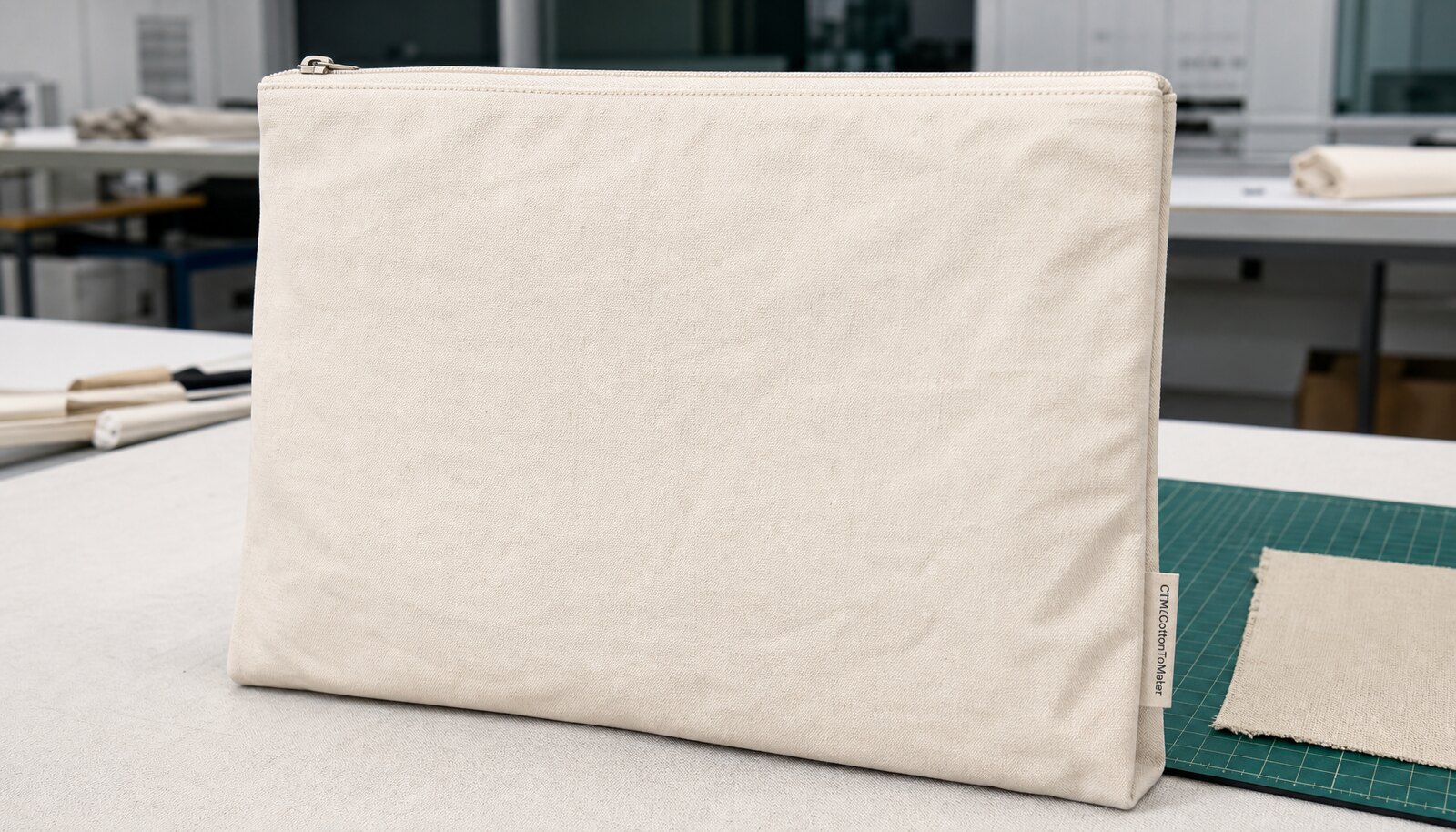
What Accounting Teams Actually Need
Accounting firms do not buy document bags the same way a fashion buyer buys a tote. The bag has one job: keep flat files, client folders, tax packs, and closing documents secure while moving between desks, meetings, storage, and courier handoffs. If the zipper catches, the bag loses shape, or the opening is too narrow for tabbed files, the item becomes a workflow problem instead of a useful office tool.
The sourcing brief should start with the document load, not with decoration. A bag that only carries paper can stay slimmer and lighter than one used for client onboarding kits, audit files, or internal file circulation. If the bag must also hold a calculator, a tablet, or dividers, that changes the gusset depth, seam reinforcement, zipper grade, and whether the bottom needs extra structure.
- Define the file format first: A4, Letter, or both.
- State whether the bag is for internal use, client handoff, or resale.
- Estimate the filled weight so the gusset and zipper are not under-specified.
- Treat the bag as an office supply with brand value, not as a generic giveaway.
Build the Spec Around the Files
For A4 programs, a practical finished size is usually around 24-25 cm wide by 33-34 cm high, with a 4-6 cm gusset if the contents are mostly paper. For Letter format, a slightly narrower width and a similar height usually work. The point is not to memorize a standard size; it is to leave enough clearance that the zipper does not press on the corners or force the file stack to bend.
Use finished measurements in the RFQ and ask the supplier to separate finished size from pattern size. That matters because sewing allowances, seam volume, and zipper insertion can change the final fit. If the bag must sit upright in a storage shelf or on a reception desk, a base board or stiffer body fabric may help, but that choice adds cost, weight, and freight volume. For most accounting use cases, a flat, reinforced sleeve is enough.
- For light paper carry, a 4-6 cm gusset is usually enough.
- If the bag must carry a tablet or heavy inserts, plan for a 6-8 cm gusset.
- Ask for finished size tolerance on the quote, not just the nominal size.
- If the bag needs to stand upright, say so early because the structure changes the cost.
Fabric and Zipper Choices That Move Price
Cotton weight is the fastest way to separate a serious spec from a vague one. A 220-250 GSM body can work for simple file transport and is usually the cheapest route. A 280-320 GSM body is the safer default for accounting-firm use because it keeps its shape better, prints more cleanly, and feels less flimsy in hand. Once you move above that range, the bag can feel more substantial, but the freight bill often rises because cotton bags are bulky even when they are light.
The fabric source matters too. Ask whether the body cloth is woven from plain cotton, twill, or canvas, and whether it comes from stock greige cloth, pre-dyed fabric, or a custom mill booking. Reorders are easier when the supplier can hold the same shade and weave across batches. Zipper choice has a similar effect. A #5 nylon coil zipper is usually the most forgiving for document bags; a #3 zipper can be fine for slim sleeves, while metal zippers add a premium look but need better handling and tighter hardware control. Ask who supplies the zipper, what size it is, and whether the puller is standard or branded.
For offices that reuse bags every day, the real risk is not just cost. It is a zipper that jams, tape that twists, or a body fabric that looks good in a sample but sags once the file is inside. A cleaner spec is often cheaper over the life of the program than a lower quote built on weak hardware.
- 220-250 GSM is the economy route; 280-320 GSM is the practical default.
- Ask for fabric type, weave, and source so reorders can match the first run.
- #5 nylon coil zippers are usually the safest choice for repeated office use.
- Metal zippers or branded pullers make sense when the bag needs a premium finish.
How Bulk Pricing Is Actually Built
Bulk price is usually driven by six variables: fabric weight, zipper grade, print method, seam density, packing format, and order quantity. Buyers often compare only the headline unit price and miss the reason one supplier looks cheaper. A quote can be lower because the fabric is lighter, the zipper is simpler, the print area is smaller, or the packing scope has been stripped down. If the quote does not show those items, the first invoice is not the full landed cost.
A better pricing plan starts with one frozen spec and then asks for quantity tiers. Request pricing at 300, 500, 1,000, and 3,000 units so the curve is visible. If the unit price hardly moves between tiers, the supplier may be covering unknown risk or omitting a cost line. If the price drops sharply at a higher tier, that usually means setup and labor are finally being spread over enough units to make the order efficient. That is the point procurement should target, not the lowest number on the first line of the quote.
For accounting-firm programs, small changes have a real cost effect. One extra print color, a woven label, or an inserted card can matter more than a slight change in fabric weight. The most useful quote is the one that lets finance and sourcing compare the same spec, the same packing, and the same shipment basis without guessing what is missing.
- Ask for unit price by tier, not only one flat number.
- Separate body fabric, zipper, print, label, and packing into line items where possible.
- If two quotes differ sharply, check what has been removed before assuming one supplier is simply cheaper.
- Freeze the spec before the final quote so the price survives sample revision.
Compare the Product Routes, Not Just the Supplier Type
The table below compares the most common product routes buyers actually choose. It is more useful than comparing supplier labels alone because the tradeoff is really about fabric weight, trim, and packing scope. A direct factory and a trading company can both source a good bag, but the price, MOQ, and lead time change once the spec gets more detailed. That is why the buyer should start from the product route and then choose the sourcing path that can support it.
For accounting firms, the best route is often not the cheapest blank bag. It is the route that can hold the same measurements, print position, zipper quality, and carton standard across repeat orders. If the bag is part of a tax-season kit or a client onboarding pack, repeatability matters more than chasing the lowest quote for a single run.
- Use a direct factory when spec control and repeat orders matter.
- Use a trading company when you need multi-SKU coordination or simpler communication.
- Use a stock route when speed matters more than exact customization.
- Use dual sourcing when the calendar is tight and the program cannot miss a deadline.
Printing and Branding That Survive Office Use
For this product category, simple branding usually wins. A one-color screen print is often the most durable and economical choice because it stays legible on natural cotton and does not fight the fabric texture. If the buyer wants a cleaner corporate look, a woven label or stitched patch can feel more refined than a large inked logo. Heat transfer can work for detailed artwork or multiple colors, but it needs a sample check for adhesion, cracking, and edge lift after handling.
Placement matters as much as the method. Artwork that sits too close to a seam, gusset fold, or zipper end is more likely to distort once the bag is loaded. A centered front mark, a lower-corner print, or a side label usually ages better than a large top-heavy graphic. For accounting-firm programs, understated branding is often better than a loud promotional design. The bag has to look credible on a desk, not like a trade-show freebie.
If the brand color matters, provide a Pantone reference and ask for a strike-off or print proof before bulk approval. If the supplier uses woven labels, approve the label width, edge finish, and stitch color as a single package. Small details become large once the order is in production, and fixing them after sewing starts is always more expensive.
- Best low-risk option: one-color screen print.
- Best premium office look: woven label or stitched patch.
- Best for detailed artwork: heat transfer, if the sample passes adhesion checks.
- Keep artwork away from seam intersections and zipper stress points.
Source Cotton and Hardware Without Surprises
Cotton sourcing should be treated as a supply decision, not just a design decision. Ask whether the body cloth is from domestic mill stock, imported greige cloth, or a custom dyed booking. That answer affects lead time and repeatability. If the program needs an eco angle, verify recycled cotton or organic cotton claims before sample approval and make sure the document trail is available. Buyers do not need a complicated sustainability story; they need a claim they can defend on the PO.
Zipper sourcing should be just as specific. Ask whether the factory buys zipper tape locally or books it with the same mill cycle as the fabric. A #5 nylon coil zipper with a standard puller is usually the safest default. Metal zippers can look sharper, but they are less forgiving when the bag is folded, and the hardware finish needs more inspection. If the puller is branded, ask whether the logo is embossed, engraved, or printed, because that changes both cost and defect risk.
Packing and freight assumptions belong in the quote, not in a side email. Cotton document bags are light but bulky, so volumetric weight often drives the shipping bill more than the actual kilograms. Ask for carton dimensions, units per carton, net and gross weight, and the expected CBM per 1,000 units. If the quote uses FOB, CIF, or DDP, normalize the number before comparing it with another supplier route. A lower unit price can disappear fast once freight and carton volume are added.
- Ask where the cotton comes from and whether the same shade can be reordered.
- Confirm whether the zipper is sourced separately or bundled into the sewing schedule.
- Request carton size and CBM per 1,000 units so freight is not a surprise.
- If the order is international, compare quotes on the same Incoterm before awarding.
Set QC Targets the Factory Can Test
Quality control for this product should be measurable, not vague. A usable standard usually starts with a signed master sample, a size sheet, and a short defect list. For office bags, the most important checks are body weight, finished size, zipper function, seam strength, print accuracy, and carton condition. The factory does not need a laboratory to catch the failures that matter. It needs a clear pass-fail standard before production starts.
A practical QC plan for procurement is simple. Keep fabric weight within about +/-5% of the target GSM, keep finished width and height within about +/-0.5 cm, and keep print placement within about 3 mm of the approved sample. Run 20-30 zipper cycles on sampled bags and reject any unit that snags, pops, or binds at the ends. For load testing, fill the bag to the intended use weight, around 2 kg for most document programs, and check that the seam ends and zipper corners do not open. If the bag is client-facing or brand sensitive, tighten the plan to AQL 1.5 major. For standard office use, AQL 2.5 major and 4.0 minor is a practical baseline.
Major defects should cover broken zippers, open seams over 5 mm, wrong artwork, missing labels, or stains over 5 mm. Minor defects can include loose thread tails, light stitch wobble, or small color drift within the approved range. The goal is to make rework decisions obvious before the shipment leaves the factory.
- Use one signed master sample and one frozen spec sheet.
- Measure finished size, not pattern size, during inspection.
- Reject broken zippers, open seams, wrong logo placement, and visible stains.
- Require carton drop protection if the bags will ship through parcel or mixed freight.
Packing, Freight, and Landed Cost
Packing needs to match the channel. For office distribution or distributor stock, bulk pack is usually the cleanest and cheapest route. If the bags are going to retail shelves or gift kits, polybags, inserts, and barcodes may be needed, but every added step increases labor and changes the carton profile. Buyers should decide that upfront, because packing changes the landed cost as much as the fabric choice does.
Freight should be calculated on the carton, not the sample photo. Cotton bags are light but bulky, so the carton dimensions can matter more than the gross weight. Ask for the number of units per carton, outer carton dimensions, gross weight, and estimated CBM before the booking is made. If one quote looks cheaper because it packs more loosely, that savings can disappear in freight or warehouse handling. The same is true when comparing FOB to DDP; one includes more cost on the supplier side, the other pushes the burden to the buyer's receiving team.
If the order is time-sensitive, reserve inspection time in the schedule. A good sample that ships late is still a bad buying outcome. The landed cost only matters when the goods arrive on time, with the right carton count, and in a condition that the warehouse can receive without relabeling or repacking.
- Bulk pack is usually best for office and distributor programs.
- Add polybags or inserts only when the channel actually needs them.
- Ask for carton dimensions before booking freight because volume often drives cost.
- Compare FOB, CIF, and DDP on the same scope, not as stand-alone numbers.
The RFQ Questions That Reveal Real Capacity
The fastest way to get a usable quote is to ask questions that force the supplier to reveal the actual spec. If the reply is vague, the quote will be vague too. For cotton zipper document bags for accounting firms, the buyer should not ask for a generic price sheet. Ask for the body fabric, zipper size, label method, packing scope, and quality standard in the same response so the numbers can be compared line by line.
A procurement team should also ask for the re-order story. A supplier that can repeat the first run without changing fabric shade, zipper type, or packing method is more valuable than one that quotes a slightly lower first order and cannot hold the spec later. The goal is not a one-off purchase. It is a repeatable sourcing plan that can support annual cycles, seasonal spikes, and client-kit replenishment without rework.
- What is the exact body fabric spec, including GSM, weave, and source?
- Which zipper size and type is included, and who supplies the hardware?
- Can you quote 300, 500, 1,000, and 3,000 unit tiers on the same spec?
- What is included in packing, and what changes if we add polybags or inserts?
- What is the sample charge, and does it convert to bulk credit?
- What is the lead time after sample approval, not just after order placement?
- How do you handle shade matching and reorder consistency?
- What inspection standard do you use before shipment?
Specification comparison for buyers
| Spec route | Typical price position | Typical MOQ | Lead time | Best fit |
|---|---|---|---|---|
| 220-250 GSM cotton, #5 nylon coil zipper, bulk pack | Lowest base price; usually the benchmark quote | 300-500 units | 2-4 weeks if fabric is already in stock | Internal file carry or test orders |
| 280-320 GSM cotton, one-color screen print, #5 nylon coil zipper | Best balance of cost and durability | 500-1,000 units | 3-5 weeks after sample sign-off | Accounting-firm staff kits and client handouts |
| 320-350 GSM cotton, woven label or stitched patch, reinforced base | About 8-15% above the balanced spec | 1,000+ units | 4-6 weeks | Premium onboarding packs or recurring office programs |
| Metal zipper or branded puller upgrade | Usually a small premium of 5-12% | 500-1,000+ units | Adds 3-7 days if hardware must be sourced separately | When the bag needs a sharper, more premium finish |
| Recycled or organic cotton with same-color branding | Often 10-25% above standard cotton | 1,000+ units | 5-8 weeks depending on fabric booking | ESG-led procurement programs |
| Bulk pack only versus polybag + insert + barcode | Bulk pack is cheapest; retail-style packing adds cost | Bulk pack can start lower; retail packing usually needs more planning | Packing can add 3-5 days | Office distribution versus resale or gift programs |
Buyer checklist before sampling
- Write the finished size for A4 or Letter files, then confirm gusset depth and zipper opening width.
- State the target fabric weight in GSM and allow only a narrow tolerance band.
- Lock the print method, print position, and number of colors before asking for final quotes.
- Specify zipper type, puller style, seam reinforcement, and whether the bag needs a lining or base board.
- Define packing format: bulk pack, polybag, inner bundle count, carton quantity, and carton marks.
- Request a pre-production sample or golden sample that matches final fabric, trim, and artwork.
- Ask for the factory's standard lead time by MOQ tier and the latest artwork change cutoff.
- Compare quotes on the same Incoterm and the same packing scope, not on unit price alone.
Factory quote questions to send
- What is the exact body fabric spec, including GSM, weave type, and whether it is plain woven, canvas, or twill cotton?
- Where is the fabric sourced, and can you keep the same shade or dye lot for a reorder?
- Is the zipper #3 or #5, nylon coil or metal, and who supplies the hardware?
- What is the MOQ for plain bags, one-color print, and more complex branding?
- Which charges are separate line items, such as screen setup, label making, sample fees, and carton marks?
- What is included in the packing standard: bulk pack, polybag, insert card, barcode, and carton dimensions?
- What is the production lead time after sample approval, and what changes with higher volume?
- Which steps are done in-house, and which ones are outsourced?
- Can you share a measurement sheet, reference sample photo, and your inspection standard before we place the PO?
Quality-control points to confirm
- Fabric weight should stay within about +/-5% of the target GSM.
- Finished width and height should stay within about +/-0.5 cm; gusset depth can allow about +/-0.3 cm.
- Print placement should stay within about 3 mm of the signed sample, with no bleed or ghosting.
- Zipper action should run smoothly through 20-30 open-close cycles on sampled units without snagging.
- Seams at zipper ends and corners should not gap, skip, or pop under a 2 kg load test.
- Thread ends should be trimmed; loose tails longer than 10 mm should be treated as minor defects.
- Major defects should include wrong artwork, broken zipper, open seam over 5 mm, or a stain over 5 mm.
- Use AQL 2.5 for major defects and 4.0 for minor defects, or tighten it if the bags are client-facing.