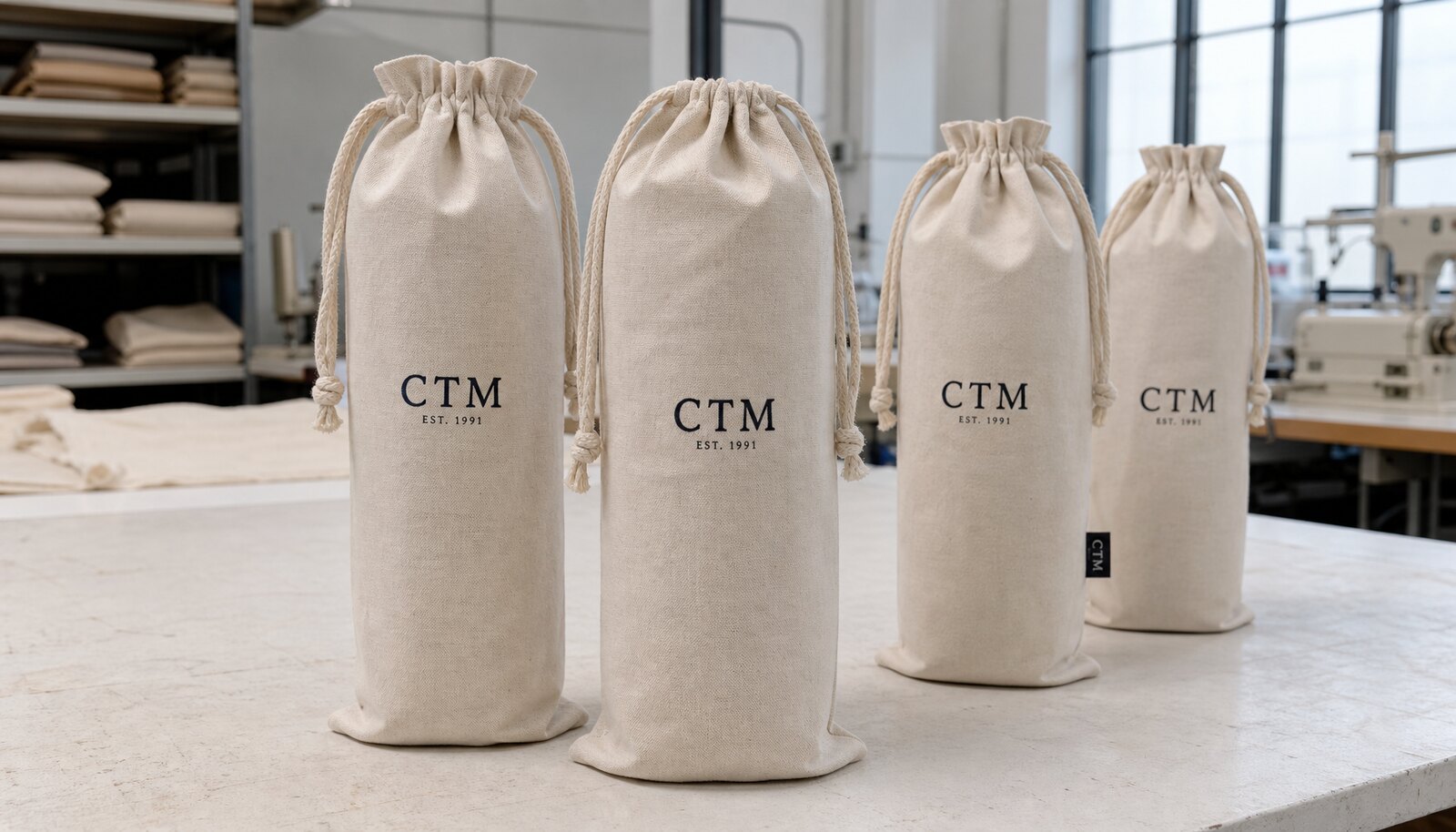
What buyers are really buying
Cotton wine bags for corporate gifts are not just a packaging item. They are part of the gift presentation, and the bag has to survive handling by procurement, warehouse staff, the client’s admin team, and finally the recipient. If the bag looks soft and premium but cannot hold a standard 750 ml bottle without distorting, the program fails at the first physical touchpoint.
The right spec starts with the bottle, not the artwork. Most quote problems come from buyers asking for a logo bag before they define bottle diameter, bottle height, closure style, and whether the bag is for a single bottle or a paired set. A supplier can only quote cleanly if the bag dimensions and finish are tied to the actual gift format.
- Define the bottle format first: standard wine, champagne, craft beverage, or non-alcoholic gift bottle.
- Decide whether the bag must feel premium, economical, or promotional before choosing fabric weight and decoration.
- Write the use case into the RFQ: end-of-year gifts, event handouts, client thank-you gifts, or retail resale.
Material choices that affect presentation and price
For this product, fabric weight is one of the biggest cost and quality drivers. Lightweight cotton around 100-110 GSM is acceptable for low-cost giveaways, but it can look thin when filled and may show the bottle outline too sharply. For corporate gifts, 120-150 GSM usually gives better body, less transparency, and a more deliberate finish without pushing the bag into an expensive category.
The weave and finish matter as much as the nominal GSM. A bag made from loosely woven cotton can feel cheaper than a slightly lighter but tighter fabric. If the brand is using the bag as part of a premium gift, ask for a sample in the exact natural or dyed shade you intend to approve, because color and weave density change how the logo reads and how the bag photographs in internal approval decks.
- Use 120-150 GSM for the most common corporate gift balance between cost and presentation.
- Ask whether the cloth is pre-shrunk or whether shrinkage must be allowed for in the final size.
- Specify whether you want natural cotton, bleached white cotton, or a dyed shade, since each affects logo contrast and lead time.
Print and branding options that hold up in use
For simple corporate logos, screen printing is usually the most economical and the cleanest to quote. It works well when the artwork is one or two spot colors and the bag surface is relatively flat. If the logo has thin strokes, gradients, or a premium feel requirement, a woven label or embroidery may fit better, but those methods change both MOQ logic and unit cost.
Do not let suppliers replace your requested print method with their default process unless the art and target price actually support it. Heat transfer can be acceptable for short runs or detailed art, but on cotton it can feel less premium and may age differently under folding or friction. If the bag is intended to be reused several times, test the decoration after folding, light abrasion, and bottle insertion rather than approving from a single flat photo.
- One-color screen print is the safest baseline for most RFQs.
- Embroidery or woven labels work best when the gift needs a premium or durable feel.
- If the logo sits near the seam or drawstring channel, request a placement mockup before bulk approval.
How MOQ and pricing usually move together
MOQ on cotton wine bags is not just a factory preference; it is tied to cutting efficiency, print setup, and packing labor. A one-color run on a standard size with bulk packing may support a lower MOQ than a custom size with individual polybags and barcode labels. If you change fabric color, print color, and packaging all at once, the minimum often rises because the line needs separate setup and more inspection time.
When comparing quotes, break the price into fabric, sewing, print setup, packaging, and cartonization. A low unit price can hide a higher setup fee or a packing charge that only appears after order confirmation. Ask suppliers to quote at at least two volumes, such as 1,000 and 5,000 pieces, so you can see whether the price curve is actually efficient or just padded at the low end.
- Request a unit price at two volumes to expose real scale effects.
- Separate print setup from recurring print cost so you can compare suppliers fairly.
- Ask whether the MOQ changes if you switch from bulk packing to retail-ready packing.
Choosing the right supplier route
There is no single best route for cotton wine bags for corporate gifts. Direct factory sourcing usually gives the best control on spec and the cleanest pricing structure, but only if the factory actually manages sewing and decoration in-house or through a stable line. Trading companies can be useful when your program includes mixed items or you need project management across several SKUs, but you have to inspect the margin structure and the real manufacturing source.
Local decorators are useful when speed matters more than import efficiency, especially if you already have bag stock in hand or need regional language labels. Stock importers work when lead time and MOQ are the main constraints, but they limit control over dimensions, fabric consistency, and exact finish. The right route depends on whether your biggest risk is unit cost, schedule, or presentation quality.
- Use direct factory sourcing when you need repeatable specs and the lowest clean landed cost.
- Use a trading company if your internal team wants one contact for a multi-item corporate gift kit.
- Use local decoration only when the schedule is tighter than international production plus freight.
Sample approval and QC thresholds
A sample is not just a marketing prop. It is the control point that tells you whether the supplier can hold the construction, print, and packing standard across the bulk run. Approve the sample only after checking seam alignment, drawstring function, logo placement, and bottle fit using the actual bottle type. If the sample is too loose, too tight, or visually off-center, those issues usually get worse at scale, not better.
Set acceptance criteria before production starts. For example, you can allow small dimension tolerance but reject a print that drifts into the seam allowance or a drawstring channel that twists under load. If the order is for a corporate gifting event, make the sample review process fast but strict, because the cost of a late correction often exceeds the savings from squeezing the price down by a few cents.
- Check the sample with the exact bottle and any insert card or ribbon you plan to use.
- Set tolerance for dimensions, print placement, and thread quality before bulk approval.
- Request a production photo or first-article inspection if the factory is large or the order is time-sensitive.
Packing for gift programs and retail handling
Packing often gets treated as a small detail, but it is where many corporate gift orders get damaged. Bulk packed wine bags are fine for internal redistribution, but if the bags are going straight to end recipients or a fulfillment house, individual polybags and clear size labels may be worth the added cost. That choice should be made in the RFQ, not after the supplier has already optimized the line for bulk cartons.
Carton structure matters because cotton bags are light but bulky. You want a carton count that balances efficient shipping with low crush risk. Ask for carton dimensions and gross weight so your logistics team can estimate storage and freight accurately. If the bags are part of a bundled gift, ask whether the factory can insert cards, tissue, or ribbons without slowing the line to the point where lead time becomes unreliable.
- State whether cartons are for warehouse handling, direct retail, or final gift delivery.
- If barcode labels are needed, define the format and placement before production.
- Confirm whether inserts or bundled items are packed by the factory or by a downstream kitting partner.
Lead time and schedule risk
Lead time should be measured from approved sample and deposit, not from the first email. On a straightforward cotton wine bag order, the production window may look manageable on paper, but sampling, artwork revision, carton approval, and line scheduling can each add days. If your event date is fixed, build a buffer for correction rounds, export documentation, and transit delays.
The real schedule risk is usually not the sewing time. It is the time lost when the buyer changes the print file, the supplier revises the bag dimension, or the packing standard is not fully defined. A clean RFQ with a frozen artwork file and a clear spec sheet is the best way to protect the schedule. If the supplier cannot state what part of the lead time is critical path, they probably do not have full control of the job.
- Freeze artwork before asking for final pricing.
- Separate sample lead time, production lead time, and freight transit time in your internal plan.
- Ask the supplier which part of the schedule is most likely to slip and why.
Landed-cost thinking for corporate gifts
The cheapest factory quote is often not the lowest landed cost. Cotton wine bags can pick up extra cost in print setup, inner packing, carton volume, and freight class because the bags are light but take up space. If your order ships by sea, volume efficiency matters. If it ships by air for a deadline, every extra fold, insert, and polybag can add to the bill.
Build the comparison around usable landed cost, not just ex-factory price. Include product cost, print setup, packing charge, domestic transport to port, export docs, and the likely freight method. For procurement teams, this is the cleanest way to compare direct factory, trading company, and local sourcing routes on the same basis. A supplier that looks expensive at source may still win once packing density and fewer handoff points are included.
- Compare ex-factory and landed cost separately so the buying decision is transparent.
- Watch carton volume, not only piece count, when freight is a large part of the total.
- Ask for a full cost breakdown before negotiating unit price alone.
Specification comparison for buyers
| Spec decision | Recommended option | When it fits | Buyer risk to check |
|---|---|---|---|
| Direct factory sourcing | Cotton 120-150 GSM with one-color print and standard carton packing | Best for repeat corporate gifts, large promotions, and custom brand runs | Confirm whether the factory actually owns print, sewing, and packing or is subcontracting |
| Trading company route | Use when you need mixed products, smaller program management, or multi-item kits | Useful if your gift program includes wine bags plus other accessories from one PO | Check margin stack, hidden handling fees, and whether they can control shade and print consistency |
| Local decorator or print house | Stock or near-stock bags printed locally after import | Fits urgent deadlines and low-volume regional events | Verify bag dimensions, seam quality, and whether local print heat or ink damages the fabric |
| Stock importer with logo add-on | Blank inventory with simple logo print or label application | Works for shorter lead times and lower MOQs | Watch for inconsistent dye lots and limited control over handle length, fabric density, and bag sizing |
| Fully custom factory run | Custom size, fabric weight, closure style, and print placement | Best for brand gifting programs where presentation matters | Demand pre-production sample approval and a detailed spec sheet before bulk cut |
| Mixed sourcing program | Blank cotton wine bags from factory, decoration and kitting done locally | Good when you need regional language inserts or multiple gift bundles | Make sure two vendors share the same color standard and delivery responsibility |
| Sustainable positioning route | Organic cotton or recycled cotton with simple print and minimal packaging | Fits ESG-led corporate gifting or premium brand positioning | Request the exact fiber claim wording and supporting documentation before order confirmation |
| Low-cost promotion route | Lightweight cotton 100-110 GSM, one-color logo, bulk packing | Appropriate for high-volume giveaways where unit cost matters most | Check opacity, seam strength, and whether the bag can stand up to a full bottle without tearing |
Buyer checklist before sampling
- Lock the bottle size first: standard 750 ml wine bottle, champagne bottle, or specialty bottle, then set the internal bag dimensions with extra clearance for neck and base.
- Specify fabric weight in GSM, not just 'cotton'; for corporate gifts, 120-150 GSM is usually a safer range than thin promotional cloth.
- Choose the print method before asking for quotes: screen print for simple logos, woven label or embroidery for a premium look, heat transfer only if the fabric and artwork support it.
- State whether you need a single-bottle bag, a double-bottle carrier, or a presentation set with insert card and outer mailer.
- Define packing clearly: bulk packed, inner polybag, or retail-ready with barcode, size sticker, and carton labeling.
- Request a pre-production sample or photo sample and approve seam, print placement, drawstring length, and color against a physical reference.
- Ask for carton quantity, carton size, net/gross weight, and palletization if the bags will move through a warehouse or gift fulfillment center.
- Confirm lead time from sample approval, not from inquiry date, and separate production time from ocean or air transit time.
- Build a tolerance note for dimensions, print registration, and color variation so the supplier knows what is acceptable and what is not.
Factory quote questions to send
- What fabric weight, weave count, and shrinkage assumption are you quoting for the cotton wine bag?
- Is the price based on direct factory production, or does it include subcontracted sewing, printing, or packing?
- What is the minimum order quantity for one-color print, multi-color print, and woven label versions?
- Can you quote three packing options: bulk packed, individual polybag, and retail-ready with barcode label?
- What is included in the sample charge, and will it be refunded against bulk order?
- What are the exact size tolerances for width, height, and drawstring opening after sewing and finishing?
- What print method are you recommending for this artwork, and what is the setup charge per color?
- How many cartons per order, what carton size, and what is the estimated gross weight per carton?
- What is the production lead time after sample approval, and what delay risks do you see at your current line schedule?
- Can you confirm whether the quoted material is bleached cotton, natural cotton, organic cotton, or blended cotton?
Quality-control points to confirm
- Fabric GSM matches the approved spec and is measured from the same batch used for production.
- Seam strength is checked at side seams, bottom seam, and drawstring channel, with no skipped stitches or loose thread bundles.
- Bag dimensions stay within agreed tolerance after washing or steam finishing if pre-shrink control matters.
- Print color, placement, and opacity match the approved sample, with no cracking, bleeding, or ghosting at fold lines.
- Drawstring length is even on both sides and slides smoothly without catching in the channel.
- Bottles fit in and out without forcing; the bag should not snag on neck glass or deform at the base.
- Cartons are labeled correctly with style code, quantity, country of origin, and inner pack count.
- No oil stains, needle marks, or lint contamination appear on the final packed goods.
- If using labels or embroidery, back-side finishing must be neat and should not scratch the bottle or gift presentation.