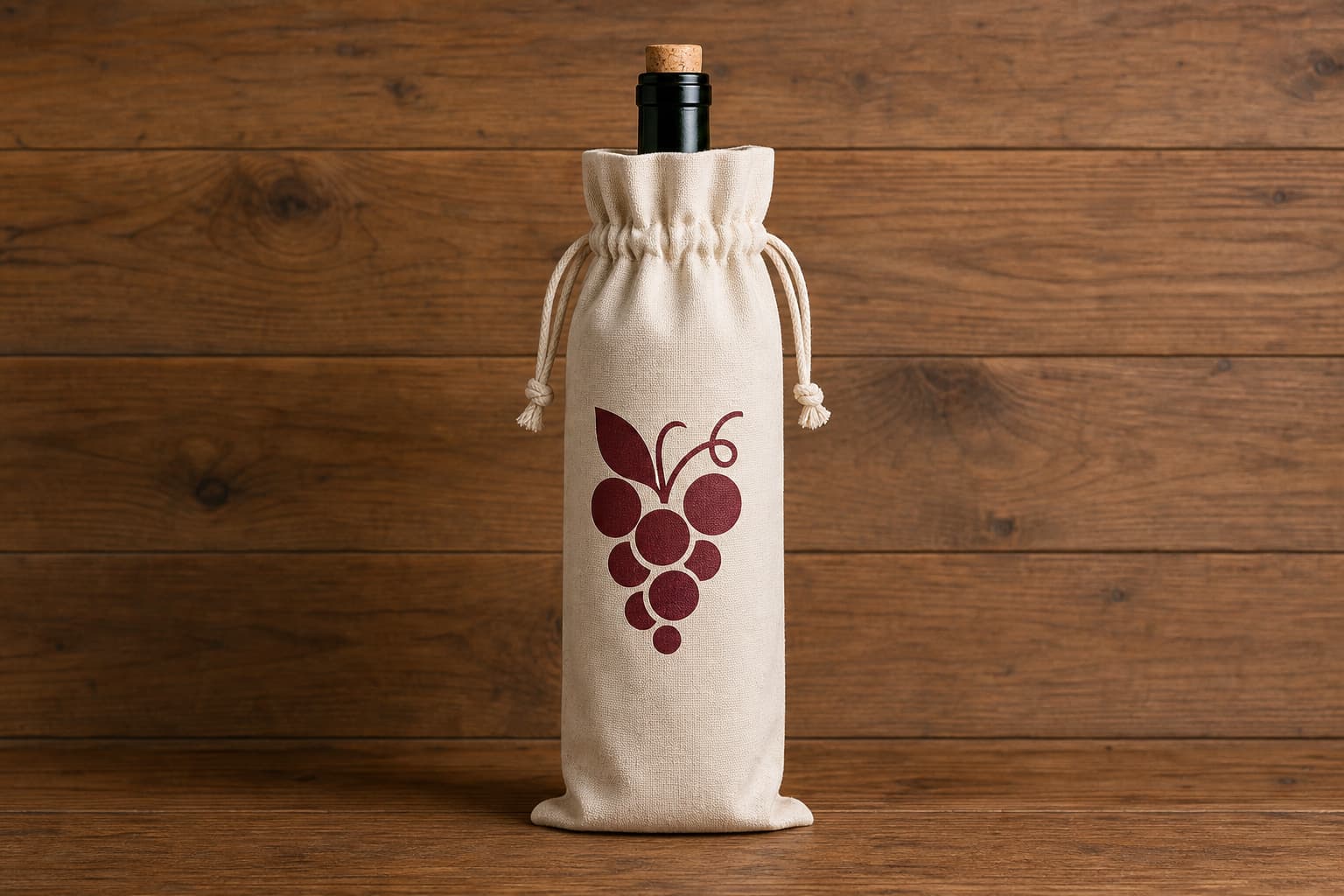
The Buying Problem: Simple Logo, Many Failure Points
Cotton wine bag logo printing is often treated as a small add-on, but most bulk problems start because the RFQ does not connect the fabric, logo method, bag size, and packing method. A logo that looks sharp in a PDF can look weak on coarse cotton, crack on a transfer, or shift after sewing if the supplier prints panels without controlling placement.
For procurement teams, the goal is not to request the cheapest printed wine bag. The goal is to receive comparable supplier quotes and samples that prove the logo can be produced repeatedly on the selected cotton bag construction.
- State the target bottle type, such as 750ml Bordeaux, Burgundy, Champagne, spirits, or olive oil bottle.
- Specify if the bag is for retail shelf display, gift packaging, tasting room sales, distributor events, or promotional giveaway.
- Decide whether the logo must be premium-looking, low-cost, washable, soft-hand, full-color, or fast to produce.
- Require the factory to quote the bag and the logo process together, not as separate vague line items.
Start With Fabric Weight Before Discussing Print
Cotton fabric affects print clarity more than many buyers expect. A 120 GSM muslin-style cotton may be low cost, but it can look thin and wrinkle easily around a bottle. A 180-260 GSM cotton or 6 oz to 8 oz canvas gives better structure and a more stable surface for printing. Heavy canvas can look more premium, but it also increases freight weight and may require stronger drawcord and tighter sewing control.
Natural cotton, bleached cotton, and dyed cotton do not print the same. Natural cotton has seed flecks and shade variation. This can be acceptable for eco-positioned packaging, but buyers should not expect the same logo brightness as printing on white polyester or coated paper.
- For economy gift use, ask for 140-180 GSM cotton and accept a softer, less structured bag.
- For retail or winery merchandise, consider 180-260 GSM cotton or 6 oz to 8 oz canvas.
- For premium reusable bottle packaging, sample 10 oz canvas only after checking stiffness, seam bulk, and freight impact.
- If color accuracy matters, request the same base fabric color in the print sample, not a substitute swatch.
Choose the Print Method Based on Artwork, Not Habit
Screen printing is usually the most practical method for one-color or two-color cotton wine bag logo printing. It gives reliable coverage, works well for clean logos, and is efficient for bulk orders. The factory should confirm ink type, mesh suitability, curing method, and whether the print hand feel is soft or slightly raised.
Heat transfer and digital transfer are useful for full-color graphics or short runs, but they must be tested on the actual fabric texture. Transfers can look sharp, but on cotton wine bags they may feel more like a film than ink. If the bag is folded across the logo during packing, transfer edges and creases need extra attention.
- Use screen print for simple logos, solid text, line art, and repeat wholesale orders.
- Use heat transfer or digital transfer when gradients, photos, or many colors are required.
- Use woven labels or sewn labels when buyers want a textile branding detail instead of a large front print.
- Avoid very fine type on coarse cotton unless the supplier proves legibility on a real sample.
- Avoid placing the logo over seams, drawstring channels, or heavy fabric folds.
Bag Size and Logo Placement Must Be Approved Together
A wine bag that fits one bottle on paper may still fail in use if the base diameter, shoulder shape, or bottle height changes. Before confirming logo layout, the buyer should tell the factory the bottle dimensions and whether the bottle will be inserted before or after shipping to the final packer.
Logo placement should be measured on the finished bag, not only on the cut panel. Sewing, drawstring channel folding, and bottom shaping can change the visible print area. A common approach is to center the logo on the front panel and keep it low enough to avoid the drawstring area but high enough to stay visible when the bottle base fills the bag.
- Provide bottle height, bottom diameter, shoulder diameter, and filled weight if available.
- Ask the factory for recommended finished bag size with tolerance, such as width, height, and bottom gusset if used.
- Confirm logo size in millimeters, not only percentage or visual reference.
- Approve logo position from fixed points: top edge, side seam, and bottom edge.
- Request a photo of the sample standing with a bottle inserted if the bag must display upright.
MOQ Logic: What Actually Drives the Minimum
The MOQ for printed cotton wine bags is not only about sewing. It is affected by fabric availability, dyeing, print screens, ink mixing, setup time, and packing requirements. A stock natural cotton fabric with one-color screen printing usually has more flexible minimums than custom dyed cotton with multi-color logo printing.
Buyers comparing quotes should ask suppliers to separate the MOQ drivers. Otherwise, one quote may appear more expensive simply because it includes custom fabric dyeing or a more durable print process, while another quote assumes stock fabric and basic ink.
- Stock cotton fabric usually gives better MOQ flexibility than custom dyed fabric.
- One-color screen print is normally more efficient than multi-color registration.
- Full-color transfer may support smaller artwork runs but can have higher unit print cost.
- Custom drawcord color, custom label, and individual retail packing can raise MOQ or lead time.
- If testing a new SKU, ask for quote breaks at realistic quantities instead of only one volume.
Sample Approval: What to Check Before Bulk Production
A good sample is not just a photo approval. Procurement teams should approve physical hand feel, fabric color, logo sharpness, print adhesion, sewing accuracy, and bottle fit. If the supplier sends a sample using available fabric instead of the planned bulk fabric, this must be clearly marked as a construction reference only.
For logo printing, the sample should include the final logo size, exact print color target, drawcord style, stitching method, and packing fold if possible. Many logo defects appear only after folding, rubbing, or loading the bag with a bottle.
- Check whether the logo edges are sharp or broken by cotton slubs.
- Rub the logo with dry and slightly damp cloth to detect weak curing.
- Insert the bottle and close the drawstring to see if the logo distorts.
- Measure finished bag dimensions after sewing, not flat fabric before sewing.
- Photograph and sign off the sample with notes on allowed tolerances.
- Keep one approved sample at the buyer side and one at the factory side for bulk reference.
Packing Decisions Can Damage a Good Print
Packing is often discussed late, but it can change the final appearance of cotton wine bag logo printing. If bags are folded tightly across the printed face, the logo may crease before receiving inspection. If natural cotton is packed without moisture control during long transit, fabric odor, mildew risk, or carton staining can become an issue.
For retail buyers, presentation matters. For distributors, carton efficiency and easy counting may matter more. The RFQ should state whether bags are bulk packed, bundled by quantity, individually polybagged, paper banded, or packed with a barcode label.
- Avoid folding directly through large transfer logos when possible.
- Define pieces per inner pack and pieces per export carton.
- Request carton dimensions and gross weight for freight planning.
- Confirm whether desiccant, liner bag, or moisture-resistant carton is needed for the shipping route.
- If retail-ready packing is needed, provide barcode, warning label, and country labeling requirements early.
Lead Time and Quote Data Buyers Should Request
Lead time depends on fabric status, sample approval speed, print setup, production queue, and packing complexity. A responsible supplier should not promise a universal timeline without checking these details. Instead, the quote should separate sample lead time, bulk production time after approval, and any time needed for custom materials.
A useful quote also gives enough data for landed cost comparison. Procurement teams should ask for unit price assumptions, artwork setup charges, print charges, packing method, carton size, gross weight, and quote validity. Without this data, two supplier prices are not truly comparable.
- Ask if fabric is in stock, greige fabric, dyed to order, or specially woven.
- Request sample lead time separately from bulk production lead time.
- Confirm whether print screen, mold, transfer setup, or label setup fees are included.
- Ask for carton measurement and gross weight to estimate freight cost.
- Require the quote to state Incoterm, currency, payment terms, and quote validity.
- Confirm when production starts: after deposit, artwork approval, sample approval, or all three.
Specification comparison for buyers
| Spec decision | Recommended option | When it fits | Buyer risk to check |
|---|---|---|---|
| Fabric weight for single bottle cotton wine bag | 6 oz to 8 oz cotton canvas or 180-260 GSM plain cotton | Retail gift packaging, winery promotions, and reusable bottle bags where the bag must stand better than thin muslin | Very light cotton may twist after sewing and make the printed logo look off-center |
| Logo print method for 1-2 color artwork | Screen printing with water-based or plastisol ink depending on hand feel target | Simple brand marks, event logos, distributor gifts, and wholesale retail packaging | Ink coverage can look uneven on slub cotton if the supplier does not test mesh count and ink deposit |
| Logo print method for full color artwork | Heat transfer or digital transfer, sampled on the exact cotton fabric | Gradient logos, artwork with small color details, or short seasonal runs | Transfers may feel heavier and can edge-lift if curing and pressing are not controlled |
| Bag structure | Flat cotton wine bag with drawstring or rope cord, reinforced side seams | Most 750ml wine, spirits, olive oil, or gift bottle packaging programs | Bottle base diameter must be confirmed; a narrow bag can fit empty but fail during packing |
| Logo placement | Centered on front panel, usually 60-90 mm below drawstring channel depending on bag height | Retail-facing logo display when the bag stands upright on shelf or gift table | Printing too close to the drawcord channel can distort during sewing and closing |
| Packing method | Flat packed in export carton with inner polybag or paper banding as required by buyer | Distributors and retail buyers needing clean presentation and easier carton counting | Over-compression can wrinkle printed areas before final receiving inspection |
Buyer checklist before sampling
- Confirm bottle size, filled bottle weight, and whether the bag must hold 750ml wine only or mixed bottle shapes.
- Specify cotton fabric weight in GSM or oz, not only the words cotton bag or canvas bag.
- Send vector logo files and Pantone references, plus acceptable tolerance if exact matching on natural cotton is not possible.
- Choose print method based on artwork, order quantity, target hand feel, and wash or reuse expectations.
- Approve a pre-production sample made with the same fabric, drawstring, ink, and sewing construction as bulk.
- Check logo position after sewing, not only on flat cut panels before assembly.
- Define packing style, carton limits, moisture protection, labeling, and any retail barcode or inner pack requirements.
- Ask the supplier to show MOQ logic by print method and color count so quote comparisons are fair.
Factory quote questions to send
- What cotton fabric options can you quote for this wine bag, including GSM or oz, weave type, shrinkage tendency, and available stock colors?
- Which logo printing method do you recommend for our artwork and why: screen print, heat transfer, digital transfer, embroidery, woven label, or another method?
- What is the MOQ for the bag itself and what is the MOQ impact of logo color count, Pantone matching, and custom dyed fabric?
- Can the sample be made with the same fabric batch or same approved fabric quality planned for bulk production?
- What logo size and placement do you recommend for a 750ml wine bottle bag, and can you mark the placement on the sample approval sheet?
- How will you test print adhesion, color fastness, rubbing resistance, and logo alignment before bulk packing?
- What carton packing method do you propose, and how many pieces per carton for our selected fabric weight and bag size?
- What quote data is included: unit price, sample cost, tooling or screen charge, print charge, packing cost, lead time, carton size, gross weight, and HS code if available?
Quality-control points to confirm
- Check fabric GSM with a cutter scale or agreed factory method before cutting bulk fabric.
- Compare printed logo color against the approved sample under consistent lighting, especially on natural or unbleached cotton.
- Measure logo placement from bag top, side seam, and bottom edge after sewing.
- Rub test the printed logo when dry and lightly damp to screen for poor curing or weak transfer adhesion.
- Load test the bag with a filled bottle weight if the buyer expects reusable handling, not only gift presentation.
- Inspect drawstring channel stitching, side seam strength, bottom corners, and loose threads around the printed area.
- Confirm carton packing prevents sharp creases across the logo face.
- Record defects by category: print smudge, color variance, off-center logo, fabric stain, sewing defect, and packing damage.