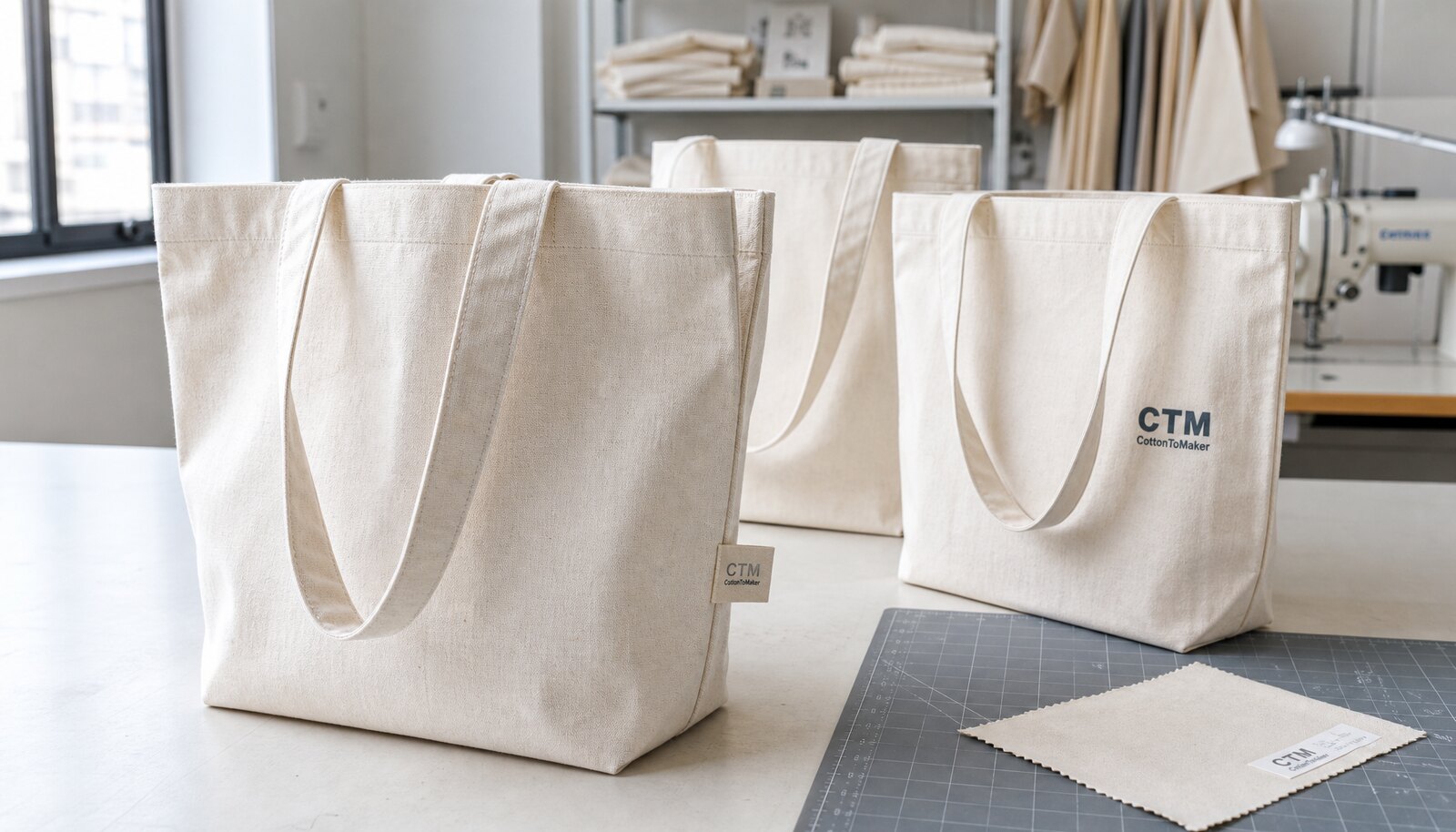
Why retail cotton shopping bags need a procurement spec, not just a design file
Cotton shopping bags for retail sit in a different buying category from giveaway totes and event bags. The customer expects them to look finished on a shelf, hold up to repeated carry use, and arrive in clean, countable cartons that are easy to receive. If the spec only covers artwork and size, the factory will fill in the gaps with its own assumptions. That is where problems start: one supplier builds for low-cost promotion, another builds for consumer resale, and both may call the product a "cotton tote."
A proper procurement spec turns a vague concept into a repeatable item. It should tell the supplier what the bag must do, what it must look like, what can vary, and what cannot vary. That means defining fabric weight, weave style, handle construction, seam details, decoration method, packing format, and inspection standard before the first sample is made. When those details are left open, the first quote may look attractive but the bulk order often reveals the real cost of corrections, reprints, and delays.
For retail buyers, the goal is not the lowest unit price on a single line item. It is the best combination of shelf appearance, repeatability, and landed cost. A bag that is slightly cheaper but creates more rejects, more customer complaints, or more receiving friction is rarely the better buy. Procurement teams should therefore compare suppliers on the full order logic: material consistency, decoration control, carton readiness, and the supplier’s ability to repeat the approved sample without hand-finishing shortcuts.
- Retail bags need shelf appeal and repeatability, not only basic carry strength.
- The quote should separate material, sewing, print, packing, and carton costs.
- A good sample matters only if the factory can reproduce it at bulk scale.
Start with the retail use case: checkout sale, branded merchandise, or gift-with-purchase
The best specification begins with the end use. A bag sold as a checkout add-on in a grocery-adjacent store is judged differently from a premium boutique tote or a membership gift. Checkout bags need fast recognition, a reasonable price point, and sturdy handles. Boutique retail bags can justify more body in the fabric, cleaner finishing, and more careful packing. Gift-with-purchase programs often live in the middle: the bag must look intentional and brand-aligned, but the buyer still wants tight cost control.
That use case changes the technical decisions. If the bag will carry books or boxed goods, you should prioritize handle reinforcement and body structure. If the bag is meant mainly for apparel or light lifestyle purchases, a lighter construction may be acceptable. If the bag will be sold as an item in its own right, the buyer should treat it more like a retail product than a promotional accessory: better edge finishing, a more stable fold, and tighter control on stains or visible weave defects.
The use case also affects how much variation you can tolerate. For a value checkout bag, a slightly rougher hand feel may be acceptable if the bag holds up. For a premium store, the same level of roughness may read as cheap. Good procurement practice is to define the commercial role of the bag first, then let that role drive the technical spec instead of trying to reverse-engineer the price after the artwork is already approved.
- Checkout sale: prioritize price, fast recognition, and stable construction.
- Gift-with-purchase: balance brand look with cost control and clean packing.
- Retail-for-resale: tighten finishing, cosmetic quality, and packaging consistency.
Fabric weight, weave, and finish: the spec choices that change both look and quote
For most retail programs, 140–160 GSM cotton canvas or drill is the most usable range. It gives enough body for a clean print, keeps the bag from collapsing into a soft pouch, and usually remains cost-effective for repeated production. Below that range, the bag can feel too thin, wrinkle easily, and show the contents in a way that looks unfinished. Above that range, the bag gains structure and a more premium hand feel, but freight, sewing resistance, and material cost all rise. In practice, a move from 150 GSM to 180 GSM is not just a minor upgrade; it changes the bag’s feel, handling, and cost base.
Weave quality matters as much as the nominal GSM. A loosely woven 160 GSM fabric can print worse and wear worse than a tighter 150 GSM cloth. Ask the supplier whether the fabric is combed or carded, and whether the finish is bleached, unbleached, or minimally sized. Bleached cotton usually gives a cleaner visual presentation and better logo contrast, while unbleached fabric creates a more natural retail look and can hide some small production variance. If the artwork uses fine type or very slim strokes, request a fabric swatch first. The same logo can look sharp on one weave and soft or broken on another.
Finish can also affect approval. Excess sizing or surface treatment may improve initial appearance, but it can change ink adhesion and make the hand feel inconsistent after folding. If the bag is meant for repeated consumer use, ask whether the finish can survive light abrasion and repeated folding without becoming chalky, sticky, or overly rough. Buyers should not approve fabric by GSM alone. The weave, finish, and print behavior all influence the final retail impression.
- 140–160 GSM: strongest default range for mainstream retail bags.
- 180 GSM: better body and premium feel, but higher cost and freight.
- Always request a real swatch if print clarity is important to the brand.
Bag construction details that affect durability, shelf appeal, and labor cost
The best bag shape depends on the shopping behavior you expect. A flat tote is usually cheaper and easier to produce, and it works well for light-to-medium retail purchases. A gusseted tote adds usable volume and improves packing capacity, but it also adds sewing complexity and can create more variation in the finished profile. If the bag must sit neatly on a shelf or hang from a display, consistent seam alignment and shape stability matter almost as much as the print itself.
Handle construction deserves specific attention. A wide handle feels more comfortable and usually looks better in retail use, but it also uses more fabric and can change the sewing method. The attachment point should be reinforced with a bar-tack or box-stitch style that the factory can repeat consistently. A beautiful sample with weak handle reinforcement is a warning sign, not a success. Handle failure is one of the most visible causes of returns and brand damage because the customer experiences it immediately.
Top hem and seam finish are where low-cost production often shows through. Ask whether the factory uses a folded top hem, what seam allowance is included, and whether the inside edge will remain clean after repeated folding. If the product will carry bottles, boxed goods, or multiple retail items, consider whether a bottom insert or slightly wider gusset is justified. Those details increase cost, but they can also reduce returns and complaints if the bag is sold as a true reusable carry item rather than a thin promotional tote.
- Flat tote: simpler and usually cheaper.
- Gusseted tote: better capacity, more labor, and more room for production variation.
- Reinforced handles and a clean hem are non-negotiable for retail resale.
How to compare supplier routes without confusing price with control
The same cotton shopping bag can be sourced through a direct factory, a trading company, or a local print converter, and each route creates a different risk profile. Direct factories usually offer the best control over sewing, fabric sourcing, and corrective action because the production process is closer to the people who cut, sew, and print the bag. Trading companies can be helpful when you need smaller volumes, mixed product lines, or easier communication, but they add margin and can slow down root-cause analysis when a defect shows up. Local converters may be useful for urgent programs or domestic compliance needs, but they often have less room to compete on repeated replenishment pricing.
Procurement teams should judge the route by order stage, not by habit. If this is a launch order and the spec may still change, a route with stronger sample coordination can be worth a slightly higher quote. If the design is already proven and you need stable replenishment, a direct factory with in-house sewing and printing usually gives better control of change requests and repeat quality. The practical question is not "who is cheapest?" but "who is accountable when the bulk differs from the sample?"
When comparing routes, ask each supplier to state whether it owns the sewing line, the printing process, and the fabric sourcing relationship. If one company is only quoting as a coordinator, the buyer should know where the real production happens. That matters for traceability, audit rights, and correction speed. A lower unit price from a layer above the factory may hide slower approvals, less transparency on material lots, and a weaker response if a defect appears at receiving.
- Direct factory: best for control and repeatable replenishment.
- Trading company: useful for flexibility, but verify where production actually happens.
- Local converter: may help with speed or compliance, but compare total landed cost, not only unit price.
Supplier validation: questions that separate a real factory from a pass-through quote
Buyer teams should do more than ask for a price list. A serious supplier conversation should establish who makes the bag, who buys the fabric, and who is responsible for the print and sewing stages. Ask for the factory name, the production address, and a plain explanation of which steps are in-house. If the supplier is a trading company, ask which factory will be used for your order, whether that factory is fixed or changeable, and whether they can share a production photo set from the current line. If they cannot answer clearly, the quote may be too opaque for a controlled retail program.
A useful validation step is to ask for evidence around traceability and process control. For example: can they link fabric lots to production lots, identify which sewing line handled the order, and match the packing list to a specific carton set? Can they provide current material declarations or third-party certificates if the fabric claims matter to your business? Can they show how they store approved samples and maintain revision control for artwork? These are simple questions, but they reveal whether the supplier runs a structured operation or only a transactional one.
For supplier audits, focus on practical checks rather than generic promises. Ask who signs off incoming fabric, how defects are sorted before cutting, how rework is handled, and what the factory does when a print color drifts from the approved sample. If the supplier has a quality manager, ask how they track top defect types month to month. If they do not track defects, they will probably not catch patterns early enough to protect your order. A short factory call can reveal a lot if you ask about process, not only price.
- Ask whether the supplier owns the sewing and printing process or only coordinates them.
- Request fabric lot traceability and production lot identification.
- Ask how the factory handles rework, print drift, and incoming fabric inspection.
- For claims about recycled or certified material, request the actual certificate, scope, and current validity, not a screenshot of a logo.
How print method changes cost, appearance, and approval risk
For cotton shopping bags for retail, screen print remains the default option for one- or two-color artwork because it balances cost, opacity, and repeatability. It is usually the best fit for bold logos, simple slogans, and clear brand marks. Heat transfer can support more detailed graphics or smaller runs, but it depends more heavily on film quality, press temperature, pressure, and operator control. Embroidery can feel premium for a small mark, but it is rarely the best answer for a large decorative field on lightweight cotton because the stitching adds labor and can pull the fabric out of shape.
The artwork itself needs to be designed for the material. Thin lines, tiny legal text, and dense shading often look better on a screen in the design file than they do on woven cotton. Buyers should ask the supplier to confirm minimum line thickness and minimum negative space before approving the artwork. If the logo includes small type, ask for a production-sized strike-off rather than a mockup. Fine details are where many otherwise good bags fail inspection, because the art looked clean digitally and then filled in on the actual weave.
Cost drivers are straightforward, but they should be stated explicitly in the quote. Every additional color usually adds setup complexity. Larger print areas increase ink usage and the chance of minor misalignment. Double-sided printing can cost materially more than single-side branding. If the print has to align with a side seam or be centered on a gusseted bag, the setup time increases and waste usually rises. Buyers should ask the supplier which spec change adds the most cost per unit so they can decide where to simplify without damaging the retail look.
- Screen print is usually the best default for simple retail branding.
- Heat transfer can work for detailed art, but durability and hand feel must be tested.
- Ask for the minimum line thickness the factory can hold on your chosen fabric.
MOQ, price breaks, and why small spec changes change the quote so much
MOQ is rarely an arbitrary number. It usually reflects fabric roll usage, screen setup, cutting efficiency, sewing rhythm, and packing labor. A factory can sometimes reduce MOQ if the bag uses stock fabric, a standard size, and one print location. Add a custom color, a special handle width, a gusset, a woven label, or a second print location, and the order becomes harder to run efficiently. That is why the most useful RFQ does not ask only for a price; it asks the supplier to explain the order assumptions behind the price.
The buyer’s job is to separate the commercial minimum from the technical minimum. A supplier may be willing to produce 1,000 units technically, but the quote may only be commercially sensible at 3,000 because the setup cost is being spread too thin. When comparing vendors, do not accept a blended MOQ response if your order mixes sizes or designs. Ask each SKU to be quoted separately, then compare the real margin by SKU. This is especially important in retail, where one slow-moving bag can drag on a more profitable range if the total order is priced as one basket.
Spec changes have very different cost impacts. Moving from one color print to two colors can be relatively modest, while changing the fabric weight or adding a gusset can affect the cut plan, labor time, and even carton dimensions. Changing the handle length might sound minor, but if it forces a new cutting pattern or reduces fabric efficiency, the per-unit price can move more than expected. Good buyers ask for the cost delta before approving any spec revision. That way, the team can choose the change that offers the most visible retail value for the least cost increase.
- Lower MOQ almost always means higher unit cost or fewer customization options.
- Quote each SKU separately if the order mixes sizes, colors, or artwork versions.
- Ask suppliers to identify the highest-cost spec change before you finalize the design.
Packing and labeling requirements that keep receiving teams happy
Packing issues create more friction than many design issues because they hit the warehouse first. Cotton bags can wrinkle, absorb dust, and shift in count if they are loosely packed. For retail distribution, the carton label should show the exact SKU, size, color, quantity, and purchase order reference. If your receiving team uses barcode scans, the label format should be agreed before production starts. The most common avoidable issue is a carton that looks fine but does not match the SKU naming used by the buyer’s system.
The folding method matters more than it sounds. A bag that folds neatly and consistently looks more expensive, stacks better in cartons, and arrives with fewer creases. If the product is sold directly from the carton into retail backstock or display, the fold spec should be part of the purchase order, not left to the factory's default method. Likewise, if the bag includes a hang tag, barcode sticker, or care card, those inserts should be listed line by line. Otherwise, the buyer may discover too late that the quote assumed no insert labor at all.
Not every retail program should use individual polybags. Bulk packing is often the better commercial choice when the bags are distributed through wholesale retail or palletized replenishment. Individual polybags increase labor, materials, and waste, and they can make the bags look overly promotional if the customer expects a natural-fiber product. Use individual bags only when the channel requires it for presentation, hygiene, or handling. The more clearly the packing standard is written, the fewer receiving surprises you will have later.
- Match carton labels to the buyer’s SKU naming exactly.
- Set the fold method before production, not after the first shipment.
- Add inserts, barcodes, and special stickers to the quote instead of assuming they are included.
Sample approval: how to review the bag like a buyer, not a designer
A retail buyer should review the sample as a production reference, not as a creative concept. Start with measurable points: finished width, height, handle length, handle symmetry, seam alignment, and print placement. Then move to tactile and visual checks: fabric hand feel, crease behavior, surface cleanliness, and how the bag looks when folded. If the bag will be sold to consumers, the sample should also be tested with a realistic load so the team can see whether the handles sit comfortably and whether the bag keeps its shape.
Pre-production approval is where many preventable problems can be stopped. The buyer should confirm the exact fabric lot, thread color, print screen or plate details, label placement, and fold spec before the bulk starts. If the supplier made the sample with manual finishing that the line cannot repeat, the sample is not a reliable promise. The approved sample must represent what the line can actually produce. In procurement terms, it is better to reject a beautiful but non-repeatable sample than to approve it and fight the bulk later.
For recordkeeping, keep one signed physical approval sample, the approved artwork file, and photos from all key angles. If you later need to resolve a dispute, that record set becomes much more useful than a vague email saying the bag "looked fine."
- Measure the sample in multiple places, not only the nominal dimension.
- Check the bag with actual retail-weight items or a realistic load.
- Keep the approved sample, artwork version, and photo set tied to the same revision.
Specification comparison for buyers
| Spec decision | Recommended option | When it fits | Buyer risk to check |
|---|---|---|---|
| Fabric weight | 140–160 GSM cotton canvas or drill | Mainstream retail programs needing a balance of body, print clarity, and cost control | Too light reads flimsy and wrinkles badly; too heavy raises freight, slows sewing, and can distort low-cost stitching |
| Fabric type | Combed cotton canvas or drill, with clear fiber content stated | Retail bags that need a cleaner surface, better print definition, and more consistent hand feel | If the supplier only says "cotton," you may get mixed yarn quality or inconsistent weave density |
| Bag construction | Flat tote with folded top hem, reinforced handles, and clean side seams | Shelf retail, bookstore, lifestyle, souvenir, and checkout sales | Weak bar-tacks, uneven hem allowance, or poor seam backtack show up quickly in customer use |
| Bottom structure | Flat bottom or light gusset only if capacity is needed | Apparel, home goods, or multi-item shopping programs | Extra structure increases sewing labor and can shift the quote materially if not specified early |
| Handle spec | 55–60 cm total handle length for shoulder carry, 2.5–3.5 cm width | Retail shoppers who need hands-free carry after checkout | Handles that are too short feel cheap; too long create drag and poor proportion |
| Print method | 1–2 color screen print for most logos and retail artwork | Simple branding, repeat orders, and cost-sensitive retail margins | Fine text may fill in on coarse weave; poor curing can cause cracking or rub-off |
| Artwork complexity | Bold logo, limited line count, and larger safe margins from seams | Products viewed from a distance or sold at checkout | Tiny legal text, thin strokes, and shaded graphics create reject risk and higher setup cost |
| MOQ route | Standard size + stock color + one decoration position | First order, test launch, or a replenishment-friendly SKU | Low MOQ can mask higher unit cost, more handwork, and weak color consistency across lots |
| Packing method | Bulk packed with precise count labels, or retail-ready folding if shelf display requires it | Wholesale distribution and palletized replenishment | Loose packing increases dust, creasing, and mixed-count errors |
Buyer checklist before sampling
- Define the retail use case first: checkout sale, membership gift, promo tie-in, or eco SKU. The use case drives GSM, print durability, fold method, and acceptable cosmetic tolerance.
- Lock the dimensions in writing, including width, height, gusset if any, handle length, seam allowance, and the exact location of labels or branding.
- State the fabric construction clearly: GSM, weave type, fiber content, bleached or unbleached finish, and whether recycled content is allowed.
- Specify artwork facts up front: print method, number of colors, Pantone references if relevant, print size, and minimum line thickness that must survive production.
- Ask the supplier to quote the same basis across all vendors: fabric weight, size, print method, packing count, carton size, and lead time after approval.
- Request a pre-production sample or signed reference sample before bulk cutting, and identify what changes are allowed without re-approval.
- Set acceptance criteria for seams, stains, print registration, measurement tolerance, and carton count accuracy before the order is placed.
- Confirm whether cartons need barcode labels, SKU stickers, mixed-size separation, or retail-ready folding instructions.
- Ask for a cost split: material, cutting/sewing, print setup, packing, carton, and any testing or certification cost.
- Record payment terms, quote validity, sample charges, and the schedule trigger for production start—approval date, deposit date, or artwork confirmation date.
Factory quote questions to send
- What exact fabric construction are you quoting, and can you state GSM with an acceptable tolerance range?
- Is the price based on stock fabric, greige fabric, or custom-dyed material, and how many fabric lots will the run use?
- Which print method is included, how many colors are covered, and are screen fees or setup charges separate from unit price?
- What is the MOQ by size, color, and artwork version, and how does the MOQ change if we mix SKUs in one PO?
- Can you quote the same bag in two fabric weights so we can compare landed cost and shelf appearance?
- What are the exact finished dimensions, handle length, and seam allowance that the price assumes?
- What is your standard carton pack count, master carton size, gross weight, and pallet pattern if applicable?
- Do you provide pre-production samples, and what specific changes can be made after sample sign-off without a new setup charge?
- Which QC checkpoints are performed in-line and at final packing, and can you share inspection photos or a report?
- What documents ship with the order: packing list, commercial invoice, material declaration, lot traceability sheet, and test reports if available?
Quality-control points to confirm
- Finished size should match the approved specification within a practical tolerance. For retail bags, a common control target is about ±1 cm on width and height for standard sizes, unless the design has a tighter display requirement.
- Handle length should be consistent from left to right and between units. A visible mismatch of more than about 0.5–1.0 cm can make the bag hang unevenly and looks careless on shelf.
- Stitching at load points should be dense and clean, with no skipped stitches, loose ends, or broken backtacks at the handle anchors.
- Top hem should be straight and even, with no exposed raw edge in the normal viewing area unless the design intentionally allows it.
- Seams should not twist the bag body. Reject bags that torque, lean, or pucker enough to distort the silhouette.
- Print should sit in the approved position and remain readable. Reject obvious misregistration, washed-out opacity, ink bleed into the weave, or cracking after a simple rub test on a production sample.
- Fabric defects should be sorted before sewing. Reject or isolate holes, oil stains, yarn slubs in visible positions, weave distortion, and contamination that would be obvious to a retail customer.
- Carton count must match SKU labels and purchase order quantity. Mixed size or mixed color cartons should be treated as a nonconformance unless explicitly approved.
- Packing should stay clean and dry. Reject shipments with odor, moisture damage, dirt transfer, or crushed cartons that will create receiving disputes.
- Keep a physical reference sample and the approved artwork version on file so the final inspection team is checking against the correct standard.