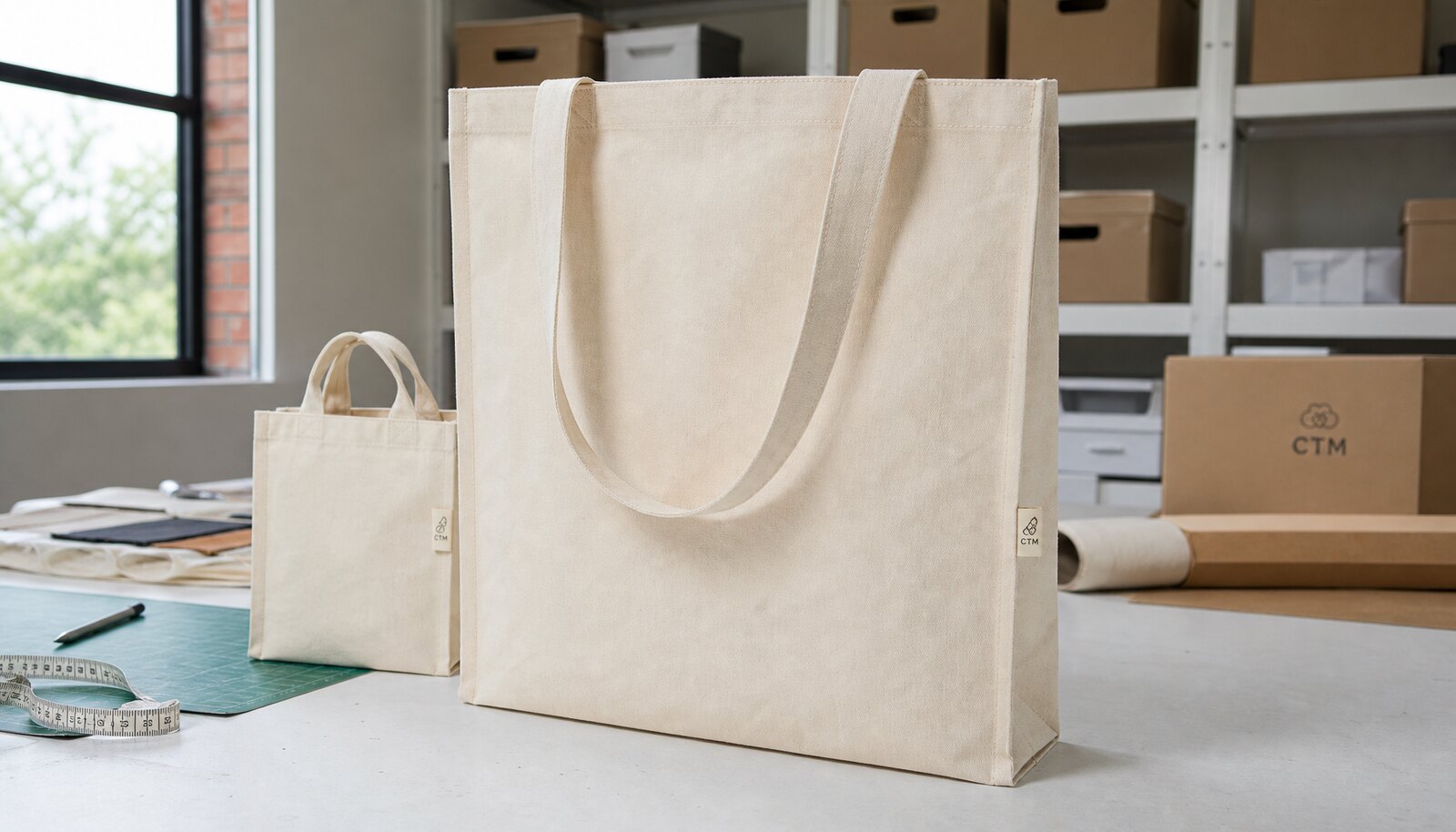
Start With The Gift Program, Not The Bag
A cotton shopping bag for corporate gifts is not the same product as a generic tote for retail shelf stock. The right spec depends on what goes inside it, where it will be handed out, and how the recipient will judge it. A conference giveaway that carries a notebook and brochure can use a lighter build. An onboarding kit with apparel, notebook, and bottle needs a stronger body, better handle reinforcement, and cleaner packing. If you start with the logo file and ignore the use case, you will end up comparing quotes that are not built for the same job.
The biggest sourcing mistake is treating appearance as the main spec. In practice, a bag can look similar in a photo and behave very differently in use. Fabric weight, seam structure, handle width, and folding style change both cost and perceived quality. For buyer teams, the best first question is not what color do we want, but what will the bag carry, how long should it survive, and how premium does it need to feel when opened.
- One-event giveaway: lighter GSM, simpler print, bulk packing.
- Employee welcome kit or retail gift: heavier fabric, cleaner folding, better print control.
- If the bag carries glass, metal, or heavier samples, ask for gusseted construction and handle reinforcement.
Choose Fabric Weight And Construction First
Cotton shopping bags are usually quoted in GSM or ounces per square yard. For corporate gifts, 140 to 160 GSM is a practical entry point when the bag only needs to carry lightweight items. Many procurement teams move to 180 to 220 GSM because that range gives a better hand feel, better shape, and a more credible premium impression without pushing the order into a heavy, costly build. Above 240 GSM, the bag starts to feel much more substantial, which can be right for executive gifts or retail-style presentation, but it adds cost and carton weight.
Fabric weight is only one part of the build. Yarn count, weave tightness, pre-shrinking, stitch density, and seam reinforcement all affect the finished result. A cheaper bag with weak seams can fail sooner than a well-made lighter bag. When you compare supplier quotes, ask for finished size, handle width, hem style, gusset depth, and whether the cotton is natural, bleached, or dyed. Those details have real impact on appearance, print clarity, and shipping cost.
- 140 to 160 GSM: light gifts, event distribution, lower cost.
- 180 to 220 GSM: most corporate gift programs, better structure and better print support.
- 240 GSM and above: premium presentation, stronger shape retention, higher freight cost.
- Compare the finished sewn size, not only the fabric cut size.
Match The Print Method To The Artwork
For cotton shopping bags, screen print remains the standard when the goal is durable branding at controlled cost. It works well for one-color or two-color logos, text, and simple graphics. The ink sits well on cotton, the setup is understandable, and repeat runs are predictable. Digital print and heat transfer are more useful when artwork has many colors, gradients, or a short run that does not justify full screen setup. Embroidery can look premium, but it is not always the right choice for a thin bag or a tight deadline.
The supplier should not choose the print method for convenience. The logo, the bag color, and the required finish should drive the decision. A dark logo on natural cotton often needs a different ink plan than a light logo on a dyed bag. If the print lands near a seam or handle stitch line, ask for a placement drawing before approving the sample. On cotton, small shifts in registration are visible, so the buyer should set an acceptable tolerance for centering and alignment before bulk starts.
- Simple logo and repeat orders: screen print is usually the most stable option.
- Short run or highly detailed art: digital or transfer may work better, but test the hand feel.
- Premium brand mark: woven label or embroidery can be better than oversized printing.
- Request a print mockup that shows seams, stitch lines, and logo clearance.
Use MOQ Logic Instead Of Treating MOQ As A Fixed Number
MOQ for cotton shopping bags is usually a function of material planning, setup time, and sewing efficiency. A supplier may offer a lower minimum for a natural bag with one print color and standard handles, then raise the MOQ sharply if you request custom dyeing, multiple print colors, special trims, or extra packing. That is normal. What matters is understanding which part of the spec pushes the line into a different production mode. If the supplier cannot explain the step-up, the quote is not transparent enough for comparison.
A clean quote should break the order into bag body cost, print cost, packing cost, and any setup or screen charges. You want to know where the money goes, because a low unit price can hide expensive setup or packing work. Ask for pricing at meaningful breakpoints that reflect your likely order sizes. For many corporate gift programs, the right question is not what is the minimum order, but at which quantity the unit cost stops dropping in a meaningful way.
- Check whether MOQ changes by artwork version, not just by total piece count.
- Separate sample fees from bulk pricing so the first quote is not misleading.
- Ask for price breaks at the quantities you are actually considering.
- Compare packing and carton cost separately from the bag itself.
Compare Sourcing Routes, Not Just Supplier Names
Cotton shopping bags for corporate gifts can come through several sourcing routes, and those routes change risk as much as price. A direct factory usually gives you better material control and a clearer line of sight into sewing quality, but it requires tighter specs and more lead time discipline. A trading company can simplify communication and combine multiple items in one shipment, but it may have less direct control over the bag build. Local decorators are useful when the schedule is tight and the bag is not heavily engineered, but they are often limited by blank stock and local print capacity.
The best route depends on the role the bag plays in the gift program. If the bag is the main visible item in a premium kit, you want factory-level control over fabric, stitching, and packing. If the bag is only one component of a short-lived event program, stock blanks with local branding may be good enough. Do not compare suppliers only by unit price; compare the sourcing route, the level of control, and the amount of rework you might need if something goes wrong.
- Direct factory: best for repeatable specs and better cost control.
- Trading company: best for multi-item programs and simpler communication.
- Local printer or decorator: best for short runs and urgent timelines.
- Stock blank route: best when speed matters more than exact build control.
Approve A Real Sample, Then Lock QC Thresholds
Cotton bags fail in very predictable ways: crooked stitching, off-center print, weak handles, uneven gussets, and size drift after sewing. The sample stage is where those problems should surface. A photo is not enough if the order has to look exact on arrival. Ask for a pre-production sample made from the final fabric, with the final print method, final handle length, and final packing style. If the supplier only sends a conceptual sample built from substitute materials, use it for direction only and do not treat it as final approval.
Before bulk release, define acceptance criteria in practical terms. Many buyers use a size tolerance around plus or minus 1 cm for a stitched cotton tote, with tighter control on print placement and logo centering. The exact threshold should match the importance of the visual layout. If the bag uses symmetry or a centered mark, ask the supplier to show seam alignment and handle spacing on the sample. Also look at how the bag behaves after pressing and folding, because some fabrics look fine flat but lose shape after pack-out.
- Measure the finished sample after pressing, not only when it comes off the machine.
- Check handle length and equal spacing by hand, not just in a photo.
- Compare the approved sample under normal daylight, not only under showroom lighting.
- Reject samples that hide weak points behind overlays or photo tricks.
Treat Packing As Part Of The Gift, Not An Afterthought
Packing affects both presentation and cost. A cotton shopping bag that ships loose in a master carton can arrive with dust, creases, or mixed packing if the warehouse process is not disciplined. That may be acceptable for an internal event giveaway, but not for a premium corporate gift. Decide early whether each bag will be folded and bulk packed, individually polybagged, or packed with an insert card and barcode. The right answer depends on who receives the bag and how visible the bag is before use.
Packing also changes the landed cost. Individual polybags protect against dust and improve presentation, but they add labor, material, and waste. Tighter folding improves carton efficiency, but careless folding can create hard crease lines across printed artwork. If the order needs multiple ship-to points, ask the factory to pack by location, lot, or SKU code. That saves repacking time and reduces mix-ups after arrival. For procurement teams, packing is not just a warehouse issue; it is part of the product spec.
- Define whether the bag ships flat, folded, or ready for gifting.
- Set outer carton marks, quantity per carton, and pallet notes if needed.
- Use moisture protection when the route crosses humid ports or long storage periods.
- If the bag is retail-like, ask for a cleaner fold line and better carton appearance.
Build The Schedule Around Artwork And Approval Risk
Lead time for cotton shopping bags includes more than sewing. The full schedule covers fabric reservation, print setup, sample approval, bulk sewing, inspection, packing, and freight booking. The slowest part is often not production itself but the handoff between artwork and approval. If the logo file changes late, or if the buyer keeps moving the print position after the sample is approved, the date slips quickly. For a fixed event, that is the risk that matters most.
The safe way to manage the schedule is to lock the spec early and hold the latest artwork sign-off date like a hard gate. Ask the supplier for a production calendar with each milestone clearly marked. If they cannot show when material is reserved, when the sample is approved, and when the carton stage begins, then the quoted lead time is only a rough estimate. For busy seasons, build extra time for freight booking and port congestion. A good buyer plans for the entire chain, not just the sewing line.
- Build time for at least one sample revision if the artwork is not fully resolved.
- Confirm whether printing and sewing happen in one facility or across multiple sites.
- Ask what happens if the first fabric choice is delayed or unavailable.
- Keep a backup spec ready if the event date cannot move.
Compare Landed Cost, Then Write A Better RFQ
The lowest factory quote is not always the lowest landed cost. Cotton bags are relatively light, so freight, carton size, and packing efficiency can matter as much as the unit price. A bag with a slightly higher source cost can actually land cheaper if it folds well and ships dense. A cheaper bag with bulky packing or oversized cartons can erase the savings fast. To compare suppliers fairly, build one landed-cost view that includes unit price, print setup, packing, carton dimensions, freight term, and destination handling.
Your RFQ should read like a production brief, not a marketing note. State the GSM, finished size, handle length, print method, logo colors, packing format, carton limit, and required delivery date. Include one reference image and one dimension sketch if possible. The clearer the brief, the easier it becomes to compare quotes that look different on the surface. When the supplier sees a complete spec sheet, they can price the same build instead of guessing what you meant.
- Request FOB or EXW first, then add freight separately for an honest comparison.
- Ask for carton dimensions and gross weight, not just unit price.
- Keep the artwork file and the spec sheet attached to the same RFQ.
- Make the supplier state clearly what is excluded from the quote.
Specification comparison for buyers
| Spec decision | Recommended option | When it fits | Buyer risk to check |
|---|---|---|---|
| Sourcing route | Direct factory with in-house sewing and printing | Best for repeat corporate gift programs, tighter cost control, and orders that need the same fabric and print again | Confirm who actually owns weaving, printing, sewing, and packing; a sales office quote can hide subcontracting |
| Fabric weight | 140 to 160 GSM for light gifts, 180 to 220 GSM for most corporate programs, 240 GSM+ for premium feel | Choose by load, gift value, and how much structure the bag needs on arrival | Check whether the quoted GSM is finished fabric weight, and whether pre-shrink or washing changes the final feel |
| Bag structure | Flat tote for documents and lightweight giveaways; gusseted tote for bottles, apparel, and sample kits | Use gussets when the bag needs volume, shape retention, or a more substantial retail look | Compare finished dimensions after sewing, not cut size on paper |
| Print method | Screen print for simple logos and stable repeat runs | Best for one to two color logos, good opacity on natural cotton, and predictable cost | Ask for print placement, Pantone match tolerance, and how the ink behaves after folding and handling |
| Premium branding route | Woven label or embroidery for a higher perceived value mark | Works for executive gifts, premium onboarding kits, and low-noise branding | Watch for distortion on lighter fabric and longer lead time for setup and sampling |
| Packing route | Flat bulk packing with outer carton marks, or individual polybag plus insert for gift-ready presentation | Choose based on distribution channel, dust control, and whether recipients will see the bag before use | Individual packs raise labor and waste; flat packs can crease printed areas if folding is careless |
| MOQ strategy | Lower MOQ with natural color and one print color; higher MOQ with custom dye, extra colors, or special trims | Best when the first order is a pilot or a short event run | Do not compare MOQ alone; compare setup count, material reservation, and how many options are locked into one line |
| Lead time route | Direct factory with artwork locked early and a signed production sample | Best when the event date is fixed and shipping lanes are stable | Sample revision, carton approval, and freight booking can move the ship date more than sewing time |
Buyer checklist before sampling
- Finished bag size, handle length, and gusset depth are written in the RFQ with tolerances.
- Fabric weight is stated in GSM, along with whether the bag is natural, bleached, or dyed.
- Print method, number of colors, and print placement are locked before sampling.
- The quote separates bag body, printing, packing, carton cost, and any setup charges.
- A physical pre-production sample is approved against the final fabric and final artwork.
- Packing format is defined, including fold direction, polybag use, insert cards, and carton marks.
- Lead time includes artwork approval, sample approval, bulk production, inspection, and freight booking.
- One backup spec is ready in case the first fabric or print method runs late.
Factory quote questions to send
- What exact GSM, weave, and finished fabric width are you quoting, and is that before or after washing or pre-shrink treatment?
- What are the finished bag dimensions, handle length, seam allowance, and gusset depth after sewing?
- How many print colors, print sides, and print locations are included in the unit price?
- What is the MOQ per color and per artwork version, and how does it change if we add a second print color or custom-dyed fabric?
- What does your unit price include or exclude, such as sampling, screens, packing, labels, cartons, and outer marks?
- Can you show a pre-production sample made with the final fabric and final printing method before bulk release?
- What are the milestone dates from artwork approval to sewing, packing, inspection, and ex-factory shipment?
- What carton size, gross weight, and loading quantity should we expect for the final packed order?
Quality-control points to confirm
- Finished dimensions stay within the agreed tolerance after pressing and folding.
- GSM and hand feel match the approved sample, with no obvious fabric thin spots or weave gaps.
- Handles are cut evenly and stitched with secure termination points and no loose thread build-up.
- Print placement is centered or positioned to the agreed tolerance, with no obvious skew across seams.
- Color appearance is consistent across cartons, especially on natural cotton where background shade can vary.
- Seams, gussets, and stress points hold up under a manual pull test without popping stitches.
- Folded and packed bags stay clean, dry, and presentable, with no dust marks or crushed corners.
- Carton labels, piece counts, and carton dimensions match the shipment records and packing list.