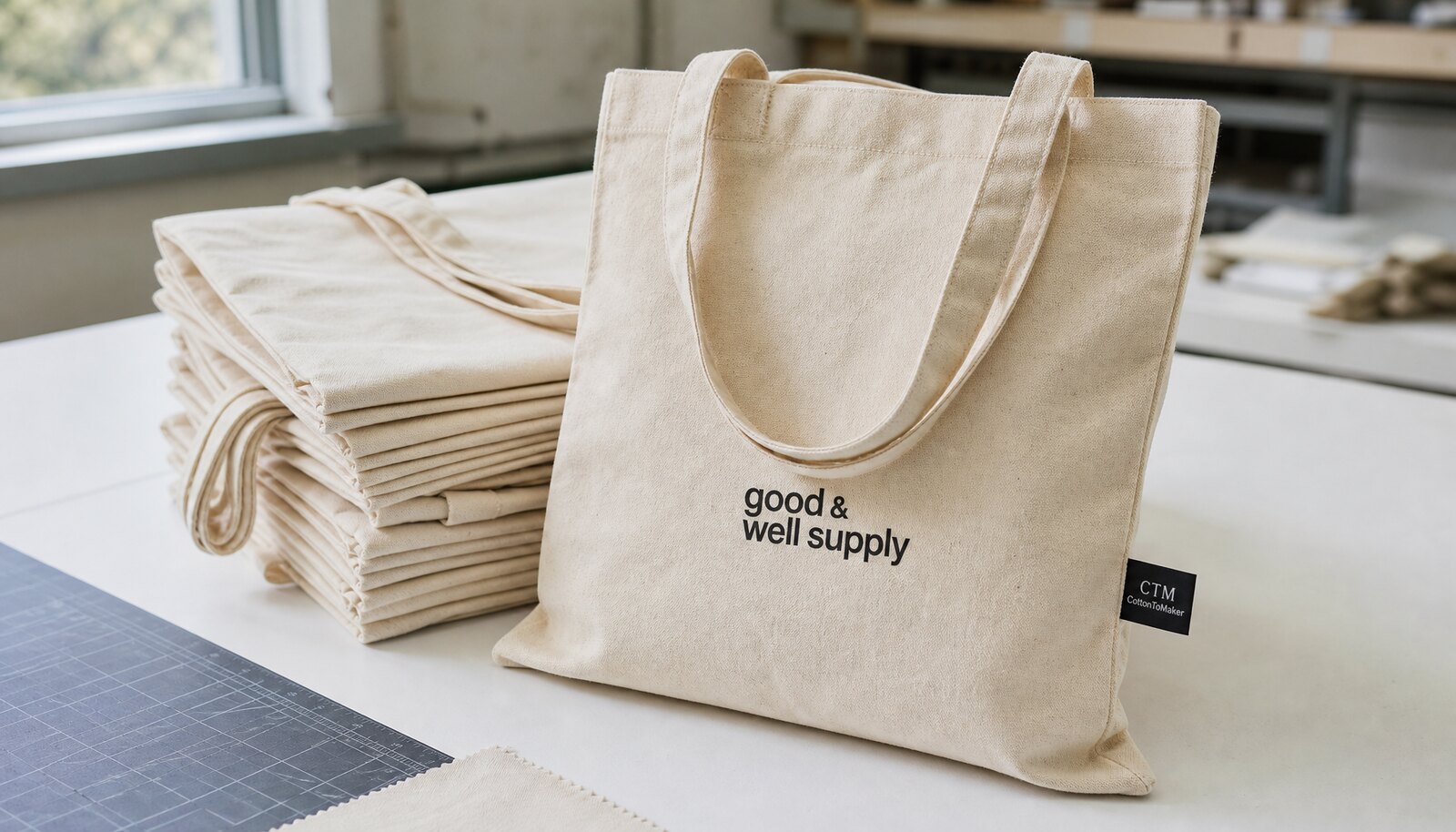
Why cotton promotional bags fail at the quote stage
Most sourcing problems start before production. Buyers often send a logo and ask for a price without defining fabric weight, bag size, print coverage, or packing method. The supplier then fills the gaps with assumptions, and the cheapest quote usually reflects the lightest fabric, simplest sewing, and least controlled decoration. For cotton promotional bags, that creates a false comparison because two quotes can look similar while the product quality is completely different.
The right way to buy is to treat the bag as a small technical product, not a generic giveaway. The bag has three cost centers that matter most: cotton fabric, labor for cutting and sewing, and decoration. Once those are defined, the quote becomes usable for comparison. If you leave out even one of them, especially print size or bag GSM, you will see price swings that are not really price swings—they are spec swaps.
- Do not compare a 120 GSM bag against a 180 GSM bag as if they were the same product.
- Do not compare screen print on one quote with heat transfer or plain blank bags on another.
- Do not approve a sample without the final packing method, because packaging affects carton size, handling, and cost.
Choose the right cotton construction for the job
For most cotton promotional bags, the practical range sits between 140 and 180 GSM. At 140 GSM, the bag stays light and cost-efficient, which suits mass giveaways, campaigns, and short-use events. At 160-180 GSM, the bag feels more substantial, carries better, and presents a cleaner print surface for brands that want the tote to be used after the event. Below that range, the bag can look thin and wrinkle easily; above it, cost rises quickly and the bag may feel too stiff for high-volume promotions.
Fabric type matters as much as weight. Plain cotton is usually fine for basic campaigns, but twill or canvas gives better body and hides minor print imperfections better. Natural unbleached cotton has a more organic look and usually needs less process work, while bleached cotton can give brighter print contrast. If the buyer wants a premium retail feel, pay attention to weave tightness and shrinkage behavior, not just GSM.
- 140-150 GSM: good for budget promotions and light documents.
- 160-180 GSM: better for retail, brand launches, and higher perceived value.
- Twill or canvas weave: better structure, better drape control, and usually cleaner print results.
How size, handle length, and shape affect usability and cost
The default tote size for cotton promotional bags is often 38 x 42 cm with a 60-70 cm handle. That size works because it handles A4 materials, product samples, and shopping use without making the bag expensive to cut and sew. Once buyers go larger, fabric usage rises and the unit price usually climbs faster than expected. A smaller bag can save cost, but if it cannot carry brochures or a boxed item, the promo value drops immediately.
Handle length is a common mistake point. A 60 cm handle usually suits hand carry and short shoulder carry. If the bag must be worn over outerwear, a longer handle or a reinforced shoulder drop should be specified. Also decide whether the handle is self-fabric, webbing, or a contrast color, because that changes both appearance and stitch workload.
- Standard promotional tote: 38 x 42 cm body, 60-70 cm handles.
- Retail or premium use: consider reinforced handles, boxed bottom, or slightly heavier fabric.
- If catalogs or products will be inserted, verify the opening width and gusset depth before quoting.
Print method choice should follow artwork, not habit
For cotton promotional bags, screen printing is still the most economical option for one or two solid colors, especially on medium to heavy cotton. It gives strong opacity and a familiar promotional look, but it needs proper artwork simplification and clean color separation. Heat transfer can work for more detailed logos or short runs, but it may not wear as well as screen print, especially if the bag will be washed or folded repeatedly. Digital direct-to-garment is less common for bulk promo bags because it adds complexity and cost unless the artwork is full color or photographic.
Buyers should control the print window clearly. The factory needs the exact width and height of the logo, plus its position from the top edge and from the side seam. If the print is too close to a seam or handle stitch, the result can look off-center even when it technically matches the artwork. For cotton promotional bags, visual balance is part of quality, not decoration.
- Use screen print for bold logos, simple text, and stable repeat runs.
- Use heat transfer only when detail matters more than long-term wear.
- Keep colors limited if you want stable price and faster setup.
What actually drives the quote on a cotton tote
A supplier quote is usually shaped by fabric consumption, print setup, sewing time, and packing. Fabric weight affects how much raw cotton is used per bag. Print setup adds fixed costs for screens, plates, or transfer preparation. Sewing time increases with handle reinforcement, internal seams, gussets, and special finishing. Packing can look minor, but once you add individual polybags, hang tags, barcode labels, or special carton marks, labor and material cost increase across every unit.
When comparing quotes, use the same commercial basis. Ask whether the price includes fabric, printing, thread color changes, sample approval, overrun allowance, and standard export carton packing. Many low quotes exclude one of those items. A useful quote should show how the unit price changes if you move from blank bag to one-color print, or from 140 GSM to 180 GSM. That is the fastest way to see whether the supplier understands real production costing or is just giving a headline number.
- Ask for price breaks at 500, 1,000, 3,000, and 5,000 pcs.
- Separate blank bag price from decorated bag price.
- Make packing and carton spec part of the price, not an afterthought.
Compare supplier routes before you compare unit price
The cheapest route is not always the best route. A direct factory with sewing and printing in one facility usually gives better control over schedule and fewer handoff errors. A trading company can be useful if you need several product categories in one order or if the buyer needs broader service, but the actual production source must still be identified. A local converter or decorator may be fine for very short runs, yet they can lose cost efficiency once volumes rise. For cotton promotional bags, the sourcing route affects not only price but also consistency from sample to shipment.
Buyers should compare supplier routes using proof, not promises. Look for production photos that show cutting tables, sewing lines, print area, and packed cartons. A real factory quote should name the material source, print process, and lead time sequence. If the supplier cannot explain where the fabric comes from or how they control print curing, the quote is incomplete regardless of price.
- Direct factory: best when repeat orders, price control, and production visibility matter.
- Trading company: useful when consolidating multiple SKUs, but require production disclosure.
- Local decorator: practical for urgent short runs, but verify print durability and carton packing.
When MOQ is flexible and when it is not
MOQ is not just a sales number; it reflects setup cost and process efficiency. For cotton promotional bags, a factory can often accept a lower MOQ if the bag is simple, fabric is in stock, and the print is one color. When the order uses custom dyed fabric, multiple print colors, special woven labels, or individual retail packing, the MOQ rises because the factory needs more setup, more fabric planning, and more labor per unit. That is why a 500-piece order may be possible on one spec and impossible on another.
Buyers should separate commercial MOQ from production MOQ. Commercial MOQ is the smallest order a supplier is willing to quote. Production MOQ is the level where the price becomes reasonable and the lead time stable. If the order is below the natural production MOQ, expect a higher unit price, less room for color matching tolerance, and sometimes a limited choice of bag size or print placement. It is better to accept those tradeoffs explicitly than to chase a low MOQ that produces unstable quality.
- Simple blank or one-color promo bag: lower MOQ may be realistic.
- Premium finish, multiple colors, or retail packaging: MOQ should rise.
- Watch for hidden costs on small orders such as setup fees or color surcharges.
Sample approval should lock the details that matter
A pre-production sample is the only practical way to approve cotton promotional bags before mass production. The sample should reflect final fabric, print size, handle construction, thread color, and packing method. A flat artwork proof alone cannot show whether the fabric wrinkles too much, the print sits too close to a seam, or the handles feel weak under load. If the supplier sends a neat sample that differs from the quoted spec, stop and correct the paperwork before the order starts.
The best sample review is simple and measurable. Lay the sample flat and check overall dimensions, print centering, seam straightness, and handle symmetry. Pull the handle firmly to feel whether reinforcement is enough. Rub the print lightly to see whether it sheds pigment. If the bag will be sold or handed out at a public event, the sample should also be checked under normal lighting, not only in a photo. A tote that looks acceptable on screen can look off-center in the hand.
- Keep one approved sample sealed as the golden sample.
- Mark any approved deviations in writing, not only by email thread.
- If final packing differs from the sample, re-approve the carton and label layout.
QC points that catch the most common tote failures
The common failures on cotton promotional bags are easy to predict: crooked handles, uneven top hems, weak bottom seams, print that shifts from bag to bag, and visible stains from handling or print curing. These are not cosmetic details; they are the defects buyers notice first and complain about most. Set acceptance limits before production starts. For example, agree on acceptable measurement tolerance, print placement tolerance, and thread loose-end limits. Once those are defined, the inspection becomes faster and less subjective.
For a typical order, a buyer should use a simple AQL-style inspection or at least a clear visual standard on carton sampling. Check carton count, pack consistency, bag shape, and whether the bags were packed cleanly after cooling. In hot print rooms, bags can trap odor if they are packed too quickly. If the order is going into retail or direct customer use, that detail matters more than many buyers expect.
- Inspect print alignment on the first, middle, and last cartons.
- Verify seam strength at handle joints and bottom corners.
- Reject bags with visible stains, oily marks, or strong chemical odor.
Packing, carton marks, and schedule risk in real shipments
Packing changes both cost and risk. Bulk packing is the cheapest route and is usually suitable for promotional campaigns where the bag will be distributed immediately. Individual polybag packing adds labor and material cost, but it protects the bag from dust and creasing and is often better for retail or e-commerce. If the buyer wants barcodes, SKU labels, or retail hang tags, those must be quoted as part of the packing method because they add handling time and can slow dispatch.
Lead time for standard cotton promotional bags is often in the 20-35 day range after sample approval, but that window depends on fabric availability and print complexity. The schedule gets tighter when fabric must be woven or dyed to order, when multiple print colors need separate setup, or when the buyer changes artwork after sample sign-off. The cleanest way to reduce schedule risk is to freeze artwork early, approve the sample quickly, and make the carton mark and packing list part of the PO. Late changes usually cost more than buyers expect.
- Bulk pack for low-cost promotions; individual polybag for retail or cleaner presentation.
- Confirm carton count and gross weight before booking freight.
- Do not change print art after sample approval unless the timeline can absorb a reset.
Specification comparison for buyers
| Spec decision | Recommended option | When it fits | Buyer risk to check |
|---|---|---|---|
| Fabric weight | 140-180 GSM cotton twill or canvas | Brand promotions, retail giveaways, and repeat-use bags where hand feel matters | Too light feels cheap; too heavy increases cost and can weaken print on coarse fabric |
| Bag size | 38 x 42 cm with 60-70 cm handles | General promotional use, trade shows, and retail handouts | Handle drop too short for shoulder carry; body too small for A4 catalogs |
| Print method | 1-2 color screen print or heat transfer for short runs | Simple logos, strong contrast, and controlled decoration cost | Fine lines may fill in; color registration drifts if artwork is not simplified |
| Supplier route | Direct factory with in-house print and cutting/sewing | Stable volumes, need for cost control, and better production accountability | Outsourced print can cause delays and shade variation if not disclosed in quote |
| MOQ logic | 500-3,000 pcs depending on fabric, print colors, and packaging | New product tests, seasonal promotions, and mixed SKU programs | Low MOQ may carry higher unit price, higher wastage allowance, or limited color options |
| Sample type | Pre-production sample based on final artwork and packing | When buyer needs approval for dimensions, print placement, and stitch quality | Paper approval alone misses size errors, ink density issues, and seam slippage |
| Packing method | Bulk packed or 1 pc polybag with carton mark | Bulk promo programs, e-commerce fulfillment, and retail-ready shipments | Overpacking adds cost; underpacking increases dust, creasing, and carton damage risk |
| Lead time | 20-35 days after sample approval for standard orders | Straightforward cotton bags without special wash or coating steps | Compressed schedules fail when fabric is not greige-stock, or when printing needs extra curing time |
| Quality standard | Stitch strength, print adhesion, and size tolerance within agreed limits | Any order where the bag carries a logo and represents the brand publicly | Loose threads, crooked handles, and washed-out print are common if AQL and acceptance criteria are not stated |
Buyer checklist before sampling
- Final bag size with tolerances, handle length, and carry style
- Fabric type and GSM target, including whether the cotton is bleached, natural, twill, or canvas
- Artwork file, print colors, print size, and print placement with clear white-space rules
- Target MOQ, acceptable overrun or underrun range, and whether mixed artwork is allowed
- Packing requirement: bulk pack, individual polybag, insert card, barcode label, or carton mark
- Sample approval requirement: pre-production sample, sealed sample, or gold sample retention
- Destination port or delivery term for landed-cost comparison
- Required QC limits for seams, dimensions, print clarity, odor, and carton condition
Factory quote questions to send
- What cotton fabric weight, weave, and shrinkage allowance are you quoting, and is the fabric dyed, bleached, or natural?
- Is the print done in-house or outsourced, and what is the maximum number of colors included in the quoted price?
- What are the exact MOQ, size tolerance, and unit price breaks at 500, 1,000, 3,000, and 5,000 pieces?
- What sample type is included before mass production, and will the sample reflect final print, thread color, and packing?
- How are the bags packed per carton, what is the carton size and gross weight, and can you quote master carton marks?
- What is your standard production lead time after sample approval, and what schedule risk should we plan for if artwork changes?
- What QC checks are included before shipment, and will you provide photos or a pre-shipment inspection report?
- If we change handle length, fabric GSM, or print coverage, how does the price change?
Quality-control points to confirm
- Bag dimensions within agreed tolerance, typically ±0.5 to 1.0 cm for common tote sizes
- Handle attachment strength and stitch density at stress points, especially where straps join the body
- Print placement centered within the approved artwork window, with no major misregistration or broken edges
- Fabric surface free from large stains, weaving defects, holes, or visible oil marks
- Seam integrity on side seams and bottom seam, with no skipped stitches or loose thread clusters
- Color consistency across cartons when using dyed cotton or printed panels
- Carton count, inner packing, and label accuracy matching the PO and packing list
- Odor control and clean finishing, especially when bags are packed immediately after printing or steaming