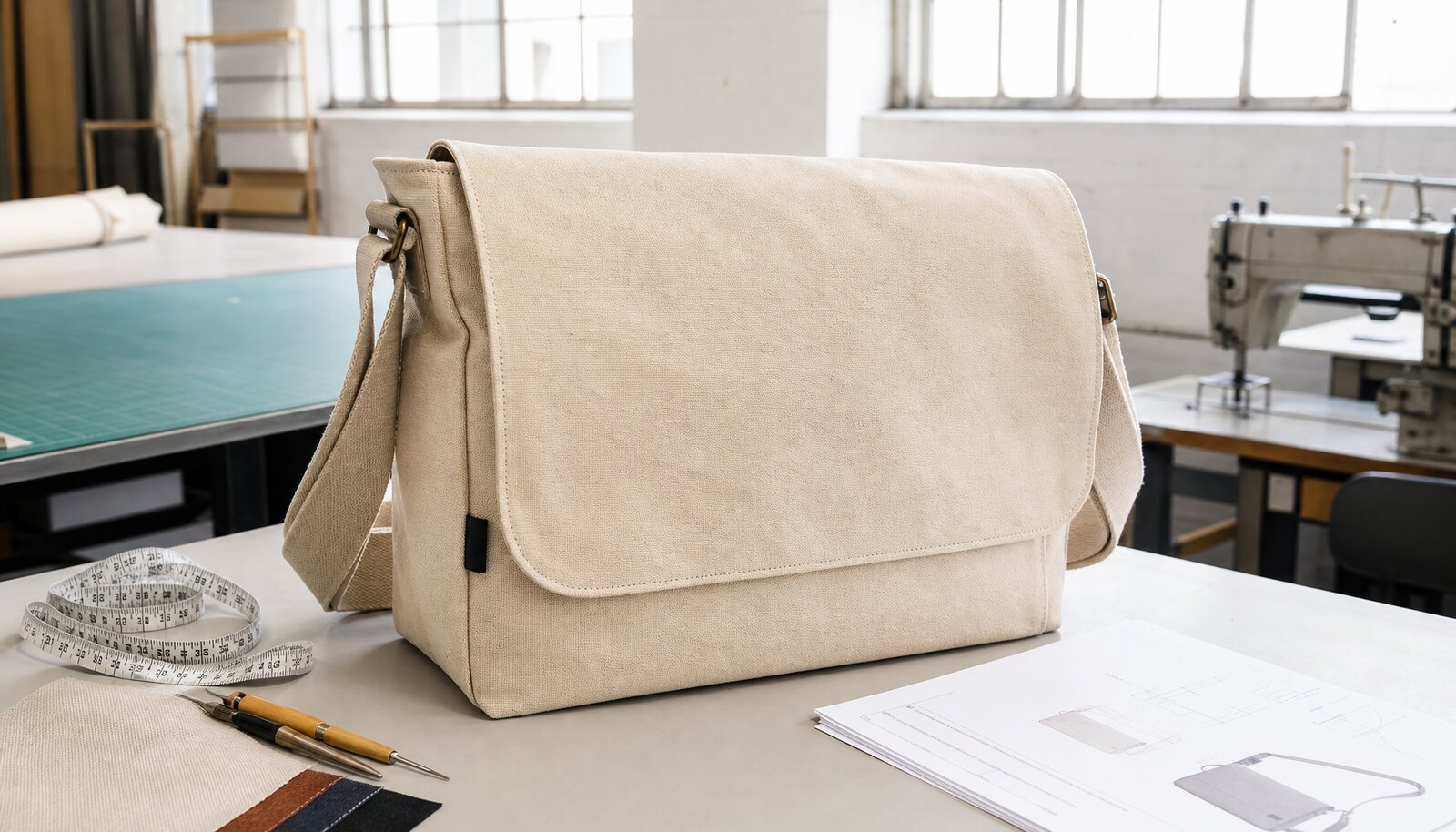
Why event buyers still choose cotton messenger bags
Cotton messenger bags for events sit in a useful middle range. They are more polished than a flat tote, more versatile than a pouch, and easier to produce than a fully structured promotional satchel. For conferences, exhibitions, training days, sponsorship activations, and retail-led event programs, that balance matters because the bag has to be usable, visible, and simple enough to manufacture on schedule.
From a procurement angle, the bag is not just a branded accessory. It is part packaging, part attendee utility item, and part visible brand surface. If the bag arrives with weak straps, a thin body that collapses under catalogues, or print that looks uneven under venue lighting, the brand loses credibility quickly. The buying decision therefore needs to cover use case, construction, decoration, packing, and delivery timing together rather than as separate tasks.
The best event bags are usually the ones that are boring in the right way: they hold what they are supposed to hold, print cleanly, and ship without surprises. Buyers who spend too much time on aesthetics and too little on production control often discover that a beautiful sample is not the same thing as a stable production run. On the other hand, buyers who reduce everything to the lowest bid can miss the fact that a slightly stronger canvas, better bartacks, or cleaner packing may save more money by avoiding complaints, replacements, and urgent reorders.
- Choose cotton messenger bags when the event needs a softer, more premium look than a giveaway tote but does not require hard-shell construction.
- Treat the bag as a sewn product with print, packing, and QC dependencies; it is not simply a blank item waiting for decoration.
- For recurring programs, lock the spec once and compare later quotes against the approved build, not against memory or a supplier’s marketing sheet.
Start with the use case, not the supplier catalog
The fastest way to get a mismatched quote is to ask for “a cotton messenger bag” without describing how the bag will be used. A conference bag carrying brochures and a notebook does not need the same body weight or closure as a VIP gift bag that must look presentable after three days of event floor handling. A merch bag meant to be photographed and resold needs better surface finish and more careful packing than a one-day seminar handout.
A useful brief starts with the contents and the setting. Will the bag hold a few printed handouts, or a full attendee kit with notebook, pen, charger, brochure stack, and bottle? Will it be carried indoors only, or taken on public transport and reused after the event? Will the audience be general attendees, sponsors, speakers, or VIP guests? These answers affect canvas weight, strap comfort, pocket design, closure type, and the acceptable level of cosmetic variance.
Use case also shapes the commercial logic. If the bag is handed out to a large attendee base, a simple open-top build may be the right answer because speed and cost matter most. If the bag is part of a premium sponsorship package, a gusset, lining, flap, or zipper may be justified because presentation value and reuse matter more. Procurement teams should document that tradeoff before the RFQ goes out, otherwise suppliers will each optimize for a different interpretation of “event bag” and the quotes will not line up.
- Write down the intended contents and approximate total weight before asking for price.
- State whether the bag is disposable, reusable, or meant for ongoing post-event use.
- Identify the audience segment because VIP and general-attendee expectations are usually not the same.
Fabric weight, weave, and finish: where most buying mistakes begin
Fabric weight drives most of the physical behavior of cotton messenger bags. A 180-220 GSM canvas is often enough for literature packs, lighter conference inserts, and short-duration use. It is usually the budget-friendly route, but if the bag is loaded with a notebook, bottle, and other kit items, the body may drape too softly or look tired once filled. A 250-320 GSM canvas gives the bag more structure, better print stability, and a more substantial hand feel, though it increases material cost and can add sewing difficulty if the supplier is not set up for heavier cloth.
Weave and finish matter too. A plain canvas weave is common, but the surface can vary significantly depending on yarn quality, density, and finish. Raw natural cotton has a softer, less processed appearance and may suit eco-positioned events, but it can also show fiber variation and absorb ink differently. Bleached or bio-polished cloth usually gives a cleaner print face and more consistent visual tone, which is useful when the brand expects a crisper presentation. If the event is positioned as premium or sponsor-led, that surface consistency is often worth paying for.
Buyers should also ask about shrinkage and dimensional stability. Cotton can move after washing or even after humidity exposure, and that affects both finished size and print alignment. The supplier should tell you whether the cloth is pre-shrunk, whether a shrinkage allowance has been built into cutting, and whether the final dimensions are based on after-finish or after-press measurements. A quote that ignores shrinkage can look cheaper up front and become more expensive when the bags arrive slightly undersized or uneven from panel to panel.
- For light inserts and low-cost campaigns, 180-220 GSM is usually workable if strap and seam construction are sound.
- For premium events, reusable bags, or heavier contents, 250-320 GSM gives better body and shelf presence.
- Ask the supplier whether the cloth is pre-shrunk, bleached, bio-polished, dyed, or left in a natural state, because finish affects both print and presentation.
Construction details that change durability and appearance
Cotton messenger bags are often quoted as if the body fabric is the only variable, but construction is what determines whether the bag feels reliable in use. The difference between an acceptable bag and a disappointing one is frequently in the seam layout, the reinforcement at stress points, and the way the front pocket or flap sits when the bag is filled. A bag that looks clean when empty may distort badly if the base is too soft or the side seams are underbuilt.
The simplest construction is an open-top messenger bag with a front pocket. It is cost-efficient, easy to pack, and quick to sew. It works well when speed and value matter. But if the bag must stand upright, protect contents, or keep a sharper profile, a gusset is often worth the added cost. A flap can improve presentation and security, while a zipper adds more closure confidence but also more labor, more tolerance points, and more failure risk if the zipper gauge and slider quality are not specified clearly.
Reinforcement is one of the most overlooked items in the quote. Strap bar-tacks, double stitching, binding tape at stress points, and base reinforcement all add small amounts of labor that protect against failure later. Buyers should ask where the factory uses machine stitching, where it uses manual operations, and which steps are inspected in-line versus at the end. That information helps separate a supplier that knows how to build the bag from a supplier that merely knows how to price it.
- If the bag will carry load, require reinforcement at strap ends, pocket corners, and side seam intersections.
- Specify whether the front pocket is decorative or functional, because functional pockets need stronger seam control.
- Do not assume a zipper or flap is a small add-on; it changes labor, trimming, QC, and lead time.
Decoration choices: pick the method that matches artwork and volume
For cotton messenger bags for events, decoration is not a last-step add-on. It is a core production decision because the print method affects cost, appearance, lead time, and durability. Screen printing remains the default for many event buyers because it is efficient for bold logos, simple spot colors, and medium-to-large volumes. It tends to give a cleaner, more integrated look on cotton than a heavy transfer layer, especially when the logo is large and the design is restrained.
Transfer methods, including heat transfer and DTF, are more flexible for complex artwork, smaller type, or color-heavy graphics. They can be useful for short runs where screen setup is hard to justify, or when several event versions share the same bag body but differ in artwork. The tradeoff is that the buyer must check hand feel, edge lift, cracking after fold stress, and how the print looks on a natural woven surface. A good digital proof is not enough; ask for a strike-off on real fabric and review it under normal light.
If the logo sits near seams, pockets, or gussets, placement becomes a production control issue, not a design preference. The supplier should provide a placement drawing with measurements from edge to centerline and should confirm the artwork stays clear of stitching and fold lines. Buyers often discover too late that a logo positioned “approximately centered” in the artwork file becomes visibly off-center once the bag is sewn and packed. That kind of error is noticeable in event photography even when it does not affect function.
- Use screen printing for bold, simple artwork when volume justifies setup.
- Use transfer methods only when artwork complexity or short-run flexibility really needs them, and confirm durability on actual fabric.
- Require a placement drawing when artwork is close to seams, pockets, zippers, or gusset edges.
How to compare supplier quotes without getting fooled by the lowest number
A good quote comparison starts by stripping out the differences that make quotes look unequal. One supplier may quote a basic sewn bag and leave decoration, inserts, or inner packing as separate add-ons. Another may quote the finished item packed for export. One may base the price on 200 GSM canvas, while another uses 280 GSM. If you compare the line totals directly, the cheapest number is often the one with the most assumptions hidden inside it.
Procurement teams should ask for a transparent build breakdown: fabric cost, cutting, sewing, reinforcement, print setup, print unit cost, packing, cartonization, and freight if relevant. That breakdown gives you two benefits. First, it shows which supplier is controlling cost through real efficiency versus through spec trimming. Second, it helps you estimate how much room exists for commercial adjustment. If a supplier is expensive only because of a high print setup charge but strong on unit economics, that may still be the best choice for a repeat program.
It also helps to compare the presentation impact of each quote. A cheaper bag that arrives wrinkled, soft, or crushed may be a poor choice for a trade-show registration desk or VIP kit. A higher-priced bag with better body, cleaner pack-out, and more stable print may actually lower the total cost of the program because it reduces rework, rejects, and emergency replacements. Buyers should therefore compare not just unit cost, but the total event outcome: production stability, presentation quality, and delivery confidence.
- Normalize specs before comparing price: same GSM, same size, same print count, same packing, same QC standard.
- Ask suppliers to separate one-time setup costs from recurring unit costs.
- Evaluate presentation impact alongside unit price, especially for VIP kits, sponsor packs, or photographed event handouts.
MOQ, unit economics, and what actually drives the price
MOQ is rarely arbitrary. For cotton messenger bags, it usually follows fabric booking logic, print setup efficiency, and sewing line planning. A factory can often be more flexible if the bag uses standard canvas and a simple logo. Once the brief includes a special pocket divider, dyed cloth, zipper, flap magnet, or multiple artwork versions, the production team has to absorb more cutting waste, changeovers, and labor disruption. Buyers should ask for MOQ by fabric color, by print design, and by special component rather than accepting one all-purpose number.
The most common hidden price drivers are the ones that sound small during the RFQ stage. A second print location, an extra layer of lining, a stitched pocket divider, stronger bartacks, a branded zipper pull, or individual folding with inserts can all raise the cost in a meaningful way. Ask the supplier which steps are manual and which are machine-based. Manual steps are where labor variability sits, and they are also where the supplier has the least room to absorb spec changes without repricing.
For event programs, the smartest commercial decision is not always to reduce the bag to the cheapest possible build. Sometimes the better answer is to simplify the design in one or two well-chosen ways that protect quality. For example, removing an unnecessary internal divider or replacing a closure with a cleaner open-top design may save more than squeezing the fabric weight down a little. The key is to remove complexity that does not add user value, not complexity that controls durability or presentation.
- Ask for MOQ by color, artwork version, and structural option separately.
- Request a cost split so you can see whether the quote is being driven by material, labor, print setup, or packing.
- Look for simplifications that reduce complexity without compromising the bag’s ability to carry the event contents.
Supplier routes and how to qualify them before you place the order
Direct factory sourcing is usually the most useful route when the order is large enough to justify tighter control over sewing, printing, and packing. If the supplier owns the production line, you have a clearer path for corrective action when something drifts during bulk production. That matters for event bags because the problems are usually not dramatic failures; they are small deviations that pile up across hundreds or thousands of units. A direct factory is also easier to assess when you want to know who is actually responsible for a defect, a delay, or a remake.
Trading companies and sourcing offices can still be useful when you need multiple products consolidated into one program or when the buying team needs a commercial buffer between itself and several factories. The tradeoff is transparency. Ask directly which factory will sew the bag, where printing happens, and whether any operation is subcontracted. If a quote is too vague about the production site, you are not buying clarity; you are buying an extra layer of distance. That distance can be acceptable, but only if you understand the margin structure and the quality accountability.
Local decorators using imported blanks are worth considering for rush programs or very small test orders. They can be a sensible bridge if you need fast turnaround and the design is simple. The buyer still needs to verify the blank bag quality, the consistency of the blank stock between batches, and whether the decoration will survive seam crossings and repeated folding. A decorated blank from a fast local provider is only a good commercial option when the blank quality is stable enough that the decoration does not end up carrying the entire quality burden.
- Direct factories are usually strongest for repeat orders, custom structures, and corrective action.
- Trading companies can simplify coordination, but only if they identify the actual production site and subcontracted steps clearly.
- Local decorators can work for urgent runs, but the buyer should verify blank quality, decoration durability, and responsibility for failures.
Vendor qualification: the questions that separate capable suppliers from polished quote writers
Before price becomes the focus, buyers should verify whether the supplier actually has the capability to make the bag as described. Ask what machine set is used for sewing, whether bartacking is done in-house, how print screens or transfer processes are managed, and whether the supplier has experience with cotton messenger bags rather than only basic totes. A capable vendor should be able to explain the seam structure, the weak points in the design, and the likely risks in plain language. If the response stays generic, that is a warning sign.
Factory verification does not require a full audit every time, but it should go beyond a brochure and a price sheet. Ask for recent product photos of similar sewn bags, a short video of the sewing or printing line if available, and the name of the QC stage that checks finished dimensions. If the order is important, ask who signs off on the pre-production sample and how deviations are recorded. A supplier that can describe its own control points is usually more reliable than one that only promises fast lead times and low prices.
A useful threshold for qualification is whether the supplier can answer specific operational questions without hesitation. Can they explain how they control print registration near pockets? Can they state the normal shrinkage allowance? Can they show how strap symmetry is checked? Can they identify which defects are considered critical? These are not academic questions; they tell you whether the supplier has process discipline or simply a quoting habit. Procurement teams that ask these questions early usually avoid the worst production surprises later.
- Ask the supplier to explain weak points in the design in its own words.
- Request evidence of similar sewn products, not only a logo list or promotional brochure.
- Confirm who signs off the pre-production sample and how deviations are tracked into bulk production.
Sampling and approval: what to check before you release bulk production
Sampling should do more than prove the logo is visible. A size sample checks proportion, strap feel, and pocket layout. A pre-production sample checks the real fabric, real decoration, and real stitching method that will be used in the bulk order. If the bag includes a new closure, a special flap, lining, or gusset, the pre-production sample is where you should catch the mismatch between concept and production reality. Skipping that step is one of the most common ways event buyers end up approving a bag that only works in theory.
Approval should be based on measurable observations. Measure the finished bag, check strap lengths on the body rather than flat on the table, inspect print placement against a ruler, and test the bag with realistic contents. If the sample is approved with notes, those notes need to be written into the order file, not left in an email thread or a comment in a chat app. Otherwise the factory may treat the approved sample as a visual reference and ignore the exceptions that mattered to the buyer.
It also helps to keep one sealed reference sample labeled with the approved version, date, and spec revision. That sample becomes the practical comparison point during final inspection. When production starts and someone asks whether the pocket should sit 5 mm higher or lower, the sealed reference prevents a long argument. Buyers who manage event bags repeatedly know that this small discipline saves time, especially when different internal teams review the order at different stages.
- Check fit and balance on the body, not only flat on a table.
- Use real event contents for load testing instead of random weights or guesswork.
- Keep a sealed reference sample with clear version control and sign-off date.
Specification comparison for buyers
| Procurement decision | Lower-cost option | Higher-control option | Buyer tradeoff to evaluate |
|---|---|---|---|
| Supplier route | Trading company quoting multiple mills and factories | Direct factory with sewing, printing, and packing in-house | Trading can simplify communication, but direct factory sourcing usually gives better control over corrective action and production transparency |
| Supply model | Local decorator using imported blanks | Factory producing bag body and decoration together | Local decoration can suit urgent runs, but the buyer must verify blank bag origin, seam quality, and print durability on finished seams |
| Fabric weight | 180-220 GSM cotton canvas | 250-320 GSM cotton canvas | Lighter fabric lowers price and freight, while heavier canvas improves body, shelf presence, and load stability |
| Construction | Open-top bag with basic front pocket | Gusseted body, reinforced base, or flap/zip closure | Simple builds are cheaper and quicker, but premium constructions reduce shape collapse and improve event presentation |
| Decoration method | 1-2 color screen print | Multi-color transfer, DTF, or combined print/embroidery detail | Screen print is generally cheaper and cleaner for bold logos; advanced methods improve artwork flexibility but add cost and durability checks |
| Lead time profile | Shorter if blank bags are stocked and artwork is simple | Longer if fabric must be custom-dyed or tooling is new | A lower unit price may be irrelevant if the supplier cannot hit the event date or if sample approval takes multiple rounds |
| Durability expectation | Light brochure carry only | Notebook, brochure, bottle, and attendee kit use | The bag must be specified to the actual load; a low-cost bag that distorts under weight becomes a brand liability |
| Presentation impact | Flat bulk packing, limited shape control | Controlled folding, inserts, and carton protection | Bulk packing can reduce freight cost, but a premium event often needs better shaping and cleaner unpacking presentation |
| QC standard | Basic final inspection only | Defined AQL with measurable defect thresholds and load/print checks | A stronger QC scope adds effort, but it is the best way to avoid strap failure, crooked prints, and inconsistent bag appearance |
Buyer checklist before sampling
- State the finished bag size, including tolerance bands for width, height, and gusset depth, rather than giving approximate dimensions only.
- Specify fabric composition, cotton canvas GSM, weave style if known, and whether the cloth is natural, bleached, dyed, or bio-polished.
- Define the load profile clearly: brochures only, notebook and catalogues, bottled drink, tablet, or mixed attendee kit.
- Set strap width, strap length, attachment method, stitch pattern, and whether the bag needs shoulder comfort or hand-carry balance.
- Confirm print method, print positions, artwork file type, number of colors, and the Pantone targets or visual reference standard.
- Require a pre-production sample or production reference sample when the construction, pocket layout, or closure is new.
- Ask for packing format, inner pack count, carton size, carton weight limit, and whether the bags need tissue, board, or polybag protection.
- Request a production calendar that shows sample, material booking, bulk sewing, printing, inspection, and ship dates.
- Define defect acceptance levels for critical, major, and minor issues, and name the items that are automatic rejects.
- Ask the supplier to identify every extra cost driver separately: print setup, color change, lining, pocket divider, zipper, zipper pull, inserts, or individual packing.
Factory quote questions to send
- What is the exact fabric specification included in your price, including GSM, weave type, shrinkage allowance, and whether the material is pre-shrunk or not?
- Is your quote for a complete finished bag or only the sewn blank body before decoration and packing?
- Which operations are included in the unit price: cutting, sewing, bartacking, printing, lining, trimming, folding, and carton packing?
- What is the MOQ per color, per print design, and per construction style, and do different artwork versions share the same sewing setup?
- Can you show the cost split between material, labor, decoration, packing, and cartonization so I can compare suppliers on the same basis?
- What sample stages are available: size sample, strike-off, pre-production sample, or production reference sample?
- What are the realistic production bottlenecks that could extend lead time: fabric booking, print approval, needle change, subcontracted sewing, or shipping congestion?
- Which defect categories do you use in final inspection, and can you provide your internal AQL or equivalent acceptance rule?
- How are the bags packed for shipment, and what controls do you use to prevent odor, moisture marks, print transfer, or deep fold lines?
- If the final order arrives with a quality issue, who owns remake, replacement, or credit responsibility, and what proof is needed?
Quality-control points to confirm
- Verify finished dimensions on actual samples, not just cut pieces, and compare them to the agreed tolerance. A common practical threshold is ±0.5 cm on small items and ±1.0 cm on larger body dimensions, unless the product design needs tighter control.
- Measure fabric weight with a documented GSM test on a representative area of the cloth; do not accept visual estimates or supplier declarations alone.
- Check strap anchors, top-edge joins, and pocket corners with a pull test or load simulation using the intended event contents. If the bag is meant to carry bottles or tablets, test with the heaviest realistic load, not a light brochure set.
- Inspect stitch density, thread trimming, and bartack consistency. Loose threads, skipped stitches, and weak bartacks are small defects that often predict larger failures after repeated use.
- Confirm print placement with a physical measurement from seam edge to artwork centerline. A logo that is only a few millimeters off can look obviously crooked on a messenger bag front panel.
- Review color consistency across random carton pulls. Shade variation between panels, between lots, or between bags in the same carton should be flagged before shipment.
- Test printed areas for rub resistance on the fold line and at seam intersections. A simple dry rub and folding check will often expose cracking, edge lift, or scuffing before bulk release.
- Open a carton sample and inspect for odor, moisture, dirt transfer, crushed corners, and crease marks. A bag can pass sewing inspection and still fail presentation QC if the packing method is poor.
- If there is lining, a pocket, zipper, or flap magnet, verify operation on every sample pull. A small closure fault can create a large event-day complaint rate.
- Use a reject list with clear examples: torn seam, missing bartack, misprint, wrong artwork, hole in fabric, severe stain, excessive shade mismatch, or closure failure. Ambiguous defects should be classified before production starts.