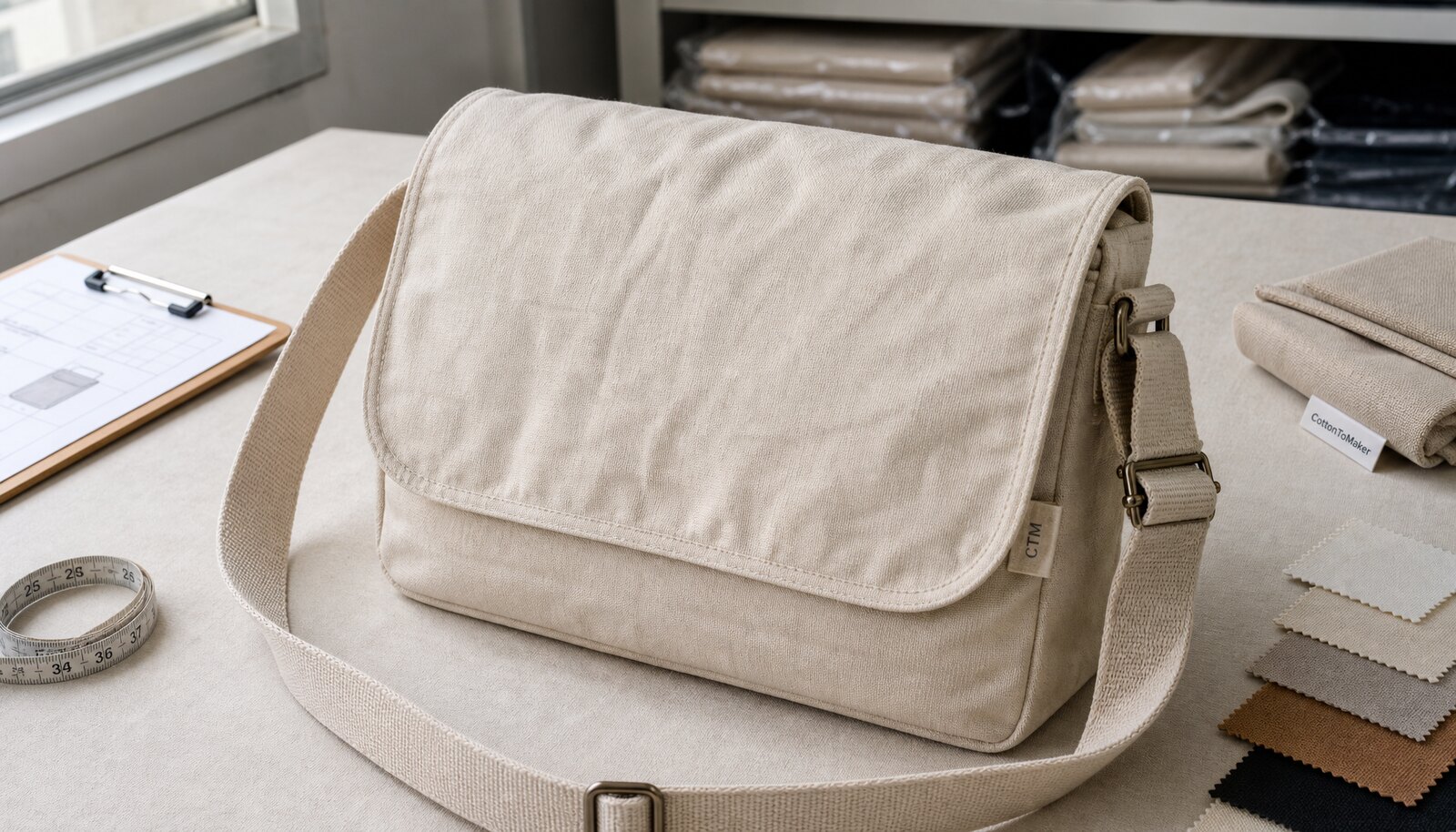
1. Start with the launch job, not the bag style
For cotton messenger bags for brand launches, the first sourcing mistake is treating the bag as a generic commodity. Procurement should define the job first, then the style. A bag for a press event has a different risk profile from a bag that will sit in a retail display, ship through distribution, or carry product samples across a venue. That difference affects fabric weight, closure choice, logo method, and how much finishing the supplier needs to do before the bag is acceptable.
Write the brief in terms the factory can price without guessing. State what the bag will carry, how visible it will be, whether it will be photographed, and whether it needs to look premium after folding and shipping. If the launch team expects a clean shelf presentation, the brief should say so. If the goal is a controlled-cost giveaway, the brief should allow simpler packing and lighter construction. The buyer gets better quotes when the use case is precise and the supplier does not need to infer the commercial intent.
- Define the use case as giveaway, retail accessory, sample carrier, or premium packaging.
- State the expected load in practical terms, not just in abstract kilograms.
- Separate the launch spec from any future replenishment spec so the supplier does not build the wrong cost structure.
2. Turn the brief into measurable fabric and size targets
The safest baseline for most launch programs is 10-12 oz cotton canvas or roughly 320-400 GSM woven cotton. That range usually gives enough body to hold shape, enough surface stability for print, and enough cost discipline for a first order. Below that range, the bag can look thin, wrinkle badly, and show logo distortion. Above that range, the unit price and carton weight rise fast, which matters when the bag is being launched in volume or shipped internationally.
Do not quote fabric weight alone. Two cloths at the same GSM can behave differently if one is tightly woven and one is loose, or if one is raw and one is washed. Specify the finished bag size, gusset, strap length, and any lining or internal board insert. For simple, repeatable launches, ask the supplier to hold finished dimensions within +/- 0.5 cm. For larger, washed, or more flexible constructions, +/- 0.8 cm is more realistic and still procurement-friendly. Without a written tolerance, the factory can deliver a range that looks acceptable on paper but creates pack-out issues later.
- Use 10-12 oz cotton canvas or 320-400 GSM as a practical default, then step up only if the presentation justifies it.
- Require finished dimensions, not approximate dimensions, in the RFQ.
- Ask whether the cloth is stock, bleached, natural, dyed, or washed because that affects lead time and visual consistency.
3. Construction details protect margin more than buyers expect
Most quote gaps are not caused by the cotton itself. They come from construction choices that are easy to overlook: lining, reinforcement patches, zipper type, strap width, and how the top opening is finished. A bag that looks acceptable in a sample photo can still fail a launch if the strap join is weak, the zipper jams, or the body collapses in packing. The buyer should ask the supplier to itemize the structure so each feature can be traded off deliberately instead of bundled into a vague unit price.
For a messenger-style bag, ask for bar-tack reinforcement or dense backstitching at all load-bearing points. A strap that is only tacked once or sewn with light stitch density is a common failure mode. A simple practical rule is 7-9 stitches per inch on the seams that carry weight. If the bag needs to carry sample kits, tablets, or multiple brochures, ask the supplier to test the construction with the intended load plus a margin rather than approving it by appearance alone. When the order is for a one-time event, it is usually cheaper to simplify closure or lining than to shave a tiny amount off the fabric spec.
- Require bar-tacks or reinforced stitching at strap joins, flap corners, and zipper ends.
- If the bag has a zipper, specify nylon coil or metal, tape width, and puller style.
- If shape matters, discuss a board insert or internal support before you approve the price.
4. Let the artwork decide the decoration method
Decoration should follow artwork complexity, not habit. Screen print is usually the baseline for simple logos and larger runs because it is reliable, opaque, and easy to cost. It works best when the logo uses one or two colors, has medium line weight, and sits on a stable print area. If the art is detailed, uses multiple colors, or has a fine outline that would break under mesh, the supplier may need heat transfer, digital transfer, or embroidery depending on the fabric and the brand position.
The buyer should not accept a print method until the sample proves the visual result on the actual cloth. On thin cotton, embroidery can pull the fabric and make the panel pucker. On rough or highly textured canvas, a delicate transfer can look good in a photo but fail on peel resistance or folding. The RFQ should state the print area, color count, placement tolerance, and what level of color match is acceptable. If a launch depends on clean logo reproduction, ask for a strike-off or decorated sample before mass approval.
- Use screen print for simple logos, stable placements, and moderate-to-large quantities.
- Use heat or digital transfer when artwork detail matters more than lowest setup cost.
- Use embroidery only when the fabric weight and brand position can support the stitch build.
5. Make MOQ a pricing tool instead of a surprise
MOQ is not just a supplier rule; it is the point where setup cost starts to make sense. The factory is paying for cutting, printing screens, sewing setup, packing materials, and carton planning. That is why 300 pieces can cost much more per unit than 1,000 pieces even when the bag looks identical. Procurement should ask for a tiered quote so the launch team can see the real economics of a test order versus a replenishment order.
A practical approach is to ask for three quantities if the supplier can support them, such as 300, 500, and 1,000 units. If the factory only wants to quote one quantity, ask them to show how setup cost is embedded in that number. Also confirm whether MOQ applies per color, per logo version, or per hardware combination. A low total order can still become expensive if each color or variant triggers a separate minimum. The right MOQ is the one that matches the launch risk, not the one that only looks small on the surface.
- Ask for a price ladder, not a single unit price.
- Separate setup charges from piece price so the quote is not misleading.
- Confirm whether MOQ is based on total order, per color, or per decoration version.
6. Compare suppliers by route, not just by quote line
The sourcing route changes both price and risk. A direct factory is usually the cleanest option when the spec is stable and the buyer wants control over fabric, stitch quality, and packing. The economics are straightforward: fewer layers, lower structural markup, and better visibility into who actually makes the bag. The tradeoff is that the buyer needs clearer artwork, a firmer QC plan, and enough internal discipline to handle revisions with the factory directly.
A trading company can be useful for small, mixed, or urgent orders, but the buyer should assume an added margin for coordination and risk absorption. That extra margin is not automatically a problem if the trader is consolidating several items, handling samples quickly, or smoothing communication across multiple factories. The issue is transparency. If the quote hides which factory is making the bag, defect resolution can become slow. A domestic broker has a different role again: local coordination, faster meetings, and easier billing in the buyer's market, but often little control over the sewing line. For launch orders, ask who owns the production risk, who pays for rework, and who can actually fix a defect without passing the issue around.
- Direct factory: best when the spec is repeatable and QC ownership needs to be clear.
- Trading company: best when the order is small, mixed, or time-sensitive and the buyer values coordination.
- Domestic broker: best when local service matters, but demand explicit visibility into the real maker and the fee structure.
7. Treat sampling as a production gate, not a courtesy step
A launch sample is only useful if it proves the exact material, logo method, seam behavior, and packing format. A photo approval is not enough when the bag will be shipped, retailed, or handled repeatedly. The sample should be measured, loaded, folded, reopened, and checked under the same expectations the bulk order will face. If the launch team expects the bag to hold a device, a bottle, or a media kit, test it with that actual load.
Procurement should request a blank sample first if the construction is still being debated, then a decorated sample once the logo method is locked, and finally a pre-production sample that uses the final fabric, final hardware, and final packing. The factory should not move into bulk production until the buyer has written approval on the sample. If the supplier says the production run will be close enough to the sample, that is not an approval standard. It is a risk statement. Use the sample to prove what will actually ship.
- Approve the physical sample, not only a photo or render.
- Check size, placement, closure function, strap feel, and fold recovery on the actual sample.
- Do not start bulk production until the final packing format is also approved.
8. Put the QC standard in writing before the factory starts cutting
QC needs thresholds, not just a checklist. For most launch orders, use a written acceptance plan such as AQL 2.5 for major defects and 4.0 for minor defects, or tighter if the bags are retail-facing. Define major defects in practical terms: broken seams, wrong logo, wrong colorway, missing closure, or bag dimensions outside tolerance. Define minor defects separately: loose thread, slight shade variation inside an accepted lot, or small scuffing that does not affect use. If the supplier does not accept a written defect definition, the buyer will end up negotiating after the fact.
Useful pass-fail thresholds keep inspection from becoming subjective. A strap should not pull loose under normal static loading. A zipper should cycle repeatedly without snagging fabric. Print should not smear, crack, or show visible transfer after simple rub testing with a clean white cloth. If the bag is colored, the buyer should ask for a shade control standard and an approved master sample. The point is not to over-engineer a commodity bag. The point is to avoid launch-day defects that could have been prevented with a few lines of written QC.
- Set size tolerance in the RFQ and repeat it in the inspection plan.
- Use a static load check that reflects the intended use, not a generic bag test.
- Define major and minor defects before production so acceptance is not negotiated at shipment time.
9. Packing, cartonization, and freight can change the real cost
Packing is where a simple bag becomes a logistics problem. Cotton messenger bags can scuff, crease, and lose shape if they are packed loosely or compressed too hard. If the printed panel is visible, a basic polybag may be enough for a simple promo order, but retail or e-commerce programs usually need more control. Ask whether the bag should include an insert card, tissue, silica gel, or a shaped board to keep the front panel flat and protect the print during transit.
Carton data is part of the quote, not an afterthought. Buyers should ask for carton quantity, carton dimensions, gross weight, and whether cartons are optimized for pallet use or for parcel shipping. This matters because cotton bags are lightweight but bulky, so the freight bill can move more than buyers expect when carton volume is inefficient. A price that looks good at the factory can lose its advantage once you add packing labor, outer carton cost, and cubic freight. The cleanest sourcing decision is the one that survives landed-cost math, not the one with the lowest piece price on the first line.
- Ask for carton count, carton size, and gross weight in every quote.
- Use individual protection when printed surfaces can rub in transit.
- Build schedule buffer for repacking or carton corrections if the bag is shape-sensitive.
10. Negotiate on landed cost and risk, not only on unit price
The final decision should be based on landed cost and launch risk. A lower ex-works price can be a false economy if the supplier needs extra sampling rounds, has weak packing discipline, or cannot hold the lead time. The real comparison is unit price plus setup cost plus sample cost plus carton cost plus freight impact plus the cost of delay. That is especially true for brand launches, where missing a go-live window can be more expensive than a small increase in unit price.
The best negotiation lever is clarity. When the buyer gives the same spec to each supplier, the quote gap becomes easier to understand and easier to challenge. Ask the factory to separate hard costs from service assumptions. Ask the trader or broker to separate source price from their fee. If one supplier hides freight assumptions, packing detail, or rework policy, treat that quote as incomplete. Procurement wins here by comparing like with like, then using the volume commitment or future order potential to negotiate the right tradeoff rather than chasing the lowest number on paper.
- Compare EXW, FOB, and delivered terms on the same basis before making a call.
- Include setup, samples, cartons, and freight effects in the total cost view.
- Choose the supplier that protects the launch date and brand presentation, not only the cheapest quote.
Specification comparison for buyers
| Spec decision | Recommended option | When it fits | Buyer risk to check |
|---|---|---|---|
| Fabric weight | 10-12 oz cotton canvas or 320-400 GSM woven cotton | Launch kits, retail trials, and carry bags that need better body than a promo tote | Below 9 oz usually looks thin and wrinkles faster; heavier cloth increases carton weight and unit cost |
| Finished size control | Lock finished width, height, gusset, and strap length with written tolerances | Any order that will be repeated, photographed, or sold through a retail channel | Unclear dimensions make quotes non-comparable and create pack-out problems |
| Stitching and reinforcement | Bar-tacks at strap joins, 7-9 stitches per inch on load-bearing seams | When the bag needs to hold samples, notebooks, or devices without seam failure | Weak reinforcement often passes a photo review and fails in use |
| Decoration method | Screen print for simple art; heat transfer for detail; embroidery for heavier cloth and premium positioning | When artwork complexity and run size are both known | Wrong method choice causes distortion, poor opacity, or high setup cost |
| Closure | Nylon coil zipper or magnetic snap for retail-ready use; open top only for low-risk giveaways | When the bag will carry valuables, devices, or products that should stay enclosed | Cheap closures create returns, transit damage, or a lower perceived value |
| Supplier route | Direct factory for repeatable specs; trading company for small or mixed orders; domestic broker for local coordination | When the buying team needs either price control, flexibility, or local service | Layered sourcing can hide who owns quality, timing, and rework |
| MOQ strategy | Quote three bands such as 300, 500, and 1,000 pcs if the factory supports it | First launches, uncertain demand, or art still under review | Very low MOQ often means setup charges, fewer fabric choices, or slower approvals |
| Packing format | Individual polybag plus carton protection when the printed face must stay clean | Retail, e-commerce, and distributor orders | Loose pack-out saves labor but increases scuffing and shape loss |
| Inspection standard | AQL 2.5 major / 4.0 minor or stricter for retail launches | Any order where launch timing or shelf presentation matters | No written inspection standard leads to subjective acceptance |
Buyer checklist before sampling
- Define the launch use case first: giveaway, retail accessory, sample carrier, media kit, or packaging insert.
- Lock finished dimensions, not rough estimates, and include tolerance on the RFQ.
- State the target load in practical terms, such as notebooks, bottles, beauty kits, or electronics.
- Choose fabric weight after setting the desired price ceiling and perceived value level.
- Approve the decoration method only after confirming logo complexity, color count, and print area.
- Specify closure type, strap length, seam reinforcement, and whether the bag needs lining or a board insert.
- Request a blank sample, decorated sample, and pre-production sample if the order is large enough to justify them.
- Ask for a written packing spec that covers polybag, insert card, carton count, and carton marks.
- Require a quoted lead-time calendar that separates sampling, material arrival, cutting, printing, sewing, finishing, and packing.
- Collect an apples-to-apples price view that separates unit cost, setup cost, sampling cost, carton cost, and freight assumptions.
Factory quote questions to send
- What exact fabric are you quoting, including weight, weave, finish, and whether it is stock cloth or woven to order?
- Can you separate the quote into cutting, sewing, printing, hardware, packing, cartons, and any setup fees?
- What is the MOQ by color and by logo version, and does that MOQ change if we alter the strap, closure, or lining?
- Which decoration method is included in the price, what print area is assumed, and how many colors are covered before extra charges apply?
- What is the finished size tolerance you will hold on the bag body, strap length, and logo placement?
- What sample can you provide before mass production: blank sample, decorated sample, or pre-production sample with final packing?
- What is the standard production lead time after sample approval, and what events most often delay the schedule?
- Which QC checks do you perform before shipment, and can you share the inspection standard or defect list?
- Are your quoted terms EXW, FOB, or delivered, and what domestic freight or warehouse charges are not included?
Quality-control points to confirm
- Finished body dimensions should stay within +/- 0.5 cm for smaller simple bags and within +/- 0.8 cm for larger gusseted or washed styles.
- Strap length should stay within +/- 1 cm of the approved sample, and strap placement should be visually centered or aligned to the agreed reference point.
- Load-bearing seams should use 7-9 stitches per inch, with bar-tacks or reinforced backstitching at strap joins and stress corners.
- A simple static load test should confirm the bag holds its intended load without seam pop, distortion, or stitch skipping; for launch programs, test at the expected load plus a reasonable safety margin.
- Printed artwork should stay aligned to the approved placement, with no obvious skew, blur, bleeding, cracking, or ghosting after light fold and rub checks.
- If color consistency matters, compare production against an approved master under a consistent light source, and if the supplier measures color instrumentally, agree the limit before production starts.
- Zippers and snaps should cycle smoothly through repeated open-close actions without snagging fabric, catching the lining, or pulling loose from the seam.
- Packed goods should show no oil spots, holes, broken yarns, loose threads, or carton crush that changes bag shape or scuffs the decoration.
- Use a written inspection plan, typically AQL 2.5 for major defects and 4.0 for minor defects, or tighter if the bags are retail-facing.
- Random carton checks should verify quantity, SKU, artwork version, and packing format against the approved pre-production sample.