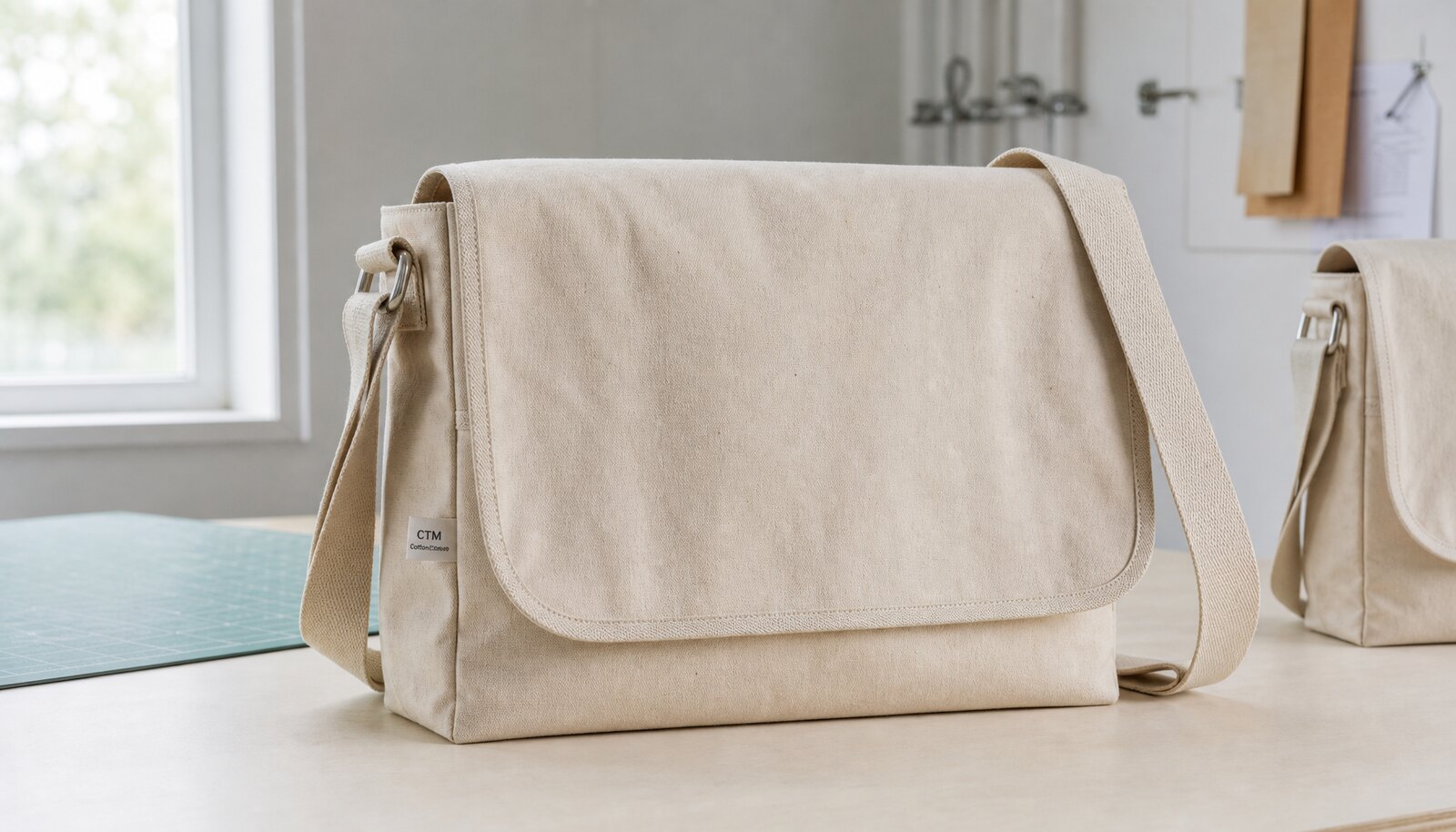
Why cotton messenger bags work for corporate gifts
Cotton messenger bags sit in a useful middle ground for corporate gifting. They feel more substantial than a simple tote, but they are easier to pack, print, and price than many structured business bags. For procurement teams, that matters because the item needs to carry a logo clearly, look appropriate in a business setting, and survive repeated handling without turning into throwaway swag.
The buying problem is usually not whether the bag is attractive. It is whether the supplier can keep the canvas weight, print quality, strap strength, and packing consistent across the whole order. A corporate gift program often has a fixed reveal date, so a bag that is 5 mm off in strap length or arrives with weak print coverage can create a brand problem before it leaves the warehouse.
- Best for onboarding kits, conference giveaways, dealer gifts, and internal recognition programs
- Easier to brand than hard goods because the logo surface is large and flat
- Works well when buyers want a reusable gift that feels practical rather than promotional
Start with the bag structure, not the logo
For cotton messenger bags for corporate gifts, the structure should be decided before the artwork. The bag needs enough body to hold documents, notebooks, a tablet sleeve, or lightweight merch without sagging badly. In most programs, a 10 oz to 12 oz cotton canvas is the safest starting point. Below that range, the bag can look too soft and wrinkle easily. Above that range, you usually pay more for material and shipping weight without getting a big improvement in perceived value.
Construction details matter as much as fabric weight. A messenger bag usually needs a flap, a main compartment, and a strap that can take repeated shoulder use. Reinforced strap ends, bar tacks at stress points, and neat internal seams are not decoration; they are what keep the bag usable after the first few weeks. If the bag will be used for employee onboarding or retail gifting, a cleaner internal finish can also reduce the chance of loose threads showing when the flap opens.
- 10 oz canvas: good for lighter gift use and tighter budgets
- 12 oz canvas: better structure and better premium feel for most corporate orders
- Reinforce strap joins and flap corners with bar tacks or extra stitching
- Avoid oversized internal pockets unless the bag is meant to carry specific document sizes
Fabric weight, color, and finish choices that affect quote clarity
A quote on cotton messenger bags is only useful if the fabric is described properly. Ask for the fabric in oz or GSM, and if possible, ask whether that weight is before or after any washing or pre-shrinking step. For cotton canvas, many suppliers quote in ounces, while some quote in GSM. That is fine as long as the reference is consistent. What causes trouble is when one supplier quotes a washed 12 oz canvas and another quotes a raw 12 oz cloth that will relax later.
Color choice also changes the commercial picture. Natural cotton is usually the most stable sourcing route because it avoids dye lot variation and often has a cleaner MOQ. Black, navy, and other deep colors may need separate dye runs and stronger ink selection for the logo. If your brand needs an exact Pantone match for both bag and print, expect a higher MOQ or extra sampling time. For corporate gifts, a natural or off-white body with one-color logo is usually the easiest way to keep both cost and schedule under control.
- Request fabric swatches before committing to a dyed body color
- Confirm whether the canvas is bleached, natural, garment-washed, or enzyme-washed
- Deep colors can show lint, stitching, and print defects more clearly
- Natural cotton often gives the best balance of cost, lead time, and logo visibility
Print method selection: what changes cost, look, and durability
The logo method is one of the biggest quote drivers. Screen printing is usually the default for corporate gifts because it is efficient for simple artwork, strong on flat cotton canvas, and repeatable once the screen is set. If your logo has one to three solid colors, screen print normally gives the cleanest cost-to-appearance ratio. It also works well when you need the bag to feel like a product, not a promo item.
Embroidery, woven labels, and heat transfer each solve different problems. Embroidery adds texture and can look premium on a smaller logo area, but it costs more and can distort light canvas if the backing is not controlled. Woven labels are useful when branding should be subtle, especially on side seams or flap edges. Heat transfer is better for complex artwork or smaller quantities, but it needs careful testing because not every transfer film holds up equally well on cotton canvas.
- Screen print: best for simple logos, repeat orders, and stable unit cost
- Embroidery: good for premium gift feel, but check fabric puckering
- Woven label: useful for discreet branding or co-branding programs
- Heat transfer: use only when artwork complexity justifies the risk and setup
MOQ logic: why the lowest number is not always the best quote
MOQ on cotton messenger bags for corporate gifts should be reviewed by component, not just as a single headline number. A supplier may offer a low MOQ for stock natural canvas but require a much higher MOQ for custom-dyed fabric or multi-color printing. Another supplier may quote a low quantity but build hidden costs into setup, sampling, or packaging. That is why a clean RFQ needs to separate bag size, fabric color, print colors, and packing requirements.
For buyers comparing supplier quotes, the best question is not simply, 'What is your MOQ?' It is, 'What is your MOQ for this exact spec, and what changes if I switch only the fabric color or print count?' That comparison reveals whether the supplier really has a repeatable production path or is just trying to win the inquiry. If you are a distributor or retail buyer, this matters even more because reorder flexibility can be more valuable than a slightly lower first-order price.
- Ask for separate MOQ by fabric color, logo color count, and packaging type
- Separate stock fabric pricing from custom dyed pricing
- Confirm reorder MOQ and reorder lead time before approving the first order
- Treat unusually low MOQ quotes as a signal to inspect the packing and QC terms closely
Comparison table: sourcing routes for corporate gift buyers
The sourcing route changes how much control you have over fabric, print, packing, and schedule. A direct factory is usually best when the bag is part of a planned corporate campaign and you need the same result every time. Trading companies can be useful if you need more flexibility across product types or if your buying team is still testing concepts. Domestic converters can help with speed, but unit cost is often higher and fabric choice may be narrower.
Use the route comparison below to decide which supplier type fits the job before you waste time on mismatched quotes. If the bag will be used once and handed out at scale, speed may matter more. If it will be photographed, re-ordered, or tied to a brand launch, consistency and evidence of factory control usually matter more.
Quote comparison table
Packing rules should cover shape support, strap folding, hardware protection, individual bag, carton drop expectation, and retailer hangtag placement. These details affect cost, damage rate, receiving speed, and whether the goods can move directly into retail or distribution.
A cotton bag can pass product QC and still create claims if cartons are mislabeled, overpacked, crushed, damp, or mixed. Treat packing as part of the specification, not an afterthought.
- Write decisions in measurable language, not only descriptive wording.
- Ask for sample photos plus one physical approval sample for important orders.
- Keep quotation, sample approval, and inspection notes tied to the same spec version.
What to compare in a factory quote beyond unit price
A useful quote for cotton messenger bags for corporate gifts should show the full cost structure. At minimum, it should separate fabric, cutting, stitching, print setup, logo application, packing, and carton charges if applicable. If the supplier only gives one lump sum, it becomes hard to compare against another factory or to understand where a price drop might cause a quality drop. Procurement teams need a quote that can survive internal review, not just a quick supplier reply.
The same logic applies to lead time. A quote should tell you when the sample is ready, how many days are needed after sample approval, and whether the supplier has enough line capacity for your booked quantity. For corporate orders, a short promised lead time is not useful if it is based on rushed packing, outsourced stitching, or skipped inspection. A slower but controlled plan is often the safer choice when the launch date is fixed.
- Separate setup cost from unit cost
- Request packing and carton details in writing
- Ask whether the lead time starts from order confirmation or sample approval
- Compare whether freight-ready packing is included or charged separately
Sample approval: the point where most avoidable mistakes appear
The pre-production sample should be treated as the contract reference. For messenger bags, measure the finished width, height, flap drop, strap length, and strap attach points. Do not approve a sample based only on a photo. Photos hide the most common issues: offset logo placement, loose thread tails, uneven seam tension, and a strap that is 20 to 30 mm shorter than the buyer expected. Those small differences are exactly what gets noticed when the bags are handed out in a corporate setting.
It is also worth checking how the sample behaves when loaded. Put in a notebook, a phone, and the sleeve or document set the bag is intended to carry. The flap should sit cleanly, the strap should not twist, and the logo should remain readable when the bag is worn cross-body or on one shoulder. If the sample fails under simple use, bulk production will not magically improve it.
- Measure sample size against a written spec sheet, not memory
- Confirm logo position from seam reference points
- Check stitching at stress points with moderate load
- Approve color only against actual fabric and print samples, not digital images
Packing, cartons, and shipment details that affect receiving
Packing can save or destroy a corporate gift shipment. Cotton messenger bags are soft goods, so they can compress well, but they also pick up dust, wrinkle marks, and carton odors if packed carelessly. For export orders, a common method is 25 to 50 pieces per carton depending on bag size and thickness. Individual polybags may be needed if the client wants cleaner presentation, but they also add labor and plastic cost. If the bags are going to distribution centers, the packing method should be compatible with fast receiving and easy count verification.
Carton marks should be simple and readable: style, color, quantity, carton number, gross weight, and destination if needed. If the order has multiple colors or sizes, make sure the carton mapping is fixed before production starts. Mixed cartons are efficient for some campaigns, but they complicate warehouse handling and can create rework at the receiving dock. For retail buyers, carton consistency is usually worth paying for because it reduces in-store sorting labor.
- Use clear carton labels and avoid mixed styles unless required
- Agree on polybag type, suffocation warning, and hangtag insertion if needed
- Specify whether cartons are master-packed by color or by order line
- Confirm total packed weight for freight planning
Specification comparison for buyers
| Spec decision | Recommended option | When it fits | Buyer risk to check |
|---|---|---|---|
| Supply route | Direct factory with bag-specific sample room and in-house printing | You need repeat orders, controlled QC, and quote transparency for corporate gift programs | Outsourced print or stitching can raise defect risk and make rework slow |
| Fabric weight | 10 oz to 12 oz cotton canvas for most gift programs | Best balance of hand feel, print clarity, and structure for everyday corporate use | Too light looks cheap; too heavy increases cost and can make the bag bulky |
| Bag construction | Unlined body with reinforced stress points and internal seam binding where visible | Best for cost control, faster lead time, and clean print surfaces | Raw seam finish or weak bar tacks can fail at the strap or flap after short use |
| Print method | Screen print for simple logos; heat transfer only for small runs or complex artwork | Corporate gifts with one to three spot colors and stable artwork | Heat transfer may crack or feel plasticky; screen print needs good color registration |
| Logo placement | Front flap or body center, with small woven label on side seam if brand rules require subtle branding | When gifts must look premium but not overly promotional | Over-sized artwork can warp on seams and look uneven on soft canvas |
| MOQ approach | Price by size, fabric color, and print color count; request one MOQ for stock fabric and a separate MOQ for custom dyed fabric | You want apples-to-apples quotes across suppliers | A low quoted MOQ may hide fabric surcharges, print setup fees, or weak packaging specs |
| Packing method | Bulk packed in polybags by 25 to 50 pcs per carton with carton marks and size labels | Standard export shipments and distributor stocking | Loose packing increases dust, scuffing, and counting mistakes at receiving |
| Sample path | Pre-production sample approved against measured spec sheet before bulk | Corporate programs with fixed launch dates and brand approval steps | Skipping measurement checks leads to strap-length errors, logo shift, or incorrect fabric hand feel |
| Supplier route | Factory with documented QC points and export packing experience over trading-only sourcing | When lead time, repeatability, and quote control matter more than fastest first reply | Trading companies may be fine for flexibility, but you need to verify who actually makes the bag |
Buyer checklist before sampling
- Define the use case: conference gift, employee welcome kit, dealer incentive, or retail gift-with-purchase.
- Lock the canvas weight target, usually 10 oz to 12 oz for a corporate gift bag unless you need a lighter promotional piece.
- Confirm finished size, strap length, flap style, closure type, and whether the bag must fit A4 documents or a 13-inch laptop sleeve.
- Choose the logo method based on artwork complexity and durability needs: screen print, embroidery, woven label, or heat transfer.
- Set acceptable tolerances for size, print position, color variation, stitch density, and carton count.
- Request sample photos and a pre-production sample before bulk approval.
- Specify packing, carton dimensions, carton marks, and whether retail hangtags or individual polybags are required.
- Ask for quoted lead time from sample approval, not from order placement.
- Compare landed cost, not just unit price, including freight, duties, and repacking if needed.
Factory quote questions to send
- What is the exact fabric construction, GSM or oz, yarn count if known, and pre-shrink treatment?
- Is the price based on stock dyed fabric, custom dyed fabric, or greige cloth that will be dyed later?
- How many print colors are included, what is the setup charge, and what is the repeat cost for reorders?
- What are the finished size tolerance, strap length tolerance, and acceptable stitch defects per carton?
- Will the logo be screen printed in-house, embroidered, or subcontracted?
- What is the MOQ by color, by print color, and by packaging type?
- What carton size, gross weight, and packing quantity per carton are quoted?
- How many days are needed for sample making, sample shipping, bulk production, and booking cargo after approval?
- Can you share inspection photos of raw fabric, print strike-off, stitching, and packed cartons before shipment?
Quality-control points to confirm
- Fabric weight must match the agreed range; reject bags that feel visibly thinner than the approved sample.
- Stitching should be even, with no loose threads at strap joins, flap corners, or pocket edges.
- Logo registration must stay within the approved position tolerance and not touch seams unless the design allows it.
- Screen print should be opaque enough for the chosen fabric color and free from pinholes, smearing, or cracking in normal handling.
- Strap length must be consistent across the order so the bag hangs evenly on the shoulder.
- Closure function, if any, must work smoothly and align with the approved sample.
- Cartons should be dry, clean, and correctly labeled with style, color, quantity, and carton number.
- Random carton count should match packing list with no mix of sizes or colors unless explicitly allowed.