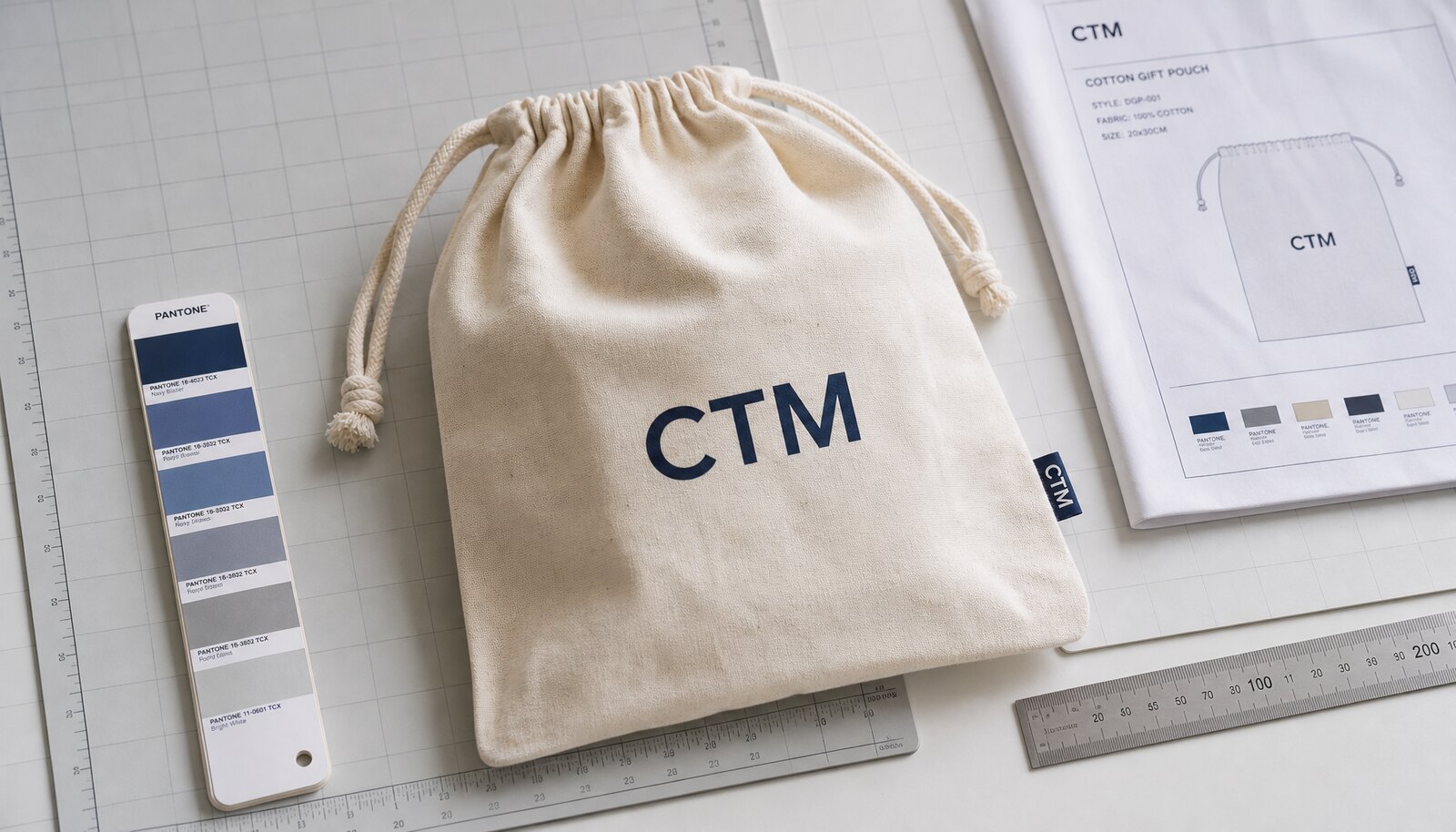
Why cotton gift pouch logo printing needs a tighter spec
Most buying problems with cotton gift pouches start before the first print strike. A pouch can look simple, but the outcome depends on fabric density, seam placement, print area, drawcord construction, and how much ink the cloth can hold without bleeding. If you only ask for "cotton pouch with logo," suppliers will quote different structures, different print methods, and different quality levels, which makes later comparison almost useless. The buyer ends up comparing apples to pears on price, not on usable product risk.
For procurement teams, the goal is not to over-spec every detail. The goal is to lock the few variables that drive cost and print quality: fabric GSM, pouch size, logo size, number of colors, artwork complexity, and packing. Once those are fixed, a factory can quote more accurately and you can see where one supplier is actually cheaper and where they are simply underquoting the print setup. This guide focuses on the decisions that matter when you are buying cotton gift pouch logo printing at scale.
- Do not compare quotes until fabric weight, print method, and artwork color count are fixed.
- Ask suppliers to quote the same finished size and the same measurement tolerance.
- Treat the logo as a production spec, not just a graphic file.
Start with the pouch body, not the logo
A good print on a weak pouch still creates a weak product. Cotton gift pouches are usually made from natural cotton, bleached cotton, or dyed cotton in light shades. For most retail and corporate gift programs, 120-140 GSM cotton is the practical starting point because it gives enough body for a clean print and still folds well in packing. If the pouch is very small, a lighter cloth can wrinkle the logo area and make registration look off. If it is a premium pouch or a pouch that must hold heavier contents, 160-200 GSM gives a better handfeel and more stable print surface.
You should also ask how the factory builds the top channel and drawstring. A top hem that is too thick can hide part of the print area, while a loose channel may distort the front panel during printing. The pouch front should have a flat, usable print zone, and the supplier should tell you exactly how many millimeters remain after seams and drawcord tunnel are built. If the logo is planned too close to the seam, the artwork may look centered on paper but land too high or too low on the finished pouch.
- 120-140 GSM: common for standard gift pouches and efficient packing.
- 160-200 GSM: better for premium feel, structure, and stronger visual coverage.
- Confirm seam allowances and drawcord channel depth before approving print size.
Pick the print method by logo complexity and order size
The right method depends on how many colors the logo has, how fine the lines are, and how much rubbing the pouch will see in use. For a simple brand mark on natural cotton, screen printing is usually the most commercial option because it is efficient, opaque enough for most logos, and easier to control on larger runs. If the design is full color, has gradients, or needs very fine detail, heat transfer or digital transfer may work better for short programs, but the buyer must check surface feel and durability carefully. Embroidery and woven labels are not print methods, but they are common alternatives when the brand wants a more premium and permanent look.
The biggest mistake is choosing a method only because it is cheaper per piece on the quote sheet. A low-cost method that distorts the logo or looks patchy on cotton becomes expensive after rework, re-sampling, or customer complaints. For a gift pouch, the brand is often visible at hand distance, so edge sharpness matters more than a small unit-price difference. Buyers should ask the factory which method they recommend for the artwork at the actual pouch size, not in abstract terms.
- Screen print: best for simple logos, solid areas, and repeatable bulk production.
- Heat transfer: useful for multi-color or short-run work, but check feel and durability.
- Embroidery or woven label: better when brand texture matters more than a flat print.
Compare the common logo methods before you request quotes
A useful quote comparison starts by separating visual effect from production risk. Some suppliers will offer several decoration methods, but they may not explain the trade-off clearly. If you need one logo on a cotton gift pouch, the practical question is which method gives you the cleanest result at your target order size with the least variation between sample and bulk. That is especially important when the pouch will be used for product launches, retail gift sets, or event giveaways, where the logo has to look correct from the first carton.
Use the comparison below to narrow your RFQ. It is not about choosing the most premium option on paper. It is about choosing the method that best fits the print artwork, order volume, and acceptable risk. If the logo is small and the pouch is natural cotton, the wrong print method can make the mark fuzzy or underfilled. If the logo is colorful and the run is small, a simple screen print may be the wrong commercial answer even if it looks attractive in theory.
How MOQ and pricing logic usually change
MOQ on cotton gift pouch logo printing is usually driven by more than sewn quantity. The factory may separate MOQ by fabric type, pouch size, print color count, and setup method. A one-color screen print on a standard natural cotton pouch may have a lower MOQ than a multi-color design or a pouch that needs a special dyed fabric. Some suppliers also quote a minimum per artwork because the screen setup, alignment, and wash testing are fixed costs that do not disappear just because the order is small.
When buyers compare pricing, the first thing to isolate is what is included in the unit price. Does the quote include blank pouch material, printing, thread color matching, inner packing, and carton marks? Does it include one proof sample or a full pre-production sample? A low unit price with a high setup fee can still make sense for a larger order, while a slightly higher unit price with lower setup costs may be better for repeat seasonal programs. Ask the factory to quote at least two volume tiers so you can see where the price curve changes.
- Check whether MOQ is based on artwork, size, color count, or total order volume.
- Ask for separate line items for blank pouch cost, print setup, and packaging.
- Request two or three quantity breaks to compare true scaling behavior.
What to put in the RFQ so the factory can quote cleanly
A strong RFQ removes guesswork. Start with finished pouch size, fabric GSM, fabric color, drawcord type, logo placement, logo size, and decoration method. Add whether the pouch is for retail shelf use, gift set use, or shipping inside a larger package, because that changes how much visual perfection you need. If you do not specify whether the logo should be centered, offset, or placed near the lower body, the factory may place it in the easiest production position rather than the best commercial position.
Artwork format matters too. Send vector files whenever possible and state the number of print colors using Pantone references or a clear equivalent. If your design uses fine text, ask the supplier to confirm the smallest line thickness they can hold on their process. For buyers who need accurate supplier comparison, the best RFQ also asks for sample lead time, bulk lead time, packing method, and carton dimensions. That forces each factory to quote the same operational scope instead of hiding cost in the process.
- Include finished size, GSM, drawcord type, print area, and print colors in the first email.
- Ask for carton dimensions and pack count, not only unit price.
- Request confirmation of the smallest line thickness and minimum text size.
Sample approval: what must be checked before bulk production
The sample stage is where most preventable defects can still be corrected. A pre-production sample should be made on the same fabric, using the same print method, and as close as possible to the same finishing process as bulk production. If the supplier sends a print on a different cloth or a different color lot, the sample is informative at best, not approval grade. For cotton gift pouch orders, you need to check whether the print sits flat, whether the ink covers the fibers evenly, and whether the fabric distorts after pressing and trimming.
Inspect the sample from a buyer's point of view, not only a factory inspector's point of view. Hold it at normal viewing distance, compare it to the approved artwork, and confirm that the logo looks intentional when the pouch is filled and tied. A flat sample may look acceptable on the bench and look off-center when used in retail packing. If your program has multiple SKUs, sample one or two variants because a different fabric shade or size can change print appearance and stitching tension.
- Approve samples only on the same fabric and same print process intended for bulk.
- Check logo alignment after the pouch is filled and tied, not only flat.
- Reject samples that use a different cloth lot or an unapproved ink color.
Packing, lead time, and the hidden cost of rework
Packing is not a secondary detail for gift pouches. If the pouches are sold as retail accessories or inserted into gift sets, a wrong pack count or wrinkled delivery condition creates receiving problems and downstream labor. Buyers should ask whether pouches are flat-packed, stacked, tied in bundles, or inserted into polybags. The right choice depends on warehouse handling and how much de-wrinkling you can tolerate before goods are filled. If the pouch is used for high-end gifting, a neat packed finish may justify more labor at the factory; if it is a promotional item, simple flat packing may be the better commercial option.
Lead time should be broken into material booking, sample making, print setup, bulk sewing, printing, finishing, inspection, and packing. When factories promise a total lead time, ask which steps are actually inside that number. Rework tends to happen when buyers approve too quickly or change artwork late. A logo repositioned by only a few millimeters can force a new screen or a new alignment run. The safest way to manage schedule is to freeze artwork, approve one pre-production sample, and then keep post-approval changes out of the order unless you are willing to reset the timeline.
- Confirm the exact unit pack method and master carton count.
- Ask whether the lead time includes sample approval and material booking.
- Avoid artwork changes after sample sign-off unless the schedule can move.
Acceptance criteria and QC checks that protect the order
Quality control for cotton gift pouch logo printing should be written in buyer language. The factory needs to know what counts as acceptable variation and what counts as rejectable defect. A common acceptance issue is print placement drift: a logo can be technically printed but sit too close to a seam or too high on the pouch body. Another issue is color inconsistency between cartons, which often happens when different print operators or different ink batches are used. Buyers should define the tolerance for each risk before bulk production begins.
A useful QC process checks three layers: the pouch body, the decoration, and the pack-out. The body should meet GSM, size, and stitching expectations. The decoration should meet placement, opacity, and rub resistance expectations. The pack-out should meet count, labeling, and carton strength expectations. If you only inspect the printed face, you may miss weak drawcords, loose side seams, or pack count errors that become expensive after arrival.
- Use clear pass/fail criteria for print position, color consistency, and stitch quality.
- Inspect both decoration and pack-out; one without the other is not enough.
- Record which carton numbers are sampled so issues can be traced if needed.
A practical sourcing workflow for procurement teams
For recurring purchases, the most efficient workflow is to keep a stable base spec and only change the variables that truly matter. That means one approved pouch size, one approved fabric weight, one approved logo file, and one approved packing method. Each time a new buyer or distributor joins the program, they can see the same reference file set instead of rebuilding the specification from scratch. The result is fewer quote deviations and a much cleaner supplier comparison. The factory also benefits because it can reuse the same screens, stitching settings, and packing method.
For one-off programs, such as seasonal gifts or distributor launches, the workflow should still stay disciplined. Ask for a quote, a digital layout, a pre-production sample, and a written approval record. If the supplier proposes substitutions, such as a different cotton GSM or a different print process, require them to explain the production impact in plain terms. Buyers do not need more options; they need fewer surprises. The best supplier is not always the cheapest one on page one of the quote, but the one that can repeat the same result across cartons, lots, and reorders.
- Keep one master spec sheet for repeat purchases.
- Use the same approved logo file for every RFQ round.
- Require written approval before any substitution goes into bulk production.
Specification comparison for buyers
| Spec decision | Recommended option | When it fits | Buyer risk to check |
|---|---|---|---|
| Logo method | 1-2 color screen print | Simple brand marks on light or natural cotton with stable artwork | Fine lines can fill in if mesh, ink, or pressure are not controlled |
| Logo method | Woven side label or sewn label | When the logo must stay crisp through handling and friction | Adds sewing cost and may look too small if brand visibility is the main goal |
| Logo method | Heat transfer | Short runs, multi-color logos, or artwork with gradients | Can crack, peel, or look glossy on rough cotton if film quality is poor |
| Logo method | Embroidery | Premium gift pouches with a textured brand feel | Stitches distort thin fabric and can pucker small pouches |
| Fabric weight | 120-140 GSM cotton | Good balance for retail gift pouches and cleaner printing | Too light may show through; too heavy raises cost and changes drawstring feel |
| Fabric weight | 160-200 GSM cotton | Premium packaging, stronger handfeel, better shape retention | Higher fabric cost and may need a wider seam allowance |
| Closure spec | Matching cotton drawcord with clean top hem | Most standard gift pouch programs | Cord length and knot style must be fixed before bulk cutting |
| Packing spec | Flat-packed with size/carton count confirmed | If you ship by master carton and need efficient warehouse receiving | Mixed sizes or loose tying can distort count and slow inbound checks |
Buyer checklist before sampling
- Confirm pouch size in finished dimensions, not cut size, and state tolerance.
- Specify cotton GSM, weave type, and whether the fabric is bleached, natural, or dyed.
- Approve logo artwork in vector format and define the exact print colors.
- State print location, print size, and whether the logo must be centered on the pouch body.
- Ask for a pre-production sample on the same fabric and same printing method.
- Request packing details: unit count per polybag, master carton count, and carton marks.
- Confirm whether the quoted MOQ is by size, by print color, or by total order.
- Check lead time separately for sample, material booking, print setup, and bulk production.
Factory quote questions to send
- What fabric weight, weave, and shrinkage allowance are you quoting for this pouch?
- Which print method is included in the price, and what is the setup charge for each color?
- Is the MOQ based on one artwork, one size, one print color, or the full order mix?
- Can you print on the front only, both sides, or on a sewn label, and how does that change cost?
- What is the approved artwork format, and what line thickness do you recommend for your process?
- Will you provide a pre-production sample on production fabric before bulk approval?
- What packing method do you quote, and can you print carton labels or barcodes if needed?
- What inspection points do you use for print alignment, color variation, and drawstring assembly?
Quality-control points to confirm
- Check print registration against the pouch centerline and seam position, not only against the fabric edge.
- Verify ink opacity on natural cotton, especially when the logo uses light colors or thin strokes.
- Inspect drawcord movement and knot security after printing and after final pressing.
- Measure finished size after pressing and folding because cotton can relax or shrink during finishing.
- Rub-test the print for smudge, powder loss, or surface cracking before bulk release.
- Confirm that carton counts, inner pack counts, and size labels match the purchase order exactly.